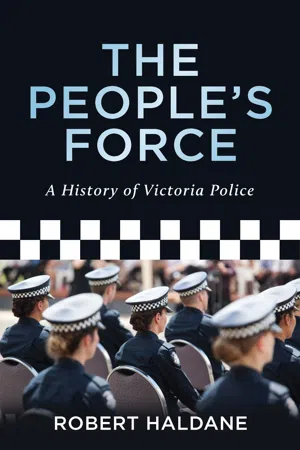
Since its formation in 1853 the story of the Victoria Police has been interwoven with Victorian social and political history. Following the amalgamation of seven separate and distinct police agencies in the colony, the resultant unified body was the first of its kind in Australia. Many events have shaped its development: the gold rushes, the Clunes riot, the Kelly outbreak, the maritime strikes, the coming of the motor car, the police strike, both world wars and the Vietnam war protests, the gangland wars, Black Saturday bushfires and the use of DNA to solve crimes all formed part of this mosaic.This revised edition of The People's Force, containing a new chapter and new illustrations, brings the history up to date to include a decade that has been full of turbulent change. The new chapter examines the administrations of Neil Comrie, Christine Nixon, Simon Overland, Ken Lay and Graham Ashton. New material deals with Silk and Miller, and other police shootings, the growth of terrorism, gender issues, racism and domestic violence. Written as a 'warts and all' history of the Victoria Police with the support and encouragement of the then Chief Commissioner S. I. ('Mick') Miller, who wanted a proper objective history of the force, not a public relations exercise. This third edition is owed largely to Miller's encouragement and his desire to see the history updated.
- English
- ePUB (mobile friendly)
- Available on iOS & Android
eBook - ePub
The People's Force
About this book
Information
1
Redcoats, Bluebottles and Alligators
During the years 1836 to 1852 there was no Victoria Police Force. It was a period of growth and unco-ordinated experimentation, during which the Port Phillip District, later the Colony of Victoria, was policed by an assortment of autonomous police forces, including the Native, Border, Mounted, and Melbourne and County of Bourke police. It was a confusing situation, compounded because the generic title ‘police’ was applied to all these forces, even though they bore little relationship to each other and exhibited differences in their composition, status, duties and uniforms. Drunks, emancipists and men from the working class predominated in the police ranks, their status and pay were low, and there was a high turnover of personnel. Few people aspired to police work and it was just a transient occupation through which many men passed on their way to other, more desirable or higherpaying employment. It also served as a stopover for miners travelling to or from the goldfields. In an effort to provide a more reliable police service, colonial officials offered career opportunities to young men and tried a range of other options, including a cadet system, the use of military pensioners, and the importation of police from London. No single alternative provided the level of security that was wanted and, faced with the dramatic social and economic changes of the gold era, concerned citizens prompted a consolidation of the disparate police forces. Using Irish and English policing models, an endeavour was made to upgrade the general standard of policemen and the service they provided. The result was the statutory formation of the Victoria Police Force in 1853 as the sole police authority in the colony.
The Rattlesnake Arrives
Early in the first permanent white settlement in the Port Phillip District the cry was raised for police and protection, the two not necessarily being synonymous in nineteenth-century Australia. Permanent European settlement was established by the Hentys, at Portland Bay in November 1834, without the assistance of police or soldiers, but those who followed were quick to seek the services of police. John Batman and his fellow expeditioners of the Port Phillip Association settled near the present site of Melbourne in 1835. Batman was a trespasser yet it was only a matter of months before he and his colleagues wrote to Sir George Arthur seeking government protection, which was eventually provided in the form of three policemen.1
This action was significant in that it set the pattern of police development in Port Phillip for many years to come, and also began the often unhappy relations between community and police in nineteenth-century Australia. The provision and level of police service was rarely planned but was normally an ad hoc response to requests such as Batman’s. As ‘protection’ the settlers usually gained inefficient men for whom they showed little or no respect and considerable enmity. Nevertheless, requests for police flowed unabated and, taken with the animosity shown towards the police, there evolved the curious anomaly of the community increasing its police services all the while being unfavourably disposed towards those who performed the task.
Police forces in Australia in the 1830s were abysmal, a source of worry to communities wherever they served. The police in Van Diemen’s Land were no exception and, having come from there, Batman would have been aware of their poor reputation in that colony. Still, he and others after him chose to request police protection rather than undertake co-operative efforts at self-protection and regulation, such as the hue and cry. Settlers, squatters and others engaged in commercial pursuits did not have time to devote to co-operative efforts of self-policing, but were more than willing to pay others to do the work for them. It might well have been the better way, for they were securing for the colony what contemporary English experience was convincingly demonstrating: community security through an organised, preventive police.2
Batman’s initial request for protection was turned down and it was almost a year before colonial officials again considered the policing of the Port Phillip District. Meanwhile reports had come of white settlers shooting Aborigines at Western Port and Portland. These incidents, together with the circumstances of Batman’s occupation, prompted Governor Bourke to send a police magistrate and two Sydney policemen to Port Phillip to investigate and report on the situation. The magistrate was George Stewart, of Campbelltown, and he was accompanied by Sergeant John Sheils and Constable Timothy Callaghan.
Stewart arrived in Port Phillip on 25 May 1836 and found a European population of 142 males and 35 females occupying an area of about one hundred square miles. During his visit the residents held a public meeting and prepared a petition to the governor, one section of which requested the permanent appointment of a police magistrate in the settlement. In his report Stewart wrote of the possibility of forming a ‘Police Establishment’ in the settlement and confirmed the general need for government protection.3 As a result, on 14 September 1836, Captain William Lonsdale, of the 4th (or King’s Own) Regiment, was appointed police magistrate for Port Phillip, and Robert Day, James Dwyer and Joseph William Hooson appointed policemen. Lonsdale was then aged thirty-six and had previous experience as an assistant police magistrate and justice of the peace at Port Macquarie. Like many civil servants who followed in his wake as head of the Port Phillip Police, Lonsdale did not have previous experience in administering a civil police force. He, and a number of his successors, had a military background. Indeed, Lonsdale was issued with two sets of instructions, civil and military. The one made him virtually commandant of the settlement, whereas the civil instructions vested him with the authority to oversee land surveys and customs collections, and to administer law and order—and all persons, including Aborigines, were reminded that they were subject to the laws of England.4
Lonsdale was vested with the dual roles of head of the police and the magistracy, and thereby a precedent was set that endured until well after the Colony of Victoria separated from New South Wales in 1851. The same person directed the police in enforcing the law and making arrests, and sat as judge in those same cases. Such a system was not in keeping with the principles of British justice, yet was not seriously questioned in Victoria until 1852. The primitive state of public administration in the early days of the Port Phillip settlement, tempered by the need for economy, no doubt contributed to this anomaly. That the situation was not earlier and vehemently decried probably suggests that Lonsdale handled his dual roles creditably.
Lonsdale commanded civil police and also soldiers, the latter serving as both a military force and a military aid to the civil power, and this did provoke controversy. There were thirty-three soldiers and their policing of a civil population, though no problem for Lonsdale, soon started a longrunning debate in the colony about civil versus military law enforcement. What fulfilled the immediate needs of the settlement in 1836 proved in the long term to be a poor precedent, greatly at variance with contemporary principles of civil policing in England.5
A most salient point emerged at once in making the Aborigines subject to the laws of England. The Aborigines had not asked for police or government protection, and their view of the police was undoubtedly very different from that held by the likes of Batman, so there has never been a single community perspective on what the police symbolise. When Day, Dwyer and Hooson commenced duty in the settlement they represented many things to many people, not the least of whom were these Aborigines suddenly embroiled in a world of police, laws and courts they did not understand or want. The instructions to place Aborigines under English law thus highlight a fundamental aspect of police–community relations. In an abstract sense the police serve one public with one set of laws, but in reality ‘the community’ is a mosaic of interest groups in which the values and wishes of dominant groups have generally prevailed.
Of the three original policemen, Day was appointed police magistrate for Port Phillip, and the other two his assistants, with the rank of constable. They were typical of that period. It has been claimed that all three were former members of the Sydney Police who were dismissed for drunkenness, but there is nothing about that in the available records. According to the only detailed study of the three men, Day was previously licensee of the ‘Highlander’ public house in Sydney and before that he was colour sergeant in the 57th (West Middlesex) Regiment of Foot. Hooson was a native-born New South Welshman of otherwise unknown background, and Dwyer was an Irishman who had served in the Sydney Police for several years—at one time as assistant chief constable—and he was given special permission to bring his wife, a ticket-of-leave holder, with him from Sydney to Port Phillip. There is no evidence that any of them were ever convicts.6
At any rate ‘law and order’ came to Port Phillip when HMS Rattlesnake anchored in Hobsons Bay on 29 September 1836. In support of the three policemen was a bonded convict, Edward Steel, who was retained as the settlement scourger for a shilling a day. The state of gaol and watch-house accommodation in the settlement made Steel a handy expedient. If offenders were not flogged or fined, the only lock-up was a somewhat insecure slab hut with a thatched roof. During the early months of the colony, law-breakers were sentenced to up to fifty lashes for offences such as ‘interfering with a constable in his duty’, and twenty-five lashes for being drunk or behaving riotously, and Steel was kept fairly busy. Other offenders were confined on a bread-and-water diet, imprisoned in irons, detained or fined.7

Melbourne’s first gaol
Along with explorers, pioneers and surveyors, police were to the fore on the frontiers of European settlement in south-eastern Australia. The arrival of Day and his men may not of itself have amounted to much, but they and Lonsdale were the first of the police who, for many years, pierced the vague frontiers, either before or in the immediate wake of explorers and surveyors. The police were not always popular or efficient, but their services were in demand and their ‘front-line’ role added to the complexity of their being at once both friend and foe to the public.
Lonsdale soon added to the civil establishment by employing William Buckley as special constable and district interpreter. Buckley, the ‘wild white man’, was an escaped convict who had lived with the Aborigines for thirty-two years. More than any other European in the settlement at that time he understood the native culture and language and thus found himself performing the dual roles of interpreter and policeman for £60 a year. The police establishment then included a runaway convict and bonded scourger. It was not really a matter of setting a thief to catch a thief, for the quintet had little to do with pursuing thieves and were primarily occupied with arresting drunks and petty offenders, only occasionally dealing with more serious cases or runaway convicts from Van Diemen’s Land. Indeed, of the first two arrests recorded in the settlement, one was the arrest by District Constable Day of Scourger Edward Steel for ‘irregularity’. Steel, when supposedly on duty, was found in the tent of a female resident. He could not give a lawful explanation for his presence and was fined the sum of ten days’ pay. In this way the agents of law and order in the settlement were hardly likely to win public respect but did add to their own returns of work.8
Although the police dealt primarily with minor matters, this was not due merely to their ineptness or to the state of crime in the settlement. The fledgling criminal justice system administered by Lonsdale did not have the capacity or authority to hear serious criminal cases. Any such offences prosecuted in Port Phillip were committed for trial to the superior courts in Sydney. When this occurred, the defendant and all witnesses were compelled to travel 600 miles by sea to Sydney to attend court. The cost in both time and money was inordinate, resulting in an almost unanimous reluctance on the part of Port Phillip residents to report any crime that might result in a Sydney court case. Consequently, Day and his men were not put to much test as sleuths, and restricted their activities to matters over which Lonsdale had jurisdiction in Port Phillip.9 During their early period of service the police were not sworn as constables, and this was a source of concern to Lonsdale. Finally, in December 1836, the authorities were furnished with the form of oath to be administered:
You shall well and truly serve our Sovereign Lord the King in the office of constable for the Colony of New South Wales so long as you shall hold that office, without fear or favour and to the best of your skill and knowledge. So help you God.10
Much the same oath has been sworn by Victorian policemen and women in the years since. While Lonsdale was finalising arrangements for an oath, his police began to depart the service. Dwyer was suspended on 31 December 1836 for being repeatedly drunk. He had been a constable in the settlement for barely three months, and in the intervening period was the ‘trusty person’ engaged by Lonsdale, and paid additional money, to complete the first official census of the Port Phillip population. Dwyer set a precedent being the first constable to perform extraneous non-police duties in the settlement, work that escalated rapidly after Dwyer’s small venture, and that proved troublesome and controversial well into the twentieth century.
On 11 January 1837, Dwyer was followed from the service by District Constable Day, also suspended for being repeatedly drunk. Hooson lingered in the police service for some months longer than the other two but was finally dismissed in even greater disrepute. In November 1837 he was found guilty of accepting a bribe from a prisoner to release him from gaol before his sentence was up. So all three original Port Phillip constables were dismissed from the force in disgrace and not again employed in that capacity in the settlement.11
The three men, and the reasons for their dismissal, were typical of the police in Port Phillip and Victoria for many years in the nineteenth century. Often drunkards, often former convicts, they were untrained, issued with no set of instructions, unequipped with staves or arms, and not in uniform. They indicate the thin line that divided members of the public from sworn police in those early days. They were drawn directly from a segment of the society they were intended to serve, and remained laymen rather than policemen. A 1980 newspaper item proclaimed:
State’s first police were drunken, corrupt, and so they were. Nor is it surprising. Police services, both in Australia and England, were at an embryonic stage. Peel’s New Police in London had been in existence barely seven years and it was not an occupation to which people of money or ambition aspired. In Port Phillip the constables were provided with military rations and paid labourers’ wages of 2s 3d a day, when clerks got five shillings a day, tide-waiters 5s 4d a day and customs officers eleven shillings a day. Police pay was not the sort of remuneration to attract men of the Port Phillip Association, who were driven by visions of acquiring huge tracts of land and the creation of villages.12
A Discordant Evolution
The experience with Day, Dwyer and Hooson did not weaken the Port Phillip settlers’ desire for police protection or Lonsdale’s efforts to provide it. Soon after Dwyer’s dismissal, another former convict, Constable Matthew Tomkin of the Sydney Police, was appointed to the Port Phillip constabulary. Tomkin has a special place in Victorian police history in that he was the first serving policeman to be killed on duty. He was murdered by musket fire in 1837 at the hands of George Comerford, a bushranger. The inglorious beginnings of the force did not lessen the dangers police faced for a labourer’s pay.
The district constable who replaced Day was Henry Batman, brother of John Batman, and he was quickly elevated to a new rank of chief constable and paid a salary of £100 a year, but neither the rank nor the comparatively high pay was sufficient to place Batman above common temptations. Within a year he was suspended from duty for accepting a bribe from one of his subordinates to alter a rostered turn of duty.13
The likes of Day and Batman proliferated in the settlement and there was a long series of appointments, dismissals and resignations within the ranks of the police. Community patience must have been sorely tried, but Lonsdale persisted in his efforts to bring a modicum of efficiency to the police corps. He was a soldier, not a policeman, and policing was novel even in England and Ireland, so it was a difficult task of trial and error. A lack of f...
Table of contents
- Cover
- Title
- Copyright
- Dedication
- Contents
- Foreword
- Acknowledgements
- Abbreviations
- Conversions
- Introduction
- 1 Redcoats, Bluebottles and Alligators
- 2 Drunks, Soldiers or Policemen?
- 3 Erinmen, Wren and O’Callaghan’s Men
- 4 Fighting with the Gloves Off
- 5 Good Men are Needed at the Top
- 6 Towards the Twenty-first Century
- 7 The New Centurions
- Conclusion
- Notes
- Bibliography
- Index
Trusted by 375,005 students
Access to over 1.5 million titles for a fair monthly price.
Study more efficiently using our study tools.
Frequently asked questions
Yes, you can cancel anytime from the Subscription tab in your account settings on the Perlego website. Your subscription will stay active until the end of your current billing period. Learn how to cancel your subscription
No, books cannot be downloaded as external files, such as PDFs, for use outside of Perlego. However, you can download books within the Perlego app for offline reading on mobile or tablet. Learn how to download books offline
Perlego offers two plans: Essential and Complete
- Essential is ideal for learners and professionals who enjoy exploring a wide range of subjects. Access the Essential Library with 800,000+ trusted titles and best-sellers across business, personal growth, and the humanities. Includes unlimited reading time and Standard Read Aloud voice.
- Complete: Perfect for advanced learners and researchers needing full, unrestricted access. Unlock 1.5M+ books across hundreds of subjects, including academic and specialized titles. The Complete Plan also includes advanced features like Premium Read Aloud and Research Assistant.
We are an online textbook subscription service, where you can get access to an entire online library for less than the price of a single book per month. With over 1.5 million books across 990+ topics, we’ve got you covered! Learn about our mission
Look out for the read-aloud symbol on your next book to see if you can listen to it. The read-aloud tool reads text aloud for you, highlighting the text as it is being read. You can pause it, speed it up and slow it down. Learn more about Read Aloud
Yes! You can use the Perlego app on both iOS and Android devices to read anytime, anywhere — even offline. Perfect for commutes or when you’re on the go.
Please note we cannot support devices running on iOS 13 and Android 7 or earlier. Learn more about using the app
Please note we cannot support devices running on iOS 13 and Android 7 or earlier. Learn more about using the app
Yes, you can access The People's Force by Robert Haldane in PDF and/or ePUB format, as well as other popular books in History & Australian & Oceanian History. We have over 1.5 million books available in our catalogue for you to explore.