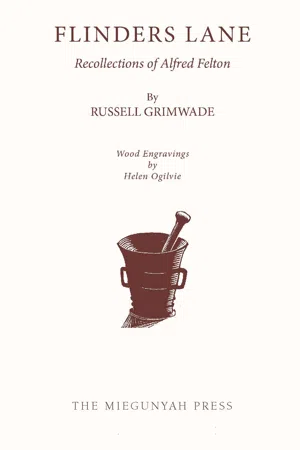
Alfred Felton started his fortune during the Australian gold rushes, selling 'Felton's Quinine Champagne' to miners. Later, he partnered with Frederick Grimwade to found a successful pharmaceutical company, Felton Grimwade & Co., and built 'the handsomest drug house in Australia', a bluestone warehouse in Flinders Lane. Their empire moved into glass manufacture, and by the time of his death, Felton was a rich man. He bequeathed most of his wealth to the National Gallery of Victoria; the value of the works acquired has now reached more than $2 billion. Flinders Lane: Recollections of Alfred Felton tells the story of this extraordinary benefactor. Illustrated with wood engravings by Helen Ogilvie, this new edition has a foreword by Sir Andrew Grimwade, great nephew of the author.
- English
- ePUB (mobile friendly)
- Available on iOS & Android
eBook - ePub
About this book
Trusted by 375,005 students
Access to over 1.5 million titles for a fair monthly price.
Study more efficiently using our study tools.
Information

CHAPTER 1
THE lean and shapely, rather sallow hand reached slowly forward. It protruded from the cylindrical black sleeve until the stiff white cuff showed the rigid bone stud in place. The hand paused above the little ivory tortoise and caressed it feelingly in tune with the happy memories of its purchase in Brindisi ten years ago. The slender second finger deliberately pushed the flexed ivory tail, and a pleasant little bell in the hollow of the shell gave forth its feeble signal and the office relapsed to silence.
Alfred Felton, in his office in Flinders Lane on a late October afternoon of 1898, had been thinking of the old home in Essex and the brothers and sisters that had been scattered to all parts of the world. His thoughts had centred on William, his eldest and favourite brother, and he was in the mood to write a letter to him. William was six years older than he, and had already left the old tannery of his father at Maldon to learn the intricacies of a hay and corn merchant’s business at Brighton when he, Alfred, had started his apprenticeship to a chemist at Woodbridge. The memories of the little chemist’s shop where he had done the most menial tasks, and of the little bunk under the counter where he had had to sleep were crowding upon him when a gaunt, lean figure resolved itself from the shadows of the office doorway :
“Yes, sir, did you ring ?”
“Oh ! Ah ! Yes, Elliston—come in.”
In long, easy strides Elliston approached the desk brushing back a chronically unruly lock from his sallow, damp forehead. As he stood waiting for Mr. Felton to speak, the long arms were crossed, hands clasping elbows in front of an ill-fitting coat and baggy trousers. His face wore an expression of thought and helpful interest, for Arthur Elliston was not of the ruck of office denizens. He was an advanced student and practitioner of the new art of shorthand writing as devised by Pitman, and his seniors were beginning to see the value of saving their labours of writing by making use of his mysterious craft. He would record in his hieroglyphics the measured dictation of his employers and subsequently transcribe into pointed longhand the monthly orders for England, and occasionally the private letters of the partners to their relatives abroad. The transcription, of course, was on thin “foreign” paper, and often crossed to minimise the postage, and special copying ink was used so that when damped a copy could be squeezed out of it by the office press into the letter-book. Elliston and his practices stood as the prototype of the army of smart young ladies that constitute the machinery of every office in every city of the world to-day. There were no “flapper stenographers” in the reign of Queen Victoria.
“Ah ! Elliston, when did I last write to Mr. William ?”
“A fortnight ago by the Orizaba, sir. I posted the letter myself, sir, in Flinders Street. It was raining, and I remember the puddles crossing the road to the letter box by the station.”
“Ah ! shouldn’t do that you know, Elliston. You shouldn’t get your feet wet—not a man like you with a wife and family. How many now, Elliston ?”
“Six, sir, and Mrs. Elliston is expecting in March.”
“Wonderful, wonderful. You should insure your life you know, Elliston.”
“Yes, thank you, sir, but I’m much better now—feeling much better now the winter’s over, sir. Of course, in the summer when the weather gets warmer—”
“Yes, yes, of course—Now get your book, and I’ll write to Mr. William.”
Elliston turned to the doorway.
“And see if Mr. Isaac is in the warehouse, I would like to speak to him.”
The shadows of the doorway absorbed the retreating figure, and the footsteps of Elliston in the little cedar and glass-panelled passage faded to silence.
Alfred Felton’s lean figure sat upright in the upholstered desk chair with the curved, padded back. Sixty-six years of age, as he was then, he held himself erect and his tallish, spare figure betokened an abstemious and self-restrained life. His manner of dressing was in conformity with his times, and gave him a sedate air as a man of substance, thought and kindliness. Clad in a black morning coat with dark striped trousers surmounted by a hard square hat his figure was familiar to those frequenting Flinders Lane a little before the usual luncheon hour. He would alight from the St. Kilda cable tram in Swanston Street and walk slowly westwards to the office, always with an umbrella in place of a walking stick, and with a fawn coloured coat folded over the left shoulder. A leg broken many years ago whilst travelling to Sydney by train was slightly stiffened and gave him a gait not free from limp. As he walked along the street his face showed an interest in those he met that was ready at an instant to bring a smile to his features or the light of pleasure to his eyes. His surroundings always appeared to interest him, and were it a group of children playing in the street or the efforts of a carrier to coax a stubborn horse, he would hesitate in his movement and in kindly manner survey the incident with interest but without participation.
As he sat in his office on this pleasant October afternoon—while Elliston was in search of Tom Isaac—his thoughts were bent to a problem that had occupied his more serious moments for many years past. He was over sixty years old, he was a wealthy man by reason of shrewd investment of his savings in a young and growing country, and he had no dependants. He had no relatives in this part of the world. There had been James, four years older than he, who had gone to Africa and started business in Grahamstown as a leather merchant, but he had married a stranger in religion, and whilst regarding the ties of family, he had no wish to see him. He had even expressed in a letter his disapproval of the suggestion that James should come with his wife and settle in Australia. And there had been young George who had come to Australia, but he was dead, killed by the tragic carelessness of taking the wrong medicine. William, the eldest, was still alive in Brighton and had been his favourite and the mentor of his boyhood, but he had not found his habit and manner of life congenial to his own tastes on his visit ten years ago. What was to become of his riches when he passed ? That was the question that appeared to have many answers, but only one correct one. He would naturally make provision for some of his nephews and nieces, and certainly for a few of those in the firm who had been helpful friends to him, like poor Elliston, for instance, with a fundamental malady and a Victorian faculty for reproduction. But even after those provisions were made there remained a considerable balance. How could that best repay the people of his adopted country who had helped him to the accumulation of his riches? How could he devise it? That was the problem to which he must bend his thoughts to find the right solution.
The little office in which he sat inspired his thoughts. The silence which invested it was broken only by the faint hum of conversation that percolated through the glass partitions from the clerks at work in the outer office, and on occasions more violently by the rumble of a horse-drawn lorry of goods passing over the rough macadam of Flinders Lane outside the window. The big cedar desk was placed end on to the window so that Mr. Felton had the light on his right hand. Opposite to him was an upright chair for the use of visitors, and on his left hand was a comfortable leather arm-chair to which the private visitor was invited. Its occupancy generally denoted that topics under discussion were not strictly business. It was frequently occupied.
To the left of the arm-chair, and also on Mr. Felton’s left, was the grey marble mantelpiece that embellished the coal grate. A fire was rarely burning, but it was laid in coal and screened by a paper fan that bore testimony to the artistry of the office cleaner.
In the iron fender stood a laboratory tripod carrying an evaporating dish. That the dish had once held water was shown by the concentric rings of dust that had been slowly deposited on the sides as the water evaporated. It dejectedly recorded an earlier enthusiasm concerning the right proportion of water vapour necessary to a healthy atmosphere and its obvious long disuse rather sadly proclaimed the supersession of that foible by some other.
The wide marble shelf of the mantelpiece dominated the little room, and the medley it supported gave the visitor his first clue to the character of the occupier. In the centre stood a black marble timepiece of French design. It had three dials, the centre being the face of an ordinary timepiece, supported on one side by an aneroid barometer that persistently and mendaciously pointed to “Fair”. On the other side was a dial purporting to reveal a wealth of astronomical data. Days of the week, months, and the phases of the moon were obviously within its designer’s hopes, but whilst the hands moved and functioned they had never been able to overcome the error of some long-past leap year. Its punctilious falsehoods were far more intriguing than the futile verities it was designed to record. The whole affair, obviously bought at some auction sale, in its black marble case inlaid with malachite panels was well fitted to be the centre piece of the collection about it.
Behind it were dusty packets of visitors’ cards, old letters and envelopes with newspaper cuttings protruding. They merged on the one hand to an engraving of Notre Dame, and on the other to a small oil painting of fruit in a deep gesso frame. A fortyounce apothecary’s measure stood attentively by, suggesting uses of emergency or diagnosis. In a substratum of papers, small boxes and packets would appear, and a small volume of Dante marked in a dozen places by pieces torn from a newspaper or sheets of tissue proclaiming their misuse.
A dark, almost undiscernible oil painting of game was set lowly on the mantel-shelf with its auction room ticket still upon the frame. At the farther end of the mantelshelf stood an odd assortment of bottles; they were unused, and as witnessed by the little labels bearing cryptic markings, obviously samples of manufacture of the works at Port Melbourne which he and his partner had established and whose management was in his hands. These bottles being uncorked and originally clean, proclaimed their tenure of the shelf by the density of the disc of dust that had quietly fallen through the open neck and settled on the bottom.
The little glass army sheltered two letterweights—one a milleflore bearing the date 1847 and the “B” that stands for Beauvais—and the other a stark photographic representation of the Rhine at Coblenz. Beside them stood the battered metal bell with its bent push-knob on the top that had been derated from the desk to the mantel-shelf on the arrival of the ivory tortoise.
In the darkest corner of the room stood a book-shelf that housed a mixture of incongruous volumes. One shelf was entirely occupied by bound volumes of Punch. Above these were illustrated books of travel and bulky formal descriptions of European galleries and museums. Then there was “Lot 107”, a series of popular scientific books bought at some sale, and by their brilliant red cloth covers and heavy plate-sunk gold lettering repelling rather than inviting perusal. That they had succeeded was shown by the dusty untrimmed and uncut edges. The topmost shelf was an odd collection of smaller books giving place at the nearer end to a heap of Punches and Spectators whose approximate dates of issue could be gleaned from the amount of curl still left in them from six weeks’ travel. The last few copies, unopened in their wrappers on top of the heap, made ineffectual attack on the curliness of their older brothers below.
On top of the bookcase was propped a framed print of Murray Downs homestead. A scrutiny of much foreground occupied by young orange trees showed a low brick building with an ample extent of iron roof and brazen sky. In front of this masterpiece of some conscientious country photographer stood a mellow ivory carving of exquisite craftsmanship of a Chinese coolie trudging along with a burden of live ducks.
In these surroundings which presented the office of his making Alfred Felton sat pondering the problem which was so persistently in his thoughts. In what way could he add to the pleasure and contentment of the people of this young city which was itself four years younger than he. His life had been an easy one, deprived of the fullest satiety of his cultural feelings perhaps by residence far distant from the seats of art and learning, but made easy by the acquisition of wealth far greater than necessary to satisfy his simple needs. In younger days, it is true, he had felt the crudities of colonial life, but that time had passed, and a wide field of sympathetic friendship had been opened to him for many years past had he wished. His health had always been good; he had had no grave illnesses, and even now though his digestion was troublesome and dyspepsia always near at hand, by care in dieting, by using “this new saccharine” instead of gross sugar, and by always sleeping with his head to the north, he was able to feel and keep well. Diet was important to anyone’s well-being, but so long as he had only a whiting for breakfast and a chicken for dinner, and no unnecessary lunch, he felt comfortable and well.
But there was no denying the fact that in a few days’ time—on November 8th, although he always believed it was December 8th—he would have his sixty-seventh birthday. What were the means within his power to add to the happiness of the people of the colony of Victoria who had helped him to a bountiful share of this world’s comforts? What was happiness? Whence arose the springs of human contentment? Was not the basis of all true pleasure to be found in contemplation of the beautiful? The beautiful in craft as displayed by one of his ivory carvings, for instance, or the creative skill of the old masters that hung in the galleries he had visited in Italy and France. Of course one must be well in health and cared for in sickness to qualify for happiness, and in this young country, whilst the material needs were satisfied in comparatively ample measure, the opportunities of the intellectual interest that paved the road to true happiness were sadly short. Along these lines of thought did it seem promising that a solution of his especial problem was to be found.
It was such a pleasing milestone to have arrived at in the elucidation of his desires that the old gentleman smiled with relief and withdrew from the breast pocket of his coat a silver bound cigar case made of crocodile skin. On opening it four thin and contorted cigars were found therein. Making his choice with some deliberation the case was closed and returned to the pocket. The end of the cigar was gently moistened between his lips and a thin strip of toilet paper wound round the end. Protection to the lips against the contamination of the tobacco leaf being thus secured, a match was struck and about to be applied to the attenuated weed when brisk steps approached in the little passage and Tom Isaac came to the presence of his old friend and senior employer.
“Good day, Mr. Felton. Did you wish to see me, sir?”
“Ah! yes, Isaac—yes—ah! I did. That phonograph you know—yes—ah! it wasn’t working very well the last time I used it and I thought perhaps you might—ah! come and see what’s the matter with it.”
Tom Isaac almost beamed with pleasure. Unaccommodating fate that had made him a commercia...
Table of contents
- Cover
- Foreword
- Title
- Copyright
- Preface
- Chapter 1
- Chapter 2
- Chapter 3
- Chapter 4
- Chapter 5
- Chapter 6
- Chapter 7
- Chapter 8
- Chapter 9
- Chapter 10
- Chapter 11
- Chapter 12
- Chapter 13
- Chapter 14
- Chapter 15
- Chapter 16
- Fulfilment
Frequently asked questions
Yes, you can cancel anytime from the Subscription tab in your account settings on the Perlego website. Your subscription will stay active until the end of your current billing period. Learn how to cancel your subscription
No, books cannot be downloaded as external files, such as PDFs, for use outside of Perlego. However, you can download books within the Perlego app for offline reading on mobile or tablet. Learn how to download books offline
Perlego offers two plans: Essential and Complete
- Essential is ideal for learners and professionals who enjoy exploring a wide range of subjects. Access the Essential Library with 800,000+ trusted titles and best-sellers across business, personal growth, and the humanities. Includes unlimited reading time and Standard Read Aloud voice.
- Complete: Perfect for advanced learners and researchers needing full, unrestricted access. Unlock 1.5M+ books across hundreds of subjects, including academic and specialized titles. The Complete Plan also includes advanced features like Premium Read Aloud and Research Assistant.
We are an online textbook subscription service, where you can get access to an entire online library for less than the price of a single book per month. With over 1.5 million books across 990+ topics, we’ve got you covered! Learn about our mission
Look out for the read-aloud symbol on your next book to see if you can listen to it. The read-aloud tool reads text aloud for you, highlighting the text as it is being read. You can pause it, speed it up and slow it down. Learn more about Read Aloud
Yes! You can use the Perlego app on both iOS and Android devices to read anytime, anywhere — even offline. Perfect for commutes or when you’re on the go.
Please note we cannot support devices running on iOS 13 and Android 7 or earlier. Learn more about using the app
Please note we cannot support devices running on iOS 13 and Android 7 or earlier. Learn more about using the app
Yes, you can access Flinders Lane by Russell Grimwade in PDF and/or ePUB format, as well as other popular books in History & Australian & Oceanian History. We have over 1.5 million books available in our catalogue for you to explore.