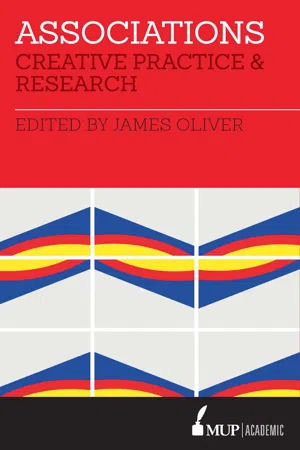
Associations is a collection of essays and reflections on creative practice and research. It presents some contemporary accounts and reflections on doing research for, through and with creative practices, particularly in the higher education sector. The overview of the book includes art and design and other creative practices-as-research intersections and will be particularly interesting to postgraduate researchers and emerging researchers. It is not a methods text, but it is oriented towards methodological thinking and the social and structural situations of creative practice and research. Contributors include: Gene Bawden; Barbara Bolt; Danny Butt; Tania Cañas; Aaron Corn; Anne Douglas; Mick Douglas; Léuli Eshrāghi; Ross Gibson; Lisa Grocott; Anna Hickey-Moody; Lucas Ihlein; Lyndal Jones; Hannah Korsmeyer; Julienne van Loon; Lachlan MacDowall; Brian Martin; James Oliver; Kate Pahl; Sarah Pink; Steve Pool; Amanda Ravetz; Ricardo Sosa; Naomi Stead; John Vella; Jessica Wilkinson
- English
- ePUB (mobile friendly)
- Available on iOS & Android
eBook - ePub
About this book
Information
PART I
ASSOCIATIONS
Preface
Place—Space—Practice
quoting a poetic preface
In the time before the bay all boats were trees. They stood end on end, settling into earth and touching air. The boats grew in the mountains and lined river valleys … The boats are here to remind us that they were here before us. And when we are gone they will stand end on end, speaking truth with the earth.1
You can’t hold places still.
What you can do is meet up with others, catch up with where another’s history has got to ‘now’.2
Culture is ordinary: that is where we must start.3
Notes
1. T Birch, ‘A Tree and a Boat’, in Broken Teeth, Cordite Books, Melbourne, 2016, p. 3.
2. D Massey, For Space, Sage Publications, London, 2005, p. 125.
3. R Williams, ‘Culture is Ordinary,’ in The Raymond Williams Reader. Blackwell Publishers, Oxford, 2001, p. 10.
Introduction: Practice as Research
James Oliver
I
This book has emerged through a series of collaborations and partnerships that I have been engaged in during my experience of supervising and coordinating graduate research. In particular, this has been in the context of two different university faculties in Melbourne—at the Victorian College of the Arts (VCA, University of Melbourne), and more recently at Monash Art Design and Architecture (MADA, Monash University). The collaborations, collegiality and communities of practice, though, extend well beyond these two institutions to others in Melbourne and much further afield. The list of contributors to this volume highlights this. I have worked with each contributor in some form or another in relation to creative practice and research, and this informs the register or tenor of the curating of this volume, particularly its transdisciplinary ethos.
As the title for this volume suggests, it is aimed at readers with an interest in the associations, relations and intersections of creative practice and research. Creative practice is a term I am using here to refer to a broad and eclectic set of practices—including diverse and constituent practices in the production or use of art, design, film, performance (theatre, dance, music), and writing, to name a few. Relevant language, such as ‘art’, ‘design’ or ‘performance’, does apply and resonate with much of the content here, but there is also a certain ambiguity about such nouns (e.g. which kind of art practice, design practice, performance practice?). Furthermore, when we over-determine practices of art, design, performance, and even research, these practices can, in effect, function as an index for identity and discipline (in professionalised relations of power and hierarchy). Associations: Creative Practice and Research is not only referencing artistic or art-based practices and research; the putative associations are therefore not just implied between and across practices, but also between and across disciplines and even beyond them. Nevertheless, the general orientation is towards the practice-as-research paradigm (or performative and process-practice paradigm).
In terms of research, though, we are more explicitly concerned with academic practices and contexts. From my perspective, research is a creative practice anyway; it is a practice of doing and making (applying and disseminating) what is traditionally thought of as ‘knowledge’. How this ‘knowledge’ is produced is, of course, a more political question, with equally provisional (disciplinary) answers. The philosophy and politics of knowledge, through a research practice, is something that each researcher will situate and negotiate (more or less) within their own practice. An academic practice of research, often situated institutionally, also brings particular attention to such practices in social and cultural terms—and to the political economy of creative endeavours and research practices of knowledge production. There is a diverse spectrum of creative practitioners and knowledge producers for whom institutional and epistemological grounds are ever shifting. Furthermore, in institutional and other organisational contexts, creative practice and research can effectively be an extractive industry—so, who is benefitting and what is the impact? These concerns require particular methodological care about the politics and ethics of research. What we imagine is possible and appropriate in one situation, or for one researcher, in terms of practice and outcomes, is not to be over-determined.
While it is envisaged that this collection could be ‘handy’ for anyone engaged in research at the intersections of creative practice, research and the academy, this is not a handbook on research; as such, this is not a methods or theory book. It is not a ‘how to’ technical book, nor is it a discipline-specific book. This is not to make assumptions about which creative practice the reader here is engaged with, or which type of research methodology they are practiced in or informed by. As a starting point, then, the expectation is that the reader is, in some manner, working with creative practice as a process of producing and disseminating knowledge and learning. My intention is that this book will not only be of interest to those engaged in (or considering embarking on) a research degree, but also for emerging researchers across disciplines, who are trying to gain some traction in situating their creative practice as research—and therefore further developing a practice-as-research sensibility, with methodological confidence, and related rigour in dissemination.
This volume is a collection of writings oriented towards developing methodological considerations in engagement with practice-as-research. Some contributor chapters are more explicit in research orientation with theory or method, while others reflect more on the conditions and politics of practice-as-research. So while this book is purposefully transdisciplinary, it also does not obviate discipline, rather, it offers some insight into discipline-oriented research through distinct themes and chapters.
The book is largely conceived of as a companion to other books on practice-as-research, including texts more explicitly focussed on theory or methods and techniques. Below, I outline a range of suggested introductory readings in order to assist readers to further explore the various practice/research trajectories or disciplines they are interested in. This is intended to assist in orienting individuals within their own practice as research. These are texts that are widely cited, or that I consider being broadly relevant resources as starting points. There are also many journal resources on library databases for more explicitly disciplinary discussion. Of course, this list is not exclusive or exhaustive, and the bibliographies of each chapter are equally important resources.
• A Fox and H Macpherson, Inclusive Arts Practice and Research: a critical manifesto, Routledge, Abingdon, 2015
• C Crouch and J Pearce, Doing Research in Design, Berg, London, 2012
• D Butt, Artistic Research and the Future Academy, Intellect, Bristol, 2017
• E Barrett and B Bolt, Practice as Research: approaches to creative arts enquiry, I B Tauris, London and New York, 2010 [2007]
• G Sullivan, Art Practice as Research: inquiry in the visual arts, Sage, Thousand Oaks, 2nd edition, 2010
• H Smith and R T Dean, Practice-led Research and Research-led Practice in the Creative Arts, University of Edinburgh Press, Edinburgh, 2009
• L T Smith, Decolonizing Methodologies: research and indigenous peoples, Zed Books, London, 2nd edition, 2012
• L Vaughan, Practice Based Design Research, Bloomsbury, London, 2017
• M Franklin, Understanding Research: coping with the quantitative-qualitative divide, Routledge, Abingdon, 2012
• P Carter, Material Thinking: the theory and practice of creative research, Melbourne University Press, Melbourne, 2004
• R Nelson, Practice as Research in the Arts, Palgrave, Basingstoke, 2013
• S Pink, Doing Sensory Ethnography, Sage, London, 2nd edition, 2015
Further notes about terminology:
Following from Robin Nelson1 in particular, I am generally referencing the phraseology and terminology of practice-as-research. I am also using it in transdisciplinary terms, and as a methodological position and approach, where the application of a creative practice (whether as context, method or outcome) is a key generative mode for the research. I make this comment as researchers sometimes use ‘practice-based’ or ‘practice-led’, including in this volume. Nevertheless, there can be confusion, even divergence, over the use of the terms ‘practice-led’ and ‘practice-based’ research. In the interests of transdisciplinary communication, I prefer practice-as-research (hyphens optional). My point is merely to highlight a particular point of discussion, potentially divergent, but may stir the reader to further reflection of language, methodology and context. I am not inclined to be dogmatic about research methods, creative practice or terminology, but language is important; not least in order to situate methodological purpose and context. Clarity and consistency are always important in a research project and writing.
In the case of a graduate researcher, practice-as-research will most likely result in a thesis submission that is a combination of a written scholarly component and a ‘non-traditional’ research output (the artistic, design or performance outcome, or indeed creative writing or a script). But the thesis could also result in the submission of a so-called ‘traditional’ writing-only thesis, where the substantive research is grounded with reference to the creative practice. This is not to de-limit or predetermine the methods or techniques a project may legitimately and meaningfully employ for practice-as-research.
For further clarity: in using the language of ‘transdisciplinary’, I am thinking in particular (but not exclusive) terms of creative practice transcending disciplinary preconceptions, rather than the translating of research practices between other practices or disciplines (which would be more akin to interdisciplinary practice). However, this is not to suggest a transcending of situation (histories, places, bodies). For example, my own view (and methodological inclination) is that in practice-as-research it is the situated practice (and emplaced practitioner) that should orient the research methodology and methods, and not a discipline or objective method per se. Of course, this is not to suggest that these cannot often all be straightforwardly aligned (particularly if one stays within a discipline). I also recognise the risk, and do not wish to over-determine or delimit the fullest scope of activity across the spectrum of creative practice and research. The point here is of relevance to those interested in interrogating methodological modalities of practice-as-research, and may open up a useful debate between practitioners, peers and communities of practice.
II
The purpose of the book is not to define the field of practice-as-research, which is diverse but also usefully under-determined. In disciplinary terms, it is further useful to think of how performance studies has been described as an inter-discipline, of being in-between many disciplines, but also reflexively holding that space of being in-between (this is the liminal space so often cited). This gets close to how I am thinking of a transdisciplinary space of creative practice and research. This transdisciplinary purposing is evident in an overview of the collection of author contributions, where transdisciplinary space sublates (holds and breaks) disciplinarity. The aim of this collection, then, is to encourage engagement with creative practice in expansive and associative terms, to think and act with methodological agility, to not be over-determinist, but to adequately and openly situate language, methodology and context in order to make research.
Knowledge is mediated by situated practice—and as Robin Nelson writes: ‘theory is imbricated within practice’. To perceive with a degree of transdisciplin...
Table of contents
- Cover
- Title
- Copyright
- Contents
- Acknowledgements
- Biographies
- List of Figures
- PART I: ASSOCIATIONS
- PART II: DISCIPLINE
- PART III: PUBLICS
- PART IV: KNOWING
- PART V: BEING
- Bibliography
- Note on Cover Art
Trusted by 375,005 students
Access to over 1.5 million titles for a fair monthly price.
Study more efficiently using our study tools.
Frequently asked questions
Yes, you can cancel anytime from the Subscription tab in your account settings on the Perlego website. Your subscription will stay active until the end of your current billing period. Learn how to cancel your subscription
No, books cannot be downloaded as external files, such as PDFs, for use outside of Perlego. However, you can download books within the Perlego app for offline reading on mobile or tablet. Learn how to download books offline
Perlego offers two plans: Essential and Complete
- Essential is ideal for learners and professionals who enjoy exploring a wide range of subjects. Access the Essential Library with 800,000+ trusted titles and best-sellers across business, personal growth, and the humanities. Includes unlimited reading time and Standard Read Aloud voice.
- Complete: Perfect for advanced learners and researchers needing full, unrestricted access. Unlock 1.5M+ books across hundreds of subjects, including academic and specialized titles. The Complete Plan also includes advanced features like Premium Read Aloud and Research Assistant.
We are an online textbook subscription service, where you can get access to an entire online library for less than the price of a single book per month. With over 1.5 million books across 990+ topics, we’ve got you covered! Learn about our mission
Look out for the read-aloud symbol on your next book to see if you can listen to it. The read-aloud tool reads text aloud for you, highlighting the text as it is being read. You can pause it, speed it up and slow it down. Learn more about Read Aloud
Yes! You can use the Perlego app on both iOS and Android devices to read anytime, anywhere — even offline. Perfect for commutes or when you’re on the go.
Please note we cannot support devices running on iOS 13 and Android 7 or earlier. Learn more about using the app
Please note we cannot support devices running on iOS 13 and Android 7 or earlier. Learn more about using the app
Yes, you can access Associations by James Oliver in PDF and/or ePUB format, as well as other popular books in Social Sciences & Social Science Research & Methodology. We have over 1.5 million books available in our catalogue for you to explore.