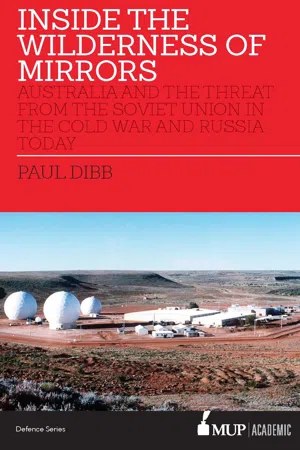
Throughout the Cold War Paul Dibb worked with the highest levels of Australian and American intelligence, and was one of very few Australian officials to be given the top-secret security clearance for access to Pine Gap. Only the most senior intelligence officers in both the US and Australia held this clearance—and even then on a strict 'need to know' basis. Inside the Wilderness of Mirrors is Paul's unique insight into how Australia saw the threat from the Soviet Union during the Cold War era and beyond. This insider's account of Australian defence strategy reveals the crucial importance of the US–Australian base at Pine Gap and why Moscow targeted it for nuclear attack, and how it felt to be an expert on the Soviet Union at a time when those who dared to study the Soviet Union were necessarily subject to suspicion from their Australian colleagues. Inside the Wilderness of Mirrors concludes by examining the ways in which contemporary Russia presents a continuing threat to the international order.
eBook - ePub
Inside the Wilderness of Mirrors
Australia and the threat from the Soviet Union in the Cold War and Russia today
- English
- ePUB (mobile friendly)
- Available on iOS & Android
eBook - ePub
Inside the Wilderness of Mirrors
Australia and the threat from the Soviet Union in the Cold War and Russia today
About this book
Trusted by 375,005 students
Access to over 1.5 million titles for a fair monthly price.
Study more efficiently using our study tools.
Information
CHAPTER 1
ASIO’s operations against the Soviet Embassy
‘You’re in deep trouble, Dibb. ASIO wants to see you!’ Thus, my boss Stuart Harris—senior economist at the Bureau of Agricultural Economics—addressed me the day of my first visit to the Soviet Embassy in Canberra. It was August 1965 and, at the request of the Minister for Trade, ‘Black Jack’ McEwen, the Bureau was working on a major research paper about the economics of the Soviet wheat industry and the prospects of Canberra securing important wheat sales with Moscow to replace the export market soon to be lost in the United Kingdom because of its announced intention of joining the European Economic Community. I had obtained Stuart Harris’s agreement to visit the embassy because there were no copies of the Soviet Statistical Yearbook (Narodnoe Khozyaistvo SSSR) available anywhere in Australia. I had contacted the embassy and been put through to the Third Secretary, Nikolai Poseliagin, who promised to give me his copy, which gave comprehensive data of the acreages sown to both winter and spring wheats in the black earth soils of the Ukraine and virgin lands of Kazakhstan respectively of the USSR. Little did I know that because of this meeting I would work as an agent for ASIO for the next twenty years, providing comprehensive information about senior Soviet Embassy personnel (including successive ambassadors), their views on matters of strategic interest to Australia, and their political, academic and journalist contacts in Canberra—as well as the strengths and weaknesses of their personalities with a possible view to securing a defection.
The ASIO person who wanted to see me the day after my visit to the Soviet Embassy was called Dave Haswell. He arranged to see me at my house in the Canberra suburb of Curtin and, after a short discussion about my research on the Soviet Union, he indicated that he would like me to meet a more senior ASIO agent the following week at the Dickson pub in Canberra. This turned out to be the person who would handle me for more than a decade and with whom I would remain friends until he died in January 1999. His name was Donald Ralph Marshall, otherwise known by his initials as DRM. He was nine days younger than me—which he never let me forget—and was born to White Russian parents in China. His father Bill (or Vladimir) Marshall (Mishchenko) worked in a key role in ASIO on the Petrov defection in 1954 and had arranged for his son to join ‘the firm’.
At the age of 25, Don was already specialising in Soviet counter-espionage where he would remain (except for a stint in the office of Attorney-General Lionel Murphy) until the Soviet Union disappeared in 1991 and he was offered a job by me in charge of Defence security. Don Marshall and I developed a close relationship in the late 1960s and the 1970s: we drank together at the Manuka Football Club with people like Max Moore-Wilton (who thirty years later became Secretary of the Department of Prime Minister and Cabinet), and at the Deakin Inn on a Friday night. I got to know his first wife, Margaret, when they lived in the nearby Canberra suburb of Hughes. He also introduced me to some of his other informants, including the Canberra Times journalist Frank Cranston, Brian Mills, who ran the Avis Rent-A-Car business in Lonsdale Street, Braddon (and who allowed ASIO to wire Avis cars for conversations) and Inspector Ron Dillon, who was in charge of the ACT Police Special Branch.
The crucial event in my relationship with ASIO occurred a couple of months after first meeting Don Marshall when he announced he was going to take me to a ‘safe house’ in Manuka to meet Ron Richards, who was Deputy Director-General (Operations) of ASIO and had played the famous role of masterminding the defection of Vladimir Petrov. Naturally, this discussion with Richards is deeply entrenched in my memory because of its critical nature and how it affected my future life. Richards made it plain to me that the Organisation believed that I might eventually have a successful career in Canberra, which could give me good access to Soviet Embassy contacts in the years ahead. He wanted to know whether I would work for ASIO and provide them with confidential briefings and insights into Soviet Embassy personalities and their thinking and help ASIO judge whether any of them might be candidates for defection. My response was that I saw such work as being in the national interest but that I wanted to have reassurances that my future career would be protected, recognising the sensitive—and perhaps even potentially dangerous—task he was asking me to carry out. I clearly recall his reassurances that the Organisation would be sensitive to any potential dangers, particularly if I made visits to the Soviet Union. Of course, none of us could have predicted the senior intelligence positions that I would hold or the degree of access I would have with the Soviet Embassy, particularly when I was Head of the National Assessment Staff, which provided intelligence assessments for the National Intelligence Committee in the 1970s.
As it so happened, two years later I landed a job with the Australian National University working with Australia’s pre-eminent Soviet specialist Professor Harry Rigby. This involved working on a US Ford Foundation grant to write a book about the economic development of Siberia and the prospects for trade with the Pacific region, especially Japan.1 As I was an economist, this book followed on naturally from the work I published for the Bureau of Agricultural Economics entitled The Economics of the Soviet Wheat Industry.2 The Siberian book enabled me to make an extensive visit to the Soviet Union in October 1968, shortly after the invasion of Czechoslovakia. My trip included visits to Moscow, Novosibirsk and the nearby scientific city of Akademgorodok, Irkutsk on Lake Baikal, the world’s largest hydro-electric station at Bratsk, and the Siberian Branch of the Soviet Academy of Sciences in Khabarovsk. In those days, very few Australians had made a trans-Siberian journey of that nature. There is little doubt that my access to such areas of research as the challenges of economic planning in resource-rich but remote Siberia were facilitated by appropriate letters from Third Secretary Poseliagin to the Foreign Ministry in Moscow.
Of course, planning this journey and reporting on its subsequent discussions demanded quite frequent meetings with Poseliagin, some of which were held in restaurants and recorded by ASIO, as well as face-to-face meetings with Don Marshall to debrief him about what had happened on this ground-breaking journey. Before I went to the USSR he had very patiently explained to me in some detail what not to do and which situations to avoid. He warned me that most likely my Intourist guides in Moscow and across Siberia would invariably be young, attractive women. Naturally, he warned me off any passionate liaisons. In fact, nothing even remotely salacious occurred in the nineteen days I was in the Soviet Union. He also warned me about carrying any packages for British intelligence or ‘Foreign Office’ contacts in London. My abiding impression of the Soviet Union in 1968 was of the poor state of its economic development, the appalling backwardness of service industries (especially restaurants), the remoteness and poverty in much of Siberia, and the harshness of security measures everywhere (particularly military deployments along the border with China at this time just a matter of weeks after the Soviet invasion of Czechoslovakia).
The relationship with Poseliagin became relatively frequent, but he never overstepped the mark. In my view, he seemed to be a straight Foreign Ministry diplomat, and that remained the case when he returned to Canberra in the early 1970s as First Secretary. There were those in ASIO who believed otherwise, and he was subject to intense surveillance by an ASIO Special Team. Poseliagin was eventually considered by ASIO as not an obvious intelligence officer, but in fact they knew little about him despite his being on a second posting to Australia. By December 1974, the Special Team had no evidence that Poseliagin was an intelligence officer or engaged in intelligence duties. Some in ASIO, however, still apparently considered that he was the likely KGB Resident in Australia, and his frequent presence near Telopea Park in Canberra raised the possibility that he was using a ‘dead letter box’ in the vicinity. In fact, I had informed Don Marshall that Poseliagin had told me he was a frequent visitor to the Manuka swimming pool adjoining Telopea Park, where he swam most mornings after he had suffered a heart attack. By November 1974 I had become head of the National Assessment Staff, and Poseliagin observed that I now had ‘a sensitive position’. In fact, he was if anything now more cautious about his dealings with me and, according to the official history of ASIO, ASIO eventually assessed that he was a genuine Foreign Affairs officer who performed his official duties well and that he was not an intelligence officer.3 In one of my records of conversation with Poseliagin, dated August 1975, he laughingly remarked just before leaving Australia for the last time that I should change my ‘portfolio and go to Foreign Affairs, and as Australian ambassador come to Moscow’. He died of a massive heart attack on a posting as Minister and Deputy Chief of Mission to the Soviet Embassy in London in 1984. I often wonder how he would have reacted to the collapse of the USSR a few years later in 1991. He certainly had very clear views about the poor prospects for unification of Germany, when he told me in 1975 that ‘as far as the USSR was concerned reunification would not occur in our lifetimes’.
Dramatic changes occurred to the seniority and experience of diplomatic and intelligence staff appointed to the Soviet Embassy in Canberra from the mid-1970s until the early 1980s. A tough, hard ambassador was appointed called Alexander V. Basov, who was a member of the 250-strong Communist Party Central Committee and had used military force against food price protesters in Ukraine in the early 1960s. He was previously Soviet ambassador in Romania and Allende’s Chile. His appointment caused considerable adverse comment in the Australian press. His two most senior diplomatic officers were Yuri Pavlov as Deputy Chief of Mission and Igor Saprykin as the number 3 with the rank of Counsellor, as well as Lev Koshlyakov as press attaché with the rank of Second Secretary and later First Secretary. The latter was considered by ASIO to be the KGB Resident. Pavlov and Saprykin were to take up a great deal of my records of conversation as Head of the National Assessment Staff and later Deputy Director of the Joint Intelligence Organisation.
I have some fifty records of conversation involving Basov, Pavlov, Saprykin, Koshlyakov and other members of the Soviet Embassy. The following extract from one of my discussions with Ambassador Basov in July 1976 gives some insight into the importance of the topics being discussed. At the instruction of my boss, the chairman of the National Intelligence Committee, Gordon Jockel, this particular record was given no further distribution other than to the Secretary of the Department of Defence, Sir Arthur Tange:
SECRET—DELICATE SOURCE
Record of conversation of Mr A.V. Basov, Soviet Ambassador with Mr P. Dibb, Head National Assessments Staff, 23 July 1976
1 I met Mr Basov at a function to celebrate Egypt’s National Day. He came directly over to me breaking off his discussion with the West German Ambassador.
2 Mr Basov said that he had two questions to ask me: the first was in what specific ways was the Soviet Union a direct military threat to Australia; the second was about Australia’s relations with China and Soviet concerns that the US would be interested in Prime Minister Fraser’s ‘four power’ proposal with regard to an anti-Soviet bloc comprising the US, Australia, Japan and China.
3 I said to the Ambassador that I thought the real worry about the USSR was the amount of money it was spending on defence and the large amounts of very sophisticated military equipment it was producing. As to the threat to Australia, I thought that the Government’s views on this subject had been clarified in various statements made recently. Basov interrupted and said that he had also read the report by Frank Cranston in the Canberra Times reporting Mr Jockel’s testimony to the Senate Committee on the Indian Ocean. I said that I supported Jockel’s opinion and my view was that, whilst I did not see a direct Soviet military threat to Australia, the build-up of the Soviet Indian Ocean naval squadron and Soviet facilities at Berbera in Somalia were of strategic concern to us. Moreover, I thought that it was time for the USSR to declare what its intentions were in relation to its build-up of military power generally.
4 The Ambassador did not comment upon my points about Soviet defence spending and its military power. He said that the USSR had been remarkably restrained in its reactions to statements by various Australian Government leaders; he stressed that this had been ‘very, very difficult’ for the Embassy. He hoped this was the right policy. He made the point forcefully that the leaders of countries must be very careful in choosing the exact words that they use about other countries. He went on to suggest that for countries the size of Australia these situations could create all kinds of difficulties.
5 In response to his questions on China, I told the Ambassador that I did not work in a policy area and that therefore I did not know exactly what Mr Fraser had said in China. The Ambassador replied that he had the greatest difficulty understanding the situation, but he knew that the Chinese were trying to create mischief. He said that China may not appear to be a threat to Australia at present but in 10 or 15 years’ time we would know differently: China had great military potential.
6 Mr Basov speculated on what Mr Fraser was going to discuss in Washington. He said that ‘it had been noted in diplomatic circles’ in Canberra that the Prime Minister of Australia was taking the unusual step of having discussions in Washington with the Pentagon and the Joint Chiefs of Staff. He said he could not see what the PM hoped to get politically out of his discussions at this particular time in Washington. Basov linked together his concerns about Australia’s so-called ‘four power’ proposal between the US, Australia, Japan and China with the visit of the PM to the Pentagon and the political situation in Washington in such a way that he left me with the strong impression that he was worried about the possibility that Australia would be advising the US to supply advanced military equipment to China that would not be in the USSR’s interests.
It was shortly after I dictated this record of conversation that I received a call asking me to see Sir Arthur Tange urgently. In his opening remarks to me, he said, ‘I understand you are our Soviet expert and I want you to visit Moscow. ASIO advises that you are to stay in the Residence with our Ambassador, Sir James Plimsoll, and not venture outside without an Embassy escort. I want you to quiz the Soviets about their naval presence in the Indian Ocean.’ The Fraser government had made a particular issue of the Soviet naval base in Somalia in East Africa because of its proximity to Western oil trade leaving the Persian Gulf. We had a brief discussion about what questions I might ask and how long I would stay in Moscow, but as I was about to leave his room he called me back, saying: ‘Now my boy, I want an Australian view on this Soviet Union place, not regurgitated American or British views.’ I made arrangements through Counsellor Igor Saprykin for me to visit Moscow in October 1976. As a result of my visit, John Burgess, Counsellor at our embassy in Moscow, sent a top-secret cable to an extremely limited list of recipients in Canberra. That cable is reproduced below:
TOP SECRET AUSTEO
Talks at the Institute of the USA and Canada, Moscow 22 October 1976 with Paul Dibb, Head of the National Assessments Staff
On 22 October Dibb and Counsellor Burgess had a long session with the Executive Secretary of the Institute of USA and Canada, Dr Ivanian, and with two section heads of the Institute, Semeiko and Streltsov. Its members are senior, capable and influential people. The three Soviet officials with whom we spoke were well prepared on Australia’s Indian Ocean policies and on detailed military issues.
Semeiko said that the USSR’s strategic relations with the USA were at a critical stage. He ‘hoped’ that a SALT II agreement could be signed after next January when the American presidential elections had been settled. There was no hope for an agreement this year. In the meantime, the US was pressing ahead with the development of long-range cruise missiles, which will be ready for deployment about the middle of 1977. The US could then threaten to manufacture large numbers of these missiles at a very low cost per unit. Instead of having an agreement on 2400 strategic nuclear launchers each, as envisaged under the Vladivostok Accords, the US could relatively quickly deploy ‘20 000 or 30 000’ cruise missiles and destroy any hope of global strategic stability. Cruise missiles were also a serious threat for world nuclear proliferation if smaller countries could get hold of them and equip them with modest but precise nuclear warheads.
Semeiko’s stated opinion was that strategic cruise missiles have to be specifically prohibited in SALT II. Tactical cruise missiles with a range of less than 500 kilometres, such as the USSR and USA have or are developing (e.g. the US Harpoon system) for their navies, are not a problem. However, intercontinental cruise missile developments must be stopped. Semeiko claimed that the strategic and tactical modes of cruise missile deployments can be detected by national means of verification. He drew diagrams of the two systems showing marked temperature differences between the hotter (650° C) power plant of the tactical weapon and the cooler (450° C) strategic weapon, which has a ‘fan tube’ cooling arrangement.
There was a very frank discussion on the Indian Ocean. The Soviets told Dibb that they had a missile handling facility, communications (intercept) station, airfield, barracks, limited repair capabilities and fuel tanks at Berbera. They said this was not a base, unlike Diego Garcia, which would have a major repair and troop handling capability. The USSR did not deploy troops overseas and, moreover, it was unlikely to get overflight permission from countries such as Iran if it ever wanted to send troops to Berbera. Although the missile handling facility at Berbera may be large enough to handle longer range naval missiles such as Shaddock, the Soviets said that we would know ‘from Australia’s access to US overhead systems’ that they have not deployed anything of that size there: ‘only small ones’. They seemed to be indicating that they have exercised deliberate restraint with the development of the missile facility at Berbera.
It is of course important that the Institute’s discussions with Dibb on Berbera be fully protected from publicity in Australia. The USSR has not been prepared to discuss these facilities with us before. Certainly, the discussions marked a much more flexible approach on the subject than official Soviet pronouncements.
Semeiko and Streltsov explained that the USSR’s strategic interests in the Indian Ocean were (A): The protection of the sea lines of communication between the Soviet Far East and European Russian ports. Russia had been seeking to protect its interest in this regard ‘ever since Catherine the Second’. The US construction of a base at Diego Garcia threatened the USSR’s lines of communication with Vladivostok. There were a number of complex factors in determining whether the USSR or the USA had the greatest presence: but ‘even if we say the USSR has more ships there’ the USA deploys aircraft carriers to the Indian Ocean and ‘you will be aware that the USSR has not yet done so’. (B): The USSR sees a potential threat from US missile-firing submarines in the Indian Ocean. The Soviets claimed that two or three years ago they had detected American SSBN deployments in the Indian Ocean. The US had told them they were only there on familiarisation exercises, but the USSR could not ignore the new contingency of a nuclear missile attack from the Indian Ocean. If such an attack were directed from Northwest Cape in Western Australia, ‘it could involve Australia in Soviet response ...
Table of contents
- Cover
- Title
- Copyright
- Contents
- Preface
- 1 ASIO’s operations against the Soviet Embassy
- 2 The wilderness of mirrors
- 3 A case study of US intelligence failure
- 4 US bases and Soviet nuclear targeting
- 5 Australian assessments of the Soviet threat
- 6 Predicting the Soviet collapse
- 7 The USSR as an ‘incomplete superpower’
- 8 Understanding post-Soviet Russia
- In conclusion
- Notes
- Index
Frequently asked questions
Yes, you can cancel anytime from the Subscription tab in your account settings on the Perlego website. Your subscription will stay active until the end of your current billing period. Learn how to cancel your subscription
No, books cannot be downloaded as external files, such as PDFs, for use outside of Perlego. However, you can download books within the Perlego app for offline reading on mobile or tablet. Learn how to download books offline
Perlego offers two plans: Essential and Complete
- Essential is ideal for learners and professionals who enjoy exploring a wide range of subjects. Access the Essential Library with 800,000+ trusted titles and best-sellers across business, personal growth, and the humanities. Includes unlimited reading time and Standard Read Aloud voice.
- Complete: Perfect for advanced learners and researchers needing full, unrestricted access. Unlock 1.5M+ books across hundreds of subjects, including academic and specialized titles. The Complete Plan also includes advanced features like Premium Read Aloud and Research Assistant.
We are an online textbook subscription service, where you can get access to an entire online library for less than the price of a single book per month. With over 1.5 million books across 990+ topics, we’ve got you covered! Learn about our mission
Look out for the read-aloud symbol on your next book to see if you can listen to it. The read-aloud tool reads text aloud for you, highlighting the text as it is being read. You can pause it, speed it up and slow it down. Learn more about Read Aloud
Yes! You can use the Perlego app on both iOS and Android devices to read anytime, anywhere — even offline. Perfect for commutes or when you’re on the go.
Please note we cannot support devices running on iOS 13 and Android 7 or earlier. Learn more about using the app
Please note we cannot support devices running on iOS 13 and Android 7 or earlier. Learn more about using the app
Yes, you can access Inside the Wilderness of Mirrors by Paul Dibb in PDF and/or ePUB format, as well as other popular books in Politics & International Relations & Global Politics. We have over 1.5 million books available in our catalogue for you to explore.