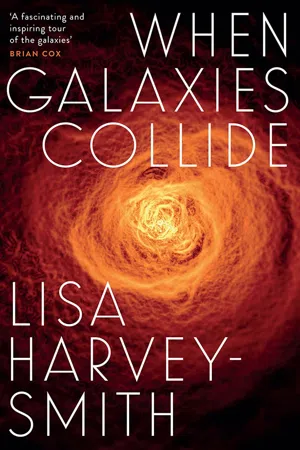
In 2018, Lisa Harvey-Smith was appointed as the inaugural Australian Women in STEM Ambassador by the Australian Federal Government.Why is the Milky Way blue? Why isn't a black hole dark? How many stars can you see with your naked eye?* How much hotter are blue stars than red ones?** Humans are the only known astronomers in the universe. When we look up at the night sky, we are linked to our ancestors. Away from city lights, we can see what generations of people before us have wondered at and weaved stories around. But all that will change. The Andromeda Galaxy is rushing towards us at 400, 000 kilometres an hour. When Galaxies Collide will guide you to look at the night sky afresh. It peers 5.86 billion years into the future to consider the fate of Earth and its inhabitants. Will the solution be to live in space without a planet to call home? Will one of the other 100 billion planets spawn life? Learn how to watch this space. * 9, 000, but only half of that from any given point on Earth.
** 38, 000 degrees vs 3, 000.
- English
- ePUB (mobile friendly)
- Available on iOS & Android
eBook - ePub
When Galaxies Collide
About this book
Information
Topic
Physical SciencesSubtopic
Astronomy & Astrophysics1
OUR FAITHFUL FRIEND
Have we lost our connection with the night sky? It’s a question I often pondered when I lived in Sydney, a city of four million people. Bright lights filled our sky and only a few of the most brilliant stars shone through the orange night-time haze. When I look back at my childhood, in a small village in the English countryside, it was a very different experience.
By day, I was surrounded by fields of wheat, barley and canola. At night, a brilliant carpet of stars was laid out above me. My family was very active and we spent countless hours walking and cycling through the countryside. Watching the landscape change throughout the year, I developed a strong connection with the natural world.
I quickly learned to read the seasons. Blackberries ripened in September. Strawberries blushed in late June. In December, lone robin redbreasts hopped through the bare hedgerows. Hawthorn brambles created bursts of ripe berries for the blackbirds in January. And then the snow came. In spring, snowdrops, crocuses and daffodils peeked out from frozen ground. Wheat was harvested in August. Crop stubble was burned or ploughed into the soil in September, and the cycle repeated.
As my interest in astronomy came to light at the age of twelve, it added a universal dimension to my experiences. I learned, slowly at first, the appearance of the night sky and watched, fascinated, as the stars changed throughout the seasons. In summer, the bright trio of Vega, Deneb and Altair dominated the sky. In winter, Orion came to visit. Every night the sky circled steadily around the North Pole Star, also known as Polaris. Although I never knew him, this was the same night sky that my grandfather, also an astronomy enthusiast, had enjoyed. As I learned the constellations that he had taught my dad, it felt as if the night sky was something bigger than ourselves—something that connects us to our ancestors.
This connection to nature and to the stars helped me find my place in the world. When I was fourteen, it also helped me navigate one of the most memorable adventures of my young life. A group of friends from my athletics club and I were given a challenge: to navigate more than 60 kilometres by bike with no outside assistance. No maps, no technology, just our eyes, our ears and our surroundings. The plan was that we’d be blindfolded, driven out into the country and dumped, and then use only our wiles and our bikes to make it home before sunset. Looking back, I’m amazed that our parents gave permission for this adventure to go ahead at all.
One friend’s dad, Joe, thought it would be the making of us. He hired a huge trailer and threw our bikes into the back. We dozen or so teenagers were sat down and blindfolded in the back seats of a convoy of cars. As we pulled out of town, Joe made a point of going round a roundabout a few times to disorient us. It was really exciting to be headed on an adventure, not knowing where we were going to end up. We must have driven for over an hour, my friends and I chatting excitedly at first, but then quickly getting quieter and more contemplative as we got deeper into the countryside, denied our usual dominant sense of vision.
After what seemed like hours, the car came to a stop and the door opened. ‘Blindfolds off!’ shouted Joe. The sunlight briefly dazzled us and the bikes clattered as they were unloaded. Car doors were slammed and Joe didn’t hang around. He shouted, ‘Good luck!’ and the convoy drove off, leaving a small cloud of dust rising up from the country lane. And there we were, twelve teenage friends, in a field 60 kilometres from home.
Where do you start when you don’t have a clue where you are? We needed to establish a baseline. We scoured the countryside looking for clues, but none of us recognised anything. Just a country lane, fields of ripening wheat and a distant church spire. A farmhand was fixing a fence a few hundred metres away. I sauntered up to him with youthful confidence and said, ‘Scuse me, we’re a bit lost. Where are we, please?’ He smiled slightly, amused at this seemingly clueless bunch of kids on bikes, and pointed to the church spire about 3 kilometres away. ‘That’s Royston,’ he said.
Royston. As a map freak, I knew it was on the western side of the county of Essex, where we lived. That told me we must have been about 60 kilometres north-west of home. So to get home, the only thing to do was to head south-east. Having no compass with us, nor any electronic gadgetry (this was 1994 and mobile phones were some way off), the only way to navigate was by the sun. My friends were town kids, with no particular interest in the cycles of the sun (or at least not one that they dared to express). I was the village kid who didn’t go to school—I taught myself at home from the age of eleven—and spent my days climbing trees, wandering the countryside and looking at the stars. It was immediately clear that I needed to step up.
I knew that the sun rose in the east and set in the west, at least in late March (the spring equinox) and late September (the autumn equinox). In summer, which we were enjoying at the time, the sun rises slightly north of east in the UK. I was confident of this because I used to track the position of sunset throughout the year from the upstairs windows of my house. In the middle of winter I could see the sunset from the front window against the background of poplar trees on the horizon towards Great Bardfield in the south-west. In summer, the sun set out of the small upstairs window to the side of the house towards Finchingfield in the north-west.
It was around 9 a.m. The sun moved towards the south around midday, so I figured that it had probably swung to approximately east. ‘We’ll get home if we follow the sun and bear right a bit!’ I declared to my friends. Since nobody had any better ideas, they took my advice and off we went.
For the rest of the morning we happily zigzagged across the winding English country lanes, up and down the undulating valleys, riding towards the sun as it made its way south. It felt like an idyllic endeavour. We were undistracted, connected to our surroundings and navigating by the star that had created us. We felt free. Empowered by a basic knowledge of the sky, a bunch of kids had a fantastic adventure and made it home safely with plenty of time to spare.
Can you remember the very first time you looked up at the night sky?
For me, it was March 1986. I was six years old and Halley’s comet was paying one of its regular visits to the inner solar system. The media were hyped for the appearance of this famous lump of rock and ice, which I knew appears every seventy-six years as a fuzzy ‘star’ gleaming in the sky, adorned with a brilliant tail. Halley’s comet has been known about since at least 240 BCE, when it was first recorded in writing by Chinese and Babylonian astronomers. It even features on the Bayeux tapestry as a portent of the Battle of Hastings, streaking across the sky in 1066 as the Normans rudely invaded England.
My dad and I ventured out into the darkness of our front garden in a small country village, 50 kilometres from the bright lights of London, and craned our necks skyward. A hedgehog scuttled by. The lights scattered down our small street threw an orange glow onto the low clouds that broke up the sky, but brilliant piercing eyes of starlight tore their way through from time to time. My dad pointed up to one of these clearings and said to me, ‘Lisa, we can’t see Halley’s comet tonight—it’s just too faint—but remember that we came out tonight and looked for it.’ The night we didn’t see Halley’s comet was my very first taste of astronomy, and it felt like a special moment. The buzz around this astronomical event made it seem like people all around the world were welcoming a rare and glamorous visitor—and I was hooked.
What was your Halley’s comet moment? Your first glimpse of a dark starry sky? Seeing a planet through a telescope? Most people have been fortunate enough to enjoy these moments. When we do, we feel something resembling a primal sense of wonder. Perhaps it’s because the night sky is literally in our DNA. After all, every atom of carbon, nitrogen and oxygen in our bodies was created by the nuclear fusion of lighter elements in the centre of a star. Biologists might argue the phrasing of this point, but it is true to say that from a physical and chemical point of view we are literally descended from the stars—they are our parents and our creators.
Not only that, but the stars have had a major influence on human society. Every star in our night sky has contributed to our ancestors’ belief systems and, later, to our astronomical science, which has helped us build an understanding of our place in the universe. The constellations we see are virtually indistinguishable from those our great-great-great-great-grandparents saw. The stars appear so static, in fact, that their patterns have been used to pass down stories, maps, myths and legends through tens of thousands of years of human history. They are a living link to our ancestors, but that’s not to say they are timeless. The universe is a dynamic place. Objects are constantly moving and shifting in space. Stars are born and they die. Galaxies collide. All of this impacts on our human experience of the stars.
How many stars do you think we can see with the naked eye? Thousands? Millions even?
Only 9000 stars are visible to the human eye. Because we can see only half of these stars from any given point on Earth’s surface, that means there are only about 4500 individual stars we can stare up at and see at any one time.
If, like me, you live in a city, you’re probably able to see only a few dozen of the brightest stars. That’s only a minute fraction of the total number of 1022 (one followed by twenty-two zeros) stars estimated to exist in the universe. For our watered-down city view of the night sky we have light pollution to thank, which sees an estimated 35 per cent of all energy used in street lighting going to waste by poorly directed light shining up into the sky. According to the International Dark-Sky Association, this wastage comes at a financial cost of $3 billion to the United States alone, not to mention the detrimental effects on the sleep patterns of birds and animals and on our enjoyment of the night sky. But don’t get me started.
Assuming we are in a dark place such as a mountaintop away from city lights, why can we still only see 9000 of the 10,000,000,000,000,000,000,000 stars with our eyes?
Most of them are too far away. The stars that we see night after night live mostly in our local neighbourhood, within 1000 light years1 (10 million billion kilometres) of Earth. The distant stars are faint because stars give off light in all directions. That means the starlight is watered down through the colossal volume of space between the stars and Earth, rendering stars that are more distant than about 1000 light years too faint to make out. There is a mathematical rule that governs this dilution effect called the inverse square law. It tells us that as the distance to a star increases, the brightness fades by the square of the increase in distance. That rather dry description means that if you look at a star ten times further away, it will seem 100 (ten squared) times fainter. Put a star 1000 times further away and it has 1000 squared, or a millionth, of the brightness. That’s why most of the stars in the universe are invisible to the naked eye.
To reveal more distant stars, modern astronomers use a telescope with a large mirror or lens to collect extra light. This increases the size of our virtual ‘eye’, revealing far fainter objects. Without telescopes, we are left exploring only the nearby avenues of our galactic city, as our ancestors did for millennia—observing our few thousand bright stars and trying to make sense of their patterns with stories, tales and legends.
For centuries, the night sky has been divided into constellations, or groups of stars. Like join-the-dot puzzles, constellations represent the imagined shapes of mythological creatures or animals that had some meaning to our distant ancestors. They were dreamed up in ancient times and were connected to complex stories or legends. Constellations are not physical groups of stars, nor are they linked by gravity. Much like a psychiatrist’s ink-blot pattern, the shapes each culture saw probably had more to do with the community’s psyche than anything else.
One of the most famous constellations is Orion, the hunter, who straddles the celestial equator and is therefore visible from every part of Earth. Orion has a stout, rectangular body made up of the supergiant stars Rigel, Betelgeuse and Saiph as well as the female warrior star Bellatrix, which is now known to be a close pair of bright stars. Orion’s right arm holds up a shield, and around his waist he has a belt made up of three bright stars. Below this belt is a sword made up of another triplet of stars. If you look very carefully, you can see that the central ‘star’ of Orion’s sword is actually a cloudy smudge of light. With a pair of binoculars or a small telescope you can make out that this smudge is a cloud of interstellar gas with a cluster of bright blue stars at its core. We now know that this is a gigantic complex of 4 million trillion trillion tonnes of star-forming gas, including the famous Horsehead nebula, which is giving rise to new stars by the gravitational collapse of the cloud.
I spent many hours as a teenager peering through a 10-inch telescope and sketching the Orion nebula in the freezing cold of my back garden. Now, as a professional astronomer, I have studied its chemical make-up and its ongoing star-forming processes using some of the most powerful radio telescopes in the world.
For centuries, ancient cultures have passed down knowledge using patterns in the stars. We know little about these stories because few physical records remain and many oral stories have been destroyed by colonial practices. However, there are many strands of information remaining in cave paintings, bone carvings and oral stories from far beyond the written records.
The ancient cave paintings of Lascaux in France are a remarkable glimpse into the relationship of Neolithic humans 15,000 years ago with the stars. The paintings include depictions of several constellations, alongside pictorial representations of the creatures with which they were associated. One of these shows Taurus, the bull, with the bright red supergiant star Aldebaran as its eye. Another painting depicts a shaman (a half-human horned creature) made up of the modern constellations of Gemini and Orion.
The Wiradjuri people of Australia had another name for the constellation the Greeks called Orion. He was Baiame, a creator god who held aloft a boomerang and a shield. Orion is upside down as seen from Australia, and the Wiradjuri story is that Baiame tripped and fell over the horizon, which explains his strange orientation in the sky. Other Aboriginal nations knew him as Nyeeruna, a hunter who spent his time chasing the Seven Sisters (the star group the Greeks knew as the Pleiades).
Today, eighty-eight constellations are officially recognised by the International Astronomical Union (IAU), the worldwide professional body for astronomers that has the sole discretion to name astronomical objects. The majority of constellations (those in the northern sky that are visible from the Mediterranean) are attributed to the ancient Greeks. This is a bit of a distortion of history, though, because many of the constellation names, as well as the common names of many bright stars, are actually derived from Mesopotamia (modern-day Iraq, Turkey, Iran and Syria) between 4000 and 5000 years ago.
The Arabic names of individual stars have been honoured by the IAU, but the Greeks had a near monopoly on the official names for the constellations. Breaking this cartel in star naming took a long time, but in 2017 another eighty-six star names from Australian Indigenous, Chinese, Coptic, Hindu, Mayan, Polynesian and South African cultures were given the official stamp of approval. Finally, the academic world is starting to recognise the historical contributions of a wider variety of human cultures in the study of the universe.
The role of Middle Eastern astronomers was not restricted to inventing star patterns—it also included studying the motions of the sun and moon, predicting eclipses, and charting the cycle of the planet Venus, which, just like our moon, goes from full to half to crescent before disappearing between Earth and the sun. They also developed the method of dividing the virtual ‘sphere’ of Earth’s sky into 360 degrees—the basis for much of our modern mathematical way of measuring the sky.
Civilisations across the globe each have their own interpretations of the star patterns. Ones you may not have heard of include the llama (Inca), the ear of grain (Persian) and the white tiger of the west (an ancient Chinese asterism). The ancient Chinese developed their own sophisticated set of constellations some 2500 years ago, which in subsequent centuries (after contact with Middle Eastern astronomers) was adapted to incorporate some of the star groups from the Mesopotamian tradition. The Chinese have arguably kept the most detailed scientific records, including noteworthy records of the stars and planets. They are the only civilisation to have recorded every appearance of Halley’s comet from 3000 years ago to the present day.
The ancient constellations were not just the product of artistic minds gazing at the stars and imagining famous people and animals. They were also connected to spiritual beliefs. Many of the early stargazers were paid by kings, queens and emperors to help them make important decisions. In those days, running a kingdom based on astrology—the alignment of stars and planets—was a popular way to conduct political affairs. Some fascinating social rituals also arose from the very deep belief many cultures had in astrology. That the word ‘disaster’ has its roots in the Greek for ‘bad star’ points to the importance of astrology in human history. In Mesopotamia and Iran, people employed trickery to counter the impending arrival of ‘unlucky’ astronomical events such as eclipses. To bamboozle the evil forces, the astrologer in the royal court would arrange for a powerless subject such as a peasant, a prisoner or a political opponent to sit on the throne for the duration of the ‘unlucky’ event. The idea was that the bad luck would fall upon the fake king, while the real monarch, tucked up in the castle or palace, would be spared. Sadly, the event always turned out to be unlucky for someone, because the substitute monarch would end up being sacrificed once the supposed danger had passed.
Of the eighty-eight official constellations, those in the Southern Hemisphere were named most recently, often by travelling Europeans. Dutch-Flemish cartographer Petrus Plancius invented twelve new constellations based on maps of the southern sta...
Table of contents
- Cover
- Title
- Copyright
- Contents
- 1. Our faithful friend
- 2. On the inside, looking out
- 3. A galaxy menagerie
- 4. The force is with you
- 5. Travelling through time
- 6. Cradle of life
- 7. Meet the neighbours
- 8. When galaxies collide
- 9. Staying connected
- Acknowledgements
- Index
- Illustration
Trusted by 375,005 students
Access to over 1.5 million titles for a fair monthly price.
Study more efficiently using our study tools.
Frequently asked questions
Yes, you can cancel anytime from the Subscription tab in your account settings on the Perlego website. Your subscription will stay active until the end of your current billing period. Learn how to cancel your subscription
No, books cannot be downloaded as external files, such as PDFs, for use outside of Perlego. However, you can download books within the Perlego app for offline reading on mobile or tablet. Learn how to download books offline
Perlego offers two plans: Essential and Complete
- Essential is ideal for learners and professionals who enjoy exploring a wide range of subjects. Access the Essential Library with 800,000+ trusted titles and best-sellers across business, personal growth, and the humanities. Includes unlimited reading time and Standard Read Aloud voice.
- Complete: Perfect for advanced learners and researchers needing full, unrestricted access. Unlock 1.5M+ books across hundreds of subjects, including academic and specialized titles. The Complete Plan also includes advanced features like Premium Read Aloud and Research Assistant.
We are an online textbook subscription service, where you can get access to an entire online library for less than the price of a single book per month. With over 1.5 million books across 990+ topics, we’ve got you covered! Learn about our mission
Look out for the read-aloud symbol on your next book to see if you can listen to it. The read-aloud tool reads text aloud for you, highlighting the text as it is being read. You can pause it, speed it up and slow it down. Learn more about Read Aloud
Yes! You can use the Perlego app on both iOS and Android devices to read anytime, anywhere — even offline. Perfect for commutes or when you’re on the go.
Please note we cannot support devices running on iOS 13 and Android 7 or earlier. Learn more about using the app
Please note we cannot support devices running on iOS 13 and Android 7 or earlier. Learn more about using the app
Yes, you can access When Galaxies Collide by Lisa Harvey-Smith in PDF and/or ePUB format, as well as other popular books in Physical Sciences & Astronomy & Astrophysics. We have over 1.5 million books available in our catalogue for you to explore.