In an era when everyone has an opinion, we rely on facts more than ever. Australia's leading thinkers give their robust opinion on the arguments and issues that fuelled public debate in 2018.This collection of essays brings you the best of the authoritative journalism for which The Conversation is renowned. Immerse yourself in the insights of experts and navigate the key questions of our times.
eBook - ePub
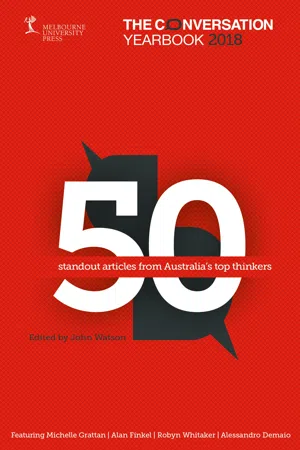
The Conversation Yearbook 2018
50 standout articles from Australia's top thinkers
- English
- ePUB (mobile friendly)
- Available on iOS & Android
eBook - ePub
About this book
Trusted by 375,005 students
Access to over 1.5 million titles for a fair monthly price.
Study more efficiently using our study tools.
Information
CHAPTER ONE
Exploring the Evidence
Young blood: Magic or medicine?
Director, Research and Development, Australian Red Cross Blood Service, and Adjunct Professor, University of Technology Sydney
Ben Franklin famously wrote that ‘in this world, nothing can be said to be certain, except death and taxes’. What he didn’t mention, despite being 83 years old, was a third, almost inevitable eventuality: ageing.
Depending on when in history and where on the planet you look, ageing is variously considered desirable—bringing with it wisdom and status—or as something to be feared, eliminated, or at least delayed as long as possible.
In the 16th to 18th centuries, Western societies believed old age was a time of considerable worth. But since the 19th century we have sought ways to eliminate or minimise the effects of ageing.
Even in the time of Herodotus (the 5th century), there were stories of a ‘Fountain of Youth’ located far away in the land of the Ethiopians, whose waters would bring youth and vigour to those who drank from it.
Blood is a potent symbol of life and of death. It is hardly surprising, then, that this incredible fluid is linked to the search for eternal youth in literature, legend, magic and medicine.
Recent scientific studies have claimed, almost vampire-like, that transfusions of blood from teenagers can help delay or reverse the ageing process. Where do these claims come from? Do they stack up? And how long will it be before we have the power to stave off what now is inevitable?
The first blood transfusion from one human to another is reported to date from 1492, for Pope Innocent VIII.
There is some discussion as to whether this was an attempt at a blood transfusion as we understand it today, or some other form of administration of blood (such as oral), given that the theory of circulation of blood was first published in 1628, almost 140 years later.
Sources from 1873 stated:
All the blood of the prostrate old man should pass into the veins of a youth who had to yield up his to the Pope.
But earlier reports, from 1723, were less specific:
Three ten-year-old boys died because blood had been taken from their veins … in an attempt to cure the Pope.
Whatever the truth of the treatment, the pope did not recover, and neither did the boys. Here, at what is arguably the start of transfusion history, we can already see the lure of the belief in the power of young blood.
Fast forward to 2017 and the reputation of ‘young blood’ is moving into the world of big business.
A company called Alkahest, based on work by Tony Wyss-Coray, a neurobiologist studying Alzheimer’s disease at Stanford University, is spruiking the results of a trial where plasma from young donors (aged 18–30) was transfused into patients with dementia.
Eighteen patients aged between 54 and 86 with mild to moderate Alzheimer’s disease were enrolled in the trial. They were infused with plasma (or placebo, in a control group) twice a week for four weeks.
Thankfully the trial was more successful than Pope Innocent VIII’s treatment. None of the patients showed any ill-effects, but neither did they show any improvement in tests of thinking ability. They did, however, demonstrate some improvement in tests that assessed their daily living skills.
At almost the same time, controversial trials by a company named Ambrosia (‘food of the Gods’, depicted as conferring immortality) are transfusing plasma from people aged 16–25 into people aged 35–92.
Despite the experimental nature of this treatment, participants are paying US$8,000 each to be included in the trial, for which there is no control group.
These factors make it virtually impossible to interpret the results, because people in the trial may ‘feel better’ merely through having paid money for a treatment they believe is going to work.
Jesse Karmazin presented the results of the study so far at the Recode technology conference in Los Angeles in mid-2017. Ambrosia’s scientists examined the levels of various molecules, believed to be predictive of cancer or Alzheimer’s disease, in the blood of people who had been treated. They found that those who had been treated with young blood had lower levels of several proteins known to be involved in disease, namely carcinoembryonic antigens (which increase in cancer patients) and amyloid (which forms plaques in the brain in Alzheimer’s disease patients).
However, the long-term significance of these changes is unclear.
The science of stealing youth
Science has come a long way since Pope Innocent VIII, so what has led these modern scientists to try what appears to be a modern version of a very similar experiment?
The roots of both these companies lie in experiments in ‘parabiosis’ (from Greek par meaning alongside, and bios meaning life)—a technique that dates back to the 1864 physiologist Paul Bert.
Bert surgically spliced animals together in his lab, so that two animals shared a single blood supply. This grizzly practice provides an opportunity to find out how soluble blood factors affect various bodily functions.
A group at Stanford University, led by Thomas Rando and including Irina Conboy, found in 2005 that when they joined the bodies and circulations of old and young mice, the muscle and liver cells in the old mice were able to regenerate as well as those in their younger counterparts.
Several experimental avenues led the researchers to conclude the factor involved was circulating in the blood, although its identity was not known.
In 2007, Tony Wyss-Coray analysed the plasma proteins of patients with Alzheimer’s disease along with those from healthy people over a number of years. He found levels of proteins in the blood change with age, with some increasing and others decreasing.
His doctoral student at the time, Saul Villeda, looked at effects of parabiosis on the brain and found that the old mice in the pairs enjoyed more brain connection, and the brains of the young mice physically deteriorated.
But it was hard to test how well these brains worked in practice, because measuring an old mouse’s ability to find its way through a maze is difficult when it is physically attached to a young mouse, which may be leading the way!
There are other problems with the interpretation of parabiosis experiments. Old animals have access to the effects of younger organs, and their brains may also benefit from the environmental enrichment of being paired with a younger animal.
The search was on for what factor or factors might be responsible for the dramatic effects seen in parabiosis experiments, and to find if their rejuvenating effects could be replicated without the inconvenience of sharing a circulatory system. There are a few molecular suspects so far.
A protein known as GDF 11 is one contender for the title of ‘youth protein’. In 2013, researchers Amy Wagers and Richard Lee found that this protein from the blood of young mice can reverse the symptoms of heart failure in older mice. A year later they showed GDF 11 appeared to act on skeletal muscle stem cells and enhance muscle repair.
Other studies have disagreed, suggesting that GDF 11 in fact increase...
Table of contents
- Cover
- Title
- Copyright
- Contents
- Introduction
- Chapter One: Exploring the Evidence
- Chapter Two: Leadership Matters
- Chapter Three: Life on the Margins
- Chapter Four: The Power of Words and Images
- Chapter Five: Navigating a Changing World
- Chapter Six: Work, Pay and Prices
- Chapter Seven: Confronting Our Past
- Chapter Eight: Questions of Identity
Frequently asked questions
Yes, you can cancel anytime from the Subscription tab in your account settings on the Perlego website. Your subscription will stay active until the end of your current billing period. Learn how to cancel your subscription
No, books cannot be downloaded as external files, such as PDFs, for use outside of Perlego. However, you can download books within the Perlego app for offline reading on mobile or tablet. Learn how to download books offline
Perlego offers two plans: Essential and Complete
- Essential is ideal for learners and professionals who enjoy exploring a wide range of subjects. Access the Essential Library with 800,000+ trusted titles and best-sellers across business, personal growth, and the humanities. Includes unlimited reading time and Standard Read Aloud voice.
- Complete: Perfect for advanced learners and researchers needing full, unrestricted access. Unlock 1.5M+ books across hundreds of subjects, including academic and specialized titles. The Complete Plan also includes advanced features like Premium Read Aloud and Research Assistant.
We are an online textbook subscription service, where you can get access to an entire online library for less than the price of a single book per month. With over 1.5 million books across 990+ topics, we’ve got you covered! Learn about our mission
Look out for the read-aloud symbol on your next book to see if you can listen to it. The read-aloud tool reads text aloud for you, highlighting the text as it is being read. You can pause it, speed it up and slow it down. Learn more about Read Aloud
Yes! You can use the Perlego app on both iOS and Android devices to read anytime, anywhere — even offline. Perfect for commutes or when you’re on the go.
Please note we cannot support devices running on iOS 13 and Android 7 or earlier. Learn more about using the app
Please note we cannot support devices running on iOS 13 and Android 7 or earlier. Learn more about using the app
Yes, you can access The Conversation Yearbook 2018 by John Watson in PDF and/or ePUB format, as well as other popular books in Social Sciences & Sociology. We have over 1.5 million books available in our catalogue for you to explore.