- English
- ePUB (mobile friendly)
- Available on iOS & Android
eBook - ePub
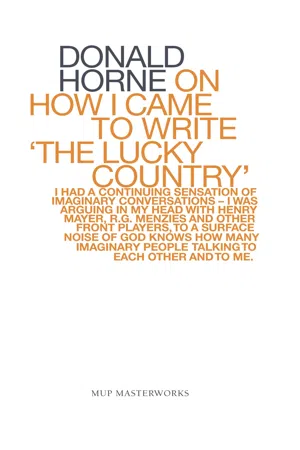
On How I Came To Write 'the Lucky Country'
Information
A New Sense of the Possible

Starting an Intellectual Magazine
Also below me on the first floor, along with the Suburban Newspapers outfit, was the one-room office of The Observer, with three hard chairs, two small desks and a typewriter shared by the staff of two—both of them later to be transformed, by the magic of politics, into Liberal Party minor notables.
One of them, Peter Coleman, had never been a journalist and had not intended to be one; by then an ex-Andersonian like me,3 he was doing a PhD in Canberra when, having just met him, I offered him a job, offhand, which he almost lost a few weeks later when I was away on holiday just before The Observer was launched and Clyde Packer initiated, or joined, a move to replace me as editor: alone and stunned, Coleman was left in an office awash with rumours; whenever he approached Clyde, Clyde would fall contemplatively silent. He hadn’t recovered when production began and, as an industrious apprentice, he then experienced the particular pain of being put in a corner with a story that nobody else was interested in and told to rewrite it, rewrite it again, rewrite it again so that all of its faults were eliminated and what remained was scarcely worth reading. He became a journalist in six weeks. As an ex-Andersonian, he had a world view somewhat like mine, he knew a fair bit and he knew how to find out almost anything else, he quickly learned the skills of writing stories in a clear, graceful succinct style. At times he fell into a kind of inattentive and capricious mood that was likely to produce useful novelties; the very sketchiness of his mind could be an asset and The Observer quickly moved into the centre of his public existence.
The other, Michael Baume (who had joined us from The Sydney Morning Herald), had found something beyond his training in economics from a political science lecturer who had been influenced by a political philosophy lecturer who had been influenced by John Anderson. It was useful that he went to concerts and the opera and ballet (and that Coleman went to plays): between us we would be able to do everything. Baume had left the Labor Party after belonging to it briefly but was still to the left of me, as, in another kind of way, perhaps, was Peter Coleman. Baume was not as pure Observer as Coleman, but he was busy, useful and genial.
However, for me, the most important thing Michael Baume did while he was with The Observer was to throw a party in his apartment in a terrace house in Kings Cross—bottles and food on a table, help yourself. It was at this party for friends old, mainly from The Sydney Morning Herald, and friends new, from The Observer and Weekend, that I met a young woman journalist, brown-haired, hazel-eyed, only just back from covering one of the complex ‘Royal tours’ of the day and a friend of Michael’s from university days, Myfanwy Gollan (at twenty-four, twelve years younger than me), with whom I talked for most of the party until we went off to have a cup of coffee and do some more talking, quickly developing a common line in things to laugh about.
As we had left for the coffee shop Pat Burgess, the assistant editor of Weekend, had called out, ‘Don’t give her a job; we’ve got too many reporters already’. Instead of a job, about a week later I offered myself in marriage—over dinner at the Chelsea, a Kings Cross restaurant vaguely reminiscent in its decor of the Café Royal in London. To save money I moved from an expensive flat at Kirribilli to a cheap ‘bachelor flat’ at the Cross—so ‘bachelor’ that in shopping on the morning of our first dinner party we began with buying not the foodstuffs, but the knives and forks and plates and the pots and pans; but although divorce from my first wife (in England) was in trail, it was trailing slowly and it was almost another two years before Myfanwy and I were married and set ourselves up in a rented apartment in Double Bay that we covered wall-to-wall with our new carpet and room-by-room with our new furniture, most of which we were still paying off. So you must imagine that my principal interest when I wasn’t in the office, and sometimes when I was, was Myfanwy, and, in the background, an enormous amount of talking over tables in Italian, Polish, Chinese and French restaurants along with the negotiation of a common circle of friends, flat-hunting, buying furniture—in general, contemplating a lifetime together.
By the time of the Anglican Press episode The Observer was already in its third year. As editor of Weekend I had got used to the moment of judgment that came each Friday afternoon as I sat there alone with carbon copies of the sales reports telling me if, that week, I was a failure or a success. How would I measure The Observer? In a memo I had written that there were ‘new kinds of educated Australians in the universities, the public service, and in all kinds of niches in private firms’, so perhaps, ‘like the journals of the eighteenth-century’, The Observer could attach itself to ‘a rising class who didn’t really know what they thought, who they were, or where they were going’. The word ‘meritocracy’ was coined the year The Observer came out. Were we about to make one of the few organised public links in Australian intellectual life with an expanding ‘educated class’?
How many of them were there going to be? At the beginning, Friday afternoon sales readings were good: they went up from 6500 in February 1958 to 8664 in May. By May we noted in ‘Observer’s Diary’ that some of the dailies were flattering us by imitation—by redoing some of our stories, even keeping the headings. In June, when sales reached 9114, we received another tribute of success: the Sydney University student paper, Honi Soit, produced a satirical insert, The Absurder, which took us off with superb exactitude. What could be better than to be accurately parodied after only five months’ existence? One answer might be that it would be better to gain more readers, but a couple of issues after we put up the price from l/- to 1/6 sales began to go down. They never came back up. By our third year we were still becalmed somewhere in the 7000s—giving us perhaps 20 000 or so readers we hadn’t met. But even if we were becalmed in sales, and even if some of our stuff wasn’t as good as we wanted it, we had been successful in our general adventure: we had brought out a journal of a kind that hadn’t been there before.
Unexpectedly, it was with a casual crew most of whom I hadn’t known. The Observer was being filled by people who saw it as a place where (so long as they didn’t use hard words) they could write articles for an audience bigger than anything offered by the ‘little magazines’, although of a kind that wouldn’t have been published in The Sydney Morning Herald or The Age. They were ‘discovering’ us—and, once they had somewhere to write, also ‘discovering’ themselves.
If this were a movie, I could cut in three significant flashbacks:
In the first of them, a slim, twenty-year-old student stands in front of my desk, both fidgety and genial, and glows confidently in his bow tie. Can I give him work doing illustrations? Yes … A guinea for little sketches to put into the text of articles to break them up. Five guineas for cover drawings. (Articles with illustrations would be paid for under two headings to make the total seem less: otherwise Packer would slash the contributor’s claim.) When the New York City Ballet and then the Royal Ballet come to town he interviews them and he draws them; he proves himself so able to handle anything that after I sack the Sydney art critic for reviewing an exhibition he hadn’t been to, I ask Robert Hughes if he can do the art reviews as well. Art reviews? He can do anything. Hughes begins, in the twelfth issue, with a review of the Hiroshima panels and at once shows that special knack for interesting an intelligent ‘general reader’ that he will take with him into his international career. He stays with us for more than a year—intense, intelligent, cooperative, restless, quick-talking but good-humoured—then, one week he doesn’t come in. He has moved to another publication.
The second flashback begins when a chap about my age walks around the room, presenting himself with genial diffidence as if he were thinking about something else; he tells us of astounding adventures in Fleet Street and then how for three years he wrote a column on the Press in the New Statesman, under the pseudonym of ‘Autolycus’, named after the pickpocket in The Winter’s Tale. Robert Raymond’s critiques of Australian newspapers begin in our seventh issue—and disappear in the eleventh when Sir John Williams, the head of the Melbourne Herald chain, seizes up with fury when he reads in The Observer that the Brisbane Courier-Mail and Telegraph, ‘issued from the same dreary cellar’, make up the ‘most unreadable pair of newspapers’ in the experience of Autolycus. Williams, who is in London, rings Packer, who is in New York, and, in his rage, accuses Packer himself of prompting this unbrotherly assault. Packer rings Sydney, where, when ‘the Boss’ is out of town, a daily line of courtiers stands, at a determined time, by his telephone, waiting to be told what to do next: Autolycus is executed in one of these phone conversations, somewhere up there in the electromagnetic spectrum. But Bob Raymond continues to write other pieces for us—until he goes on to invent Four Corners for the ABC.4
The last flashback opens when I meet Henry Mayer at a friend’s house. He seems taken over by malevolent rage. However, the malevolence comes because, as an LP plays on, he is improvising a running translation of the main numbers in The Threepenny Opera and the rage because he can’t keep up with the LP. I don’t see him again until he explodes crankily into our third issue with a defence of minority interests: ‘The obvious fact is that society is nothing but a collection of pressure groups. In a totalitarian state the pressure groups are proscribed … In a democracy they are listed in the pink pages of the telephone directory’. After that, as if it were a compulsory spiritual exercise, he writes a book review every fortnight, always with an eye for grabbing the interest of ‘general readers’, even if by sometimes irritating them. Henry hounds us on with cries for new things, some offered in curt telephone calls, others sent on the back of scraps of paper torn off expired manuscripts, always ending Cheers … HENRY. Born into a rich, liberal secular Jewish family in Berlin, educated in Germany, Switzerland and Italy, then exiled to London, and then exiled again, to Australia, on the deportation ship, Dunera, Henry has set himself the task of creating around him an intellectual life he can live with: he is drafting the first serious book on the Press to be written in Australia, he is trying to make the study of Australian politics interesting for first-year University students, he is producing the Association of Political Science’s journal as a thoroughly unacademic publication. At our Observer parties and dinners Henry shouts down everyone (genially, but his glasses seem to glint malevolently) and then he instructs us in wisdom. He professes to believe in nothing, but his actions are more generous than his words. They testify to one of the most hopeful faiths possible to human beings—a belief in the necessity for continuing the discussion.
Seeking ‘voices’ from other states was slapdash. We didn’t have much connection with the intellectual-cultural-academic coteries of other states, nor even know many people from other states. But then we didn’t have much connection with the coteries of Sydney either. We were creating our own ad hoc coterie, however small and flimsy. (As it turned out, readership of The Observer was as strong in Melbourne as it was in Sydney. Its appeal, such as it was, was probably to Australian intellectuals generally, most of whom didn’t belong to any local group.) Almost everything done about foreign affairs—one of The Observer’s strongest cards—came from blow-ins, often with a home-grown, pot-luck flavour because it was mainly chance that decided which countries got in. The Canberra economist Heinz Arndt was in India, so we ran a series on India; Hugh Atkinson had written The Pink and the Brown, a novel set in India, so we also had some India from him. The Sydney political scientist Joan Rydon was in South Africa, so we covered the treason trials. For a while Iraq (which we spelt ‘Irak’) came into consideration because Peter Coleman knew a couple of Australians there; another friend visited Turkey, so he did the latest army coup. As with foreign affairs, so in the arts: if we detected someone who ‘can write’, then that was a field that mattered to The Observer. Dick Hughes, the jazz pianist, took us up for a while so we had blues and jazz reviews every issue. Alan Brissenden began writing on ballet so we had ballet even when there wasn’t any. I met Tibor Meray, a Hungarian emigré, when he was touring a convincing anti-Soviet turn in Australia—so when he was back in Paris he wrote on what was doing in Paris. One of the best pieces we ran in the arts section was a double-page article, WHY ARE AUSTRALIAN FILMS SO BAD? … ‘Ideas are what our films lack’, it said. ‘… There is no feeling for our way of life … In 60 years no important Australian film producer has ever honestly tackled a worthwhile theme.’ It was by Bruce Beresford, a twenty-year-old Sydney University student, who had also ‘discovered’ us for his own purposes.
As you might have expected from an intelligently conservative journal, we lived, partly, on a certain openness to change—of which some of the best random specimens were drawn by pen in black ink when Les Tanner joined us. Tanner sketched an urban Australia of back-garden patio philosophers and espresso-bar pundits in a way that was unmatched (although the Hungarian cartoonist George Molnar had, earlier, presented his urban Australia); he had a special line in the mild follies of Australian ‘progressives’, and, by putting himself among them, treated them with a wry tenderness. Peter Hastings, a gossipy and witty friend of mine—who had once stolen a posting to New York that was supposed to have been mine—offset the tediums of being an executive on the Sunday Telegraph by doing us parodies, prose sketches and sprightly interviews that even when they were with King Peter of Yugoslavia or Danny Kaye also told something about Australia. When Myfanwy left the Herald (they might have asked her to go anyway, because they didn’t usually keep on married women) she began a column, ‘For the Consumer’, thereby becoming The Observer’s only regular woman contributor, in which she recorded changes in ordinary life in Australia. The ‘ideas conference’ system also produced a continuing run of quirky series—of which my favourite was HOW THEY EARN THEIR LIVING, where the examples ranged from priests to gangsters; Peter Coleman wanted to put in things from all over the place, to give people something new to talk about and perhaps also to relieve his boredom.5
An early surprise was that The Observer became one of the first, if modest, articulators of what later became known as ‘multiculturalism’ (a word then unborn). This came to us from one of the blow-ins, Desmond O’Grady, a jobless Catholic intellectual whom, on a friend’s recommendation, I put on the staff of Weekend, a part of his fate to which he became patiently resigned while he waited for something better: in an article he wrote for The Observer, ‘THE PROBLEMS OF THE AUSTRALIAN ITALIANS’, O’Grady, who was married to an Italian immigrant, said: ‘Once here, the Italian does not think of assimilating. It would be a pity if he did. Society has been diversified and we can be enriched by this contact with another culture’. You didn’t find that kind of thing in the daily papers. Without having thought about it before, we saw the ‘New Australian’ minorities as an actuality and even sought articles from them, written in their own terms—as ‘Greek Australians’, ‘Hungarian Australians’, ‘Czech Australians’, ‘German Australians’, ‘Yugoslav Australians’. (On Aborigines we were no better than the times allowed. In a cover story, ‘MAKING BLACK WHITE’, however, Peter Coleman began: ‘Despite official claims, our policy towards the Aborigines has in one fundamental respect never changed. Once the idea was to kill them off; then the more humane program was to let them die out peacefully; now the policy is to assimilate them. But as far as the Aborigines are themselves concerned, the result in each case is the same … extinction’.)
The word ‘ethnic’ had also not come into use, but we may have been the first to raise the possibility that Catholics were part of the normal Australian experience—a realisation that was, in a broad sense of the word ‘ethnic’, to become by far the most significant ‘ethnic’ shift of the 1960s. For decades the Catholic Church had been vacuum-packed and hermetically sealed but there were now some breakouts into general intellectual life from what was spoken of as ‘the Catholic ghetto’ and because there was nowhere else to go, some of these Catholics came to the pages of The Observer. Between them, they had five different periodicals, but in these they spoke to themselves; in speaking to each other they wrote articles and letters in The Observer. We welcomed ‘the new breed of Catholic intellectuals’ as providing ‘an important cultural, literary and political dissent that invigorates Australian intellectual life … They bring to discussion what can be described as the European tradition’. (That was one up on intellectuals in an Aust...
Table of contents
- Cover
- Title
- Copyright
- About this book
- Contents
- Fun and Brilliant Improvisation
- A New Sense of the Possible
- Knocking Down a National Edifice
- Recovery Program
- A Talent for Enthusiasm
- The Lucky Country
- Notes
Trusted by 375,005 students
Access to over 1.5 million titles for a fair monthly price.
Study more efficiently using our study tools.
Frequently asked questions
Yes, you can cancel anytime from the Subscription tab in your account settings on the Perlego website. Your subscription will stay active until the end of your current billing period. Learn how to cancel your subscription
No, books cannot be downloaded as external files, such as PDFs, for use outside of Perlego. However, you can download books within the Perlego app for offline reading on mobile or tablet. Learn how to download books offline
Perlego offers two plans: Essential and Complete
- Essential is ideal for learners and professionals who enjoy exploring a wide range of subjects. Access the Essential Library with 800,000+ trusted titles and best-sellers across business, personal growth, and the humanities. Includes unlimited reading time and Standard Read Aloud voice.
- Complete: Perfect for advanced learners and researchers needing full, unrestricted access. Unlock 1.5M+ books across hundreds of subjects, including academic and specialized titles. The Complete Plan also includes advanced features like Premium Read Aloud and Research Assistant.
We are an online textbook subscription service, where you can get access to an entire online library for less than the price of a single book per month. With over 1.5 million books across 990+ topics, we’ve got you covered! Learn about our mission
Look out for the read-aloud symbol on your next book to see if you can listen to it. The read-aloud tool reads text aloud for you, highlighting the text as it is being read. You can pause it, speed it up and slow it down. Learn more about Read Aloud
Yes! You can use the Perlego app on both iOS and Android devices to read anytime, anywhere — even offline. Perfect for commutes or when you’re on the go.
Please note we cannot support devices running on iOS 13 and Android 7 or earlier. Learn more about using the app
Please note we cannot support devices running on iOS 13 and Android 7 or earlier. Learn more about using the app
Yes, you can access On How I Came To Write 'the Lucky Country' by Donald Horne in PDF and/or ePUB format, as well as other popular books in History & World History. We have over 1.5 million books available in our catalogue for you to explore.