- English
- ePUB (mobile friendly)
- Available on iOS & Android
eBook - ePub
About this book
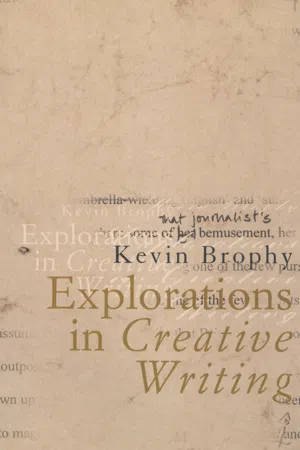
This set of reflective essays about the writing life examines the poetics and politics of reading as a writer, teaching and learning about writing in an academic or informal setting, and pacing oneself through writing projects. Academic investigations about the medieval concept of the writer and the novelization of the poem accompany more practical discussions about keeping a writer's sketchbook and conducting research. The growth of creative writing programs and the particular role of the artist in Australian society is explored.
Trusted by 375,005 students
Access to over 1 million titles for a fair monthly price.
Study more efficiently using our study tools.
Information

Looking at Sophie
More than halfway through my life, I have become a parent. Perhaps like many who come to this experience relatively late, I have been overwhelmed by the intensity, the joy, the worries and the intimacy of this life as a parent. When Sophie was born her mother and I began writing in a journal. We wrote of those daily details involved in caring for a baby, learning how to be a parent and getting to know a new human being. We thought of the journal as a record we could give to Sophie in the future, perhaps when she became a parent herself. At first we wrote in it every day, but after a decade we wrote in it about once a week, sometimes once a month. Nevertheless there are now ten of these journals packed with details of Sophie’s life and her younger brother Raph’s life.
Asked if I would write an essay about being the father of Sophie for a book on fathers and daughters, I knew that with the journals a lot of the note-taking had already been done. I was pleased to have the opportunity to go back over the journal entries and relive parts of those past years.
The essay, though, did not emerge from the journals in a simple way. I was aware, first of all, that I wanted to write about being the father of a daughter, not simply the parent of a child. And I wanted to write about being a father who is a writer. This presented me with particular challenges. What elements of my experience have been specific to a father of a daughter? I have tried at every step to pull the essay back to this question. A second consideration is connected with the problem of being a parent and a writer: how do I select what I will tell? What experiences are mine to tell, and what telling would break confidences or intrude too far on others’ privacy? As I put the essay together I showed drafts to a number of friends, and one asked me how I thought Sophie might react when she came to read this later in her life. My response was that if I wrote to protect Sophie, or myself, then what I wrote would not rise above platitudes and evasions. There is love and joy in being the father of a daughter, but even love and joy can be strange birds. And love and joy are not all there is to it. I feel perplexed and exposed by some of what I wrote here, but I trust that readers will take some care with the father and the writer they find. I am still not sure if I have said too much or too little in what follows.
■ ■ ■
Sometimes I have dreams that complete unfinished incidents from the previous day’s experiences. These tidying-up dreams treat my waking life as if it is only ever a half-drawn picture or a half-told story. When Andrea was pregnant with Sophie I had one of these dreams after we viewed an image of our child on the screen of an ultrasound machine. The doctor could not tell us if the image of the swimming foetus was male or female because the position of the legs prevented close enough examination. This did not matter. It was, in a way, a relief not to know. The doctor did show us the heart beating in the chest, the oversized head and the arms. Then he counted the fingers on one hand of the image on the screen. There were five fingers. He said that the baby was normal. In the presence of all that humming technology I was surprised at his primitive act of counting fingers. But we accepted his verdict on our child’s normality and thanked him for the black and white photograph of our child as a fuzzy shape floating in a darkened, swirling universe.
That night I dreamed I was watching my child on the ultrasound screen again and I counted the toes this time because I was aware that the doctor had only counted the fingers. To my relief there were five toes on each foot as well.
Another of these completion dreams was connected with a book I had bought for Sophie when she was five years old. As parents who were both teachers we had discussed the fact that though we read books every day with Sophie almost all of them were books of fiction. She should be learning more about science or history, we thought—she should know more facts. Andrea mentioned a book she had seen in the bookshop at the museum. It was a book about the human body—full of facts, many of them illustrated. Sophie had shown some interest in learning about the biological drama going on underneath her skin.
I don’t really know if it was true that she showed such an interest. She went along with us when we talked about biology, and she looked at pictures we showed her. Perhaps as an an adult she will remember that we were the ones interested in biology.
I was passing the museum soon after our discussion and stopped and bought the book called The Body and How It Works. At home that afternoon I sat with Sophie looking at the finely coloured and highly detailed illustrations of a skeleton, a brain, a heart, stomach and bowels, blood vessels purple and red, the nervous system.
We found an illustration of the beginning of life. On the page floated a large sphere with a yellow yolk-like centre and around this sphere were tiny tadpole-like sperm. One of the sperm was pictured wriggling close to the enormous yellow yolk at the centre of the female egg. The following illustrations showed the division of the cells and the growth of the foetus until finally there was a baby pushing its way out of the mother, face wrinkled, hands bunched and legs bent for kicking.
Beginnings, like endings, must abide by a certain logic. When we looked at the illustration I was thrown by the moment the book chose as the beginning of life. I said something like, ‘Here is the egg from the mother, and here are the sperm from the father’. Sophie accepted this as an arbitrary enough beginning point and we got on with it.
In the dream I had that night I supplied the beginning the book had avoided. Sophie watched Andrea and me having sexual intercourse. She watched with the same mild interest she had shown towards the book about the body. She seemed slightly amused, and she made a face, indicating that what she was witnessing was yucky—a bit like fingerpainting with snot.
My anxieties over finding satisfactory beginnings and endings are the preoccupations of a fiction writer and poet. But they are also part of my reaction to being a parent—and what parent is not a teacher as well?
I had thought that being a parent would require no more than remembering what it was like to be a child: if I could be truly sympathetic to my child’s experience I would know what to do in any circumstance. But of course it’s not like that. It soon became clear that I had grown another life. I found myself in the place of a parent—with a responsibility, a threat of failure and an emotional involvement I had not imagined beforehand. This other me had to be invented on the spot or find himself repeating those diatribes and clichés from his own parents. It was like waking as a character in someone else’s book. No wonder I rewrote beginnings and endings in my dreams.
■ ■ ■
I cannot write about Sophie without writing about her arrival, which was another beginning. She was three days overdue when Andrea took castor oil on her doctor’s suggestion, and her waters broke. At the Women’s Hospital we were told to go out walking and eat a spicy meal. We bought a bottle of Drambuie for later celebrations, some bunches of daffodils, stocks and fresias, and we ate vegetarian at a restaurant near the hospital with Andrea standing up most of the time because of the pain from contractions and the water still leaking from her. But nothing much happened for another half a day. When five days overdue she was induced with a drip. Wires were attached to the baby’s head. The wires trailed out of Andrea and were attached to her leg and then to a machine that displayed the baby’s heartbeat: between 120 and 150 beats a minute. Another monitor was attached to Andrea’s middle to measure the strength of contractions. A glucose drip and a sentosin drip were attached to the back of her hand. She looked small and vulnerable. She was given a pethedine injection but nothing much changed. The contractions were not building up. My tasks were to change her bedpans, give her sips of water, supply her with butterscotch and keep a record of the intervals between contractions. I was probably mostly in the way but I needed to keep busy to stop panicking.
We were told that Andrea could not have another pethedine injection because it would depress the baby. This was the first time we had been told that pethedine affected the baby. I noticed that already the baby’s heartbeat was consistently lower. Andrea decided to have an epidural injection. The anaesthetist arrived in sloppy green overalls, a paper hat, crooked glasses, five o’clock shadow and with a tray on wheels. The epidural drug was fed into Andrea’s spine through a slow release mechanism so she had yet another attachment trailing from her body. When the epidural drug was injected the baby’s heartbeat went down to below 80 beats per minute for about five minutes. Doctor, anaesthetist and midwife stood watching the monitor in silence. The sentosin drip was stopped to bring a halt to the contractions. Andrea was given oxygen through a mask. The doctor asked the anaesthetist if the operating theatre was ready for an emergency caesarian.
The baby’s heartbeat gradually recovered, the drip was resumed and the midwife went back to giving instructions to Andrea on how she should push, where her legs should be, how she should breathe. After another hour of screaming and pushing the head showed and the doctor took a large pair of scissors and cut Andrea. The head came out as Andrea made her last and most magnificent scream. The head was purple, with eyes closed. It looked large and rubbery. The doctor put her hand round the baby’s neck and unhooked the cord. She took the head in both hands, turned it, tugged, tugged again. She tugged until the neck stretched. I was afraid she would pull the head off the neck. Finally one shoulder came out, white, then with another pull the whole body slid out and landed on its back between Andrea’s legs. It didn’t move. It was dark purple. I could see we had a daughter, but the doctor and midwife were still calling her ‘he’. I wondered if she was alive. The midwife lifted her and the baby gave a short cry. ‘He’s a girl!’ the midwife announced and I burst into tears and reached for the camera. The midwife said I should wait until she had cleaned the baby before I took photographs. She too was anxious about proper beginnings.
■ ■ ■
To have a daughter. What did this mean? Of course it meant at once another beginning—a chance to rewrite the history of personal, family and gender politics. Is the parent always like the witch in Hansel and Gretel’s story—caging or pushing children into that oven where they will be remade into all that is desired, all that is correct? We spend so much time feeding them—food, stories, information, lies, speeches, values, history, prejudices. Andrea and I thought we would give her a name that was not gender specific, a name that was strong and would have enough variations to give her choices. Though we had joked she was Sophie Brophy before she was born, we decided to call her Josephine. Then she could be Jo, Josie or even Joe if she wanted. I rang the newspapers and dictated the birth announcement with her name as Josephine Jane Lloyd. An hour later we decided to call her Sophie so I rang the newspapers back and changed the announcements. Even in the naming of the child we could not be sure how much control we had, what our motives were, why one name should come before another.
At the time I thought it would be a relatively simple matter to play ball games with Sophie, take her to the football, give her confidence in climbing and running, and generally save her from the restrictions sometimes imposed on girls. We did go to the football together. Carlton’s football ground is a short walk from our home in Brunswick. But by the time she was three she made it clear she did not want to keep going to the football because she could not see any women out there playing. Sophie also made it clear to us at the age of eighteen months after only a few days at creche that her favourite colour was pink and all things feminine would be explored thoroughly. Dolls, cheap jewellery, dress-ups, fairy wings, make-up, treasure-boxes and beads galore littered her room. I was a bystander to this world and I saw that in it she had found a freedom and a confidence I had not considered possible. I am that clumsy figure of a witch at the oven door who is pushed into his own trap while the children get on with their adventures.
When we tried to correct some of what we thought was bad-mannered talk, we put it to her that we might disapprove of what she says, but we still love her. She pointed out that what she said and what she was were the same thing. When she was upset at something someone said to her at school I reminded her of the rhyme, ‘Sticks and stones’ and she told me that her version of the rhyme was ‘Sticks and stones can break my bones but worms can never hurt me’, because words could h...
Table of contents
- Explorations in Creative Writing
- Contents
- Acknowledgements
- Introduction
- PART ONE: Reading writing
- PART TWO: Making writing
- PART THREE: Talking writing
- Works Cited
- Index
Frequently asked questions
Yes, you can cancel anytime from the Subscription tab in your account settings on the Perlego website. Your subscription will stay active until the end of your current billing period. Learn how to cancel your subscription
No, books cannot be downloaded as external files, such as PDFs, for use outside of Perlego. However, you can download books within the Perlego app for offline reading on mobile or tablet. Learn how to download books offline
Perlego offers two plans: Essential and Complete
- Essential is ideal for learners and professionals who enjoy exploring a wide range of subjects. Access the Essential Library with 800,000+ trusted titles and best-sellers across business, personal growth, and the humanities. Includes unlimited reading time and Standard Read Aloud voice.
- Complete: Perfect for advanced learners and researchers needing full, unrestricted access. Unlock 1.4M+ books across hundreds of subjects, including academic and specialized titles. The Complete Plan also includes advanced features like Premium Read Aloud and Research Assistant.
We are an online textbook subscription service, where you can get access to an entire online library for less than the price of a single book per month. With over 1 million books across 990+ topics, we’ve got you covered! Learn about our mission
Look out for the read-aloud symbol on your next book to see if you can listen to it. The read-aloud tool reads text aloud for you, highlighting the text as it is being read. You can pause it, speed it up and slow it down. Learn more about Read Aloud
Yes! You can use the Perlego app on both iOS and Android devices to read anytime, anywhere — even offline. Perfect for commutes or when you’re on the go.
Please note we cannot support devices running on iOS 13 and Android 7 or earlier. Learn more about using the app
Please note we cannot support devices running on iOS 13 and Android 7 or earlier. Learn more about using the app
Yes, you can access Explorations In Creative Writing by Brophy, Kevin in PDF and/or ePUB format, as well as other popular books in Literature & Literary Criticism. We have over one million books available in our catalogue for you to explore.