- English
- ePUB (mobile friendly)
- Available on iOS & Android
eBook - ePub
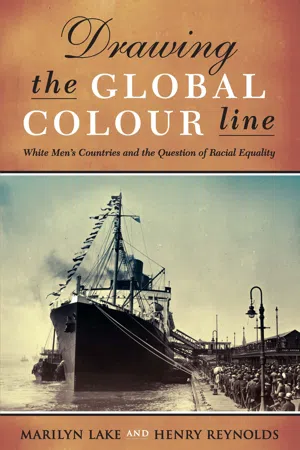
Drawing The Global Colour Line
Information
Part 1
Modern mobilities
1 The coming man: Chinese migration to the goldfields
Lowe Kong Meng arrives in Melbourne to find prosperity and prejudice
In 1853, Lowe Kong Meng, a young Chinese merchant and master of his own ship, arrived in the port of Melbourne, in the British colony of Victoria, carrying cargo from Mauritius. Gold had been discovered in the colony just two years earlier and the rush to be rich had begun. Immigrants poured in from around the world. The area around Melbourne was the traditional country of the Kulin people, but British settlers arriving across Bass Strait in 1835, proceeded, on the basis of a dubious treaty with the traditional owners, to occupy the land along the Yarra River and the rich pastoral country that lay beyond.
Within a couple of decades, local Indigenous communities were overwhelmed by the disease, dispossession and violence that accompanied colonial settlement. Survivors living near Melbourne were forced to reside on the swampland on the outskirts of the bustling new city. The logic of settler colonialism invariably meant displacement, if not extermination, of Indigenous peoples.1 British colonists assumed a right of entitlement secured by the imperial relations of racial domination.
Melbourne residents had celebrated their separation from New South Wales with the passage of the Australian Colonies Government Act in 1850; with extensive rolling pastures and fertile agricultural land the colony’s future looked assured. Then the discovery of vast new mineral wealth attracted hundreds of thousands of fortune-seekers, including merchants and traders, like Lowe Kong Meng, who were keen to provide goods and services to the rapidly expanding market. In just three years, between 1850 and 1853, the Victorian population quadrupled, shipping increased sevenfold and the value of imports twentyfold.2
The United States joined Great Britain as a major source of imports and immigrants. In the year Lowe Kong Meng sailed into the port of Melbourne, 143 American ships anchored in Hobson’s Bay and 40 per cent of imports came from the United States. American merchants, including George Francis Train, formerly a Boston shipping agent, helped revive the ailing Chamber of Commerce. Melbourne, he declared, ‘though situated so far out of the way, cannot fail to be a great city’.3
Lowe Kong Meng also saw great commercial opportunities in this southern outpost, and for Chinese merchants, Australia was not so far out of the way. Though only twenty two years of age, Lowe Kong Meng was already a successful businessman, trading between Mauritius and Calcutta (Kolkata) in the Indian Ocean and Singapore and Canton (Guangzhou) in the South China Sea. After a brief tour of inspection of the goldfields, he departed for India, returning the following year with fresh merchandise, with which he set up shop. Kong Meng & Co. sold tea and other provisions from a building in Little Bourke Street, in the heart of Melbourne’s Chinatown. Like several thousand other Chinese who arrived in the Australian colonies that year, Lowe Kong Meng came and went freely; no-one asked for papers or passport or proof of naturalisation.
Born in the Straits Settlements to Lowe A Quee, a merchant, and his wife, Chew Tay, Lowe Kong Meng was a British subject whose forbears, like the majority of Chinese who would seek gold in Victoria, came from the Sze Yap district near the port of Canton, long a centre of Arab, Malay, Siamese and European shipping and trade. Educated in Penang and Mauritius, Lowe Kong Meng was well read in world literature and could speak English and French fluently. A loyal son of the Sze Yap district, he was also a man of the world and an exponent of what he would call ‘cosmopolitan friendship and sympathy’.4 His sympathies only stretched so far, however. Family legend had it that on one occasion, when accosted on the goldfields by a ruffian, who addressed him in pidgin, he explained that he would be very pleased to converse in French, Chinese or English, but that he did not understand his assailant’s peculiar lingo.5
Many languages, dialects and accents could be heard among the ‘colourful medley of polyglot nationalities’ that mingled on the Victorian goldfields in the 1850s.6 Hundreds of thousands of people arrived from all over the world. By the end of the decade, the population of the colony had increased fivefold. Most newcomers sailed from Europe, the majority from Britain and Ireland, but there were also large numbers of Germans at the diggings and smaller groups of French and Italians, including Carboni Raffaello, whose book, The Eureka Stockade, provided one of the most lively accounts of goldfields politics.7 The Swiss miners concentrated at Daylesford, while Scandinavians supported their own club and newspaper at Ballarat. Several thousand goldseekers also crossed the Pacific from California, where gold had been discovered in 1849. Many Australian prospectors lured to the Californian goldfields now returned. These were mobile, multicultural and largely masculine communities.
The Victorian goldfields, like those on the west coast of the United States, New South Wales and, later, Queensland, also attracted thousands of Chinese fortune-seekers keen to share in the bonanza. By 1852, according to the United States census, there were 25,000 Chinese miners in California, and, as in the case of Victoria, nearly all came from Guangdong Province.8 During 1852 and 1853, a few hundred arrived in Victoria, then the number quickly increased, with around 10,000 Chinese landing in Melbourne in 1854. Most of those who left Canton for Victoria in the early 1850s were farmers and traders, mostly literate and with some money of their own.9 Others made use of the so-called credit-ticket system whereby Chinese bankers and merchants lent money for fares that had to be repaid. The ‘Gold Mountain’ of California and the ‘New Gold Mountain’ of Australia promised sudden fortunes.
Victoria looks to California, but leads the way in immigration restriction
In both Victoria and California there had been protests in the late 1840s against the attempted landing of convicts, a presumed source of moral contamination. The sudden arrival of large numbers of Chinese prompted discussions of a different kind of threat, the danger posed by aliens or foreigners. A tax on alien miners was introduced by the Californian legislature in 1850, disallowed the following year, and introduced again in 1852, the same year in which a landing tax was introduced, payable by the ship’s master for each alien passenger.10
American miners also took direct action against the Chinese, forming numerous vigilante committees to drive the alien race away by force.11 Possessed by ‘a presumptuous spirit of monopoly’, American miners were intent on clearing ‘the entire mining region of Celestials’ as one San Francisco newspaper noted.12 As yields declined, Chinese labourers increasingly congregated in San Francisco, where they found success in the laundry and restaurant business. Anti-Chinese agitation began to centre on complaints of cheap labour, low wages and unfair competition.13 Industrial employment as well as gold were claimed as the exclusive preserve of white men.
Agitation against the Chinese in Australia was frequently inspired by the example of California.14 A significant proportion of the miners on the Victorian fields had come directly from the lawless districts of the Pacific Slope and they often carried their preference for direct action with them. The Americans were better armed than the majority of the diggers and more ready to use their guns to defend their property and interests. In Bendigo, in 1854, where 2,000 Chinese were digging among a group of 15,000 miners, agitators suggested that a mass action take place on American Independence Day: ‘a general and unanimous uprising should take place in the various gullies of Bendigo the 4th July next ensuing, for the purpose of driving the Chinese population off the Bendigo gold-fields’.15 Cooler heads prevailed and the demonstration was postponed, but hostility simmered. In Ballarat, the American propensity for guns was evident in the formation of the Independent Californian Rangers Rifle Brigade, about 200 strong, which was involved in organising military drill prior to the miners’ revolt over licence fees, that culminated in the battle at the Eureka Stockade at the end of 1854.
On the Californian and Victorian goldfields, European miners criticised the Chinese because of their alien customs, clannishness, pagan rituals, lack of women, labour competition and fast increasing numbers.16 Increasingly, their objections were couched in the language of race and colour. In a significant move, in 1854, the Californian government introduced a new tax on alien miners, that in exempting those eligible for naturalisation, effectively classified and targetted the Chinese as non-white.17 (Under the United States law of 1790, naturalisation was restricted to ‘free white persons’.) Invoking the same binary logic of white and not-white, the Californian Supreme Court ruled that Chinese could not give evidence against a white man, because the legislation providing that ‘no Black, or Mulatto person, or Indian, shall be allowed to give evidence’ also applied to the Chinese, being of the same ‘Mongolian type’ as Indians.18 In categorising blacks, Indians and Chinese as not-white, the Californians were also defining themselves, not just as Americans, but as ‘white men’, invoking a sense of self with which miners in the Australian colonies quickly identified.
At the end of 1854, in Victoria, following the Eureka uprising in which several miners and soldiers were killed, the Victorian government appointed a Commission of Enquiry to investigate the turbulent conditions of the goldfields. It emphasised the part played by foreign elements in fomenting the rebellion: ‘The foreigners formed a large...
Table of contents
- Cover
- Title
- Copyright
- Contents
- Acknowledgments
- Introduction
- Part 1 Modern mobilities
- Part 2 Discursive frameworks
- Part 3 Transnational solidarities
- Part 4 Challenge and consolidation
- Part 5 Towards universal human rights
- Index
Trusted by 375,005 students
Access to over 1.5 million titles for a fair monthly price.
Study more efficiently using our study tools.
Frequently asked questions
Yes, you can cancel anytime from the Subscription tab in your account settings on the Perlego website. Your subscription will stay active until the end of your current billing period. Learn how to cancel your subscription
No, books cannot be downloaded as external files, such as PDFs, for use outside of Perlego. However, you can download books within the Perlego app for offline reading on mobile or tablet. Learn how to download books offline
Perlego offers two plans: Essential and Complete
- Essential is ideal for learners and professionals who enjoy exploring a wide range of subjects. Access the Essential Library with 800,000+ trusted titles and best-sellers across business, personal growth, and the humanities. Includes unlimited reading time and Standard Read Aloud voice.
- Complete: Perfect for advanced learners and researchers needing full, unrestricted access. Unlock 1.5M+ books across hundreds of subjects, including academic and specialized titles. The Complete Plan also includes advanced features like Premium Read Aloud and Research Assistant.
We are an online textbook subscription service, where you can get access to an entire online library for less than the price of a single book per month. With over 1.5 million books across 990+ topics, we’ve got you covered! Learn about our mission
Look out for the read-aloud symbol on your next book to see if you can listen to it. The read-aloud tool reads text aloud for you, highlighting the text as it is being read. You can pause it, speed it up and slow it down. Learn more about Read Aloud
Yes! You can use the Perlego app on both iOS and Android devices to read anytime, anywhere — even offline. Perfect for commutes or when you’re on the go.
Please note we cannot support devices running on iOS 13 and Android 7 or earlier. Learn more about using the app
Please note we cannot support devices running on iOS 13 and Android 7 or earlier. Learn more about using the app
Yes, you can access Drawing The Global Colour Line by Henry Reynolds, Marilyn Lake in PDF and/or ePUB format, as well as other popular books in History & World History. We have over 1.5 million books available in our catalogue for you to explore.