eBook - ePub
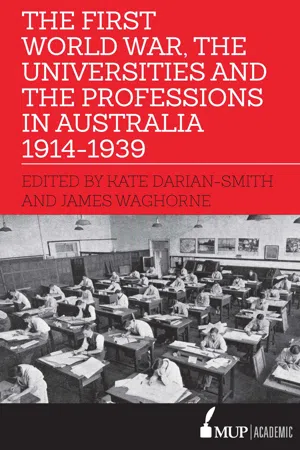
The First World War, the Universities and the Professions in Australia 1914-1939
- English
- ePUB (mobile friendly)
- Available on iOS & Android
eBook - ePub
The First World War, the Universities and the Professions in Australia 1914-1939
Trusted by 375,005 students
Access to over 1.5 million titles for a fair monthly price.
Study more efficiently using our study tools.
Information
Subtopic
Australian & Oceanian HistoryIndex
HistoryCHAPTER 1
The War, the Universities and the Professions
In its first issue after the declaration of World War I, the editor of the Melbourne University Magazine, Donald Clifford Anderson, a third-year medical student, asked the open question ‘what, now, is our position as students?’ In his attempt to answer this question, Anderson argued that students’ duty ultimately lay with ‘King and Empire’, but that they also had responsibilities to their profession and ‘those to whom he [sic] owes his professional training’.1 This discussion reveals the intrinsic connection between Australian universities and the professions that a university education qualified students to enter. It also highlights how university students in the early decades of the twentieth century understood the relationship between their studies and future career, and their wider national and empire responsibilities. For some, World War I was an interruption, and volunteering for military service or other war work meant setting aside one’s profession for the duration of the conflict. The interruption could, of course, be permanent: Anderson enlisted in 1915, was invalided home in 1916 and did not return to university to complete his degree. In other cases, it was possible directly or indirectly to deploy one’s professional skills in Australia’s military and civilian war effort, and gain experience and training that supported subsequent employment in the years of peace.
Professional expertise was mobilised during war in an unprecedented variety of ways. Chemists produced dyes, gas and explosives; physicists developed means of submarine detection and aircraft design; geologists and engineers developed tunnelling techniques and logistics; mechanical engineers oversaw the mass manufacture of munitions; and bacteriologists developed new medical treatments. Doctors, nurses and masseurs sustained soldiers in the trenches, and treated those who were physically and psychologically damaged in the fighting. Public servants, lawyers and translators were employed in the war bureaucracy, while artists and writers found new modes of expression to convey the trauma of battle and its aftermath. Australia’s wartime role as a supplier of primary products to Britain stimulated federally funded research into agriculture, and the universities worked with government to develop national industrial capacity.
The First World War, the Universities and the Professions examines how Australia’s extraordinary contribution to World War I extended well beyond the nation’s military forces to the expertise of its universities and professional associations, and opportunities for training its men and women. In making these links between the war and its impact on the universities and the professions, and in examining the complex links that existed between the universities as educational and research bodies, and the professional associations and industry they served and shaped, it teases out a new history of the war’s impact on Australia’s workforce, economy and society. Many occupational fields were transformed by the rapidity of technological change between the outbreak of hostilities in 1914 through to the interwar decades. Students, graduates and staff of Australia’s universities would play a central role in these changes, as professional groups sought accreditation through university degrees and diplomas, the leadership of research and the application of new knowledge. Some professions continued to rely on apprenticeship and work training, but they were increasingly in the minority.
In 1914, there were six universities in Australia. The largest of these were the oldest, established in Sydney in 1850, Melbourne in 1853 and Adelaide in 1874. There were also newer universities in Tasmania (established 1890), Queensland (established 1909) and Western Australia (established 1911). Overall, the university sector was small, with a total of 4297 students enrolled across all institutions in 1915, and their fees (with the exception of Western Australia, funded by an endowment) and the time required to complete degrees made them institutions for the middle classes.2 In the decades before the war, Australian universities adopted professional degrees, such as medicine, law and engineering, and by 1914 these were well established, particularly at the older institutions.
World War I altered Australian universities in immediate and longer-term ways. In the following decades they doubled in size and the number of sub-professorial staff burgeoned, allowing the teaching of a much-enlarged program of electives within degrees as well as a suite of new diplomas in specialist subjects. As a result, the university student body expanded in the 1920s, perhaps most notably with an increase in the number of women enrolling in some degrees—although women were still a minority on campuses. War had stimulated research within the universities, and their research programs continued to expand, culminating in the introduction in 1935 of federal funding through the Council for Scientific and Industrial Research (established 1926), and the National Health and Medical Research Council from 1936. After the war, the status of university training as the basis of professional qualification was also strengthened.3
As highlighted in the case studies in this book, the impact of the changes wrought by the upheaval of World War I was evident within the sciences, humanities, social sciences, and the creative and applied arts. However, such impacts were varied and uneven, and in many instances the war only halted or accelerated trends in professional and technological practice that were already in train prior to 1914. There is no doubt that the experience of military service, or civilian war work in Australia and overseas, had a profound effect on the personal outlook and careers of thousands of university students and graduates who took part in the war. These stories, whether of individual men and women, or university classes or cohorts, have been collected by the Expert Nation project team. A database has brought the wartime and career records of more than five thousand individuals who returned from the war from the universities of Sydney, Melbourne, Adelaide, Tasmania, Queensland and Western Australia, together with records from the Australian War Memorial, and other personal and biographical details. This compilation of archival materials has been the stimulus for the professional case studies collected in this volume, and provides new insights into the successes and challenges of the reintegration of university-educated Australian veterans into the professional workforce following demobilisation. It combines individual biographical information with broad national coverage. This reveals the way in which developments were felt differently from the perspective of different states, while the aggregate of individual careers provides new insights into professional mobility and forms of qualifications.4
From the nineteenth century, the rise of professional organisations was a feature of Western society, and the expanding political power of the professions accelerated during the twentieth century. Sociologists have defined the emergence of a profession as a sequential process: the identification of a basis of knowledge and expertise, legitimised by universities and other training; the formation of an association; and claims to a monopoly of practice and labour through a regulatory framework.5 This trajectory has been complicated by the observation that different professions claim different forms of knowledge, including that derived from practical work. Moreover, professions are not always homogenous, and may include internal hierarchies and interests, just as different professions may compete within the same sphere of activity, as in the health sciences.6 While the formation of a profession may be in response to society, often it is the agency of professionals themselves, and the militancy of their associations, that has forced social change. Professions shape the knowledge they control, defining needs as well as fulfilling them.7 More recent international scholarship has placed greater emphasis on the place of knowledge and expertise, rather than the instruments of organisation, in studies of the professions.8
In Australia, economic, social and geographical forces have shaped the development of professional groups. From the nineteenth century ideas about ‘professional service’ and the formation of occupational associations were influenced by British connections. Australia’s small and dispersed population led to the establishment of parallel associations in the various state capitals, that only gradually combined into federal bodies. As many chapters in this book make evident, World War I was an important factor in the gradual emergence of national organisations during the interwar decades. The role of government as the principal supporter of professional groups, from health care to music, has influenced the market for knowledge.
Australian historiography has not dealt in great depth with the collective role of the professions and professional knowledge, apart from more sweeping analyses of social stratification, the rise of intellectual movements, and the development of knowledge and research within the university sector.9 The focus has been on the period after World War II, emphasising the massive expansion in the educational system, the power of the federal government and the growth of the national economy.10 We argue that this later expansion has overshadowed the changes in the professions and the rise of expertise that dated back to World War I, and developed in the 1920s and 1930s as national professional organisations formed, and the federal government assumed greater responsibility for the funding of research and the control of knowledge.
Perhaps there is no better example to illustrate how World War I stimulated the professional application of knowledge than that of chemistry. It was the most important of the interwar sciences, essential to research in cognate areas such as medicine, engineering and agricultural science. In the early twentieth century, Australia played a minor role in what has been called an ‘empire of science’. It exported its strongest chemists to work in research institutions and chemical plants overseas, while concentrating on applying knowledge formed overseas in the limited Australian industry.11 Yet chemists were among the most novel participants in World War I, and their work in factories in Britain was celebrated as a distinctive contribution.12 The elevated status of chemistry in the war led to the formation of the Australian Chemists’ Institute in 1917, spurred by Australia’s hosting of the meetings of the Australian and New Zealand Association for the Advancement of Science.13 Champions of scientific research such as Orme Masson, Professor of Chemistry at the University of Melbourne, were instrumental in the formation of the federally funded Advisory Council of Science and Industry in 1916, which evolved into the Council for Scientific and Industrial Research by 1926.
In tracing the shifting role of universities and their graduates through the 1910s to the 1930s, some key themes emerge in The First World War, the Universities and the Professions. These include the growing government validation of research, both in universities as well as state and national bodies, and the development of modern professional associations. There was variance in the ways these groups organised, and claimed the exclusive right to conduct certain practices, from administering medical care, to interpreting and applying the law, to writing for newspapers or performing in an orchestra. Some have strong, organised disciplines with dominant central associations, others were more amorphous groupings, such as professional writers who developed other means of informal organisation.
Across this volume, many authors argue that the experiences of World War I contributed to greater specialisations in traditional professions such as chemistry, engineering or medicine. As a consequence of the war, professional bodies also adopted a national outlook that transcended state boundaries or empire loyalty, and actively protected entry to some occupations based on required standards of practice and academic qualification. The universities worked with professional associations to regulate, standardise and accredit. The field of medicine, to give one example, saw the rise of the specialisations of psychiatry and physiotherapy, and the high status associated with surgery, and this was reflected in the conduct of medical degrees and the registration requirements of the Australian branch of the British Medical Association.
Other chapters also point to the ways that the war stimulated new forms of professional organisation and training—from economics to anthropology to graphic art. Indeed, the 1920s and 1930s saw the maturing of a number of ‘modern’ professions in areas such as librarianship, public health and urban planning. In addition, the technological advances in radio broadcasting, photography and film created new avenues of specialisation for musicians and writers. The interwar period also saw significant changes in the movement of women into professional roles, notably in teaching and nursing; the growth of the public service and state institutions as major employers; and increased international networks of scholarly exchange and training.
The volume begins with a general overview by Hannah Forsyth that analyses census data across the first half of the twentieth century to survey the scale of occupational categories, and provides essential context for the following chapters. The remainder of the book is divided into four sections, examining: the Medical Sciences, including dentists, psychologists, nurses and physiotherapists; Science and Technology, including the hard sciences, engineering, and veterinary and agricultural science; the H...
Table of contents
- Cover
- Title
- Copyright
- Contents
- List of Illustrations
- Acknowledgements
- 1. The War, the Universities and the Professions
- 2. Census Data on Professions, War Service and the Universities 1911–1933
- The Medical Sciences
- Science and Technology
- The Humanities, Social Sciences and Education
- The Arts: Design, Music and Writing
- Contributors
- Index
Frequently asked questions
Yes, you can cancel anytime from the Subscription tab in your account settings on the Perlego website. Your subscription will stay active until the end of your current billing period. Learn how to cancel your subscription
No, books cannot be downloaded as external files, such as PDFs, for use outside of Perlego. However, you can download books within the Perlego app for offline reading on mobile or tablet. Learn how to download books offline
Perlego offers two plans: Essential and Complete
- Essential is ideal for learners and professionals who enjoy exploring a wide range of subjects. Access the Essential Library with 800,000+ trusted titles and best-sellers across business, personal growth, and the humanities. Includes unlimited reading time and Standard Read Aloud voice.
- Complete: Perfect for advanced learners and researchers needing full, unrestricted access. Unlock 1.5M+ books across hundreds of subjects, including academic and specialized titles. The Complete Plan also includes advanced features like Premium Read Aloud and Research Assistant.
We are an online textbook subscription service, where you can get access to an entire online library for less than the price of a single book per month. With over 1.5 million books across 990+ topics, we’ve got you covered! Learn about our mission
Look out for the read-aloud symbol on your next book to see if you can listen to it. The read-aloud tool reads text aloud for you, highlighting the text as it is being read. You can pause it, speed it up and slow it down. Learn more about Read Aloud
Yes! You can use the Perlego app on both iOS and Android devices to read anytime, anywhere — even offline. Perfect for commutes or when you’re on the go.
Please note we cannot support devices running on iOS 13 and Android 7 or earlier. Learn more about using the app
Please note we cannot support devices running on iOS 13 and Android 7 or earlier. Learn more about using the app
Yes, you can access The First World War, the Universities and the Professions in Australia 1914-1939 by Kate Darian-Smith, James Waghorne in PDF and/or ePUB format, as well as other popular books in History & Australian & Oceanian History. We have over 1.5 million books available in our catalogue for you to explore.