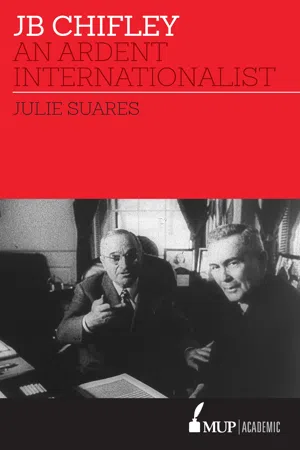
This, combined with his rural background and commitment to the labour movement, played a major role in the development of his internationalist perspective. Often overlooked by historians, Chifley believed that the only way to avoid war and economic depression was through the establishment of international rules-based economic and collective security institutions. These were beliefs he had held since the early 1930s. Chifley was a prime minister with a keen interest in post-war Asia, who understood that the old colonial order was ending. He was a great admirer of the Indian Prime Minister, Jawaharlal Nehru. This book reveals the extraordinary convergence of worldviews of two fellow internationalists, Chifley and Nehru. This convergence can be seen in their views on the need to adjust to a changing post-colonial world; their internationalism; their support for the United Nations; their opposition to Western colonialism; their anti-war attitudes and their animosity towards the American and British Cold War framework through which the post-war world was viewed. Historian Frank Bongiorno wrote about Julie's work on Chifley: '... it is a tremendous achievement to produce such a new vision of a major political figure... it is an important contribution to Australian political, foreign policy and intellectual history'.
- English
- ePUB (mobile friendly)
- Available on iOS & Android
eBook - ePub
About this book
Trusted by 375,005 students
Access to over 1.5 million titles for a fair monthly price.
Study more efficiently using our study tools.
Information
Part I
Origins of Chifley’s Internationalism

AW Stargardt selected and compiled the collection of Chifley’s speeches published as Things Worth Fighting For: Speeches by Joseph Benedict Chifley. Many thanks to Professor Janice Stargardt and to Janice and Wolfgang’s son Professor Nicholas Stargardt for their gift of a photo of AW Stargardt and their kind permission for me to use it in my book on Chifley.
CHAPTER ONE
‘Mr JB Chifley … a great friend of India’
In June 1951, a delegation of Indian journalists visited Australia for the opening of the Australian federal parliament and to report on the Commonwealth jubilee celebrations commemorating the fiftieth anniversary of the federation of Australia. Journalist JN Sahni, president of the Press Association of India, was a member of the delegation.1 His description of this visit provides an intriguing account of an Indian journalist’s perceptions of Australia and former prime minister JB Chifley, whom he interviewed on 13 June 1951.2 After arriving in Darwin behind schedule, inclement weather and thick fog in Sydney forced the delegation to continue their journey to Canberra in a small Australian Holden. Sahni wrote that, travelling through ‘rich undulating country, peppered with small towns, villages and scattered farm houses … thick forests of gum and bush, lent an exotic colour to the landscape’. During this trip to Canberra, Sahni’s exuberant comments on the ‘picturesqueness’ of the countryside met with reserve from his Australian driver, who it turned out was not a native of New South Wales, but a Tasmanian. Sahni noted that ‘state loyalties in Australia die hard’. He added:
You do not have to be in Australia for many hours, or to see many places to realize that it is a rich country, with abundant resources, and has a kindly, affable, prosperous unpretentious people, a little over-conscious of their kinship with the white races, and slightly over-afraid of an Asiatic infiltration.3
The delegation duly arrived in the ‘infant Capital city’, one that Sahni compared to New Delhi in the mid-1920s, existing ‘more in design than in reality’.4 The capital’s major buildings consisted of ‘Parliament House, the Secretariat, two shopping centres, a few hotels and hostels’. From Canberra’s centre, through ‘long open stretches of wild country, dimly lit, but extensive roads … reach out to cottage homes which are springing up rapidly on the periphery of the Capital’. The Indian journalists missed the ‘colourful Jubilee ceremony’, but were in time for the parade. ‘Striped trousers, tail coats, top hats, long flowing dresses indicated the formality of the occasion’, even though they were exposed to ‘drizzling rain’ and ‘wet seats’.
That night there was a banquet with ‘more tail coats, decorations and speeches’. The delegation of Indian journalists, together with the distinguished visitors, parliamentarians, diplomats and journalists, heard eminent Australian politicians ‘trace Australia’s story of coming of age’. Amongst them was former prime minister William Morris ‘Billy’ Hughes, who declared in his speech, ‘The time has come for common people to rule, and to ask vested interests and class-minded people to get out’. Sahni expressed surprise because:
Judging from the formal attire of the guests, the decorative pendants hanging from the collars of some on the main table, and the multiple decorations displayed on the lapels of several others, it almost looked like a body of lords and barons. And yet there was one man, who sat at the end of the main table, wearing a smoky lounge suit, a blue cotton tie, and a simple pastel shirt. He had evidently not had the time to brush back his unruly hair. He smoked the pipe of the common man.5
This was Joseph Benedict Chifley, prime minister of Australia from 1945 to 1949, treasurer from 1941 to 1949, leader of the Australian Labor Party, now Opposition leader and, according to Sahni, ‘the most powerful man in Australia outside the Government’. Next day, late in the afternoon of 13 June, Sahni interviewed Chifley. It was Sahni’s ‘last interview of the day’ and Chifley’s ‘last interview for all time’.6 Over the course of two hours, the wide-ranging conversation explored many subjects, ‘from pipe smoking to Yoga’.7 The journalist described Chifley as having:
an athletic figure, reminiscent of the early rough life he had led. His sharp, small, dark eyes, shadowed by shapely arching brows, emphasised honesty, frankness, a kindly heart, and an observant mind. There was a ruggedness about his cheekbones, which would have made him indistinguishable in any team of workers in overalls. He spoke the workers’ mixture of brogue and cockney, with almost Gladstonian sense of inflexion and emphasis. As I sat there talking to him, smoking our respective pipes, sharing tobacco from a common carton, helpfully offered by my host, I little realized that this man, who combined the toughness of a bricklayer, with the vision and dynamic urge of a great architect of his nation’s destiny, was conveying through me his last message.8
During this interview, Chifley told Sahni that India had ‘a very great leader’ in Jawaharlal Nehru,9 India’s first prime minister and foreign minister after it became an independent nation in 1947 until his death in 1964.10 Nehru, together with Mohandas Karamchand Gandhi, were the leaders of the Indian independence movement in India’s long struggle against Britain.11 Sahni wrote that Chifley insisted on talking about India and repeatedly got up from his desk to study a map of Asia. He was particularly interested in whether Nehru was still convinced that India should remain neutral in the event of war. Sahni replied that despite pressure from the rival power blocs, he thought that Nehru had the courage and tenacity to resist their influence. Chifley urged Nehru to remain neutral—India could do ‘a great service to the world … by showing the way to preserving peace’. He then asked about India’s ‘great leader Gandhi’ and his ‘methods of international co-operation to pacifically meet the challenge of war’; it was a tragedy that ‘so many fine young men should become gun-fodder every five or ten years in every country’. In response, Sahni described the Gandhian creed of non-violent resistance at great length.12
Referring to the Indian-Pacific region, Chifley stated: ‘we on this side of Asia, from Bombay to Sydney, could do a lot for mutual development, and for helping each other in distress’; he urged a rationalisation of the economies of India and Australia on the ‘basis of greater inter-dependence and mutual help’. When asked his opinion of Commonwealth politicians’ attitude towards the Indian–Pakistan conflict over Kashmir, Chifley replied he thought it was ‘damn impertinent of any outsider to try to dictate a solution to India and Pakistan’. The two countries should be left alone to settle the issue themselves. In Chifley’s opinion, if Nehru and Liaquat Ali Khan, Pakistan’s prime minister, were not able to settle this problem, ‘no outsider can’. He then went on to confide in Sahni something that was not generally known in India: the United Nations Security Council had offered him the position of mediator in the dispute between India and Pakistan over Kashmir, before the position was offered to High Court judge, Sir Owen Dixon. Chifley appreciated the confidence shown by the Indian government in ‘two Australians’.13
Chifley also explained to Sahni that he did not care for public functions such as the jubilee ball and would not be attending.14 He mentioned his struggle to ‘preserve his right to smoke his pipe, and to wear the clothes of the common man, even in the presence of royalty, and at all formal occasions’.15 When Sahni said he wanted to discuss Australian affairs, Chifley suggested that the journalist should see more of Australia first, then have lunch with him and discuss his impressions of Australia on his return to Canberra.16 That night, Sahni described the state ball:
Representatives of all nations, delegates from Common-wealth countries, men and women from all sections of Australian society, dressed in almost regal formalism, lent splendour to a fantastically decorated Ball room. The...
Table of contents
- Cover
- Title
- Copyright
- Contents
- Acknowledgements
- PART I: ORIGINS OF CHIFLEY’S INTERNATIONALISM
- PART II: CHIFLEY AND ECONOMIC INTERNATIONALISM
- PART III: CHIFLEY AND AUSTRALIAN FOREIGN POLICY TOWARDS ASIA
- PART IV: CHIFLEY AND THE ESTABLISHMENT OF A NEW COLLECTIVE POLITICAL–STRATEGIC ORDER
- PART V: CONCLUSION
- Bibliography
- Index
Frequently asked questions
Yes, you can cancel anytime from the Subscription tab in your account settings on the Perlego website. Your subscription will stay active until the end of your current billing period. Learn how to cancel your subscription
No, books cannot be downloaded as external files, such as PDFs, for use outside of Perlego. However, you can download books within the Perlego app for offline reading on mobile or tablet. Learn how to download books offline
Perlego offers two plans: Essential and Complete
- Essential is ideal for learners and professionals who enjoy exploring a wide range of subjects. Access the Essential Library with 800,000+ trusted titles and best-sellers across business, personal growth, and the humanities. Includes unlimited reading time and Standard Read Aloud voice.
- Complete: Perfect for advanced learners and researchers needing full, unrestricted access. Unlock 1.5M+ books across hundreds of subjects, including academic and specialized titles. The Complete Plan also includes advanced features like Premium Read Aloud and Research Assistant.
We are an online textbook subscription service, where you can get access to an entire online library for less than the price of a single book per month. With over 1.5 million books across 990+ topics, we’ve got you covered! Learn about our mission
Look out for the read-aloud symbol on your next book to see if you can listen to it. The read-aloud tool reads text aloud for you, highlighting the text as it is being read. You can pause it, speed it up and slow it down. Learn more about Read Aloud
Yes! You can use the Perlego app on both iOS and Android devices to read anytime, anywhere — even offline. Perfect for commutes or when you’re on the go.
Please note we cannot support devices running on iOS 13 and Android 7 or earlier. Learn more about using the app
Please note we cannot support devices running on iOS 13 and Android 7 or earlier. Learn more about using the app
Yes, you can access JB Chifley by Julie Suares in PDF and/or ePUB format, as well as other popular books in History & Australian & Oceanian History. We have over 1.5 million books available in our catalogue for you to explore.