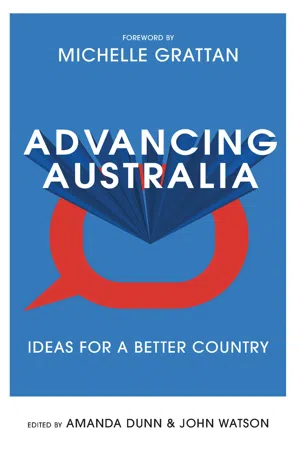
Politics in Australia is in a dire state. The Coalition government is led by its third prime minister in four years, two of whom were toppled by their own party. Before that, the Labor government ousted two prime ministers. Voters' trust in politicians is at an all-time low, there is policy inertia on key issues, and ideology and internal politics too often trump good government. We have the diagnosis, but what's the cure? In this collection of essays, the country's best academic minds look at the key issues and chart a way forward. They examine how Australia's taxation system could be fairer; the priorities in progressing Indigenous Australians' rights; the absurdity of the constant 'left versus right' debate; how to fix private health insurance; and how to settle the conflict between population and migration policies. Here are innovative and bold ideas to advance Australia.
- English
- ePUB (mobile friendly)
- Available on iOS & Android
eBook - ePub
About this book
Information
Subtopic
Global PoliticsCHAPTER ONE
Thinking big: What the major parties should do if they win government (and even if they don’t)
Win or lose the next election, it may be time for the Liberals to rethink their economic narrative
Carol Johnson
In the heady political days of late 2018, former federal treasurer Peter Costello argued that the Liberals need to unite behind a clear economic narrative. He claimed that this would avoid Liberal politicians defining themselves on the ‘social issues’ that have divided the government.
However, the ideological problems in the Liberal government go beyond the evident, and electorally damaging, differences over social issues. The Liberals’ economic ideology, which often cuts across their internal division between conservatives and moderates, may also be contributing to their difficulties.
Is it now time for the Liberals to reconsider their free market, neoliberal economic policy narrative? It emphasises lower taxes combined with radical deregulation, privatisation, corporatisation, major cuts to government spending on services and the dismantling of Australia’s century-old industrial arbitration system.
But it is a narrative that contributed to the 2014 budget cuts that helped undermine the Abbott government. It gave rise to the proposed tax cuts for big business that con tributed to the poor results in the 2016 election and 2018 byelections. It also made it harder for the Liberals to accept a range of regulatory policy issues, including the need for a banking royal commission.
Costello’s critics claim that his own tax cuts significantly reduced government revenue. This made it much more difficult for future governments to return the budget to surplus.
Has neoliberalism’s time passed?
The Liberals have always argued that they would be better economic managers than Labor; that they supported individual rights and free enterprise and opposed Labor’s so-called ‘socialism’. Nonetheless, their economic narrative has not always been the neoliberal, free market one that Costello and others have espoused from the Howard government on. The Liberals originally believed in a more substantial role for government.
Labor has been quietly moving away from some neoliberal positions that it embraced during the Hawke and Keating years. For example, it is now more supportive of government regulation and has re-embraced Keynesian perspectives that see a major role for the state in managing capitalist economic cycles.
It has also questioned some neoliberal aspects of past Labor government industrial relations policy, such as an over-reliance on enterprise bargaining, acknowledging that this has contributed to reduced wages and conditions.
The Liberals have introduced some electorally opportunistic economic measures. These include funding for industries in sensitive electorates, energy price measures and backing down on tax cuts to big business that they couldn’t get through the Senate. But they have not undertaken a major reconsideration of their economic ideology despite the related policy problems, from unpopular budget and tax cuts to originally opposing a banking royal commission.
Yet Robert Menzies, the founder of the party, decried laissez-faire economics and argued for more controls, not fewer. He boasted of reading Keynes, given that politicians need to know ‘a great deal about applied economics’.
Menzies championed the role of Liberal administrations in establishing an industrial relations arbitration and conciliation system that gave ‘to organised labour the basic wage, the standard working week, the protection of employees and the enforcement of their legally established rights’. Nonetheless, the Howard government largely abolished such a system in its neoliberal- influenced (and electorally unpopular) WorkChoices legislation.
In short, the Liberals were originally more influenced by social liberalism, rather than neoliberalism, in that they were more willing to endorse state intervention to protect the welfare of citizens and the smooth functioning of markets.
So why might it be important for the Liberals to reconsider some of their economic policy narrative now?
Time for a rethink
Social democrats are fond of claiming that it has been their historical role to save capitalism from its own excesses, including during the global financial crisis. However, social liberals can argue that they have also aimed to do that.
Capitalism now faces some major policy challenges. The very neoliberalism the Liberals have championed since Howard has contributed to a crisis of consumption. In Australia, the weakening of both unions and arbitration protections, particularly industrial awards, has contributed to lower wage outcomes. Reduced consumption then has impacts on private businesses that have trouble selling their goods and services.
Contemporary Liberal governments have tended to respond to cost-of-living pressures by arguing they will cut taxes and energy costs while Labor will increase them. However, negative campaigning against Labor’s tax and energy policies may prove insufficient to allay voters’ concerns about low wages growth. Voters may also be less convinced by arguments for free markets and light-touch regulation in the wake of the disturbing findings of the banking royal commission. This is despite the government’s belated pledges to take action, including on regulatory issues it had previously rejected.
There is also evidence, at both federal and state level, that neoliberal deregulation, privatisation and outsourcing of government functions have contributed to dysfunction in many areas. Examples include high-rise building safety (such as structural failures and flammable cladding) and the pharmaceutical industry.
The Royal Commission into Aged Care, initiated by the Morrison government, is likely to reveal further regulatory failures in both design and implementation.
Federal and state governments have repeatedly proved naive in their belief that inadequately regulated industries will put the needs of ordinary Australians before the pursuit of financial gain. Consequently, they risk doing too little, too late.
The case for greater government intervention
A neoliberal belief in free markets has arguably contributed to the Liberals’ inadequate efforts to address serious market failures in areas ranging from climate change to high-speed broadband.
As well, Howard-era neoliberal beliefs, which saw people primarily as individuals and movements for social change as politically correct ‘special interests’ attempting to rip off taxpayer funds, have contributed to a failure to address real issues of discrimination. The Liberals’ failure to deal with gender equity in their own party is just the latest manifestation. This from a party that a women’s organisation played a major role in establishing in the Menzies era, winning quotas in party governance structures as a result.
Importantly, all of this is happening just as the global economy enters a period of considerable uncertainty. This calls for careful government management of the economy and its social effects. Trade tensions between China and the United States reflect broader geopolitical and economic challenges to the West as Asia rises.
Technological disruption is likely to increase unemployment, including through offshoring jobs. Developments in biotechnology will pose major ethical and regulatory challenges for governments.
For all the above reasons, it is becoming harder to argue that neoliberal market solutions, from tax cuts to deregulation, will necessarily benefit and protect ordinary voters. Public support for government spending on services is rising.
The Liberals’ current economic narrative leaves them particularly vulnerable to Labor’s claims they primarily support the big end of town. Whether they win the 2019 election or find themselves back in opposition, it may be time for the Liberals to reconsider their attitude to the role of government in providing services and regulating markets, while still claiming they are more supportive of private enterprise and are better economic managers than Labor.
The challenges of 21st-century Australia may require the Liberals to draw on some of their earlier, social liberal, perspectives.
Carol Johnson is an Adjunct Professor in the Department of Politics & International Relations at The University of Adelaide. She has published extensively on issues in Australian politics and has a particular interest in the ideology of both the Liberal and Labor parties.
A Shorten government could shift the country on important issues and show a little spunk
Frank Bongiorno
What will a Shorten government be like? It’s hazardous to predict how an opposition party will govern once in office. Only an imaginative reading of the policy speech Bob Hawke delivered in the Sydney Opera House in February 1983 could have led anyone to expect that his would be a government of financial deregulation, tariff cuts and privatisation. John Howard promised we would ‘never ever’ get a GST. God forbid that Tony Abbott should cut funding to the ABC.
Circumstances change. Government have second thoughts. And in practical politics some commitments do matter more than others, despite the scorn heaped on Howard for distinguishing core and non-core promises.
A Shorten government would occupy a political centre that the Coalition has foolishly vacated. Most of the damage was done by Abbott as prime minister. But Malcolm Turnbull’s failure to recalibrate was no less significant, his fate as a hostage to the right sealed at the 2016 election.
Bill Shorten and his treasurer, Chris Bowen, would inherit an economy that, for all its vulnerability, has been touched more lightly than most by the global ordeals of the last decade. And Labor would govern a nation that has maintained a fair level of social cohesion. Here, the populisms of left and right disrupting European and American politics, and the rise of the political strongman, have had only the faintest echoes.
Shorten is no Jeremy Corbyn; he is not even a Jacinda Ardern. Australia has not experienced a fierce anti-migrant backlash. Yes, there are complaints about ‘congestion’, and conservative politicians and radio shock jocks are prepared to kick the African gang can along. But Australia’s politics lacks the desperation and the loathing associated with Brexit, Donald Trump and the creepier versions of contemporary xenophobia.
The problem of trust
That should be an attractive field for a centre-left government, as good as it gets in a post-GFC world. But polls and surveys also indicate that trust in politics is low. That’s a problem for Shorten. Social democracy is a rational politics that demands a certain level of trust, or at least of popular consent.
If people are disengaged, it’s bad news for centre-left governments because it becomes easier for vested interests to buy undue influence. Politics loses its sense of proportion. The world as we know it will come to an end if this mining tax is implemented, or that tax break taken away. Every effort to reset priorities becomes a challenge to an entrenched interest with the cash and connections to make its oppression widely appreciated.
Still, to predict that Shorten will govern from the centre is to say almost nothing unless you are also willing to say what that centre might look like. The political centre likely to be occupied by a Shorten government in 2019 is a very different beast from its counterpart of before 2008. It will likely be a ‘radical centre’, to use a phrase favoured by Noel Pearson.
The policy priorities for Labor
A Shorten government is likely to be much more preoccupied with economic inequality than the Hawke–Keating Labor governments. It will be a government more worried about income stagnation, wage theft and a housing market that has locked many out. Still, it will work hard to avoid the perception it’s a soft touch. It might eventually increase benefits for those without a job. But it has, in opposition, given no sign it is willing to risk the votes of the hard-working and the self-righteous in the interests of a little less cruelty to the unemployed.
Labor will continue to worry over low wage growth and, in government, it might try to widen the scope for industry-wide bargaining. This will raise the invariably sensitive issue of its relationship with the union movement, and especially with the ACTU under the dynamic leadership of Sally McManus.
A Shorten government’s relationship with the unions is a matter on which its leader is vulnerable to criticism, given his background as a leader of the Australian Workers’ Union. He will surely seek to avoid the impression that the unions are dictating terms, but the ‘Change the Rules’ campaign being run by the ACTU will keep the pressure on. And with wages as flat as they are, and union coverage so low, this old bogey may well have run out of steam everywhere but in the Murdoch media.
For this and other reasons, a Shorten government will be more frank than governments of the 1980s and 1990s about the ways that markets fail, and of the need for governments to intervene when they do. It will ride the ill-will towards the banks to strengthen regulation, although without making life too uncomfortable for the big four.
It will be more concerned with the need to create public goods as a pillar of continuing prosperity. It will oversee a modest expansion of the higher education sector and adopt a more coordinated approach, with more generous funding, to research policy. It will embrace science with enthusiasm—because it helps us prosper—and will feign enthusiasm for culture and the arts to keep quiet, if not happy, the luvvies, bookworms and eggheads. The Australian War Memorial will continue to do better than the National Library, Archives or Museum.
A Shorten government would regard climate change as the most pressing challenge of the age. But, unlike Kevin Rudd, Shorten understands that he will be unable to change his mind about that importance when the going gets tough, as it will. A Shorten government will resume the task of creating a carbon market—which it won’t call a tax—and it will hasten the take-up of renewable energy.
It will be rightly preoccupied with issues of gender equality, exploiting its competitive advantage over a Coalition hamstrung by a perception that it is unsympathetic and uncongenial to women. It will attempt modest experimentation around Indigenous recognition and a voice to parliament, and might flirt with a treaty and a truth-telling commission. It will set out a road map to a republic and probably end up in the usual bog as soon as talk of models begins. It will engage in as much or as little cruelty towards those seeking asylum as it feels it needs to keep the boats out, the votes in, and the feral commentariat off its back.
As long as Trump remains in office, a Shorten government will be more sceptical about the alliance with the United States. It will tread warily around China’s burgeoning global ambitions. Will a Prime Minister Shorten, like Prime Minister Gillard, discover a taste for international affairs? It’s hard to know, but there will be significant interest in an electorally successful...
Table of contents
- Cover
- Title
- Copyright
- Contents
- Foreword
- Chapter One Thinking big: What the major parties should do if they win government (and even if they don’t)
- Chapter Two Building a strong economy that is fair for all
- Chapter Three Curing chronic problems in Medicare and private health insurance
- Chapter Four Hard lessons: Making our education system fair, accessible and world-class
- Chapter Five Moving climate politics beyond ideology and into action
- Chapter Six The idea of Australia
- Chapter Seven No-one left behind: How to build a safer, more equitable society
- Chapter Eight Securing the nation without fear or favour
- Chapter Nine Global order: Securing Australia’s place in the world
- Chapter Ten Reaching a ceasefire in Australia’s culture wars
- Chapter 11 People power: Population, migration and regional Australia
Trusted by 375,005 students
Access to over 1.5 million titles for a fair monthly price.
Study more efficiently using our study tools.
Frequently asked questions
Yes, you can cancel anytime from the Subscription tab in your account settings on the Perlego website. Your subscription will stay active until the end of your current billing period. Learn how to cancel your subscription
No, books cannot be downloaded as external files, such as PDFs, for use outside of Perlego. However, you can download books within the Perlego app for offline reading on mobile or tablet. Learn how to download books offline
Perlego offers two plans: Essential and Complete
- Essential is ideal for learners and professionals who enjoy exploring a wide range of subjects. Access the Essential Library with 800,000+ trusted titles and best-sellers across business, personal growth, and the humanities. Includes unlimited reading time and Standard Read Aloud voice.
- Complete: Perfect for advanced learners and researchers needing full, unrestricted access. Unlock 1.5M+ books across hundreds of subjects, including academic and specialized titles. The Complete Plan also includes advanced features like Premium Read Aloud and Research Assistant.
We are an online textbook subscription service, where you can get access to an entire online library for less than the price of a single book per month. With over 1.5 million books across 990+ topics, we’ve got you covered! Learn about our mission
Look out for the read-aloud symbol on your next book to see if you can listen to it. The read-aloud tool reads text aloud for you, highlighting the text as it is being read. You can pause it, speed it up and slow it down. Learn more about Read Aloud
Yes! You can use the Perlego app on both iOS and Android devices to read anytime, anywhere — even offline. Perfect for commutes or when you’re on the go.
Please note we cannot support devices running on iOS 13 and Android 7 or earlier. Learn more about using the app
Please note we cannot support devices running on iOS 13 and Android 7 or earlier. Learn more about using the app
Yes, you can access Advancing Australia by John Watson, Amanda Dunn in PDF and/or ePUB format, as well as other popular books in Politics & International Relations & Global Politics. We have over 1.5 million books available in our catalogue for you to explore.