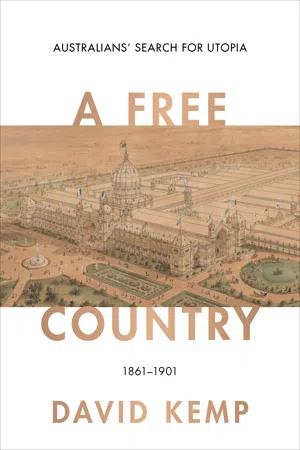
A Free Country: Australians' Search for Utopia 1861–1901 tells how Australians, inspired by their new democracy, attempted to use their freedom to build a society without social and economic conflict.As the second book in a landmark five-volume Australian Liberalism series, A Free Country shows the successes and missteps in the attempt to establish the legal and moral foundations for a liberal society in Australia, examining the ideological battles of the period. The national politics of twentieth-century Australia had their roots during this time, as utopian dreams of 'social reconstruction' opposed liberal ideals of individual freedom, fostering the concept of 'class wars' and leading to the ongoing involvement of trade unions in politics. As emerging collective ideas of nationalism, empire, race and class challenged individual rights and threatened to seed domestic and international conflict, liberals succeeded in bringing the six colonies into one Australian nation founded on liberal principles, writing a constitution hailed as the most democratic in the world.
- English
- ePUB (mobile friendly)
- Available on iOS & Android
eBook - ePub
About this book
Information
Topic
Geschichte1
Education and religion

IT WAS THE issue of education, more than any other, that brought colonial liberalism directly into conflict with the religious denominations in general and the Catholic Church in particular. The liberals, focused on community and nation-building, believed that the churches, without financial support from the state, would not have the resources to provide schools with wide coverage and that even with state aid, there was a growing risk that many of the colony’s children would not have access to a school with trained teachers, for whether a school was established or not would rest mainly with the churches.
Those most concerned by the liberals’ determination to educate the whole population were the Catholics, many of whom saw liberalism as a secular philosophy that would lead to the destruction of faith among their flock, and to the replacement of Catholic social norms with those of a rationalistic, materialistic and un-Christian society. The Protestant churches were deeply uneasy at the prospect that the Catholics would receive more aid from the state to build up their schooling even further.
Despite the suspicion of the Catholics, the liberals were by no means irreligious as a group. Many of the leading figures of liberalism in Australia in the nineteenth century identified with one or other of the religious denominations. Some of them were Catholic. Many of the liberals, not all, were thus religious themselves, but it would be true to say that they, just like the founders of the American republic, were not principally men of faith but men of reason.
Although the liberals became at times angrily critical of the churches, they still generally accepted that the moral order of society had a religious basis. William Ewart Gladstone, the greatest figure of the age in world liberalism, was a deeply religious High Church Anglican, and his political liberalism had been born not of any weakening of faith but of his realisation that ‘the transcendental purpose to which his life was dedicated could only be realised in freedom’.1 A modern writer, T.L. Suttor, from a Catholic perspective, on the other hand sees ‘secular’ liberalism as ‘human autonomy sanctioned by religious agnosticism’.2 John Stuart Mill helpfully provided a definition of ‘secular’ with which most of the liberals would have been comfortable:
Secular is whatever has reference to this life. Secular instruction is instruction respecting the concerns of this life. Secular subjects are therefore all subjects except religion. All the arts and sciences are secular knowledge. To say that secular means irreligious implies that all the arts and sciences are irreligious, and is very like saying that all the professions except the law are illegal.3
The liberals generally did not see religious faith as inconsistent with the rule of reason, but as existing in a different realm. Their views had evolved out of the Reformation, and as heirs of the Enlightenment and the debate on Catholic emancipation, the colonial liberals were determined that the intense conflicts over religion of earlier times should not be resumed in the new world. Such Catholics as Charles Gavan Duffy and such Protestants as George Higinbotham agreed on this.
The liberal view was that reason and science, not faith, should lead education in particular, and this was exemplified in the conditions of appointment of the foundation professors to Melbourne University in 1854: that they must not be ministers of religion nor lecture on religious topics either inside or outside the university.4 In this the colonial universities were closer to those of Scotland than England, where, in the latter case, Anglican faith was a condition of entry. The university in Australia was to be the expression of, and an instrument for, Enlightenment liberalism. To those who believed in the redemption of the world through faith, and held it as a matter of faith that reason would not save humanity, this was a false road.
The colonial liberals grappled again and again in parliamentary debates with the issue of reconciling their commitment to enlightenment with their belief in a moral order. They found it difficult to understand the intensity of the conflicts of theology that exacerbated the religious differences in the community, and their reasonable moderation told them that it would be desirable if the agreed common elements of Christian belief and observance could be established and made the basis for an education based on values behind which the community could be united. They wanted a harmonious society, hoped that it might be possible to get rid of religious conflict, and saw schooling as a possible means for doing so.
In the liberal view, education was not only necessary to support the new democracy. The colonial liberals also believed that if government provided the framework for individuals to pursue their values, develop their talents and exercise their adventurous initiative, there would be extraordinary material progress. Universal education in the basic skills needed for the exercise of reason—literacy and numeracy, grammar and geography—were essential to the realisation of this project. The denominations had a different view. Not surprisingly, for them, the differences between them mattered, and both the Catholics and the evangelical Protestants saw the concept of a common religious curriculum as a ‘lowest common denominator’ option and a threat to a society in which religious faith and knowledge of Christ played a large part in people’s lives. A common religious curriculum was little better than a ‘secular’ curriculum.
The ‘elephant in the room’ was the Catholic Church. The liberals seemed baffled by the Catholics, for the Catholics were genuinely involved in a different agenda and moreover, and paradoxically, it was the Catholics who were foremost in confronting the liberals with arguments drawn from liberalism to demand their minority rights.
The Anglicans and other denominations were intensely aware of the potential strength and social role of the Catholics in Australia. The adherents of Catholicism were relatively much more numerous than in England as a result of the high proportion of Irish immigrants. The Catholic Church had features that aroused their suspicion. It had international links beyond the British Empire to the Vatican in Rome; the Catholic clergy were perceived to be highly influential with adherents; and the Church seemed increasingly determined, as mid-century was passed, to intensify its resistance to liberalism and to the rationalism of the Enlightenment. From the Protestant perspective, there was a risk that the Catholic Church would become the stand-out defender of the Christian faith as the other denominations were gently absorbed into a liberalised and rationalised curriculum in government schools. The Protestants were determined that this would not happen. They were not, however, arguing from strength, for liberalism, as Suttor describes it, had continued to increase in influence.
Now Australia, even more than de Tocqueville’s America, was a country where newness, the absence of institutionalised traditions, the retreating frontier and its premium on up-to-datedness and adaptability, all singularly favoured the religion of liberty and progress. From the very first months of democracy in Australia, the words of Europe’s great debate were bandied about on the hustings—this man stood for the happiness of the greatest number, another was ‘no wordy theorist, but a practical utilitarian’. The Idea, as Victor Hugo called it, never ceased to claim that it was neutral in regard to religion, or not hostile to true Christianity.5
After the failures of Bourke and Gipps to establish universal primary schooling, there was a sense of desperation about the liberals’ determination that this time the churches would not be allowed to stand in their way. In 1847, under Governor FitzRoy, government-funded schools had been at last established after more than a decade of debate, and these began the provision of schooling to those areas (mainly country) where the religious denominations had not established schools. This dual system of provision still did not, however, satisfy those who held the view that in a democracy all children were entitled to a basic level of education.
Once the Port Phillip District had became an independent colony, with a rapidly growing population as a result of the gold discoveries, it provided fresh opportunities for liberals and the churches to debate the needs of the new society. It was in Victoria that the debate over education became for a time the central issue in the building of that society.
In Victoria the Common Schools Act of 1862, passed under a government led by the Catholic O’Shanassy, had established a common schools board to provide funding for both government and denominational schools, and spent substantial amounts of money to employ teachers. Some thought the system was working, but the more reformist among the liberals were concerned that the teachers were not well trained and, more importantly, that almost half the children in the eligible age groups were still not attending school. These liberals concluded that the new system was still not up to the task of providing an educated populace for the new democracy and set up a Royal Commission to report on how to fix it.
In New South Wales, the Public Schools Act 1866 provided for non-sectarian public schools and continued support for denominational schools, provided, among other things, that they employed teachers with comparable levels of training to those in the public schools, used the same textbooks, and were subject to the same inspection and discipline. An hour a day was set aside in the government schools for denominational religious teaching. Henry Parkes, who was responsible for this legislation, placed considerable emphasis on teacher training, with the objective, among others, of preventing the churches inserting into schools on other grounds people who were inadequately trained as teachers. He claimed that it would ‘put a stop forever to the interference of the clergy in school management’.6
The New South Wales Public Schools Act of 1866 was at first condemned by both Protestants and Catholics, but the Protestants, and, most significantly, the Church of England, seemed prepared to reconcile themselves to the legislation. The Catholics, however, maintained a continuing opposition to the Act. The Act was also criticised by those whom Parkes was to characterise as the ‘extreme’ secularists, and Parkes found himself defending it for some fifteen years against opposition from both sides. Among the wider public, the Act seemed to be generally accepted.
The man who carried the liberal argument in Victoria was George Higinbotham, himself an Anglican, albeit somewhat unorthodox. Like his philosophical guide, Mill, he detested sectarianism, but his disgust at interdenominational rivalries among the Protestant churches was ultimately to determine his attitude and push him towards a secular solution. As a liberal, Higinbotham had initially sympathised with Mill’s view that parents should establish schools and government should help.
Higinbotham was also an early apostle in Australia of the reforms to the civil service in England, flowing from the Northcote–Trevelyan Report of 1854—a vision of government-provided services free of patronage and political bias in which entry was on the basis of examination and promotion on merit. This vision of a new kind of government service took decades to implement, but it exercised a powerful influence on the minds of the colonial liberals, who came to see government services as comprising essentially technical operations that should be entrusted to appropriately trained and skilled people. For Higinbotham, it was a short step to a vision of a teaching service very different from the one that existed at the time.
Higinbotham was an emerging political giant in the new parliament of Victoria. One who knew him described a unique political leader:
If Higinbotham had not lived in a remote colony he would have been an important figure in the history of democracy. He combined the fanaticism of Loyola with the chivalry of Bayard. He had an intransigence, an inability to compromise, which made him a difficult colleague and rather impracticable as a statesman. But these qualities themselves attracted the passionate loyalty of the typical citizen. High-minded and selfless, his sense of duty kept him at work on non-controversial subjects in which he accomplished much of enduring value. As a Parliamentary orator he has seldom been excelled; his voice was like a sensitive musical instrument; his delivery and manner were faultless; perfect in arrangement, his handling was logical, his language nervous; great ideas were balanced by flashes of self-revealing passion.7
Higinbotham was not anti-Catholic, although like many Protestants—and like Mill—he believed the Catholic Church was organised on illiberal authoritarian principles. His views about the role of the churches in education were more influenced by his contempt for the divisions and conflicts among those who ran the Protestant denominations in the colony. Their inability to agree had frustrated him beyond measure. His lack of tolerance for their differences had been intensified by his experiences in trying to reach an accommodation with them in the course of the 1867 Royal Commission. The following year, during the visit of Queen Victoria’s son, Prince Alfred, Orange and Catholic tensions had flared, and a Catholic Irishman had attempted to assassinate the prince in Sydney. Liberal scepticism of the churches, and Protestant suspicion of Irish Catholics, was reinforced.
Higinbotham argued that the conflicts between the Protestant denominations were insubstantial, and with a certainty born of anger he advised that it would be desirable if they ‘would consent to their own extinction, and merge into some common form of Christian society’—but that would be too much to hope in the foreseeable future. ‘At present we are concerned only with the question of the education of the young, and not with the imparting of common sense and of rational conduct to the old,’ he declared.8 Dispute and free debate had worn him down, and his solution was neither tolerant of diversity nor one of which Mill would have approved.
Higinbotham had concluded that the tradition whereby the state had provided the churches with land grants and financial support for their schools had been deeply misguided. The Protestants had become fixated on their property as a matter of status, and little concerned with theology and religion:
They do not know, and they will not learn, that they have not and cannot have as sects—for sects they are—anything of the organic life of the Christian community, of which they are the self-dismembered fragments. Their proceedings are not only injurious to the cause of education, but a disgrace to our social and political system; and the matter of education, which does concern the State, these sects must not be permitted to regard as their exclusive property. This is the problem we have to consider: how we may get rid of the sects in dealing with education.9
Doubtless conscious of his position of present political power, he echoed the remarks of King Henry II and said the problem was ‘how to get rid of these turbulent intruders upon the peace and welfare of the State household?’10 He reminded the Legislative Assembly of Victoria: ‘The commission were unanimously of the opinion that, until the connexion which now exists between the religious sects in this country and the State is absolutely, finally, and for ever put an end to, you cannot establish in this country a sound or successful system of public education.’11
Higinbotham’s central concern was that as a result of the failure of the system, the new democracy was not receiving the public instruction it required. Instruction was still not reaching enough children. He estimated that less than half of the 170,000 children in the ‘ages of instruction’ were in either the common or the private schools. He believed that this compared poorly with England (which, he argued, was then making great progress), and that, unless a higher proportion of children could be brought into the school system, ‘[t]he next generation of Victorians will not be so well instructed as the existing generation, because at present, as far as regards primary instruction, the people of Victoria are better instructed than the present generation of Englishmen’.12
He had come to the opinion that the Victorian Common Schools Act (1862)13 had been a failure. Although his analysis was not accepted by Edward Langton, proprietor of the free trade journal Spectator, Higinbotham had developed an evangelical determination to do away with the existing system of school...
Table of contents
- Cover
- Title
- Copyright
- Dedication
- Contents
- Illustrations
- Acknowledgements
- Introduction
- 1 Education and religion
- 2 Free trade and protection
- 3 The liberal economy
- 4 Liberty and liberalism
- 5 Law and morality on the frontier
- 6 Utopianism and the market
- 7 The ‘reconstruction of society’
- 8 Class war
- 9 Political unionism
- 10 Liberalism and the new economics
- 11 The confident hopes of men
- 12 Democracy and national character
- 13 The triumph of free trade in New South Wales
- 14 Nation, class and race
- 15 A charter of liberty and peace
- Notes
- References
- Biographical notes
- Index
Trusted by 375,005 students
Access to over 1.5 million titles for a fair monthly price.
Study more efficiently using our study tools.
Frequently asked questions
Yes, you can cancel anytime from the Subscription tab in your account settings on the Perlego website. Your subscription will stay active until the end of your current billing period. Learn how to cancel your subscription
No, books cannot be downloaded as external files, such as PDFs, for use outside of Perlego. However, you can download books within the Perlego app for offline reading on mobile or tablet. Learn how to download books offline
Perlego offers two plans: Essential and Complete
- Essential is ideal for learners and professionals who enjoy exploring a wide range of subjects. Access the Essential Library with 800,000+ trusted titles and best-sellers across business, personal growth, and the humanities. Includes unlimited reading time and Standard Read Aloud voice.
- Complete: Perfect for advanced learners and researchers needing full, unrestricted access. Unlock 1.5M+ books across hundreds of subjects, including academic and specialized titles. The Complete Plan also includes advanced features like Premium Read Aloud and Research Assistant.
We are an online textbook subscription service, where you can get access to an entire online library for less than the price of a single book per month. With over 1.5 million books across 990+ topics, we’ve got you covered! Learn about our mission
Look out for the read-aloud symbol on your next book to see if you can listen to it. The read-aloud tool reads text aloud for you, highlighting the text as it is being read. You can pause it, speed it up and slow it down. Learn more about Read Aloud
Yes! You can use the Perlego app on both iOS and Android devices to read anytime, anywhere — even offline. Perfect for commutes or when you’re on the go.
Please note we cannot support devices running on iOS 13 and Android 7 or earlier. Learn more about using the app
Please note we cannot support devices running on iOS 13 and Android 7 or earlier. Learn more about using the app
Yes, you can access A Free Country by David Kemp in PDF and/or ePUB format, as well as other popular books in Geschichte & Australische & ozeanische Geschichte. We have over 1.5 million books available in our catalogue for you to explore.