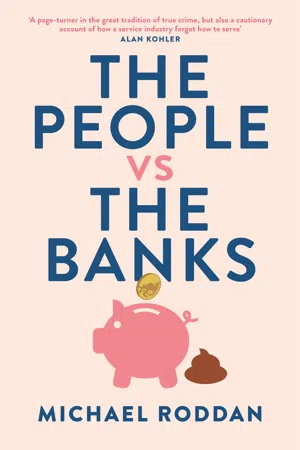
The banking royal commission has put the financial sector on trial and exposed its self-interest, corruption and excess. The People vs The Banks reveals what happens when businesses put profit before punters, reward bad behaviour and assume they are beyond the law. The day of reckoning for liars and thieves in pin-striped suits has arrived.
- English
- ePUB (mobile friendly)
- Available on iOS & Android
eBook - ePub
The People vs The Banks
About this book
Information
1
BARBARIANS AT THE GATE
‘Things have changed,’ Scott Morrison told the guardians of the financial system.
It was Wednesday night, 29 November 2017, and Wayne Byres, the head of Australia’s banking regulator, APRA, and Philip Lowe, the Reserve Bank governor, were hooked up on a call to Morrison, urging the treasurer to take control of the situation at the eleventh hour. It would be ‘the least worst option’, they said.
Frustrated by the Coalition’s refusal to set up a royal commission into the banks, a cabal of rogue backbenchers led by Nationals MP Barry O’Sullivan were on the brink of clinching enough votes to launch their own unwieldy financial services inquiry. The proposed commission of inquiry, which would be instilled with all the powers of a royal commission but set up outside of the hands of the government, was finally within reach. Tomorrow, the bill was sure to pass parliament.
It couldn’t be allowed to happen, Byres and Lowe warned Morrison. O’Sullivan’s commission could do irreparable damage to the financial system. Everybody’s job, everybody’s mortgage, every loan to every business in the country was dependent on the strength and credibility of the financial system, they said, and O’Sullivan was about to lift the lid on Pandora’s box.
With the help of a few of his Nationals colleagues, Labor, the Greens and a handful of crossbench MPs, O’Sullivan had just secured the numbers to blow open the casket. On the numbers, Morrison had lost control, and the executives of the major banks were terrified. For two years, they had claimed the sky would fall in should they be subjected to the glare of a royal commission. Recessions, spiralling interest rates and housing market implosions were all forecast by a sector desperate to avoid scrutiny. Now, it was all but certain at the hands of the uncontrollable O’Sullivan bill.
Lines of urgent communication were opened up between the banking sector and the Reserve Bank of Australia (RBA) and the Australian Prudential Regulation Authority (APRA), the two regulators charged with protecting the stability of the financial system.
For Lowe and Byres, the national economic interest dictated that the government would have to take a different course from the one it had charted. A royal commission was ‘regrettably necessary’, the pair told Morrison.
‘We had to deal with the maths in the Parliament,’ Morrison later said. ‘And the maths in the parliament was going to lead to an unwieldy and directionless and haphazard commission of inquiry which would have done far greater damage—and that was not something that we believed should be allowed to happen.’ Things had changed.
There are decades where nothing happens. And then there are weeks where decades happen. Over that last week of November, everything happened.
Just seven days earlier, O’Sullivan had released his private member’s bill for the commission of inquiry into the banking sector. It had sprung from a seldom-used piece of legislation that allows the parliament to hold the government to account. When the government of the day will not launch a royal commission into a particular case, a separate Act allows the parliament to establish a commission of inquiry that reports to parliament rather than the governor-general. Any such inquiry can be given whatever powers a parliament sees fit to give it, as long as they are constitutional.
Greens senator Peter Whish-Wilson had floated the idea of a financial services commission of inquiry a year before, borrowing from the unusual parliamentary manoeuvre that had been used to investigate High Court justice and former Labor attorney-general Lionel Murphy in the 1980s.
Despite the pace of events in the last week of November, momentum for the commission of inquiry had been building for some time.
In late October, the High Court’s decision to disqualify former deputy prime minister Barnaby Joyce on the basis of his dual citizenship had shaved down the government’s wafer-thin parliamentary majority. In the aftermath, Queensland independent Bob Katter and Nick Xenophon Team MP Rebekha Sharkie had given support to a push by Queensland Nationals MP George Christensen to trigger a commission into the banks. Christensen had only recently backed down from his threat to cross the floor to support the Greens’ own bill for a commission of inquiry, which was co-sponsored by the Senate crossbench and passed the upper house.
Fast-forward a few months, and now O’Sullivan was releasing his own draft bill for a commission of inquiry. This time, it had the numbers to pass. O’Sullivan had opened the door to his office and invited input from any other politician on Capital Hill. The bill would hit the floor in a week’s time, and all he needed was seventy-six votes on the floor of the House of Representatives. With a few concessions here and a few amendments there, he was virtually assured of the numbers.
The horsetrading resulted in dramatically expanding the terms of reference for the mooted inquiry as input from various MPs who stormed into his office dragged them wider. But O’Sullivan was happy to be accommodative.
The breadth of what the commission would be investigating sent shivers down the spines of the banks. It proposed to test whether behaviour in the financial sector was ‘unethical’—a seemingly absurd hurdle to clear for a financial services firm, let alone any business. A ‘fairness and propriety’ test would have implications well beyond the banking sector, while an investigation into whether banks had acted fairly when impairing sinking borrowers would directly fall foul of prudential laws requiring banks to do so. The ragtag parties across the Senate would also be given the power to nominate three commissioners—a former judge, a community representative and a financial expert. The banks feared a circus where they’d be forced to swallow the sword.
All sorts of MPs were walking into O’Sullivan’s office, across party lines, with every idea being written into the draft bill. One of them was Labor senator Sam Dastyari, who had eventually persuaded his leader, Bill Shorten, to take up a proposal for a banking royal commission in the party’s election platform.
The Nationals MPs were determined to launch the inquiry. Liberal government MPs were aghast at their Coalition partners. Prime Minister Malcolm Turnbull had been calling O’Sullivan repeatedly over the week. A former merchant banker himself, he believed O’Sullivan had little comprehension of what he was about to unleash and, like a dog chasing a garbage truck, little idea of what he wanted. It would be a political disaster if Labor and the Greens could anoint the commissioner overseeing the inquiry, but it was an own goal O’Sullivan didn’t seem to comprehend.
Financial Services Minister Kelly O’Dwyer was told to try to sort the mess out. She called O’Sullivan into her office on that Wednesday morning as he was wrapping up the draft bill. While O’Dwyer kept her composure at the meeting, she was privately horrified about the extent of control the Greens and Labor would have over the inquiry. She told O’Sullivan the government needed more time to consider the draft bill and urged him to hold off on his threat to introduce it at least until the next day, which would give Morrison enough time to work out a plan.
The delaying tactic worked, and pushed the treasurer and prime minister into crisis mode. As her meeting with O’Sullivan ended, O’Dwyer strode across parliament and into Morrison’s office. He was sitting with Nationals MP Llew O’Brien, who had threatened to cross the floor to support the O’Sullivan bill. O’Brien pleaded with Morrison to back the inquiry. He was under pressure from constituents in his regional Queensland electorate over recent sackings of local bank employees.
As O’Brien left, O’Dwyer and Morrison came to the reluctant conclusion that the Nationals would not be for turning. They didn’t understand the consequences of the O’Sullivan bill, nor did they care. As things stood, the parliament would in about twenty-four hours’ time be voting for the commission of inquiry.
It was clear Morrison’s Plan B had not worked. Under the threat of the O’Sullivan plan, the treasurer had been rushing together a new compensation scheme for victims of financial scandals in a bid to soothe the Nationals revolt. A week prior, he had called the chief executives and chairs of the major banks to discuss his plan to resolve ‘legacy issues’ attached to historical misconduct. Under the proposal, a panel would mediate and review cases and award compensation.
The mini-royal commission looked promising. Warren Entsch, a Liberal MP who had long been agitating against the banking sector, was involved in the negotiations. But the banks were circumspect about the plan’s ability to derail O’Sullivan.
The discussions with the bank bosses brought all the executives together. National Australia Bank chairman Ken Henry and Westpac chairman Lindsay Maxsted met with Morrison on 23 November, and Commonwealth Bank chairman Catherine Livingstone and ANZ chairman David Gonski met with him the next day. The bankers were supportive of the move, but didn’t think it would kill the political football O’Sullivan was handballing around parliament.
They were proven correct. Come Monday, the nation’s politicians had once again descended on Canberra and O’Sullivan was able to gather the numbers for his commission of inquiry bill. Tuesday’s newspaper headlines told the bankers all they needed to know. Time was up.
The bank chairs discussed the imminent threat over a phone hookup and decided they needed to come up with a contingency plan. They tapped their chief executives to get together on the Wednesday, at the same time as O’Dwyer was winning her brief reprieve from O’Sullivan in his office.
By early evening on Wednesday 29 November, the bankers had all agreed it was desperate times. The desperate measure, then, would be to rip off the bandaid. A letter signed by the four chairmen and the chief executives was sent to the treasurer in which they told him that the next morning they would call for a royal commission into themselves—one with properly instituted terms of reference—and hoped the government would fall behind the plan. The letter would be lodged with the Australian Securities Exchange (ASX) on the Thursday morning at 8.30 a.m., which would make it a public document. It would be game over.
Unbeknown to the bankers, Morrison had been preparing a grudging Plan C. The wheels had already been in motion as the government was not oblivious to reality. A small circle of Cabinet ministers had been working fast and hard behind the scenes to prepare the ground for their own banking royal commission. After opposing such a move for two years, in the panicky week Turnbull had decided he was now open to such a measure.
In a Cabinet meeting earlier in November, the prime minister had raised the prospect that the government might be forced to hold a royal commission. Morrison had been furious at the suggestion. Back-flipping would make him look utterly foolish for arguing so stridently against such an inquiry for so long, he told the meeting. But it was clear the ground was already shifting beneath him.
On Tuesday 21 November, a second small Cabinet meeting was called. In that meeting of crestfallen MPs, all too aware that they had their backs against the ropes, Turnbull raised again the possibility of the government holding its own royal commission. If it was inevitable, they might as well control it. They could even broaden the inquiry beyond the big four banks to the places they wanted it to go, while keeping it on a tight leash so it didn’t look where they didn’t want it to look.
After that meeting, the pointy heads in the Department of Treasury were asked to start designing the government’s own royal commission, just in case. Treasury dutifully came back to Morrison with advice and a draft terms of reference, and held discussions with Attorney-General George Brandis about the potential inquiry’s content and scope.
The government’s key economic advisory department basically already had everything ready to go. Treasury deputy secretary John Lonsdale had spent quite a lot of time in the year leading up to this moment thinking about a royal commission and advising the government on what it might look like.
After the Cabinet meeting, Morrison used the next two days talking to the banking chiefs and the rest of his parliamentary colleagues. The treasurer would become a late convert, changing his mind on the royal commission given the threat of a much more uncontrollable commission of inquiry. As he received the signed letter from the bank bosses, everything had fallen into place. A late-night phone call soon after with the APRA and RBA bosses, warning of the price of inaction, was enough to seal the deal.
Turnbull called a Cabinet meeting for early on the Thursday morning, just before the ASX would publish the signed letter from Commonwealth Bank, Westpac, National Australia Bank and ANZ.
At 8.31 a.m., the statement hit the market: ‘Major banks unite to call for certainty and stability’. David Gonski and his ANZ chief Shayne Elliott, Catherine Livingstone and CBA boss Ian Narev, Ken Henry and head of NAB Andrew Thorburn, and Lindsay Maxsted and his chief Brian Hartzer said it was time for the government to ‘act decisively’. Writing to the treasurer ‘as the leaders of Australia’s major banks’, they gave the government all it needed to backflip on its own reticence regarding a royal commission. ‘Our banks have consistently argued the view that further inquiries into the sector, including a royal commission, are unwarranted,’ the letter said. ‘However, it is now in the national interest for the political uncertainty to end.’
As financial market traders digested the document, the meeting of Cabinet ministers endorsed a decision to set up a royal commission. Less than half an hour after the bank statement went live, Turnbull and Morrison walked out into the prime minister’s courtyard for a press conference to announce the commission. What had once been unthinkable was apparently now the only way to restore confidence in the financial sector.
‘Since the financial crisis there have been examples of misconduct by financial institutions, some of them extremely serious. And that’s demanded a response from the institutions themselves and from government,’ Turnbull said. ‘The only way we can give all Australians a greater degree of assurance is a royal commission into misconduct in the financial services industry.’
The prime minister gave one stern warning: ‘This will not be an open-ended commission. It will not put capitalism on trial.’
In Sydney, Australian Banking Association (ABA) chief executive Anna Bligh was caught unawares.
Bligh, the chief lobbyist for the banking sector, had been forewarned that the letter from the major banks would be sent to the treasurer, but she was shocked at the pace of events. As the statement went live, the former Queensland premier was on stage at the national conference of the Association of Superannuation Funds of Australia (ASFA) partaking in a discussion about the diminishing trust in the financial sector. On one side of her was ASFA chief Dr Martin Fahy, and on the other, the chairman of the superannuation fund Cbus, Steve Bracks.
In the final minutes of the hour-long session at the Sydney Convention Centre, a hand arose in the crowd, begging to interject. The room was informed that a banking royal commission had just been announced by the government, and the tenor of the discussion took a turn.
‘The thing about commissions of inquiry,’ Bligh said, ‘I’ve called them. I’ve given evidence in them. And they don’t always go the way that people think they might when they go out.’
As the discussion drew to a close, Bligh slipped out the back door of the conference room. She stopped for a quick discussion with two reporters but, not having been forewarned of the immediate launch of the royal commission by the government, was whisked away to catch up on the news.
I was one of those reporters, and the pace with which the government had turned around its opposition to a royal commission had taken me by surprise, too. I’d had little reason to believe the O’Sullivan bill would be successful. I had been with The Australian newspaper writing about the banking and financial sector for a few years by this point, and there had been a lot of posturing but little in the way of delivering a royal commission.
I had been watching in parliament in Canberra just a few months earlier, in June, when George Christensen had backed down from his threat to cross the floor for the Greens commission of inquiry bill. Despite Christensen talking a big game about how he wanted an inquiry into the lenders, when the Damocles sword was dangled over Turnbull’s head the rogue Nationals MP failed to swing. It had seemed to me that rhetoric would be taking precedence over action against the banks for some time to come.
And there had been little sign from the banking community that they would buckle to the pressure. The day before the royal commission was called, Westpac head of business banking David Lindberg, one of the most senior executives at the nation’s second-largest bank, had told a gathering of industry figures that an inquiry into the banking system could bring the nation closer to a recession and ‘economic collapse’ if it deterred global investors from operating in the local financial sector. Little did he realise that his boss was part of the industry coup organising a royal commission into themselves.
While it seemed few people inside the industry were aware of the plan, Bligh was by now used to being the last to be told of the government’s intentions. The Coalition had already sucked dry its account of political capital in defending the banking sector from a royal commission, but as it did so, Morrison had been intent on proving he was not a lackey for the financial industry. Indeed, the appointment of Bligh to the banking sector’s top post just six ...
Table of contents
- Cover
- Title
- Copyright
- Contents
- Abbreviations
- 1. Barbarians at the gate
- 2. Capital in the twentieth century
- 3. The impeccable system
- 4. Justice must be seen to be done
- 5. Irrational exuberance
- 6. Liars and thieves
- 7. Boom and bust
- 8. A sorry business
- 9. Workers’ capital
- 10. The big rort
- 11. Doctor’s orders
- 12. How much is enough?
- 13. Last gunslingers in town
- 14. The watchdogs that didn’t bark
- 15. Veni, vidi, vici
- 16. Ill fares the land
- Acknowledgements
Trusted by 375,005 students
Access to over 1.5 million titles for a fair monthly price.
Study more efficiently using our study tools.
Frequently asked questions
Yes, you can cancel anytime from the Subscription tab in your account settings on the Perlego website. Your subscription will stay active until the end of your current billing period. Learn how to cancel your subscription
No, books cannot be downloaded as external files, such as PDFs, for use outside of Perlego. However, you can download books within the Perlego app for offline reading on mobile or tablet. Learn how to download books offline
Perlego offers two plans: Essential and Complete
- Essential is ideal for learners and professionals who enjoy exploring a wide range of subjects. Access the Essential Library with 800,000+ trusted titles and best-sellers across business, personal growth, and the humanities. Includes unlimited reading time and Standard Read Aloud voice.
- Complete: Perfect for advanced learners and researchers needing full, unrestricted access. Unlock 1.5M+ books across hundreds of subjects, including academic and specialized titles. The Complete Plan also includes advanced features like Premium Read Aloud and Research Assistant.
We are an online textbook subscription service, where you can get access to an entire online library for less than the price of a single book per month. With over 1.5 million books across 990+ topics, we’ve got you covered! Learn about our mission
Look out for the read-aloud symbol on your next book to see if you can listen to it. The read-aloud tool reads text aloud for you, highlighting the text as it is being read. You can pause it, speed it up and slow it down. Learn more about Read Aloud
Yes! You can use the Perlego app on both iOS and Android devices to read anytime, anywhere — even offline. Perfect for commutes or when you’re on the go.
Please note we cannot support devices running on iOS 13 and Android 7 or earlier. Learn more about using the app
Please note we cannot support devices running on iOS 13 and Android 7 or earlier. Learn more about using the app
Yes, you can access The People vs The Banks by Michael Roddan in PDF and/or ePUB format, as well as other popular books in Economics & Banks & Banking. We have over 1.5 million books available in our catalogue for you to explore.