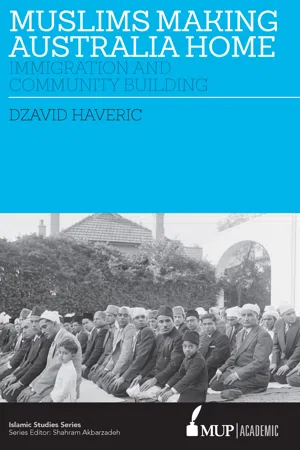
The story of Islam and the Muslim people is an integral part of Australian history. This book covers the period from post-World War II until the 1980s when the history of Islam in Australia unfolded into a rich multi-ethnicity, manifested by diverse Muslim ethnic groups. Muslim migrants found Islam in Australia more pluralistic than they found possible in their homeland, because in Australia they met fellow Muslims from many different ethnic, racial, cultural, sectarian and linguistic backgrounds. Muslims are an integral part of Australia's social fabric and multicultural way of life, shaping their Muslimness in an Australian context and their Australianness from Muslim viewpoints and experiences. Documenting socio-historical characteristics rather than providing a theological interpretation, Muslims Making Australia Home covers interrelated Islamic themes in the sociology of religion by noting how these themes reappear in cultural history. The book reveals many unknown or little-known historical facts, stories and valuable memories
- English
- ePUB (mobile friendly)
- Available on iOS & Android
eBook - ePub
About this book
Information
CHAPTER 1
Post-World War II to the 1980s
Muslim Immigration
Immigration in the last decades of the White Australia Policy
Australia has a long history of immigration. It is one of the few traditional settler immigration countries in the Western world. It was the apparent need for population growth and economic development in the post-war period that led to the broadening of Australia’s immigration policy. As a consequence, successive waves of migration led to the settlement of Muslim communities of diverse ethnic backgrounds across Australia. Over time, Muslims would arrive in Australia from 183 countries, making them one of the most ethnically and nationally heterogeneous communities.
The first years of the post-war period was marked by the arrival of large waves of migrants, refugees and displaced people. From 1947 Australia allowed a number of displaced Muslim immigrants to come to Australia in search of a better life or to find refuge from war or persecution. They also left their countries of origin because of poverty, the breakdown of social structures and the decline of local industries. This movement was mainly a migration of the ‘rural-to-urban’ type.
In 1947, the Australian government entered an agreement with the new International Refugee Organisation (IRO) to settle displaced people from camps in Europe. This scheme was extended to include ‘displaced persons and European people generally’ and among them were European Muslims. The early post-war period encouraged immigrants to express their cultural heritage. In 1947, the number of Muslims was negligible and did not even register on the national census.1
Although the impact of discriminatory migration policies was still strong, the government had to review these as ‘populate or perish’ became the motto, coined by Labor minister for immigration Arthur Calwell, indicating a need for and acceptance of the new settlers. However, the White Australia Policy with its racial prejudices and social inhospitality marked a long period from 1901 until 1973. It regarded ethnic identities of non-British migrants, their cultures and languages as undesirable. They were exposed to social-economic hardship and assimilation. The Policy maintained an old loyalty and a belief in creating a monocultural ‘Anglo-Celtic’ Australian nation. It restricted migrants from entering Australia, especially of Asian backgrounds. It caused many inequalities and anomalies.2 On the other hand, the post-war demands for a new outlook for an immigration program would gradually develop, along with a recognition of the value of the cultural diversity of migrants outside of Europe.3
Between the late 1940s and late 1950s, refugees who had been selected in overseas locations by Australian officials working in collaboration with the IRO, UNHCR and Intergovernmental Organisation for European Migration were resettled in Australia. They were considered to be an integral part of the overall migrant intake.
We must remember that it is a big adventure for people to pull up their roots in countries where they and their families have lived for many years to come to Australia to start a new life.4
Ships of many nations left European ports, bound for Australia, bringing a polyglot, multiethnic and multicultural human cargo. Displaced persons travelling to Australia were carried on passenger ships provided by IRO contracts.5 Many of these ships, having carried new settlers to Australia in the late 1940s and 1950s, remain unlisted in sociological and historical studies of migration and are still virtually unknown,6 such as the Misr, Asturias, Partizanka, Protea, Rena, Kaninbla, Skaugum, Amara Poura Glasgow, Castel Bianco, Fairsea, Goya, Heintzelmann, Oxfordshire, Howze, Anna Salen, Hellenic Prince, Roma, Ugolino Vivaldi, Skaubryn, Nelly II, Tioscana, Aurelia, Fairsea, Begona, Flamencia, Castel Felice and Via Rio Triestino.
Many ships departed European ports such as Bremerhaven, Napoli, Genoa–Pyrenees, Malta and Limassol, some stopping at Tripoli and then going through the Suez Canal with stopovers in Port Said and Colombo, while others travelled via Gibraltar around the Cape of Good Hope. Most voyages by ship lasted one month, while some lasted up to sixty-two days. There were also some migrants who came by aeroplane, stopping at airports in Cairo, Abadan, Karachi, Calcutta and Singapore, and finally arriving in Darwin, Sydney, Melbourne and other airports.
The earliest post-war Muslim arrivals came as individuals or small groups and rarely with family. European Muslims were admitted to Australia during the White Australia Policy when issues of the population’s predominant ‘whiteness’ were still important. They were exempted from restrictions imposed on earlier Muslims by the same policy. Muslim refugees entering Australia in this period included ‘European Turks’—Turkish Cypriots, Muslims from Bosnia, Albania, Kosovo, Bulgaria, Russia, Hungary and Poland. While Lebanon is Middle Eastern rather than European, Lebanese Muslims were classified as of ‘European appearance’.7
There were numerous examples of post-war Muslim arrivals. For instance, in 1948, a couple of Bosnian Muslims travelled from Germany on the Protea, a ship that was not in the best condition; it had already undergone significant repairs on four occasions. It stopped near the coastline of the Suez Canal when it again needed repairs. The ship was restored by capable Sudanese workers who were able to work in the hot weather. The Protea then continued sailing to Australia and reached the port of Melbourne after forty-five days. From Melbourne, the arrivals were taken to the Bonegilla migrant camp.8
Another story is from 1949: a Kosovo-born Albanian was transferred to a refugee camp in Beirut. The young Muslim, who gave his occupation as a mechanic, was regarded as educated, with five years of secondary school education. He was fluent in Albanian, Yugoslavian, Turkish and Italian. He impressed the Australian selection officials and was duly offered admission. He arrived in Melbourne aboard a US troopship in 1949.9
In 1950, the only English-speaking Cypriot among the thirty-one who reached Adelaide by train from Darwin confirmed reports that ‘an international racket in migrants to Australia is operating in the Middle East.’ He was a 32-year-old barber, who was on his way to Sydney. At that time, many migrants were paying fares to Australia well in advance of their departure. He paid £118 to a tourist agent at Famagusta, Cyprus, to come by ship to Australia. Later, he found out there was no ship available and had to pay an extra £42 to come by plane. On top of that, he had to pay an extra £50 to exchange his ship ticket for one by air.
Australia’s official figures in 1947 indicated the Muslim population was 2704. These were mostly Muslim settlers prior to World War II.10 They were the Indo-Afghan cameleers and/or their descendants dispersed mainly in rural areas who in the past worked on historic inland explorations of Australia and the trade, and transport of supplies and equipment needed for the construction of its earliest and greatest infrastructure projects, such as the railway line between Port Augusta and Alice Springs, and the Overland Telegraph Line. This population was in rapid decline due to the impact of the White Australia Policy. Only a handful of them spent the last years of their lives in cities where a mosque existed such as in Adelaide, Perth and Brisbane. The forthcoming arrival of European Muslims and their encounters with a few of these old settlers testified to the continuation of Islam in Australia. From the late 1940s, it was estimated the first several hundred Cypriots, Albanians, Bosnians and a handful of Middle Eastern people had arrived. Between 1947 and 1956, 350 Turkish Cypriot settlers were living in Australia. For the same period, the number of Bosnian Muslims in Australia was estimated at about 300. Between 1949 and 1955, Australia received 235 persons classified as ‘displaced’ from Albania. The Albanian population continued to grow steadily until it peaked in 1961 at 753.11
This increasing migration was reflected in the national census figures. Apart from the des...
Table of contents
- Cover
- Title
- Copyright
- Contents
- Acknowledgements
- Foreword
- 1 Post-World War II to the 1980s: Muslim Immigration
- 2 Building Networks and Community Institutions
- 3 Multiethnic Muslim Communities in Victoria
- 4 Building Communities in Victoria from the 1950s to the 1980s
- 5 Interfaith Relations in Victoria from the 1950s to 1980s
- 6 Multiethnic Muslim Communities in New South Wales
- 7 Multiethnic Muslim Communities in Queensland
- 8 Multiethnic Muslim Communities in Western Australia
- 9 Multiethnic Muslim Communities in South Australia
- 10 Multiethnic Muslim Communities in the Northern Territory
- 11 Multiethnic Muslim Communities in the Australian Capital Territory
- 12 Multiethnic Muslim Communities in Tasmania
- 13 Post-World War II Sufism in Australia
- Conclusion
- Bibliography
- Index
Trusted by 375,005 students
Access to over 1.5 million titles for a fair monthly price.
Study more efficiently using our study tools.
Frequently asked questions
Yes, you can cancel anytime from the Subscription tab in your account settings on the Perlego website. Your subscription will stay active until the end of your current billing period. Learn how to cancel your subscription
No, books cannot be downloaded as external files, such as PDFs, for use outside of Perlego. However, you can download books within the Perlego app for offline reading on mobile or tablet. Learn how to download books offline
Perlego offers two plans: Essential and Complete
- Essential is ideal for learners and professionals who enjoy exploring a wide range of subjects. Access the Essential Library with 800,000+ trusted titles and best-sellers across business, personal growth, and the humanities. Includes unlimited reading time and Standard Read Aloud voice.
- Complete: Perfect for advanced learners and researchers needing full, unrestricted access. Unlock 1.5M+ books across hundreds of subjects, including academic and specialized titles. The Complete Plan also includes advanced features like Premium Read Aloud and Research Assistant.
We are an online textbook subscription service, where you can get access to an entire online library for less than the price of a single book per month. With over 1.5 million books across 990+ topics, we’ve got you covered! Learn about our mission
Look out for the read-aloud symbol on your next book to see if you can listen to it. The read-aloud tool reads text aloud for you, highlighting the text as it is being read. You can pause it, speed it up and slow it down. Learn more about Read Aloud
Yes! You can use the Perlego app on both iOS and Android devices to read anytime, anywhere — even offline. Perfect for commutes or when you’re on the go.
Please note we cannot support devices running on iOS 13 and Android 7 or earlier. Learn more about using the app
Please note we cannot support devices running on iOS 13 and Android 7 or earlier. Learn more about using the app
Yes, you can access ISS 28 Muslims making Australia home by Dzavid Haveric in PDF and/or ePUB format, as well as other popular books in Social Sciences & Islamic Studies. We have over 1.5 million books available in our catalogue for you to explore.