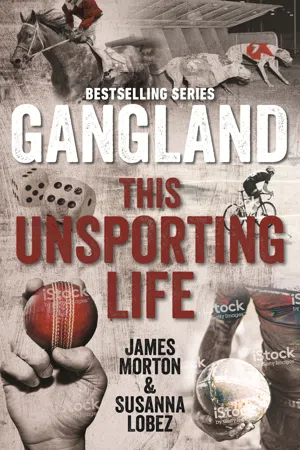
Sport has always attracted organised crime. Huge sums of money are wagered in every arena, and rorts, swindles and unsporting behaviour have shadowed players of all codes. Cricket and footy are not immune, with Heath Shaw and Ben Cousins caught up in gambling and drugs, and NRL star Ryan Tandy in match-fixing. Plenty of punters have criminal connections—Alphonse Gangitano and the Moran brothers. Drugs play a major part on and off the fields of play (looking at you, Essendon Football Club and Cronulla-Sutherland Sharks) with horses and greyhounds also routinely doped. James Morton and Susanna Lobez investigate the cheating underbelly of sport, from the first cricket pitch invasion in the 1890s through to the contemporary scandals that will leave you wondering if there is such a thing as a sporting chance.
- English
- ePUB (mobile friendly)
- Available on iOS & Android
eBook - ePub
Gangland This Unsporting Life
About this book
Information
Publisher
Victory Books DigitaleBook ISBN
9780522874815
Year
2019It’s Just Not Cricket
1
It was shortly after the drinks interval on Saturday 24 March 2018 that, metaphorically at least, the pavilion roof fell in on Australian cricket, and for that matter Cricket Australia. The roof at the time was in Cape Town where South Africa was the host nation. It had been an unhappy Test match from the start, with Australia having a hard time in the series.
It was then Australian bowler Cameron Bancroft was clearly seen on the television coverage and on screens around the ground apparently rubbing the ball with a small yellow object. After Bancroft realised that he had been seen, he was shown on the screens hiding the object in the front of his trousers. He was then approached by the umpires and he showed them a dark microfibre sunglasses pouch he took from his pocket. The umpires inspected the ball, and chose neither to offer the ball to the South African team to replace it if they wished, nor award them five penalty runs. This indicated that the ball had not been altered in any noticeable way. The aim behind ball scraping, however, is to have one side smooth and the other rough so that the bowler can produce a delivery that swings more than an undoctored ball.
At the press conference at the end of the day’s play, Bancroft, who was accompanied by Australia’s captain Steve Smith, admitted that he had been shown attempting to alter the condition of the ball using a short length of yellow adhesive tape to which dirt and grit had adhered, forming an abrasive surface.1
Andy Pycroft, the match referee, charged Bancroft with a Level 2 offence of attempting to alter the condition of the ball. David Richardson, CEO of the International Cricket Council (ICC), charged Smith with ‘conduct of a serious nature that is contrary to the spirit of the game’. Smith accepted the charge and the proposed sanction of two suspension points, which equated to a ban for the next Test match, four demerit points being added to his record, and a fine of 100 per cent of his match fee. Bancroft accepted the charge against him, was handed three demerit points and was fined 75 per cent of his match fee.
Over the next few days all sorts of explanations were offered. First up was Bancroft, who said the following day, ‘I panicked quite a lot. That obviously resulted in me shoving it down my trousers’. Next to bat on 29 March was captain Steve Smith, who broke down in tears as he explained, ‘It was a failure of leadership, my leadership. I will regret this for the rest of my life. I’m gutted.’ And finally on 31 March the man designated to become the villain of the piece, vice-captain David Warner, who opened the Australian innings with Smith in Cape Town and who was said to have promoted the rort, expected the worst: ‘In the back of my mind I suppose there is a tiny ray of hope that I may one day be given the privilege of playing for my country again, but I am resigned to the fact that that may never happen.’2
In the wash-up and after an investigation into the incident by Cricket Australia, Bancroft admitted he used sandpaper, something cricketers use to smooth their bats. Smith also admitted that he knew of the plan in advance of Bancroft’s actions. He said the plan was made during the lunch break by the ‘leadership group’, which he did not name. Smith said it was a ‘big mistake’, but when questioned by the media, he added that he would not be standing down as captain.
Smith and Warner were banned from elite cricket for twelve months and Bancroft copped nine months.3
How could this have happened?
The country that had been seen as a plucky underdog in the first Ashes Test in 1882 had slowly morphed over time into Australia becoming the force in international cricket in the mid 1990s. With that success came confidence, and a deep-seated love of touting their team as the model for how things should be done in the sport.
Wasn’t cricket the ‘Beautiful Game’ until, at least in England, soccer usurped it?
‘It just isn’t cricket,’ our parents told us, and in turn their parents had told them when explaining the meaning of fairness and good, well-mannered behaviour. But it turns out cricket had an undeserved reputation. It never was a game for gentlemen. Well, perhaps that is not quite true. There is no doubt that come harvest time the aristocracy would roll up their sleeves and bowl a few overs to the labourers, and that was one reason there was no 1790 revolution in England. However, money is usually always a consideration.
From the beginning there was heavy betting by the aristos and landowners who arranged fixtures solely for the purposes of gambling. Their lordships thought the game was a good medium for the employees to provide the opportunity on which to gamble. And in their turn the lower orders could not see why they should not benefit by taking a bit on the side from their opponents’ sponsors not to perform.
In the eighteenth century it had been a brutally competitive game played for high stakes. In 1775 William Waterford was convicted of manslaughter and received nine months (compared with a bigamist who received twelve that year) after the death of George Twigg in a match on Bakewell Common in Derbyshire. By the late nineteenth century gone were the days when catches could be made in hats or shirts; gone were non-strikers blocking bowlers from catching returns, nor could fielders block batsmen. Now there was no need for the proprietor of the Artillery Ground in Finsbury in London to patrol the boundary and spectators with a ‘smacking whip’, as was used as crowd control at prizefights.
In 1817 William Lambert, then the leading English professional cricketer who, the year before, had written ‘Rules for Playing The Noble Game of Cricket’, sold the match between England and the XXII of Nottingham. He was banned from Lord’s cricket ground and never again played in a first-class match.
For the nineteenth century country parson, the Reverend James Pycroft, cricket was fundamentally English. Writing in The Cricket Field he extolled the virtues of Victorian cricket as opposed to the game played in the previous century: ‘Foreigners have rarely imitated us. English settlers everywhere play at cricket; but of no single club have we heard that dieted either with frogs, saur-kraut or macaroni.’
Of his previous life, Pycroft, who played what would be now considered to be four first-class matches between 1836 and 1838, wrote, ‘The temptation [to cheat] was really very great—too great by far for any poor man to be exposed to’. He favourably compared the virtues of Victorian age cricket with the disgraceful state of play at the turn of the century when:
Lord’s was frequented by men with book and pencil, betting as openly and professionally as in the ring at Epsom, and ready to deal in the odds with any and every person of speculative propensities.
It was an attitude adopted by the members of the Melbourne Cricket Ground (MCG) in Australia when cycling racing was introduced there in the 1890s.
Sadly Pycroft, far away in his Dorsetshire parsonage, did not appreciate what was actually happening in the wider world. Or perhaps things did change in the second half of the nineteenth century.
In Australia the first Indigenous man to be recorded playing cricket was ‘Shiney’, who in 1835 played for the Sorrell and Carlton clubs against Hobart Town. When he died—apparently killed on the water-front—a local doctor John Clarke acquired his head and smoked and preserved it in whisky, before on his own death bequeathing it to the Royal College of Surgeons in Ireland. It was only after considerable lobbying by Shiney’s great-grandson, activist Michael Mansell that it was returned to Australia in 1990.4
To make up the sides on rural stations around the country where cricket was played, pastoralists often enlisted their Indigenous station hands and stockmen whose tribal people lived nearby. In the 1860s William Hayman from the Western District of Victoria formed a team of men from three local tribes—Jardwadjali, Gunditjmara and Wotjobaluk. By 1866, with the help of cricketer turned coach Tom Wills, the team was considered ready for Melbourne where, on Boxing Day 1866, they were trounced by the Melbourne Cricket Club. At least the eight thousand spectators were reported to have enjoyed the match.5
More matches were played and a Sydney tour arranged, but there the team’s funds were embezzled and they were stranded. Rescue came from Hayman, a new coach Charles Lawrence, the ex-all England player, and financial backers who saw the moneymaking aspects of this team. A tour of England was planned for 1868. They were the first Australian XI, paving the way for the Ashes. Had the organisers delayed a year, the Victorian Aboriginal Protection Act would have prevented the players from leaving their ‘reserves’.
Although the 1868 tour is seen as a landmark in Australian sporting and social history, in fact like all other sports it was about money. The organisation of the first Australian team to tour England was not undertaken in an effort to integrate the Indigenous community and make improvements to their lives. However altruistic it may seem and have been portrayed, it was the exploitation of an ‘exotic’ culture to make money from them.
Some saw it as a kind of ‘zoological’ display and observed that disparaging terms were used to describe the players. But London’s Sporting Life raved about the ‘native Australians’ and expressed surprise that they were not ‘savages’ but rather ‘perfectly civilised’.
In addition to playing cricket, at the end of each day the team was required to perform ‘traditional Aboriginal sports’ for the crowds—boomerang and spear throwing—and one man, Jungunjinanuke, known as ‘Dick a Dick’, wielded a club to deflect cricket balls thrown by spectators. However, The Times described the tourists as ‘the conquered natives of a convict colony’ and their participation in county cricket as ‘a travestie [sic] upon cricketing at Lord’s’. London’s Daily Telegraph was perhaps more complimentary when in May 1868 it commented, ‘Nothing of interest comes from Australia except gold nuggets and black cricketers’.6
For the men the tour was gruelling. Forty-seven matches were played in a four-month period, plus on-field entertainment. However, their ability was something of a surprise to their hosts and to the cricket elite of England. The team won fourteen matches, lost fourteen and nineteen were drawn.
Not only was the tour taxing, for some of the players it was also tragic. The trip was against the explicit advice of the Central Board for Protection of Aborigines and the team had to board the boat for England secretly. Two members died before the ship even sailed from Melbourne. Another player known as King Cole contracted tuberculosis and died in England following a bout of pneumonia. Three more died within five years of returning to Australia. In addition to their sense of displacement they were exposed to infectious diseases and introduced to alcohol. The survivors came home to little fanfare and after a couple of matches at the MCG most went back to their stations, soon to be corralled into the ‘reserves’.7
From the playing point of view the success of the tour was Unaarrimin, also known as ‘Johnny Mullagh’, who scored 1698 runs, bowled 1877 overs, 831 of which were maidens, and took 245 wickets. Pressed on occasions into keeping wicket, he stumped four. A true all-rounder, he was considered the ‘Black WG Grace of the team’.
When an opposing captain called him ‘a nigger’, Mullagh threw away his wicket. One night on tour Mullagh was not allowed into a hotel to sleep and instead was shown to a room near the stables that the hotelier thought was more appropriate for ‘the nigger’. He chose to spend the night in the open.
Mullagh played for Western Victoria and a Melbourne club for another two decades. He continued to play until a few months before his death aged fifty in August 1891. The Johnny Mullagh memorial trophy is named after him and in Harrow, Victoria, the Johnny Mullagh Cricket Centre was established in his honour.8
Perhaps the real tragedy is that virtually nothing came of the tour for the benefit of Aboriginal cricketers generally. In 1879 in Western Australia a Spanish monk engaged a local pastoralist to teach cricket. The motivation was to use cricket to replace the traditional corroboree, which was seen as a ‘great obstacle to the successful introduction of our civilisation’. Many missionaries saw cricket as the ‘antidote to Aboriginality’.
Weaned from corroboree to cricket, the New Norcia team became rather successful and was nicknamed the ‘Invincibles’. Often they walked all the way to Perth or Fremantle for games, for which of course government permission had to be obtained. Later Daisy Bates, the anthropologist and welfare worker among the Indigenous people, would comment that this ‘clean British sport’ had civilised the New Norcia team into ‘black Caucasians’.
The reality is that there have been few Indigenous cricketers who have played for Australia in the 150 years since that Aboriginal team started the ball rolling in 1868. To an extent it was the grinding poverty that prevented them from doing so. Years later when Doug Nicholls, the twentieth-century sprinter turned VFL player, was asked why he didn’t take up cricket he said the other sports were ‘cheaper than cricket, no pads or white trousers’. Cricket may have been seen as ‘a passport to the white man’s world’ but boxing, running and later football were considered easier and cheaper to begin with. For instance, various Gift footraces paid up to a thousand pounds to the winner.9
There have, of course, been exceptions. Jack Marsh, described by fellow cricketer Les Poidevin as ‘A well set-up, perfectly built … man, with an ebony-black, smooth, clear shining skin and twinkling black eyes’ and ‘quite good company’, started off as a sprinter, known as the fastest man in Australia at the end of the nineteenth century. Turning to cricket, by the early 1900s he was recognised as ‘the best bowler in the world’, who ‘terrorised batsmen’. Because of his bowling action there were, however, attempts to brand him as a ‘chucker’. In 1902 visiting English players refused to play against him. One afternoon he was no-balled seventeen times and after the tea interval appeared with his wrist in a splint in an effort to show he was not throwing. That and his Aboriginality excluded him from an overseas tour.
He returned to running and was certainly still good enough to be matched against Arthur Postle, known for publicity purposes as ‘The Crimson Flash’, the colour of his running vest, in a race in Melbourne in 1906 organised by John Wren. On a wet track before a crowd of 12,000, given a two-yard (1.8-metre) start, Marsh was caught at the tape but many people thought it was a dead heat....
Table of contents
- Cover
- Title
- Copyright
- Contents
- Introduction
- 1 It’s Just Not Cricket
- 2 On and Off the Field
- 3 The Peds
- 4 On Ya Bike!
- 5 Ringers
- 6 Jiggery-pokery
- 7 Nobblers
- 8 They Shoot Horses, Don’t They?
- 9 The Hoops
- 10 When Rogues Go Racing
- 11 Cooking the Bookies
- 12 Fur, Feathers and Skin in the Game
- 13 Scullduggery
- 14 Gone to the Dogs
- 15 In the Ring and on the Mat
- 16 After the Game Is Over
- 17 Two-up, the National Game
- 18 And the Future?
- Notes
- Acknowledgements
- Select Bibliography
- Index
Trusted by 375,005 students
Access to over 1.5 million titles for a fair monthly price.
Study more efficiently using our study tools.