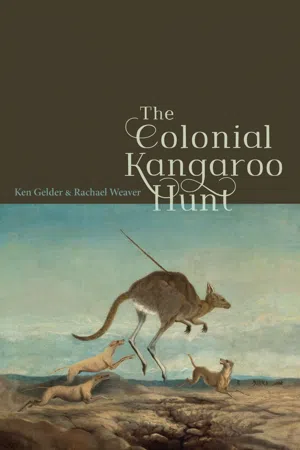
From the arrival of Captain James Cook in 1770 to classic children's tale Dot and the Kangaroo, Ken Gelder and Rachael Weaver examine hunting narratives in novels, visual art and memoirs to discover how the kangaroo became a favourite quarry, a relished food source, an object of scientific fascination, and a source of violent conflict between settlers and Aboriginal people. The kangaroo hunt worked as a rite of passage and an expression of settler domination over native species and land. But it also enabled settlers to begin to comprehend the complexity of bush ecology, raising early concerns about species extinction and the need for conservation and the preservation of habitat.
- English
- ePUB (mobile friendly)
- Available on iOS & Android
eBook - ePub
The Colonial Kangaroo Hunt
About this book
Trusted by 375,005 students
Access to over 1 million titles for a fair monthly price.
Study more efficiently using our study tools.
Information
1
Shooting the First Kangaroos
Who shot the first kangaroo? Aboriginal people hunted kangaroos with spears and clubs for thousands of years, of course, either alone or in groups. Penny Olsen and Lynette Russell note the wide variety of Aboriginal hunting methods, ‘including pursuit with dingoes, spearing, ambush, encirclement, stockades, pitfall traps and battues, where beaters drive game towards the hunters’.1 In Dark Emu (2014), Bruce Pascoe also notes the Aboriginal use of large nets and describes the ‘battue system of kangaroo and emu harvesting’ that involved driving many of the creatures into an enclosed site and killing them en masse.2 The battue (from the French battre: to beat or hit) became important to white pastoralists after settlement too, and we shall see some examples of the large-scale extermination of kangaroos in colonial Australia later in this book. But the first shooting of a kangaroo—or rather, the first documented shooting—happened a few years before white settlement officially began.
James Cook’s first HMS Endeavour voyage around the world saw the ship grounded on a reef off the coast of far north Queensland in June and July 1770. The botanist Joseph Banks was on board, along with Daniel Solander, who had studied under the famous Swedish naturalist Carl Linnaeus; Linnaeus’s taxonomies for species classification were already profoundly influential. The Quaker artist Sydney Parkinson was also there, and Cook was assisted by a number of experienced naval officers, including Lieutenant John Gore, the Endeavour’s third in command. About ten months earlier, when the ship visited New Zealand, Gore had shot a Maori man for taking a ‘piece of Cloth’: ‘I must own it did not meet with my approbation,’ Cook reported in his journal, ‘because I thought the Punishment a little too severe for the Crime.’3 While carpenters worked to repair the damaged ship off the coast of Queensland, Cook sent some of his crew ashore to look for food. The men returned with some pigeons, and an account of a strange new species: ‘One of the Men saw an Animal something less than a greyhound; it was of a Mouse Colour, very slender made, and swift of Foot.’4 The next day Cook himself spotted a kangaroo for the first time: ‘it was of a light mouse Colour,’ he wrote, ‘and the full size of a Grey Hound and shaped in every respect like one, with a long tail, which it carried like a Grey hound; in short, I should have taken it for a wild dog but for its walking or running, in which it jump’d like a Hare or Deer.’5 Two weeks later—on 14 July 1770—Gore went into the bush with his gun. ‘Mr. Gore, being in the Country, shott one of the animals before spoke of,’ Cook reported; ‘it was a small one of the sort, weighing only 28 pounds clear of the entrails … It bears no sort of resemblance to any European animal I ever saw; it is said to bear much resemblance to the Jerboa, excepting in size, the Jerboa being no larger than a common rat.’6 Soon afterwards, Cook noted that local Aboriginal people seemed to refer to the animal as a ‘Kangooroo, or Kanguru’.7
For John Simons, the first documented shooting of a kangaroo on 14 July 1770 ‘contains in itself the microcosm of the settlement of Australia’.8 In fact, he goes on to compare Gore’s shooting with the famous ‘shot heard round the world’ fired five years later at Concord, Massachusetts, that literally triggered the American Revolution. Perhaps this is making too much of the reflex action of the man Tim Flannery has called ‘the Endeavour’s most accomplished hunter’.9 Even so, Simons is right to note that this event had much larger and more long-lasting ramifications both for native species and for Aboriginal people—who were also fired upon with muskets by the Endeavour’s crew. It is certainly a foundational moment in the violent European settlement of Australia.
The first shooting of a kangaroo happens simultaneously with the naming of the species, as if the two things are inevitably tied together. Markham Ellis has noted that the Endeavour’s naturalists were also interested in ‘collecting vocabulary’ and drew on local Aboriginal names for the kangaroo: for example, the Guugu Yimidhirr word ganguru, ‘which signified one of the five kangaroo and wallaby species indigenous to Endeavour River’.10 There is a common view that the naming of the kangaroo was also a misnaming based on Banks’s misunderstanding of his Aboriginal interlocutors (or vice versa). Ellis suggests that ‘the adoption of an Indigenous name was not accorded to other species where Banks was more confident of his classification’; but he adds that the word kangaroo ‘was an unstable Anglophonisation … of an Indigenous word’.11
To shoot a native species and to name that species are both colonising acts. Soon afterwards, naturalists would compete with each other to give the kangaroo its scientific name. It was the English zoologist George Shaw who eventually succeeded and, as Danielle Clode notes, ‘the full taxonomic designation of the species’ is now in fact ‘Macropus giganteus Shaw 1790’.12 But something interesting happened with Cook’s earlier Aboriginal-derived naming of the kangaroo that, for a moment at least, placed this creature outside the developing taxonomic framework of Western scientific classifications of species.
In Cook’s descriptions above, the kangaroo is perhaps surprisingly compared to a greyhound. Banks kept a greyhound on the Endeavour that soon afterwards joined in the hunt for kangaroos. In his journal of the expedition, the botanist has a running title for this earliest of encounters—Kill Kanguru—that both names the new species and immediately sentences it to death.13 The kangaroo, Banks writes, ‘hops so fast that in the rocky bad ground where it is commonly found it easily beat my grey hound, who tho he was fairly started at several killd only one and that quite a young one’.14 Banks’s greyhound in effect becomes the first imported kangaroo dog, killing the creature to which it is also descriptively connected in these early explorer accounts. This particular event takes place on 29 July in Banks’s journal and sets an early size limit on the greyhound’s capacity to kill: ‘we saw few and killd one very small one which weighd no more than 8½ lb. My greyhound took him with ease tho the old ones were much too nimble for him.’15 Banks goes on to record and confirm the Aboriginal name for the creature, kangooroo. The ‘largest we shot’, he adds, ‘weighd 84 lbs’.16 This is the third kangaroo killing recorded in the early journals. It happened on 27 July, two weeks after Gore’s first shooting and two days before the greyhound kills the juvenile. Cook himself gives a functional, understated account of the event, rounding down the weight prior to the kangaroo’s dismemberment: ‘Mr. Gore shott one of the Animals before spoke of, which weighed 80 lbs. and 54 lbs., exclusive of the entrails, Skin, and head; this was as large as the most we have seen.’17 Banks also devotes a brief entry to the 27 July killing, lending the kangaroo a kind of feral anonymity: ‘This day was dedicated to hunting the wild animal. We saw several and had the good fortune to kill a very large one which weighd 84 lb.’18
Cook’s journal entry for 27 July goes on to provide a sense of just how quickly the body of the kangaroo was dismantled into its component parts—for scientific analysis, but also to provide meat for an expedition low on provisions. His blunt account of the stripping-down of the animal contrasts with Banks’s comments on the treatment of the one Gore had shot two weeks earlier, which was much smaller, at 28 pounds. ‘The Beast which was killd yesterday’, Banks writes, ‘was today Dressd for our dinner and provd excellent meat.’19 This is an expression of refined culinary taste by an English, Eton-educated soon-to-be-baronet, an immensely wealthy landowner—the complete opposite of Cook, who was the son of a Scottish farm labourer. The Endeavour’s crew were hunting and eating a number of native species: pigeons, turtles (which Banks also relished) and shellfish. But the kangaroo is the first native species to be placed in an aristocratic, epicurean register. Having stripped the creature down, they perform the civilising ritual of ‘dressing’ (the word is capitalised) it for dinner; they then value the taste of this new form of game meat accordingly. They do the same with the 84-pound kangaroo shot two weeks later, but this time Banks’s culinary tastes are disappointed: ‘Dind today upon the animal, who eat but ill, he was I suppose too old. His fault however was an uncommon one, the total want of flavour, for he was certainly the most insipid meat I eat.’20

As we shall see, shooting the kangaroo is the first in a chain of reactions to species that works to secure colonisation in the New World: skinning, butchering, cooking, preserving and eating; but also culling, clearing, managing and trading; and scientifically recording, dissecting, classifying and stuffing (taxidermy); and producing along the way an immense amount of commentary, a great many sketches, poems and novels, and a number of significant works of art.
Sydney Parkinson was one of two artists or ‘draughtsmen’ on the Endeavour; he is best known for the extensive collection of botanical drawings and watercolours he completed on the journey, now held at the Natural History Museum in London. Parkinson died of dysentery and malaria on board the Endeavour on 26 January 1771 but kept his own journal of the expedition, which was published posthumously in 1773. This was the same year John Hawkesworth published a commissioned edition of Cook’s journal that notoriously took a number of liberties with the text, mixing up details from Cook and Banks, adding some of Hawkesworth’s own observations, ‘weaving together an imagined, composite point of view’,21 and incorporating some of Parkinson’s sketches without acknowledgement. Parkinson’s grieving brother, Stanfield, was keen to publish Sydney’s journal himself and argued bitterly with Banks and Hawkesworth, who both took legal measures to try to stop his publication going ahead. Most commentators have been flatly unsympathetic to Stanfield’s role here;22 but Noah Heringman has offered a different perspective, arguing that Stanfield’s claims to his brother’s intellectual property (drawings, notes, collected items) were perfectly reasonable under the circumstances.23 Stanfield’s preface to the eventual 1773 publication of Sydney’s journal certainly gives an aggrieved, often downright furious account of Hawkesworth’s and Banks’s various threats and transactions. The journal entries themselves, on the other hand, quietly bask in the abundance and complexity of the natural world, offering vivid, colourful descriptions of the various examples of native flora and fauna that Sydney was seeing for the first time. His account of the kangaroo is the most detailed and keenly observed of any of the Endeavour journals, although it echoes Cook and Banks in several ways, not least through that peculiar tendency to compare the kangaroo to a greyhound. The kangaroo is, he writes,
an animal of a kind nearly approaching the mus genus, about the size of a grey-hound, that had a head like a fawn’s; lips and ears, which it throws back, like a hare’s; on the upper jaw fix large teeth; on the under one two only; with a short and small neck, near to which are the fore-feet, which have five toes each, and five hooked claws; the hinder legs are long, especially from the last joint, which, from the callosity below it, seems as if it lies flat on the ground when the animal descends any declivity; and each foot had four long toes, two of them behind, placed a great way back, the inner one of which has two claws; the two other toes were in the middle, and resembled a hoof, but one of them was much larger than the other. The tail, which is carried like a grey-hound’s, was almost as long as the body, and tapered gradually to the end. The chief bulk of this animal is behind; the belly being largest, and the back rising toward the posteriors. The whole body is covered with short ash-coloured hair; and the flesh of it tasted like a hare’s, but has a more agreeable flavour.24
Banks and Parkinson were active participants in what Peter Macinnis calls ‘evidence-eating science’,25 which saw naturalists routinely consume the species they killed and examined. The taste of the meat becomes one more way of classifying, and distinguishing between, different species. Kangaroo meat, for example, is ranked in relation to other examples of game more familiar to Europeans: for Parkinson, the kangaroo has ‘a more agreeable flavour’ than, say, hare.
But before it can be eaten, each part of the kangaroo must be carefully described and detailed. This was a...
Table of contents
- Cover
- Title
- Copyright
- Contents
- Acknowledgements
- Note on measurements
- 1. Shooting the First Kangaroos
- 2. Settlers, Aboriginal People and the Kangaroo Hunt
- 3. The Kangaroo Hunt as Sport
- 4. The Kangaroo Hunt Poem
- 5. Dogs, Skins and Battues
- 6. Colonial Kangaroo Hunt Novels and Fantasies
- Notes
- Bibliography
- Picture credits
- Index
Frequently asked questions
Yes, you can cancel anytime from the Subscription tab in your account settings on the Perlego website. Your subscription will stay active until the end of your current billing period. Learn how to cancel your subscription
No, books cannot be downloaded as external files, such as PDFs, for use outside of Perlego. However, you can download books within the Perlego app for offline reading on mobile or tablet. Learn how to download books offline
Perlego offers two plans: Essential and Complete
- Essential is ideal for learners and professionals who enjoy exploring a wide range of subjects. Access the Essential Library with 800,000+ trusted titles and best-sellers across business, personal growth, and the humanities. Includes unlimited reading time and Standard Read Aloud voice.
- Complete: Perfect for advanced learners and researchers needing full, unrestricted access. Unlock 1.4M+ books across hundreds of subjects, including academic and specialized titles. The Complete Plan also includes advanced features like Premium Read Aloud and Research Assistant.
We are an online textbook subscription service, where you can get access to an entire online library for less than the price of a single book per month. With over 1 million books across 990+ topics, we’ve got you covered! Learn about our mission
Look out for the read-aloud symbol on your next book to see if you can listen to it. The read-aloud tool reads text aloud for you, highlighting the text as it is being read. You can pause it, speed it up and slow it down. Learn more about Read Aloud
Yes! You can use the Perlego app on both iOS and Android devices to read anytime, anywhere — even offline. Perfect for commutes or when you’re on the go.
Please note we cannot support devices running on iOS 13 and Android 7 or earlier. Learn more about using the app
Please note we cannot support devices running on iOS 13 and Android 7 or earlier. Learn more about using the app
Yes, you can access The Colonial Kangaroo Hunt by Ken Gelder, Rachael Weaver in PDF and/or ePUB format, as well as other popular books in History & Australian & Oceanian History. We have over one million books available in our catalogue for you to explore.