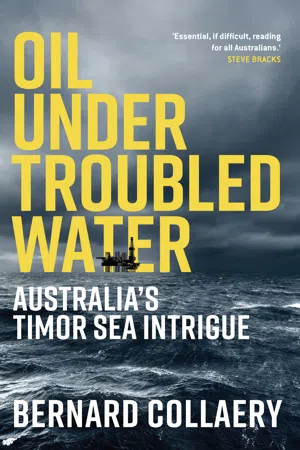
In May 2018 Bernard Collaery, a former Attorney-General of the Australian Capital Territory and long-term legal counsel to the government of East Timor, was charged by the Australian Commonwealth Director of Public Prosecutions with conspiracy to breach the Intelligence Services Act 2001. He was forbidden from talking about the charges against him, but under parliamentary privilege independent MP Andrew Wilkie revealed what has since been described as 'Australian politics' biggest scandal'.Five years earlier, after ASIO officers raided Collaery's home and office, Collaery told journalists that ASIS had been bugging the East Timorese government during negotiations over Timor Sea oil. He was about to represent East Timor; as well as calling the evidence of a former senior ASIS agent known publicly only as Witness K, at The Hague in a case against the Australian government. Oil Under Troubled Water relates the sordid history of Australian government dealings with East Timor, and how the actions of both major political parties have enriched Australia and its corporate allies at the expense of its tiny neighbour and wartime ally, one of the poorest nations in the world.
- English
- ePUB (mobile friendly)
- Available on iOS & Android
eBook - ePub
About this book
Information
1
THE ATLANTIC CHARTER—‘WHITHER THOU GOEST’
The Australian Government’s emphatic response to the Atlantic Charter is a useful starting point for the story of Australia’s relations with East Timor. The Charter’s drafting history tells much about a new world order insisted upon by President Franklin Roosevelt and embraced more wholeheartedly by Australia than by Britain. The Charter sentiments, widely publicised, gave promise of a more secure post-war society watched over by the United States and Britain.
After three days of talks aboard warships anchored in Placentia Bay, Newfoundland, British Prime Minister Winston Churchill and US President Franklin Roosevelt released an eight-point joint declaration on 14 August 1941, soon after captioned ‘The Atlantic Charter’.1 Among other declarations of principle, the Charter affirmed the right of all peoples ‘to choose the form of governments under which they will live’. Within three years, Roosevelt’s proposal at Placentia Bay of two great powers policing a post-war world evolved into a United Nations world order.
With Roosevelt’s New Deal response to the Great Depression widely admired within the Australian Labor Party (ALP), the Atlantic Charter’s assurance of a more egalitarian post-war world order had an immediate impact on Labor’s formulation of an independent Australian foreign policy. Although there was nothing new in the exposition of principle in the Charter,2 the timing was of great significance. President Roosevelt and sections of the US Congress were anxious that the US not be brought into a war that would restore the old order. Having formulated a statement of four basic freedoms in his annual address to Congress on 6 January 1941, Roosevelt now appeared to find common ground with Churchill for the restoration of democracy in Europe and democratic progress elsewhere.
A working concept for a declaration was discussed aboard the USS Tuscaloosa by Roosevelt luminary Under Secretary of State Sumner Welles and Foreign Office head Sir Alexander Cadogan on 9 August 1941,3 after Roosevelt and Churchill had met that morning and agreed that they should issue a joint declaration of ‘the aims and desires of the two governments regarding the kind of world that should be constituted after the war. It was to be regarded as a summary of the objectives of those nations opposed to the domination of the world by the Axis powers’.4 Welles and Cadogan, to whom Churchill had assigned Britain’s role in drafting the declaration, spent the afternoon at Welles’ desk on the Tuscaloosa weaving the thoughts of the two leaders into a joint declaration of war aims.5 Both men had preconceived notions of what each side hoped to achieve from the declaration. Cadogan was privy to discussions between Churchill and Roosevelt’s adviser Harry Hopkins en route to Placentia Bay, and, according to Roosevelt’s son, Welles had flown from Washington with a working draft.6 Hopkins had crossed the Atlantic with Churchill and was empathetic to Britain’s predicament. Churchill later made clear that he both anticipated and was receptive to Roosevelt’s idea of a joint declaration of principles.7
While Churchill recognised that a joint declaration in lofty terms had to come, his unwavering purpose was to edge a supposedly neutral US further into the European war and to secure immediate support for a strong warning to Japan. On the first evening, Churchill retired to his quarters aboard HMS Prince of Wales and committed his thoughts to a draft, which Cadogan took to Roosevelt’s wardrooms aboard the USS Augusta and gave to Welles. Churchill’s draft opened with a statement as to why the leaders had settled on the need for such a declaration, which Welles recalled ‘glowed with Churchill’s genius’.8 Although the onboard working papers and secret cables to London, Stalin and the Dominion governments referred to a proposed declaration of ‘war aims’, the document as released had become, for Congressional digestion, a declaration of principles ‘on which they base their hopes for a better future for the world’. The second section of Churchill’s draft contained the text of the declarations, which was rewritten, as Welles found Churchill’s declarations ‘too vague or too sweeping’.9 From the language adopted, one may recognise that in framing the principles, Cadogan allowed Welles to adapt phrases from Roosevelt’s speeches, settled American doctrine and Welles’ own recent pronouncements.10
Under Secretary Welles had known Eleanor Roosevelt since childhood and for many years, much to Secretary of State Hull’s chagrin, had enjoyed privileged access to the President. A reading of Welles’ wartime speeches leaves little doubt that Welles was contributing from personal conviction to the Charter drafting.11 Neither Hopkins nor Sumner Welles throw much light in their accounts of the Charter drafting on the consultation process, if any, with Congressional leaders on the draft before a further version was handed to Churchill around midday on 11 August 1941. Shortly afterwards, and conscious that the meeting was due to conclude the following morning, Churchill cabled his all but formally declared Deputy Prime Minister Clement Attlee, informing him that Roosevelt wanted to release a declaration of war aims after the meeting and asking Attlee to summon the full War Cabinet that evening and let him have a response to ‘the Roosevelt draft … without the slightest delay’.12 In his cable to Attlee, Churchill proposed several wording changes to the ‘free-trade’ fourth paragraph and a qualified reference to the League of Nations in paragraph seven. Neither Roosevelt nor Churchill was keen on any commitment to revive the League. The Welles/Cadogan redraft that Churchill represented to Attlee as Roosevelt’s draft was sent unchanged a minute later by separate cable.13
The full War Cabinet met immediately and responded in two cables. The first, at 4:10 am on 12 August 1941, requested two changes: first, the addition to Roosevelt’s free-trade paragraph four of the words ‘and to promote greatest possible expansion of markets for the interchange of goods and services throughout the world’; and second, the insertion between Roosevelt’s paragraphs four and five of a new paragraph— ‘Fifth. They support the fullest collaboration between nations in the economic field with the object of securing for all peoples’ freedom from want, improved labour standards, economic advancement and social security’.14 Authorship of this paragraph, later given hallowed status in British Labour Party history as ‘the social security clause’, was attributed to the Minister for Labour and National Service Ernest Bevin and became a Labour Party rubric.
The War Cabinet’s second cable proposed the addition before the word ‘promote’ in paragraph four of the words, ‘with due respect to their existing obligations’.15 Later that day Churchill advised Attlee that Roosevelt had accepted all of the amendments proposed by Britain.16 Soon afterwards Churchill took the precaution of requesting the Dominions Office to inform Dominion governments immediately that the text of a joint declaration of war aims would soon be released and that a reference to ‘economic co-operation’ should not be interpreted as prejudicing imperial trade preferences agreed at the 1932 Ottawa Conference.17 After Welles returned to Washington, Secretary of State Hull berated him for not securing from Britain a clear commitment to abolish the imperial trade preferences that so offended US free-trade sentiments.18
Beyond the addition of the fifth paragraph concerning social security and a revised wording of the free-trade declaration, there was little substantive change to the seven-point Welles/Cadogan draft. While the final eight-article declaration was issued officially as a joint US–Britain effort, the ideology sprang from the New World19 and was what the labour parties in Britain and Australia wanted to hear. Those working on the draft were settling on a page that would become for generations the catch-cry of US democratisation. Unsurprisingly, Attlee’s papers reveal that the text of the draft Charter evoked a unanimous assent from his Labour colleagues in the War Cabinet.20 With Churchill’s astute encouragement, Attlee wasted no time in broadcasting to the world by BBC Radio the text of the Charter.21 Jago observes that ‘after persistently reassuring his party colleagues that Labour was faithful to socialist principles in its handling of the war, Attlee announced the Atlantic Charter, giving substance to his claim … For the first time he linked the continued fighting with a tangible step towards the extension of socialism’.22 Attlee’s words fell on receptive ears in Canberra where the ALP was to take government within two months.
Roosevelt’s White House confidante and Special Envoy to Britain, Harry Hopkins, returning to report to Roosevelt on a visit to Russia, accompanied Churchill aboard HMS Prince of Wales to the Placentia Bay meeting. Roosevelt, like Hopkins, saw the necessity to counter isolationists within the war-wary US Congress by telling the American people there was a compelling ideological basis to justify more direct US support for Britain. From the start of his very personal role as Roosevelt’s emissary to Britain, Hopkins mirrored faithfully Roosevelt’s grand vision of a New Deal for democracy. The fervour with which Roosevelt and Hopkins set about this task as the Nazi grip on Europe tightened and war with Japan loomed, was unsurprising.
Hopkins’ first mission to London eight months earlier had been nothing less than apocalyptic. Arriving at Waterloo Station on the evening of 9 January 1941 during a heavy air raid with incendiary bombs falling on the railway lines at Clapham Junction as his train entered London,23 Hopkins was treated to the spectacle of a centre of democracy under fire. Before returning to Washington, he moved Churchill to tears when, during a dinner with Churchill and the Secretary of State for Scotland Tom Johnson, he said:
I suppose you wish to know what I am going to say to President Roosevelt on my return. Well, I’m going to quote you one verse from the Book of Books in the truth of which Mr Johnson’s mother and my own Scottish mother were brought up: Whither thou goest, I will go; and where thou lodgest, I will lodge; thy people shall be my people, and thy God my God. Even to the end.24
By March 1941 Roosevelt had secured assent to the Lend-Lease Bill,25 which not only bolstered Britain’s war effort but also accelerated US industrial preparedness for war.
Churchill had been diffident about three articles in the Rooseveltinspired Charter. First was the right to self-determination of all peoples, which Churchill knew was a necessary ingredient to assuage neutrality-minded elements of Congress, but he was not keen to see it applied to the British Empire. Second was a post-war free-trade agreement, a concept regarded with suspicion by the Conservative Party, which supported Imperial trade preferences. Third was the reference to a world free ‘from want and fear’, whatever that meant to the non-New Deal minded Churchill. Churchill accepted a commitment to self-determination at the time, but later qualified Britain’s intention. Roosevelt conceded a tweaking of the free-trade declaration, and, on the ‘freedom from want and fear’ issue Roosevelt accepted readily, in British Labour terms, a more specific commitment to ‘social security’.
Reporting on his meeting with Churchill to Congress, President Roosevelt affirmed a broad application of the Charter.26 This was certainly the interpretation of Australian Prime Minister Robert Menzies, who told the Australian Parliament that the Charter was ‘a reminder to us that the new order of the world, of which we have from time to time spoken, is now in the making’.27 In his statement to the House of Commons on 9 September 1941, Churchill referred to progress towards constitutional government in India, Burma and other parts of the British Empire and claimed that the Charter referred primarily to European States under Nazi domination.28 He told the House of Commons that the Charter was ‘a statement of certain br...
Table of contents
- Cover
- Title Page
- Copyright Page
- Contents
- Preface and Acknowledgements
- A Note on Sources and the Limitations of Archival Research
- Introduction
- 1 The Atlantic Charter—‘Whither Thou Goest’
- 2 The Allies, Australia and Portuguese Timor
- 3 After the War—The Vision Fades
- 4 Australia and Portuguese Timor
- 5 The Australian Continental Shelf—Declaring Boundaries
- 6 Post-Colonial Abandonment—Australia and the Indonesian Occupation of Timor-Leste
- 7 Timor-Leste Edges Towards Independence
- 8 Transition in Timor-Leste and the Timor Gap Treaty
- 9 The Transitional Government Negotiates a New Treaty
- 10 ‘Independence’ for Timor-Leste
- 11 The FALINTIL Tragedy
- 12 Australian Opportunism
- 13 Lighter Than Air—The Helium Escapes
- 14 A Matter for Inquiry
- 15 Australian Gameplay
- 16 Export Trade Versus Defence
- 17 Determining Maritime Boundaries
- 18 Timor-Leste Complains
- 19 The Universal Relevance of the Rule of Law
- Notes
- Index
Trusted by 375,005 students
Access to over 1.5 million titles for a fair monthly price.
Study more efficiently using our study tools.
Frequently asked questions
Yes, you can cancel anytime from the Subscription tab in your account settings on the Perlego website. Your subscription will stay active until the end of your current billing period. Learn how to cancel your subscription
No, books cannot be downloaded as external files, such as PDFs, for use outside of Perlego. However, you can download books within the Perlego app for offline reading on mobile or tablet. Learn how to download books offline
Perlego offers two plans: Essential and Complete
- Essential is ideal for learners and professionals who enjoy exploring a wide range of subjects. Access the Essential Library with 800,000+ trusted titles and best-sellers across business, personal growth, and the humanities. Includes unlimited reading time and Standard Read Aloud voice.
- Complete: Perfect for advanced learners and researchers needing full, unrestricted access. Unlock 1.5M+ books across hundreds of subjects, including academic and specialized titles. The Complete Plan also includes advanced features like Premium Read Aloud and Research Assistant.
We are an online textbook subscription service, where you can get access to an entire online library for less than the price of a single book per month. With over 1.5 million books across 990+ topics, we’ve got you covered! Learn about our mission
Look out for the read-aloud symbol on your next book to see if you can listen to it. The read-aloud tool reads text aloud for you, highlighting the text as it is being read. You can pause it, speed it up and slow it down. Learn more about Read Aloud
Yes! You can use the Perlego app on both iOS and Android devices to read anytime, anywhere — even offline. Perfect for commutes or when you’re on the go.
Please note we cannot support devices running on iOS 13 and Android 7 or earlier. Learn more about using the app
Please note we cannot support devices running on iOS 13 and Android 7 or earlier. Learn more about using the app
Yes, you can access Oil Under Troubled Water by Bernard Collaery in PDF and/or ePUB format, as well as other popular books in Politics & International Relations & Politics. We have over 1.5 million books available in our catalogue for you to explore.