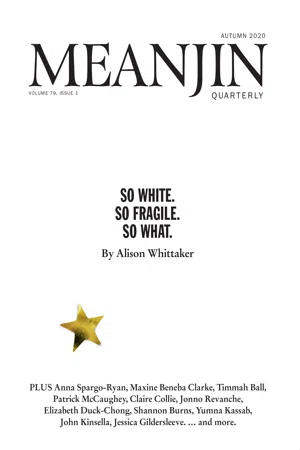
In this edition's cover essay, Gomeroi poet, essayist and scholar Alison Whittaker takes on the idea of white fragility and asks 'Has white people becoming more aware of their fragilities and biases really done anything for us; aside from finding a new way to say 'one of the good ones' or worse, asking us to?'. Whittaker aims squarely at a progressive white culture that sees an elevated racial conscience as a path to post-colonial innocence. In other essays, Timmah Ball asks that most fundamental of questions: Why Write? 'Were they looking for the next successful blak book... ' while Anna Spargo-Ryan writes powerfully on the often-brutal history of abortion in women's lives and men's politics. Rick Morton shares his version of Australia in Three Books and Maxine Beneba Clarke considers risk and writers' acts of courage. New fiction from Yumna Kassab, Sue Brennan, Nick Robinson and John Kinsella, and poetry by Ouyang Yu, Sarah Holland-Batt, Marija Pericic and Andrew Sant.
- English
- ePUB (mobile friendly)
- Available on iOS & Android
eBook - ePub
Meanjin Vol 79 No 1
About this book
Trusted by 375,005 students
Access to over 1.5 million titles for a fair monthly price.
Study more efficiently using our study tools.
Information
Subtopic
Literary EssaysIndex
LiteratureESSAY
SAVE US: WHAT DO WE WANT FROM OUR SUPERHEROES?
Martyn Pedler
Before it was a Bomb, the Bomb was an idea. Superman, however, was a Faster, Stronger, Better idea.
—Grant Morrison, Supergods
IT SEEMS THE superhero is an idea whose time has come. Popular culture is saturated with men and women with extraordinary powers and glib one-liners, thanks primarily to Marvel’s cinematic domination of the box office. The 22nd film made by Marvel Studios—Avengers: Endgame (Anthony and Joe Russo, 2019)—bested James Cameron’s Avatar (2009) as the biggest movie of all time, reaping almost US$2.8 billion. Collecting comic books might remain a niche activity, but the superheroes born in their pages are everywhere. As critic Glen Weldon says, ‘The wall between nerd and normal is now a thin, permeable membrane through which ideas like Batman flow freely back and forth.’1
This isn’t the first superhero boom. The first occurred barely after the superhero was born. The general consensus is that it took place in 1938 with Action Comics #1 and the first appearance of Superman. While there had been pulp heroes before him—Zorro, Doc Savage, The Shadow—Superman’s teenage creators, Jerry Siegel and Joe Shuster, seemed to create something entirely new. Superman appears on the cover, effortlessly lifting a car overhead; in the bottom-left corner, there’s a man losing his mind at the sight of it. He wasn’t the only one. Superman scholar Ian Gordon describes the character as one that ‘by 1941 appeared in the monthly Action Comics and the bimonthly Superman comic book, a radio serial that aired three times a week, and a comic strip carried by 230 newspapers to a combined circulation of twenty-five million readers’.2 DC licensed the character to a toy company the year after he first appeared, already proving that Superman is as much a corporate brand as a superheroic character. Gordon adds, ‘Not only has Superman sold us an array of products from peanut butter to American Express cards, but these products have sold us Superman.’3
Tim Burton’s blockbuster Batman (1989) made the bat symbol so ubiquitous that superhero writer and editor Paul Levitz said ‘it was virtually impossible to buy black T-shirts in America not emblazoned with the Bat-symbol’.4 The superhero logo is about more than easy branding opportunities. It’s a way of holding together all the various incarnations of a character.5 The gun-toting Batman of his earliest comic book appearances? The utterly and comedically sincere Batman of the 1960s TV show? The grim-and-gritty Batman of 1980s graphic novels? They’re all contained in that simple logo. One of the differences between superheroes and the various ‘mystery men’ who preceded them is that, according to comic book academic Peter Coogan’s definition, the superhero costume proclaims their identity; furthermore, ‘The chevron especially emphasizes the character’s code name and is itself a simplified statement of that identity.’6 More succinctly, as cult comic book writer Grant Morrison puts it, ‘Superman was his own T-shirt.’7
But why this contemporary resurgence? Academic Liam Burke boils down the main reasons to three, and we’ve already discussed the third: ‘Contemporary filmmaking paradigms that favor content with a preexisting fan base and an amenability to franchise.’8 Superman’s radio show in the 1930s immediately proved this franchise potential, as did the onslaught of Batman branding in the 1980s. When Disney acquired Marvel Entertainment for $4.24 billion in 2009, it added a constellation of superheroes to its overwhelming catalogue of beloved intellectual property. Variety went so far as to say that Disney doesn’t just own our childhood stories, it owns ‘all the mythologies’.9 It’s why I don’t need to explain who Batman is, or what Superman’s origin might be, or how Spider-Man’s powers work—you already know. You may not read their comics or watch their movies, but these narratives have seeped into general consciousness. According to Bradford W. Wright, Superman’s story is as ‘as familiar as any in the English language’.10

Another reason for the current popularity of superheroes is that new technology allows spectacle from the comic page to be more easily re-created on screen. Superman: The Movie (Richard Donner, 1978) promised us that, thanks to cutting-edge effects, we’d ‘believe a man can fly’. It took a little longer for us to believe a man could swing from a web. As Spider-Man (2002) director Sam Raimi said of its hero, ‘I don’t think there’s ever been a time in history, up until now, that you really could have made this Spider-Man picture.11 CGI spectacle has its own Kryptonite, however. As superhero scholar Scott Bukatman writes in the provocatively titled ‘Why I Hate Superhero Movies’, digital imagery often produces ‘some vaguely rubberoid action figures harmlessly bouncing each other around the space’.12 It’s one thing for a superhero to defy gravity. It’s another for them to become weightless, and too many of these films still have a third act that’s mostly pixels mashing together. This tendency was satirised in Spider-Man: Far from Home (Jon Watts, 2019), as the villain Mysterio’s illusions needed destructive drones behind them to add any kind of impact.
These industrial reasons for peak superhero, however, seem unsatisfying. Burke’s remaining reason for superhero prevalence feels the most intuitive, the most powerful: ‘Cultural traumas and the celebration of the hero following real-life events, in particular the 9/11 terrorist attacks.’13 Many creators agree with this position; for example, Iron Man (2008) director Jon Favreau said 9/11 set the stage for the popularity of the movie.14 These characters require cultural trauma to justify their existence. Frank Miller, the man behind the iconic Dark Knight Returns comics from 1986, once said that Batman ‘works best in a society that’s gone to hell. That’s the only way he’s ever worked.’15 Unless we need saving, superheroes are pointless. Luckily, then, we’re not exactly in danger of living in a risk-free utopia. This leaves superheroes free to embody what Ben Saunders poetically describes in his book Do the Gods Wear Capes? as ‘the wish that things were otherwise’.16
You can see this desire in the reaction of superhero stories to the September 11 attacks. Media theorist Henry Jenkins writes that they brought superheroes ‘back to their core and renewed the themes and iconography of the Cultural Front for a new generation’.17 Further back, Japan’s attack on Pearl Harbor in 1941 has been described as America’s traumatic origin story, its radioactive spider-bite, transforming the country into its own kind of ‘superhero’.18 Remember the famous image of Captain America socking Hitler in the jaw from Captain America #1? It was published before America entered the war. The comic’s creators weren’t just capturing the patriotic zeitgeist. They were attempting to move its needle. Despite Captain America’s blow, however, the real Hitler remained stubbornly difficult to defeat. DC Comics also struggled with this during Vietnam: ‘How was it that a being so powerful could not simply end the war?’ Instead Superman chose to leave the fight to US troops; this highlighted his faith in the capabilities of American men and women.19 Superheroes can’t end war. No matter how powerful they might be, real history—with real casualties—is more powerful.
In the aftermath of 9/11, then, superheroes struggled to make sense of the attacks that also occurred in their fictionalised New York. (While DC is more famous for the New York-inspired Gotham and Metropolis, its universe has a New York City, too, just like Marvel.) A sombre, black-covered issue of Amazing Spider-Man had superheroes gathering, shocked, in the aftermath of the 9/11 attacks; it was mocked for depicting even the villainous Doctor Doom weeping over the dead.20 Other stories had superheroes pointing out that the heroes of 9/11 were the all-too-human first responders. ‘Next to policemen, firemen, doctors, nurses, and selfless civilians,’ writes Morrison, ‘the superheroes were silly, impotent daydreams, and for a moment, they seemed to falter, aghast.’21 Henry Jenkins wonders whether ‘Superman is more important than the average men and women who are accidental casualties of his power struggles, or whether everyday people have the power to solve their problems without turning to superheroes for help’.22 Marvel Comics even attempted a handful of titles featuring these heroic first responders under the title The Call of Duty (2002), but they didn’t last. For all the attempts to show superheroes in awe of ‘real heroes’, audiences wanted the former, not the latter.
When audiences received Superman Returns (Bryan Singer, 2006), it showed deliberate visual echoes of 9/11. Now, however, Superman is there to help. He destroys falling debris with his heat vision and catches people plummeting from buildings. These echoes aren’t just there to borrow the power of real-life tragedy, they allow that tragedy to be prevented.23 In Superman Returns, 9/11’s famous ‘Falling Man’—the man who jumped from the towers to his death, as photographed by Richard Drew—can live. This made the fantasy of the following Superman movie, Zack Snyder’s Man of St...
Table of contents
- COVER
- TITLE
- COPYRIGHT
- CONTENTS
- EDITORIAL
- NATIONAL ACCOUNTS
- THE ART OF GOVERNANCE
- MEN FEELING IMPORTANT
- BORDER CONTROL
- FEELING THE FOREST
- AN IRRELEVANT STATE
- AUSTRALIA IN THREE BOOKS
- WHY WRITE?
- AGE, CLASS, POLITICS
- CROSSES, FLAGS, ARCHES
- A CONSPIRACY OF WITCHES
- DIGITAL INTIMACY AND THE AESTHETICISATION OF SOUND
- ON WRITING AND RISK
- STREAM DRAMA
- BLASPHEMY, ITALIAN STYLE
- THE SECRET MISFORTUNE OF THE LUCKY COUNTRY
- BERLIN: THE BURDEN OF THE PAST
- SAVE US: WHAT DO WE WANT FROM OUR SUPERHEROES?
- SO WHITE. SO WHAT.
- YARRAVILLE RIFIFI: MY LIFE IN CINEMA AND CRIME
- THE RATS OF THE SKY
- OLD WIVES’ TALES
- WHEN WE TALK ABOUT MOTHERHOOD
- PLEASE SHUT THE DOOR QUIETLY
- THREE STORIES
- FEEDING TIME
- THE WATCH
- HERE BE LIONS
- LETTER TO THE AUSTRALIANS
- TELLING TUNE
- THE BURDEN OF SHAME
- TWO SURVEYS, TWO MILESTONES: ONE PREMATURE DEATH
- Australian Films
- Over the Mountains and Far Away
- Two Figures at a Window
- Passionfruit
- Between the Pen and the Roundabout
- The Jaguar
- Fish Market
- The Cloud, the Tree, and the South Wind
- Rodent Brain Slices
- Until Java
- Medical Developments
- Aviation
- Poetry contributors
Frequently asked questions
Yes, you can cancel anytime from the Subscription tab in your account settings on the Perlego website. Your subscription will stay active until the end of your current billing period. Learn how to cancel your subscription
No, books cannot be downloaded as external files, such as PDFs, for use outside of Perlego. However, you can download books within the Perlego app for offline reading on mobile or tablet. Learn how to download books offline
Perlego offers two plans: Essential and Complete
- Essential is ideal for learners and professionals who enjoy exploring a wide range of subjects. Access the Essential Library with 800,000+ trusted titles and best-sellers across business, personal growth, and the humanities. Includes unlimited reading time and Standard Read Aloud voice.
- Complete: Perfect for advanced learners and researchers needing full, unrestricted access. Unlock 1.5M+ books across hundreds of subjects, including academic and specialized titles. The Complete Plan also includes advanced features like Premium Read Aloud and Research Assistant.
We are an online textbook subscription service, where you can get access to an entire online library for less than the price of a single book per month. With over 1.5 million books across 990+ topics, we’ve got you covered! Learn about our mission
Look out for the read-aloud symbol on your next book to see if you can listen to it. The read-aloud tool reads text aloud for you, highlighting the text as it is being read. You can pause it, speed it up and slow it down. Learn more about Read Aloud
Yes! You can use the Perlego app on both iOS and Android devices to read anytime, anywhere — even offline. Perfect for commutes or when you’re on the go.
Please note we cannot support devices running on iOS 13 and Android 7 or earlier. Learn more about using the app
Please note we cannot support devices running on iOS 13 and Android 7 or earlier. Learn more about using the app
Yes, you can access Meanjin Vol 79 No 1 by Jonathan Green in PDF and/or ePUB format, as well as other popular books in Literature & Literary Essays. We have over 1.5 million books available in our catalogue for you to explore.