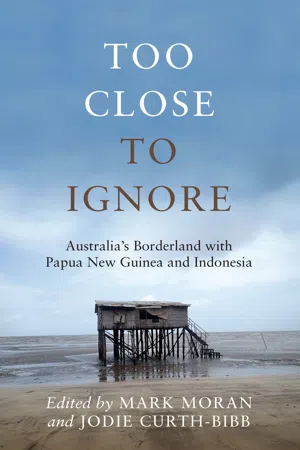
Less than five kilometres from Australia's most northern islands in the Torres Strait lies the southern coast of Papua New Guinea (PNG). The people living on the PNG side of the border along the South Fly coast live in abject poverty, with a near total absence of services and infrastructure. The disparity in income, housing and health outcomes when compared with their nearby neighbours and relatives in the Torres Strait Islands, is extreme. The border is the focus of a range of interventions by the Australian and Queensland governments, including border protection, quarantine, marine resource management, and infectious disease control, including an alarming outbreak of multi-drug resistant tuberculosis. Restrictions are increasing on trading, fishing and access to Australian services. However, questions remain as to whether this focus is having unintended consequences, increasing the destitution and frustration on the PNG side, in turn exacerbating the security threat to Australia. And as the Australian border hardens, the Indonesian border beckons. This book presents the results of three years of research into the unique social and political geography of the borderland. The Torres Strait Treaty between Australia and PNG serves to construct a complex institutional layering, a tiered economy and a hierarchy of identities between those South Fly villagers who have rights under the Treaty to travel into Australia, and those who do not. This creates a politics of expectation and frustration that permeates everyday life along the South Fly coast, through which development projects must navigate.
eBook - ePub
Too Close to Ignore
Australia's Borderland with PNG and Indonesia
- English
- ePUB (mobile friendly)
- Available on iOS & Android
eBook - ePub
About this book
Trusted by 375,005 students
Access to over 1.5 million titles for a fair monthly price.
Study more efficiently using our study tools.
Information
Subtopic
Global Development StudiesIndex
Social SciencesChapter 1
Introduction
Less than five kilometres from Australia’s northernmost island lies the southern coast of Papua New Guinea (PNG) (figure 1.1). Just 15 to 20 minutes in a dinghy (depending on the weather) and you are there. This geographical proximity is matched by a cultural closeness, as the people on either side of this passage of water have a long history of reciprocal relationships and shared identity. Despite this closeness, these peoples face a starkly different future, and they could hardly be further apart in terms of quality of life, well-being and access to opportunity.
The villagers on the PNG side of the border experience acute disadvantage. They rely on water tanks (which are often poorly maintained) or are forced to walk long distances to get fresh water; transport by dinghy is extremely expensive and at times dangerous; there is no electricity; the few health facilities that exist are often ill-equipped and unstaffed; and students often need to travel long distances to get to a primary school. Houses are made of bush materials and are not mosquito-proof. Villagers either use a pit latrine, if the household has one, or they use the beach or the bush for a toilet. There is limited access to markets and limited employment opportunities close to home.
South Fly District of Western Province PNG can be seen as something akin to a triangle, defined by three powerful external influences: the Torres Strait Islands of Australia, the Merauke Regency of Indonesia and the Fly River Corridor, with the mining benefits and environmental impacts flowing from the Ok Tedi Mine. In understanding the context, we have utilised a spatial conceptual tool that draws on the notion of a ‘borderland’, which extends beyond the district’s administrative boundaries into Australia, Indonesia and the Fly River Corridor.

Figure 1.1: Map of the South Fly–Torres Strait region. (Created by Tim Skewes and reprinted with permission from Elsevier)1
This borderland sits at the periphery of the PNG state. It receives very little in the way of public expenditure or service delivery from its government. But perversely, the prices for basic commodities are comparable to those in Torres Strait (table 1.1),2 due to the high transportation costs, and macroeconomic distortions, arising from the high levels of foreign direct investment in the PNG economy, predominantly from mining. Given the relative poverty experienced by those on the PNG side of the border, the elevated cost of goods is an enormous obstacle to development. Although many can rely on subsistence crops rather than purchasing store goods, there is no avoiding the barrier of high-cost fuel in the South Fly. Fuel is essential for basic transportation to markets and health services, but the cost of a single litre of fuel can reportedly be as high as 10 kina (approximately A$4). The cost of fuel is significantly cheaper in outer islands of the Torres Strait (A$2), and even more so across the border in Indonesia due to a state fuel subsidy.3
Table 1.1: Median basic commodity prices in the South Fly and Torres Strait Islands

Note: The currency of Papua New Guinea is Kha(K). Prices collected from five Torres Strait Islands communities and fourteen South Fly communities.
Despite these difficulties, the people maintain strong families and social bonds within their village communities. For those villages with gardens, subsistence activities provide people with sufficient food and daily exercise, although they remain vulnerable to drought. People in these villages are already well engaged with the global cash economy and with the advantages and problems it brings. Many villages are becoming increasingly dependent on processed, store-bought foods like rice, flour and sugar, which are contributing to an increase in ‘lifestyle diseases’ such as diabetes.
When PNG was still a colony of Australia, the people in the South Fly and Torres Strait Islands enjoyed close relationships that fostered mutual benefits for both parties. This began to transform after PNG gained independence in 1975. Signed in 1978 and ratified in 1985, the Torres Strait Treaty then defined the border between Papua New Guinea and Australia. The benefits that flowed to Torres Strait Islanders as Australian citizens have steadily increased ever since, lifting their living standards. Meanwhile, the people living in the South Fly have received limited support from their government and aid agencies, and their living standards have deteriorated. Environmental damage caused by the Ok Tedi Mine has spoiled the marine environment on which many of them depend, especially those villagers near the mouth of the Fly River.
In recent years, the management of the Australian border and the Torres Strait Treaty has increasingly hardened. By limiting traditional visits to 14 villages, there is now another divide: Treaty villagers, who benefit from the treaty, and those in non-Treaty villages, who do not. Many non-Treaty villagers now have to sell their produce and crafts to Treaty villagers, who then on-sell those products to Torres Strait Islanders, some of whom then themselves on-sell into mainland Australia.
South Fly villagers must carve out a livelihood in the border region to raise cash for various things, including costs associated with their children’s schooling. Many still depend on productive cross-border relationships in Torres Strait. They travel across the border to work as domestic help; access health services; engage in traditional activities; and sell arts, crafts and other goods. But these cross-border interactions are stifled by the vague and variably enforced regulations in place, which allow only for ‘traditional’ activities across the border. Work for PNG nationals in Torres Strait is fraught. Many are paid with food and second-hand clothes, or with meagre sums, so that their activities are deemed by Australian border authorities to qualify as traditional.
Although people of Torres Strait also experience disadvantage relative to non-Indigenous Australia, there is a sharp divide when looking across the border into PNG. Household incomes in the South Fly District are significantly lower: while Torres Strait Islanders reliably earn their income from work or welfare payments, South Fly residents’ income is intermittent and diverse, from opportunistically selling crafts, gardening, hunting, fishing and, for a few, whatever remittances their relatives can manage. Torres Strait Islanders are concerned about the plight of people living in the South Fly, but they are also concerned by the pressure visitors place on their limited island resources, especially their water supply, health services and housing.
Health services for PNG nationals are extremely limited. When transport can be organised, patients make their own way to the hospital in Daru. But over-crowding in Daru’s limited housing has made it difficult to control the epidemic of multidrug-resistant tuberculosis (MDR-TB) and other disease outbreaks. Many South Fly residents access Australian health services for emergency care, putting pressure on Queensland Health clinics on the outer Torres Strait Islands. The precarious health context highlights the need for aid programs to take a population health approach that encompasses both sides of the border.
The problems of underdevelopment of the South Fly and the difficulties this has caused for border security have long been known. Consistent with Recommendation 25 of the 2010 Senate Inquiry, Torres Strait: Bridge and Border,4 the authors set out to understand the development context of the South Fly borderland, with particular attention to the external effects of the Australian and Indonesian borders and the mining-affected Fly River Corridor. We then explored how international aid assistance and improved border management could ameliorate this underdevelopment.
The state of the borderlands
The Torres Strait Treaty defines a Protected Zone, control over which is divided between Australia and PNG, to preserve the traditional way of life of traditional inhabitants and the marine environment. This interacts with a number of other jurisdiction boundaries including Fisheries, Internal Waters, Coastal Waters, Territorial Sea, Contiguous Zone Limit, and Exclusive Economic Zone.5
The treaty also defines the cross-border passage of 14 PNG Treaty villages6 and 14 Torres Strait communities.7 The population affected by the border extends beyond these nominated villages and island communities, to include the greater Torres Strait Region of Australia (to Thursday Island and the tip of Cape York), as well as much of the South Fly District.8 Although it is technically a maritime border, crossings are made daily in small dinghies. According to the 2019 Australian National Audit Office (ANAO) Inquiry, more than 27 000 PNG nationals crossed the border in 2017–18.9
Those deemed to be ‘traditional inhabitants’ are subject to provisions under the treaty, which allow them to cross the international border into the Torres Strait. Although initially there was no real enforcement of an official definition of ‘traditional inhabitants’, in 2000 formal notes were exchanged between PNG and Australia restricting the definition to the 14 Treaty villages.
The Torres Strait Treaty has been recognised for its innovation in international law and support for customary activity.10 It was designed to accommodate existing cultural ties and traditional ways of life and the associated travel between islands and across the international border. But as Kevin Murphy outlines (chapter 2), the social construction of the borderlands does not map easily onto the border and corresponding treaty arrangements. There is a history of mobility to accommodate relationships, cultural exchanges, marriage, trade and resource extraction, as well as warfare and consequent internal migration inside this borderland. As some groups have permanently settled in new territories, they have pushed out and displaced others who still have claims to such lands today. The consequences of these movements continue to evolve and drive social tensions.
The existence and placement of the border under the treaty, and the administrative interpretations that have operationalised its management, have resulted in a range of asymmetries. At odds with a cultural ethos of reciprocity that borderlanders once shared, the current regime of border management instead fuels resentment that exacerbates pre-existing social tensions, with potentially destabilising effects. On the Australian side of the border, Torres Strait Islanders have access to the services and benefits of the Australian welfare state, whereas on th...
Table of contents
- Cover
- Title Page
- Copyright Page
- Contents
- Preface
- Contributors
- Glossary
- Chapter 1 Introduction
- Chapter 2 The sociohistorical context of the borderlands
- Chapter 3 Contesting the Treaty
- Chapter 4 The politics of distribution
- Chapter 5 Governance
- Chapter 6 Health at the margin
- Chapter 7 Fisheries
- Chapter 8 Ok Tedi Mine
- Chapter 9 WWF’s ‘Gift to the Earth’
- 10 Conclusion
Frequently asked questions
Yes, you can cancel anytime from the Subscription tab in your account settings on the Perlego website. Your subscription will stay active until the end of your current billing period. Learn how to cancel your subscription
No, books cannot be downloaded as external files, such as PDFs, for use outside of Perlego. However, you can download books within the Perlego app for offline reading on mobile or tablet. Learn how to download books offline
Perlego offers two plans: Essential and Complete
- Essential is ideal for learners and professionals who enjoy exploring a wide range of subjects. Access the Essential Library with 800,000+ trusted titles and best-sellers across business, personal growth, and the humanities. Includes unlimited reading time and Standard Read Aloud voice.
- Complete: Perfect for advanced learners and researchers needing full, unrestricted access. Unlock 1.5M+ books across hundreds of subjects, including academic and specialized titles. The Complete Plan also includes advanced features like Premium Read Aloud and Research Assistant.
We are an online textbook subscription service, where you can get access to an entire online library for less than the price of a single book per month. With over 1.5 million books across 990+ topics, we’ve got you covered! Learn about our mission
Look out for the read-aloud symbol on your next book to see if you can listen to it. The read-aloud tool reads text aloud for you, highlighting the text as it is being read. You can pause it, speed it up and slow it down. Learn more about Read Aloud
Yes! You can use the Perlego app on both iOS and Android devices to read anytime, anywhere — even offline. Perfect for commutes or when you’re on the go.
Please note we cannot support devices running on iOS 13 and Android 7 or earlier. Learn more about using the app
Please note we cannot support devices running on iOS 13 and Android 7 or earlier. Learn more about using the app
Yes, you can access Too Close to Ignore by Mark Moran, Jodie Curth-Bibb in PDF and/or ePUB format, as well as other popular books in Social Sciences & Global Development Studies. We have over 1.5 million books available in our catalogue for you to explore.