Conflict and Change in Cambodia
eBook - ePub

Conflict and Change in Cambodia

  1. 160 pages
  2. English
  3. ePUB (mobile friendly)
  4. Available on iOS & Android
eBook - ePub

Conflict and Change in Cambodia

About this book

In the thirty years after the Second World War, Cambodia witnessed the reassertion of colonial power, the spread of nationalism, the birth and growth of a communist party, the achievement of independence, the stifling reform during the decade of peace, the rise of an armed domestic insurgency, the encroachment of an international war, massive bombardment and civilian casualties, pogroms and ethnic 'cleansing' of religious minorities. From 1975 to 1979, genocide took another 1.7 million lives. Then, after liberation from the Khmer Rouge regime, Cambodia survived a decade of foreign occupation, international isolation, and guerrilla terror and harassment. UN intervention and democratic transition were followed by Cambodia's defeat of the Khmer Rouge in 1999 amid continuing internal tension and political confrontation.

Against this backdrop of more than thirty years of conflict in Cambodia, Conflict and Change in Cambodia brings together primary documents and secondary analyses that offer fresh and informed insights into Cambodia's political and environmental history.

This book was previously published as a special issue of Critical Asian Studies.
Frequently asked questions

Yes, you can cancel anytime from the Subscription tab in your account settings on the Perlego website. Your subscription will stay active until the end of your current billing period. Learn how to cancel your subscription.
At the moment all of our mobile-responsive ePub books are available to download via the app. Most of our PDFs are also available to download and we're working on making the final remaining ones downloadable now. Learn more here.
Perlego offers two plans: Essential and Complete
  • Essential is ideal for learners and professionals who enjoy exploring a wide range of subjects. Access the Essential Library with 800,000+ trusted titles and best-sellers across business, personal growth, and the humanities. Includes unlimited reading time and Standard Read Aloud voice.
  • Complete: Perfect for advanced learners and researchers needing full, unrestricted access. Unlock 1.4M+ books across hundreds of subjects, including academic and specialized titles. The Complete Plan also includes advanced features like Premium Read Aloud and Research Assistant.
Both plans are available with monthly, semester, or annual billing cycles.
We are an online textbook subscription service, where you can get access to an entire online library for less than the price of a single book per month. With over 1 million books across 1000+ topics, we’ve got you covered! Learn more here.
Look out for the read-aloud symbol on your next book to see if you can listen to it. The read-aloud tool reads text aloud for you, highlighting the text as it is being read. You can pause it, speed it up and slow it down. Learn more here.
Yes! You can use the Perlego app on both iOS or Android devices to read anytime, anywhere — even offline. Perfect for commutes or when you’re on the go.
Please note we cannot support devices running on iOS 13 and Android 7 or earlier. Learn more about using the app.
Yes, you can access Conflict and Change in Cambodia by Ben Kiernan,Caroline Hughes in PDF and/or ePUB format, as well as other popular books in Histoire & Histoire de l'armée et de la marine. We have over one million books available in our catalogue for you to explore.

Information

1. The Collapse of the Pol Pot Regime, January-April 1979

Introductory Note by BEN KIERNAN
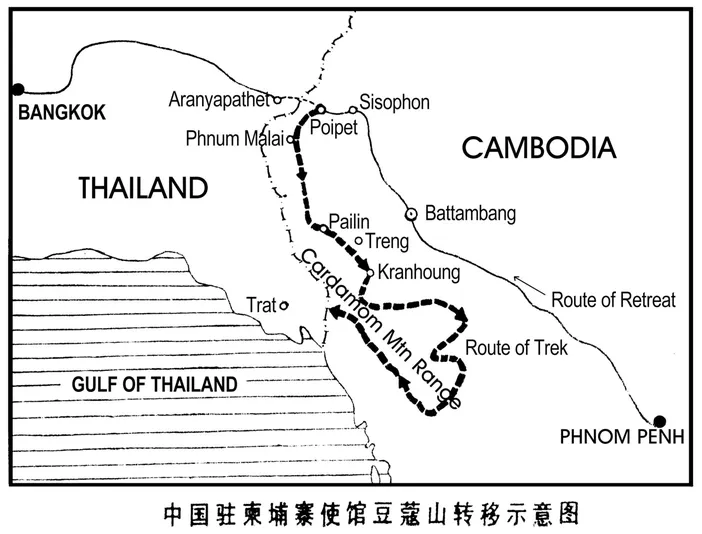
THE ACCOUNT THAT FOLLOWS is a rare picture of the fall of Democratic Kampuchea (DK). It appeared in Chinese in 1992 under the title “From Phnom Penh to the Cardamom Mountains,” in Yun Shui’sChinese Diplomats in International Crises. Beijing, which has published little on its support for DK, classified the bookneibu, meaning it was intended “for domestic use only.” This article describes the Pol Pot regime’s second evacuation of Phnom Penh, following its depopulation after victory over Lon Nol in 1975. About 20,000 Khmer Rouge troops and workers were living in Phnom Penh in January 1979, as advance Vietnamese units approached the capital. Chinese Embassy staff abandoned the city along with the retreating DK forces. For several months, the Chinese tried to maintain a diplomatic post in the shrinking Khmer Rouge zone. They held out in the jungles of northwest Cambodia near Thailand, in Battambang Province and then in the Cardamoms near the border town of Pailin. Finally the Chinese diplomats gave up hope of maintaining an embassy in Cambodia, and crossed into Thailand.
Yun Shui was apparently not an eyewitness; his account seems based on interviews with participants and on the embassy journal. The gripping story of the Khmer Rouge’s flight, despite the propagandistic tone, demonstrates China’s role and commitment to the DK regime. It also carries unintended ironies. The rugged setting of this account of the Khmer Rouge collapse was the location of the movement’s birth in the 1967-68 rebellions against Sihanouk’s regime. The Chinese diplomats’ hardships also recall the privations under which a million Cambodian victims of the first evacuation had perished in 1975-78 at the hands of China’s DK ally — a toll silently ignored in what follows.

An Account of Chinese Diplomats Accompanying the Government of Democratic Kampuchea’s Move to the Cardamom Mountains*

* From Yun Shui,Chinese Diplomats in International Crises (Guoji Fengyunzhongde Zhongguo Waijiaoguan) (Beijing: World Knowledge [Shijie Zhishi Chubanshe], 1992), 85-112, “From Phnom Penh to the Cardamom Mountains.”
Yun Shui Paul Marks,translator
In spite of the condemnation of world opinion, daring the might of all under heaven, the Vietnamese invaders brazenly dispatched ten regular divisions to conquer Democratic Kampuchea (DK) by military force. On 7 January 1979 they occupied Phnom Penh, the capital of the Government of Democratic Kampuchea. This was naked shameless aggression. It shocked the entire world.

The First Evacuation from Phnom Penh

By 2 January 1979 the Vietnamese invaders had fought to near Phnom Penh, but Phnom Penh’s residents were still at peace.
At 8 P.M. on the evening of January 2 Counselor Wang Yupei was relaying documents to all the embassy comrades in the embassy’s 3rd floor meeting room when suddenly duty officer Comrade Wang Shuxiang walked in. She said to Counselor Wang in a quiet voice: “[Pol Pot’s nephew] Little Hong1 has come. I showed him to the receiving room.”
Comrade Wang Yupei handed the documents he was holding to another leader to read and motioned for the interpreter, Comrade Fu Xuezhang, to go downstairs with him to meet the guest.
“I am entrusted by the Cambodian Communist Party center and the Cambodian government to report an important situation to the embassy....” Counselor Wang gathered from the sweat on Little Hong’s forehead and his disturbed look that the matter was extraordinary. Without waiting for Little Hong to finish he motioned for Fu Xuezhang to go upstairs to get Ambassador Sun Hao.
“The front line is critical. The Vietnamese Army has fought to Tonle Bet and O Reang Ov. It’s estimated the enemy will continue to push forward and will bombard Phnom Penh.” Little Hong looked at Ambassador Sun Hao and Counselor Wang Yupei. “The Cambodian government has announced that Phnom Penh is in a state of war. Central organs, the diplomatic corps, and Chinese technical personnel in Phnom Penh will withdraw to Battambang this evening.”
“Today this evening?” asked Ambassador Sun.
“Yes. An immediate operation. [Son Sen’s nephew] Ni Kon, the chief of the Protocol Office of the Ministry of Foreign Affairs, is responsible for arranging the evacuation of the diplomatic corps,” Little Hong said with emphasis.
Assistant military attaché Wang Maoxing returned in a rush just after Ambassador Sun and Counselor Wang had sent off Little Hong. Wang reported on an emergency meeting with the Cambodian General Staff’s Meng Qing. In addition to confirming the decision to withdraw, Meng also said that “many division commanders have been killed. The front lines are unstable.”
Ambassador Sun looked at his watch. It was 8:20 P.M. He immediately called a meeting. All Chinese personnel in Phnom Penh would be evacuating tonight. Send a telegram to the rear before we go and then pack the radio in a vehicle. Make contact with China again after we arrive in Battambang. Destroy all documents and notebooks. Each person brings only the clothes he’s wearing, crackers, and canned food as best he can. He reiterated: take down the embassy sign. Clean all offices and quarters and make your beds well to demonstrate that the Chinese Embassy had an orderly retreat.
Time was of the essence. Every minute and every second was precious. Sixty-one officials nervously yet methodically set to work. Wang Shuxiang went to tell the overseas students; the military and economic attaché officers each went to inform their groups of experts.
Inside the embassy each unit destroyed documents. Drivers readied vehicles. Cooks boiled eggs and made porridge.
At 9 P.M. Cambodian Ministry of Foreign Affairs Ambassador Niao Sukun arrived to tell Ambassador Sun that the operation had been moved up. Departure was now at midnight.
Map showing route of retreat from Phnom Penh and trek into the Cardamom Mountains. Adapted from Yun Shui,Chinese Diplomats in International Crises (Guoji Fengyunzhongde Zhongguo Waijiaoguan) (Beijing: World Knowledge [Shijie Zhishi Chubanshe], 1992), 8.
Counselor Wang pressed on, ordering the destruction of telegrams and documents.
At 10 P.M. Little Hong returned on his motorcycle to tell Ambassador Sun that the evacuation time would be even earlier. All effort was underway to leave before 12 [midnight].
At 10:50 P.M. thirty students ran to the embassy carrying their bags.
At 11 P.M. the ambassador held an emergency meeting with Diplomatic Protocol Office head Ni Kon to discuss the Chinese experts outside of Phnom Penh. Ni Kon said that the Vietnamese army’s main objective was Phnom Penh. Arrangements for the Chinese experts outside of Phnom Penh had not yet been considered. Ni Kon emphasized that diplomatic corps personnel would depart at midnight.
At 10:20 P.M. our eastern team assisting at Chup rubber plantation came under attack. The embassy immediately ordered the 559 experts in the eastern zone to leave immediately on the cargo shipsXianghong andLianghu, then unloading at Sihanoukville.
Fifteen vehicles departed the Chinese Embassy at midnight. The Cambodians sent two large American 8-wheel trucks to follow. The convoy drove through Phnom Penh’s silent streets.
Pre-dawn Phnom Penh on the 3rd was cloudy and misty. The water of the Mekong flowed darkly downstream. A big and tall “family of travelers” began to grow at one spot.
Chinese, Egyptian, Romanian, Yugoslavian, and Burmese diplomats joined by our experts who had pulled out of the east and Phnom Penh said goodbye to Phnom Penh. Vehicles big and small, stretching for kilometers, headed to the northwest.
Towns, villages, hills, and plains along the way all seemed normal, without a hint of war. Farmers laboring in the fields and children on the side of the road were startled at the sight of the long dragon-like convoy.
One after another, the Phnom Penh-based diplomatic corps arrived at the northwestern town of Battambang at noon on the 3rd.
At 5:30 P.M. Comrade Dun from the Cambodian Ministry of Foreign Affairs met with Ambassador Sun. “Evacuating the diplomatic corps from Phnom Penh last night was a precautionary measure. We were worried that after occupying O Reang Au the Vietnamese would continue to advance and would bombard Phnom Penh. Our Army has now regained the initiative on the O Reang Au to Chup line. The higher-ups have decided that the diplomatic corps and technical groups can return to Phnom Penh tomorrow.”
Dun’s words caused a sinking sensation. Last night they had repeatedly urged a rapid evacuation of Phnom Penh. Today, not five hours after arriving in Battambang, they tell us to return to Phnom Penh!
The Chinese Embassy had a general estimate of the military situation around Phnom Penh drawn from experts who had been withdrawing from the east. At the front there was basically no more army. Phnom Penh would be threatened shortly. However, an embassy is an official organ sent to one state as the representative of another state to carry out diplomatic relations and to manage various interactions. The Chinese government and people resolutely supported the righteous struggle of the Cambodian government and people to preserve their national independence and state sovereignty. The Chinese Embassy decided to reside where the country’s government was.
At 8 A.M. on the 4th, all the comrades of the Chinese Embassy departed Battambang according to the arrangements made by the Cambodian Foreign Ministry. At 6 P.M. that night they returned to the imminently endangered Phnom Penh.
The Chinese Embassy discovered that they were the only embassy that returned to Phnom Penh. They would be there just forty-eight hours.

The Second Evacuation from Phnom Penh

January 6 marked a turning point in the military situation.
Cambodian Foreign Ministry Secretary-General Suo Hong came to the embassy early to notify Ambassador Sun that “the situation is extremely serious. The Vietnamese are attacking Phnom Penh from two sides, the north and the south. In the north they have crossed the Mekong at Tonle Bet and entered Kampong Cham City. In the south four planes bombed Takeo City. A large number of Vietnamese tanks are advancing on Highway One towards Phnom Penh.”
January 6 was the most tense of days for the Chinese Embassy. No one slept for an entire day and night.
Counselor Wang Yupei was to lead thirty-five officials on a Chinese civil aviation flight to Beijing. They woke at dawn and hurriedly turned over their work and packed their bags.
At 11 A.M. the embassy passengers, the experts, and the students arrived one after another at Pochentong Airport, 155 in total. On a normal day the departure lounge held a smattering of travelers. It had now come alive.
Ten Westerners holding their bags had been in the waiting room two hours. Each was very anxious.
When these Westerners figured out that Yang Chong was the Chinese Embassy’s administration officer they cornered him and demanded that he agree to let them on the Chinese flight to Beijing.
Yang Chong knew that the majority of people trying to leave Phnom Penh were elderly male and female comrades. Limited seating meant that 625 people could not leave. If his own compatriots could not board, how could he accommodate these people?
The heavy thud of distant artillery suddenly sent the waiting room into a frenzy.
In the afternoon the artillery came increasingly closer. The front continuously reported peril. Vietnamese artillery units had reached the north side of the Mekong. Vietnamese reconnaissance aircraft began surveillance flights over Phnom Penh. The waiting room fell silent. The weather was hot and heavy. The hearts of the travelers were even heavier. No one could breathe.
At 3 P.M. Suo Hong informed Ambassador Sun anxiously: “The situation continues to worsen. The Center has decided that the Chinese Embassy and technical personnel should again evacuate to Battambang.” The Cambodian side asked, however, that the male comrades from the medical unit remain temporarily. The Cambodian side would be responsible for their evacuation when the situation became critical.
At 4:20 P.M. Prince Sihanouk, Princess Monique, and twenty family members suddenly arrived at the airport, escorted by Ieng Sary and Ambassador Sun Hao. This increased the tension even more.
Sihanouk and Monique had fled their country twice in ten years. Their hearts were heavy and the look on their faces said that they were worried about leaving and destroying their family.
The prince and princess brought twenty passengers. Regulations limit a Boeing 707 to 150 passengers. The number of people in the waiting room now exceeded 185.
Who should be allowed to board? After discussion the embassy decided that all thirty foreign friends would go. A portion of the Chinese students would stay.
The thirty students then decided that they would all stay. What a moving choice! What splendid Chinese youth! When the ten foreigners heard the news that they would be leaving they broke into tears.
Tw...

Table of contents

  1. Cover
  2. Half Title
  3. Title Page
  4. Copyright Page
  5. Contents
  6. Introduction: Conflict in Cambodia, 1945-2006
  7. 1. The Collapse of the Pol Pot Regime, January-April 1979
  8. 2. Democratization, Elite Transition, and Violence in Cambodia, 1991-1999
  9. 3. International Intervention and the People's Will: The Demoralization of Democracy in Cambodia
  10. 4. Logging in Muddy Waters: The Politics of Forest Exploitation in Cambodia
  11. 5. Contested Forests: An Analysis of the Highlander Response to Logging, Ratanakiri Province, Northeast Cambodia
  12. DOCUMENTS
  13. Contributors
  14. Index