eBook - ePub
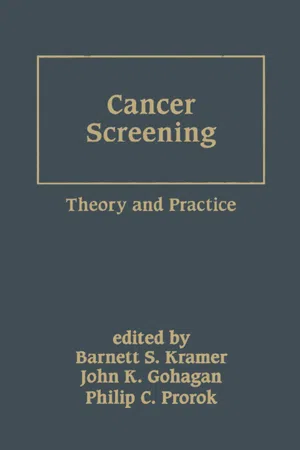
Cancer Screening
Theory and Practice
- 650 pages
- English
- ePUB (mobile friendly)
- Available on iOS & Android
eBook - ePub
Cancer Screening
Theory and Practice
About this book
This useful reference provides solid knowledge of the risks and benefits associated with the cancer screening process, assesses abnormal results and therapeutic outcomes, and facilitates the communication of these issues to patients.
Describes screening tests from individual, health care, ethical, legal, and regulatory perpectives!
Gatherin
Information
III
SCREENING FOR SPECIFIC CANCERS
7
Breast Cancer
Institute of Cancer Research, Sutton, Surrey, England
I. INTRODUCTION
The high incidence of breast cancer worldwide, its high mortality rate despite recent advances in therapy, and the fact that, compared with some other common cancers, breast cancer occurs in women at relatively young ages have generated considerable interest in screening for breast cancer and in improving techniques and effectiveness of screening.
II. EPIDEMIOLOGY AND ETIOLOGY
A. Incidence
Breast cancer is the most common cancer worldwide among women, with an estimated 719,100 new cases in 1985 (1). It is the most common cancer in women in all developed countries other than Japan, with age-standardized incidence rates ranging from 84.8 per 100,000 in North America to 11.1 per 100,000 in western Africa. The lifetime risk of breast cancer development is 1 in 12 in the United Kingdom.
Incidence rates of the disease in a number of countries in recent years have been affected by increasing levels of screening (2,3,4), leading to increases in incidence rates in women in the age groups targeted for screening. However, in the United Kingdom, for example, there is evidence that incidence rates were increasing before the introduction of nationwide screening in 1988–1989 (5). In the United States, age-standardized rates of invasive disease have stabilized since 1987 (6).
Breast cancer incidence rates increase with increasing age, with generally a slower rate of increase after age 50 years. It is hypothesized that this difference may be due to influence of different hormones (7), which may be of relevance to the possible differential benefit of screening at different ages.
B. Mortality
Breast cancer is the leading cause of death from cancer in women worldwide, with an estimated 308,000 dying of the disease in 1985 (8). Again, highest rates occur in developed countries, except Japan. Average age-standardized rates in 1985 were 18.1 per 100,000 in developed countries and 10.9 per 100,000 in developing countries. Rates have generally been increasing, but there has recently been evidence from some countries that rates are leveling, or beginning to decrease (9). In the United Kingdom, it seems unlikely that screening will yet have had a considerable effect, and improvements in treatment have been suggested to be the most likely cause of the recently observed decrease (3).
In the United States, where a decrease in the age-adjusted breast cancer mortality rate of 6.8% between 1989 and 1993 has been observed, it has been proposed that both improvements in therapy and earlier detection by screening are responsible (6).
C. Risk Factors
Geographical variations in incidence and migrant studies, in which people migrating from low-to high-risk areas develop an increased risk, suggest that the risk of breast cancer is largely determined by environmental factors. Dietary factors that have been associated with an increased risk of breast cancer include obesity in postmenopausal women and high dietary fat intake (10). However, whereas case-control studies as well as international variations in incidence and migrant studies support an association of increased risk with fat intake, results of prospective studies are inconsistent and less clearly supportive (11). There is evidence that a diet high in fiber, fruits, and vegetables is associated with a decreased risk. The role of alcohol is not clear, with some but not all studies showing a weak association. There is also some evidence that increased levels of physical activity may have a protective effect.
The risk of breast cancer is increased with early age at menarche, late age at menopause, and late age at first pregnancy, all of which suggest a role of endogenous hormones in its etiology (12). It appears likely that exposure to estrogens, particularly estradiol, results in an increased risk.
A number of studies have suggested an increased risk of breast cancer with use of oral contraceptives. A recent collaborative reanalysis of data from 54 studies found that women were at a small increased risk of having breast cancer diagnosed while taking combined oral contraceptives and in the 10 years after stopping, with a relative risk in current users of 1.24 (95% CI 1.15–1.33) (13). Ten or more years after stopping oral contraceptives, there was no evidence of increased risk. In addition, breast cancers diagnosed in ever users were more likely to be localized compared with nonusers, and this difference persisted beyond 10 years after cessation of use.
The effect of use of hormone replacement therapy on breast cancer risk remains unclear. A cohort study of 23,000 Swedish women has recently shown an increasing relative risk of breast cancer incidence with time after exposure to an estrogen-progestin combined brand, with a standardized incidence ratio of 1.4 (95% CI 1.1–1.8) after 10 years of follow-up (14). One meta-analysis of 28 studies found an increased risk of less than 10% (15), and another found an increased risk only in women with more than 15 years of exposure (16).
However, the increasing number of women using hormone replacement therapy (HRT), together with the fact that such women will be older and having higher incidence of breast cancer than those using oral contraceptives, means that this may be increasingly important. In addition, it has been suggested that the use of HRT may affect the sensitivity of mammography (see Section V. B.1).
It is estimated that between 5% and 10% of all breast cancer cases may be due to inherited cancer predisposition genes. Women with a first degree relative with breast cancer have a relative risk of 1.5–2. The risk is increased with number of affected relatives, and younger age at diagnosis (17). Recently, two breast cancer genes BRCA1 and BRCA2 have been identified which are likely to account for about 85% of all familial breast cancers.
Some benign breast conditions are associated with an increased risk of subsequent development of breast cancer. One study has shown that the relative risk in women with proliferative compared with nonproliferative benign lesions is 1.9, with a relative risk of 5.7 in those with atypical hyperplasia (18), and the diagnosis of fibroadenoma has also been shown to be associated with an increased long-term risk of breast cancer (19).
D. Primary Prevention
Many of the risk factors for breast cancer are not amenable to intervention. However, trials of chemoprevention are in progress in high-risk women to determine whether use of tamoxifen results in a decreased risk (20). In the United States, a dietary intervention study is taking place, also in high-risk women, with the intervention group randomized to a very low-fat diet (21).
III. NATURAL HISTORY
As discussed previously, some benign breast conditions are markers for the subsequent development of cancer, but none has been identified as a precursor lesion. It has been recognized for some time that tumor size is related to the probability of both lymph node involvement and distant metastasis (22). It is this that has led to the concentration on detection of small invasive cancers as the target for breast cancer screening in order to maximize the resulting reduction in mortality rate. There is considerable variation in the growth rates of breast tumors. Estimates of the mean duration of the asymptomatic, preclinical phase have been made using data from screening studies...
Table of contents
- Cover
- Half Title
- Series Page
- Title Page
- Copyright Page
- Series Introduction
- Preface
- Table of Contents
- Contributors
- I Background
- II Basic Principles of Screening
- III Screening for Specific Cancers
- IV Into the Future
- Index
- About the Editors
Trusted by 375,005 students
Access to over 1.5 million titles for a fair monthly price.
Study more efficiently using our study tools.
Frequently asked questions
Yes, you can cancel anytime from the Subscription tab in your account settings on the Perlego website. Your subscription will stay active until the end of your current billing period. Learn how to cancel your subscription
No, books cannot be downloaded as external files, such as PDFs, for use outside of Perlego. However, you can download books within the Perlego app for offline reading on mobile or tablet. Learn how to download books offline
Perlego offers two plans: Essential and Complete
- Essential is ideal for learners and professionals who enjoy exploring a wide range of subjects. Access the Essential Library with 800,000+ trusted titles and best-sellers across business, personal growth, and the humanities. Includes unlimited reading time and Standard Read Aloud voice.
- Complete: Perfect for advanced learners and researchers needing full, unrestricted access. Unlock 1.5M+ books across hundreds of subjects, including academic and specialized titles. The Complete Plan also includes advanced features like Premium Read Aloud and Research Assistant.
We are an online textbook subscription service, where you can get access to an entire online library for less than the price of a single book per month. With over 1.5 million books across 990+ topics, we’ve got you covered! Learn about our mission
Look out for the read-aloud symbol on your next book to see if you can listen to it. The read-aloud tool reads text aloud for you, highlighting the text as it is being read. You can pause it, speed it up and slow it down. Learn more about Read Aloud
Yes! You can use the Perlego app on both iOS and Android devices to read anytime, anywhere — even offline. Perfect for commutes or when you’re on the go.
Please note we cannot support devices running on iOS 13 and Android 7 or earlier. Learn more about using the app
Please note we cannot support devices running on iOS 13 and Android 7 or earlier. Learn more about using the app
Yes, you can access Cancer Screening by Barnett S. Kramer, John K. Gohagan, Philip C. Prorok, Barnett S. Kramer,John K. Gohagan,Philip C. Prorok in PDF and/or ePUB format, as well as other popular books in Medicine & Epidemiology. We have over 1.5 million books available in our catalogue for you to explore.