- 384 pages
- English
- ePUB (mobile friendly)
- Available on iOS & Android
eBook - ePub
Introduction to Modern Algebra and Its Applications
About this book
The book provides an introduction to modern abstract algebra and its applications. It covers all major topics of classical theory of numbers, groups, rings, fields and finite dimensional algebras. The book also provides interesting and important modern applications in such subjects as Cryptography, Coding Theory, Computer Science and Physics. In particular, it considers algorithm RSA, secret sharing algorithms, Diffie-Hellman Scheme and ElGamal cryptosystem based on discrete logarithm problem. It also presents Buchberger's algorithm which is one of the important algorithms for constructing Gröbner basis.
Key Features:
- Covers all major topics of classical theory of modern abstract algebra such as groups, rings and fields and their applications. In addition it provides the introduction to the number theory, theory of finite fields, finite dimensional algebras and their applications.
- Provides interesting and important modern applications in such subjects as Cryptography, Coding Theory, Computer Science and Physics.
- Presents numerous examples illustrating the theory and applications. It is also filled with a number of exercises of various difficulty.
- Describes in detail the construction of the Cayley-Dickson construction for finite dimensional algebras, in particular, algebras of quaternions and octonions and gives their applications in the number theory and computer graphics.
Frequently asked questions
Yes, you can cancel anytime from the Subscription tab in your account settings on the Perlego website. Your subscription will stay active until the end of your current billing period. Learn how to cancel your subscription.
No, books cannot be downloaded as external files, such as PDFs, for use outside of Perlego. However, you can download books within the Perlego app for offline reading on mobile or tablet. Learn more here.
Perlego offers two plans: Essential and Complete
- Essential is ideal for learners and professionals who enjoy exploring a wide range of subjects. Access the Essential Library with 800,000+ trusted titles and best-sellers across business, personal growth, and the humanities. Includes unlimited reading time and Standard Read Aloud voice.
- Complete: Perfect for advanced learners and researchers needing full, unrestricted access. Unlock 1.4M+ books across hundreds of subjects, including academic and specialized titles. The Complete Plan also includes advanced features like Premium Read Aloud and Research Assistant.
We are an online textbook subscription service, where you can get access to an entire online library for less than the price of a single book per month. With over 1 million books across 1000+ topics, we’ve got you covered! Learn more here.
Look out for the read-aloud symbol on your next book to see if you can listen to it. The read-aloud tool reads text aloud for you, highlighting the text as it is being read. You can pause it, speed it up and slow it down. Learn more here.
Yes! You can use the Perlego app on both iOS or Android devices to read anytime, anywhere — even offline. Perfect for commutes or when you’re on the go.
Please note we cannot support devices running on iOS 13 and Android 7 or earlier. Learn more about using the app.
Yes, you can access Introduction to Modern Algebra and Its Applications by Nadiya Gubareni in PDF and/or ePUB format, as well as other popular books in Mathematics & Applied Mathematics. We have over one million books available in our catalogue for you to explore.
Information
Chapter 1
Elements of Number Theory
"God made the integers, all the rest is the work of man."
Leopold Kronecker (1823-1891)
"Mathematics is the queen of the sciences and number theory is the queen of mathematics. She often condescends to render service to astronomy and other natural sciences, but in all relations she is entitled to the first rank."
Carl Friedkich Gauss (1777-1855)
Numbers, in particular natural numbers and integers, have, enthralled mathematicians from ancient times to the present, A branch of mathematics which studies the properties of integers is called number theory. The beginnings of this theory can be seen already in the works of Euclid (323-283 BC). The Ancient Greek mathematician, Diophantus (III C. AD), was the first to create number theory as a separate and rigorous mathematical discipline. Unfortunately, after Diophantus, almost nobody developed number theory until the XVIIth century. "Arithmetics" of Diophantus, which is so far considered as one of the most mysterious phenomenons in the history of science, had a large influence on the French mathematician Pierre Fermat (1601-1655), who made many important discoveries: in number theory Thauks to his works, the study of integers again became the center of attention of mathematicians. One of the significant discoveries of P. Fermat was the quite simple theorem, which is now known as Fermat's: Little Theorem. Nevertheless it currently has quite significant applications, in particular, in cryptographic algorithms.

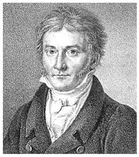
Carl Friedrich Gauss (1777-1855)
The further progress in number theory is connected with such prominent mathematicians as L. Euler (1707-1783), J.L. Lagrange (1736-1813) and C.F. Gauss (1777-1855). In his famous book "Disquisitiones arithmeticae" (1801), C.F. Gauss presented the fundamentals of number theory, systematized the knowledge of predecessors, introduced new methods and made various famous discoveries. In particular, Gauss created a new branch of number theory: Modular arithmetics, i.e., the theory of congruences.
In this chapter, which may be considered as an introduction to elementary number theory, we review some basic concepts of this theory, including divisibility, division with remainder, greatest common divisors, least common multiplies, congruences and their properties. We also describe some i...
Table of contents
- Cover
- Title Page
- Copyright Page
- Preface
- Contents
- 1. Elements of Number Theory
- 2. Elements of Group Theory
- 3. Examples of Groups
- 4. Elements of Ring Theory
- 5. Polynomial Rings in One Variable
- 6. Elements of Field Theory
- 7. Examples of Applications
- 8. Polynomials in Several Variables
- 9. Finite Fields and their Applications
- 10. Finite Dimensional Algebras
- 11. Applications of Quaternions and Octonions
- Appendix
- Index