PID Tuning
eBook - ePub

PID Tuning

A Modern Approach via the Weighted Sensitivity Problem

  1. 168 pages
  2. English
  3. ePUB (mobile friendly)
  4. Available on iOS & Android
eBook - ePub

PID Tuning

A Modern Approach via the Weighted Sensitivity Problem

About this book

The PID controller is the most common option in the realm of control applications and is dominant in the process control industry. Among the related analytical methods, Internal Model Control (IMC) has gained remarkable industrial acceptance due to its robust nature and good set-point responses. However, the traditional application of IMC results in poor load disturbance rejection for lag-dominant and integrating plants. This book presents an IMC-like design method which avoids this common pitfall and is devised to work well for plants of modest complexity, for which analytical PID tuning is plausible. For simplicity, the design only focuses on the closed-loop sensitivity function, including formulations for the H? and H2 norms. Aimed at graduate students and researchers in control engineering, this book:

  • Considers both the robustness/performance and the servo/regulation trade-offs
  • Presents a systematic, optimization-based approach, ultimately leading to well-motivated, model-based, and analytically derived tuning rules
  • Shows how to tune PID controllers in a unified way, encompassing stable, integrating, and unstable processes
  • Finds in the Weighted Sensitivity Problem the sweet spot of robust, optimal, and PID control
  • Provides a common analytical framework that generalizes existing tuning proposals
Frequently asked questions

Yes, you can cancel anytime from the Subscription tab in your account settings on the Perlego website. Your subscription will stay active until the end of your current billing period. Learn how to cancel your subscription.
No, books cannot be downloaded as external files, such as PDFs, for use outside of Perlego. However, you can download books within the Perlego app for offline reading on mobile or tablet. Learn more here.
Perlego offers two plans: Essential and Complete
  • Essential is ideal for learners and professionals who enjoy exploring a wide range of subjects. Access the Essential Library with 800,000+ trusted titles and best-sellers across business, personal growth, and the humanities. Includes unlimited reading time and Standard Read Aloud voice.
  • Complete: Perfect for advanced learners and researchers needing full, unrestricted access. Unlock 1.4M+ books across hundreds of subjects, including academic and specialized titles. The Complete Plan also includes advanced features like Premium Read Aloud and Research Assistant.
Both plans are available with monthly, semester, or annual billing cycles.
We are an online textbook subscription service, where you can get access to an entire online library for less than the price of a single book per month. With over 1 million books across 1000+ topics, we’ve got you covered! Learn more here.
Look out for the read-aloud symbol on your next book to see if you can listen to it. The read-aloud tool reads text aloud for you, highlighting the text as it is being read. You can pause it, speed it up and slow it down. Learn more here.
Yes! You can use the Perlego app on both iOS or Android devices to read anytime, anywhere — even offline. Perfect for commutes or when you’re on the go.
Please note we cannot support devices running on iOS 13 and Android 7 or earlier. Learn more about using the app.
Yes, you can access PID Tuning by Salvador Alcántara Cano,Ramon Vilanova Arbós,Carles Pedret i Ferré in PDF and/or ePUB format, as well as other popular books in Scienze fisiche & Ingegneria elettronica e telecomunicazioni. We have over one million books available in our catalogue for you to explore.
1
Introduction
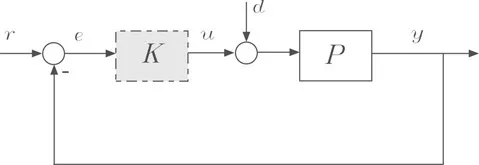
The aim of this introduction is to guide the reader through the content of subsequent chapters, offering a high-level presentation of the underlying concepts and ideas that appear all throught the book. The discussion that follows is based on the unity feedback, linear time invariant (LTI), and single-input-single-output (SISO) continuous-time system of Figure 1.1, where P is the plant and K the feedback controller to be designed. The output signals y, u represent, respectively, the plant output and the control action. Two exogenous inputs to the system are considered: d and r. Here, d represents a disturbance affecting the plant input, and the term regulator mode refers to the case when this is the main exogenous input.
fig1_1.webp
Figure 1.1
Conventional feedback configuration.
1.1Servo, regulation, and stability
The term servo mode refers to the case when the set-point change r is the main concern. Although the reference tracking can be improved by using a two-degree-of-freedom (2DOF) controller [72, 20], there will always be some unmeasured disturbance directly affecting the plant output, which may be represented as an unmeasured signal r (in this case, the plant output would be the control error e = ry). In summary, there is a fundamental trade-off between the regulator (input disturbance) and servo (output disturbance) modes. The closed-loop mapping for the system in Figure 1.1 is given by
[yu]=[TSPKSS][rd]H(P,K)[rd]
(1.1)
where S11+PK and TPK1+PK denote the sensitivity and complementary sensitivity functions [72], respectively (note that S + T = 1). In terms of the performance for the regulator and servo modes, the closed-loop effect of disturbance and set-point changes on the outpu...

Table of contents

  1. Cover
  2. Half Title
  3. Title Page
  4. Copyright Page
  5. Dedication
  6. Contents
  7. Foreword
  8. Preface
  9. Authors
  10. 1. Introduction
  11. I. Model-Matching Approach to Robust PID Design
  12. II. WEIGHT SELECTION FOR SENSITIVITY SHAPING
  13. III. WEIGHTED SENSITIVITY APPROACH FOR ROBUST PID TUNING
  14. Appendix A
  15. Bibliography
  16. Index