Astrology, Almanacs, and the Early Modern English Calendar is a handbook designed to help modern readers unlock the vast cultural, religious, and scientific material contained in early modern calendars and almanacs. It outlines the basic cosmological, astrological, and medical theories that undergirded calendars, traces the medieval evolution of the calendar into its early modern format against the background of the English Reformation, and presents a history of the English almanac in the context of the rise of the printing industry in England. The book includes a primer on deciphering early modern printed almanacs, as well as an illustrated guide to the rich visual and verbal iconography of seasons, months, and days of the week, gathered from material culture, farming manuals, almanacs, and continental prints. As a practical guide to English calendars and the social, mathematical, and scientific practices that inform them, Astrology, Almanacs,and the Early Modern English Calendar is an indispensable tool for historians, cultural critics, and literary scholars working with the primary material of the period, especially those with interests in astrology, popular science, popular print, the book as material artifact, and the history of time-reckoning.
- 312 pages
- English
- ePUB (mobile friendly)
- Available on iOS & Android
eBook - ePub
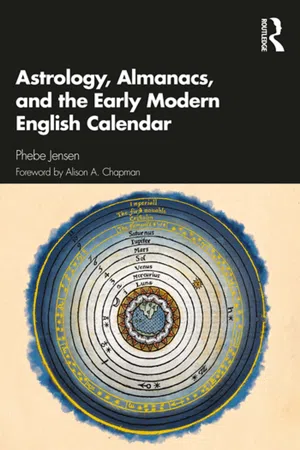
Astrology, Almanacs, and the Early Modern English Calendar
About this book
Trusted by 375,005 students
Access to over 1.5 million titles for a fair monthly price.
Study more efficiently using our study tools.
Information
Part I Backgrounds
1.1 Astrology
The astrology included in sixteenth-century almanacs and prognostications involved two different areas of astrological praxis, both of which derive from the work of the second-century CE mathematician Claudius Ptolemaeus. Ptolemy established the contours of the Ptolemaic universe in the thirteen-volume Almagest, and laid out the major principles of astrology in the single-volume Tetrabiblos (also known as the Quadripartitum).1 The centrality of Ptolemy’s Tetrabiblos for the astrology of the early modern almanac reflected a wider movement—joined by Lutheran astrologers and supported by some religious leaders, especially Philip Melanchthon—that sought to clear away from astrological practice elements of medieval and Arabic astrology deemed superstitious. As Ornella Faracovi has written, the sixteenth century saw an effort “to reform astrology by returning to the classical works, de-emphasizing magic, and focusing instead on the physical influences of the stars and planets on living things in the sublunar sphere.”2 Although based on a Ptolemaic model of the universe, this reformed astrology was not in conflict with emerging Copernican theories but, in fact, benefited from them, as the Copernican model of the universe improved the accuracy of astronomical predictions, and, therefore, (theoretically at least) of astrological prognostications.3
Ptolemaic astrology—understood as part of natural philosophy and supported rather than threatened by the Copernican revolution—was the basis for the astrology in early modern English calendars, including the printed almanac. The prognostication portions of annual almanacs were the result of one branch of Ptolemaic judicial astrology, known as revolutions. But the material in the almanacs concerning Zodiac Man and elections for physic and husbandry reflected a lunar astrological practice that developed in the middle ages. Though lunar astrology also followed guidelines established in Ptolemy’s Tetrabiblos, it did not involve casting figures or horoscopes. Other calendrical prognostications that appeared in medieval manuscripts had nothing to do with Ptolemaic astrology. These included (1) the Days of the Month prophecies (sometimes called lunar prognostics or lunaria), (2) the Egyptian Days, (3) brontologies (prognostications by thunder), and (4) Esdras or dominical letter prophecies. All of these prognostications lingered in early modern calendars and perpetual almanacs. Because of their longevity, they should be understood as part of early modern calendar culture, but they must also be distinguished from the astrological prognostications, based on Ptolemy, that retained scholarly credibility through the early modern period.
Ptolemaic judicial astrology
Astronomy, according to Ptolemy in the Tetrabiblos, was the study of the movements of the celestial bodies. Astrology was the study of the influence of those movements in the sublunar sphere. Modern readers probably find no particular difficulty in distinguishing between astronomy and astrology, but the terms, though not exactly interchangeable, were not always used precisely to differentiate the two practices in popular use in medieval and early modern England.4
Ptolemaic astrology followed the Ptolemaic model of the universe (derived and refined from earlier classical models) and the originally Aristotelian distinction between the supralunar and sublunar spheres.5 That model can be seen in Figure 1.1.1, from William Blagrave’s The Mathematical Jewel (1585).

Figure 1.1.1 Ptolemaic Universe, William Blagrave, The Mathematical Jewel (1585), 7. Photograph by Phebe Jensen, from the collection of the Folger Shakespeare Library, STC 3119.
The Earth is at the center of the universe. On it can be seen the heaviest of the four elements, earth, covered with the second heaviest, water. The earth is surrounded by stylized clouds representing air, and the lightest element, fire, is represented by the ring of fire believed to exist just beneath the sphere of the first planet (the Moon). The seven planets are represented in concentric circles, from nearest to farthest from Earth: the Moon, Mercury, Venus, the Sun, Mars, Jupiter, and Saturn. These are both labeled and marked with the traditional planetary symbols (still in use today). The eighth sphere, labeled “the firmament,” represents the fixed stars. The symbols here (also still in use) denote the stars that reside in the narrow band against which all seven planets (including the Sun) make their apparent journey around the earth. That path is known as the ecliptic; the stars that lie along that path are the twelve constellations of the Zodiac. (We now know this plane is actually the plane of our solar system, since the Moon and all the planets rotate around the Sun on approximately the same plane as the earth.) As in Figure 1.1.2, graphic representations of the universe often cut away the other stars in the firmament, leaving the narrow band of the twelve Zodiac signs so that it appears “in manner of a girdle, or as a garlande of floures” wrapped around the earth (Kalender, J8r). In reality, the twelve constellations are not neatly spaced across this 360-degree girdle, but astrology divides the twelve signs into twelve equal thirty-degree increments that are used to calculate the location of the planets.

Figure 1.1.2 Armillary Sphere, Anonymous, The Kalender of Shepeherdes (1528), P3v. The Huntington Library, San Marino, California, RB 69440.
According to Aristotle, the supralunar universe—everything above the ring of fire—is eternal and never changing, but everything in the sublunar world is mutable. There, the four elements that comprise all matter are forever commingling and transforming as they are acted upon by the qualities of heat and cold, moistness and dryness. That matter includes the human body, which is made up of the four bodily humors that correspond to these four elements: black bile with the earth, phlegm with water, yellow bile with air, and blood with fire.
Judicial astrology is predicated on the “major premise” of astrology: the belief that the planets and the stars influence the mutable sublunar world.6 That principle is anchored in the obvious fact that two of the planets, the Sun and the Moon, have discernible effects in the sublunar sphere: the Sun in heating, cooling, the generation of plants, etc. and the Moon on the tides. The deductive reasoning here is that though the influences of the Sun and Moon are more easily perceived, the other planets also exert influences on the sublunar world. That influence—at least in the kind of astrology practiced by sixteenth-century almanac compilers—is physical. More specifically, judicial astrology operates on the assumption that the configuration of the stars at key moments influences matter in the sublunar world, including the physical bodies of human beings. The influence depends on the location of the planets and the Zodiac relative to the Earth and to each other.
The first step in making a prognostication is to create a map of the universe at a particular moment. That map is the horoscope chart. The moment for which a horoscope chart is cast would depend on which of the four general areas the astrological practitioner is working. These areas, as defined by the fourteenth-century scholar Albertus Magnus yet still applicable in the early modern period, include (1) nativities, (2) horary questions, (3) elections, and (4) revolutions. For nativities, horoscopes would be cast for the moments of conception and birth. Nativity charts allowed the astrologer to assess an individual’s temperament and complexion, and also to identify future challenges (and the possibility of good fortune) over the course of a life. Nativities were widely cast, disseminated, and studied, but also often resisted on religious grounds. For the second area, interrogatories or horary questions, astrologers would cast a figure for the moment at which a client asked a question. This practice became the stock in trade of the professional astrologer, but it was also the practice subject to the greatest controversy, as it was seen as an Arabic innovation of Ptolemy’s principles. In the third area of practice, elections, astrologers would cast a horoscope for timing a particular event or initiating an important action: starting a journey, getting married, or scheduling a coronation, a topic on which Elizabeth I consulted John Dee. These three areas of judicial astrology had little to do with almanacs or calendars, though almanacs did traffic in a different kind of elections associated with lunar astrological medicine.
That leaves the fourth and final area of astrological praxis defined by Magnus: revolutions. This is the area in which almanac compilers operated. With revolutions, astrologers compiled horoscope charts that yielded generalized predictions for humankind. As these were general rather than individual predictions, they escaped some (though not all) of the opprobrium leveled at nativities, interrogatories, and elections. The most important chart in the study of revolutions was the horoscope of the year, taken at the moment of the Sun’s entry into the first point of Aries, at the Spring Equinox. That horoscope also was believed to predict, more specifically, the inclinations in the Spring quarter of the year. Almanac compilers often refined their forecasts by also considering horoscopes cast for the start of the other three seasons: the Summer Solstice, the Autumn Equinox, and the Winter Solstice. Another set of charts that would be factored in when assessing revolutions were those cast for relevant eclipses. This analysis followed the guidelines in Tetrabiblos concerning when, where, and for how long the effects of an eclipse would be felt, based on the location, duration, and extent of the eclipse.
In order to fully comprehend the information in astrological almanacs, it is useful to understand the methods used by astrologers in creating the horoscope chart—also known as a figure. A horoscope chart is a snapshot of the universe taken at a particular moment in time from a particular vantage point on the earth. Blagrave’s diagram (Figure 1.1.1) can help clarify the protocol in erecting figures or casting horoscopes.7 This diagram apparently presents a snapshot of the Ptolemaic universe at a particular moment (though it may well be an imagined or contrived moment). Imagine that the geographical location of the event being charted is at the very top center of the earth (in the twelve o’clock position). From that perspective, the celestial objects on the Eastern horizon are in the 9:00 position, and the celestial objects on the Eastern horizon at 3:00. The 12:00 position for the diagram as a whole is the zenith in the visible sky; everything in the lower half of the diagram is under the earth.
To cast a figure, the astrologer essentially maps the configuration of the universe at a particular moment, such as we can imagine in Blagrave’s diagram, onto a horoscope chart, such as the one on the cover of John Harvey’s almanac for 1589 (Figure 1.1.2). That chart provides twelve separate triangles representing thirty degrees each. These are the twelve astrological houses. The houses begin with the first house at the ascendant—the nine o’clock position in the diagram. They then proceed cou...
Table of contents
- Cover
- Half Title
- Title Page
- Copyright Page
- Dedication
- Table of Contents
- List of figures
- Foreward, by Alison A. Chapman
- Acknowledgements
- Introduction
- Part I Backgrounds
- Part II How to read an early modern almanac
- Part III Early modern calendars
- Bibliography
- Index of Saints and Holy Days
- Index
Frequently asked questions
Yes, you can cancel anytime from the Subscription tab in your account settings on the Perlego website. Your subscription will stay active until the end of your current billing period. Learn how to cancel your subscription
No, books cannot be downloaded as external files, such as PDFs, for use outside of Perlego. However, you can download books within the Perlego app for offline reading on mobile or tablet. Learn how to download books offline
Perlego offers two plans: Essential and Complete
- Essential is ideal for learners and professionals who enjoy exploring a wide range of subjects. Access the Essential Library with 800,000+ trusted titles and best-sellers across business, personal growth, and the humanities. Includes unlimited reading time and Standard Read Aloud voice.
- Complete: Perfect for advanced learners and researchers needing full, unrestricted access. Unlock 1.5M+ books across hundreds of subjects, including academic and specialized titles. The Complete Plan also includes advanced features like Premium Read Aloud and Research Assistant.
We are an online textbook subscription service, where you can get access to an entire online library for less than the price of a single book per month. With over 1.5 million books across 990+ topics, we’ve got you covered! Learn about our mission
Look out for the read-aloud symbol on your next book to see if you can listen to it. The read-aloud tool reads text aloud for you, highlighting the text as it is being read. You can pause it, speed it up and slow it down. Learn more about Read Aloud
Yes! You can use the Perlego app on both iOS and Android devices to read anytime, anywhere — even offline. Perfect for commutes or when you’re on the go.
Please note we cannot support devices running on iOS 13 and Android 7 or earlier. Learn more about using the app
Please note we cannot support devices running on iOS 13 and Android 7 or earlier. Learn more about using the app
Yes, you can access Astrology, Almanacs, and the Early Modern English Calendar by Phebe Jensen in PDF and/or ePUB format, as well as other popular books in Literature & Literary Criticism. We have over 1.5 million books available in our catalogue for you to explore.