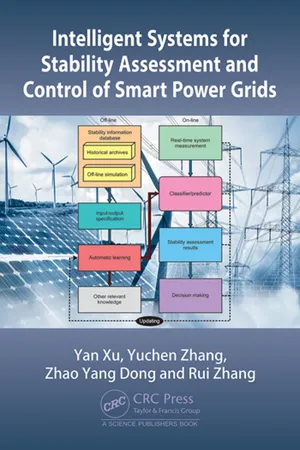
Intelligent Systems for Stability Assessment and Control of Smart Power Grids
eBook - ePub

Intelligent Systems for Stability Assessment and Control of Smart Power Grids

  1. 290 pages
  2. English
  3. ePUB (mobile friendly)
  4. Available on iOS & Android
eBook - ePub

Intelligent Systems for Stability Assessment and Control of Smart Power Grids

About this book

Power systems are evolving towards the Smart Grid paradigm, featured by large-scale integration of renewable energy resources, e.g. wind and solar power, deeper participation of demand side, and enhanced interaction with electric vehicles. While these emerging elements are inherently stochastic in nature, they are creating a challenge to the system's stability and its control. In this context, conventional analysis tools are becoming less effective, and necessitate the use alternative tools that are able to deal with the high uncertainty and variability in the smart grid.

Smart Grid initiatives have facilitated wide-spread deployment of advanced sensing and communication infrastructure, e.g. phasor measurement units at grid level and smart meters at household level, which collect tremendous amount of data in various time and space scales. How to fully utilize the data and extract useful knowledge from them, is of great importance and value to support the advanced stability assessment and control of the smart grid.

The intelligent system strategy has been identified as an effective approach to meet the above needs. This book presents the cutting-edge intelligent system techniques and their applications for stability assessment and control of power systems. The major topics covered in this book are:

  • Intelligent system design and algorithms for on-line stability assessment, which aims to use steady-state operating variables to achieve fast stability assessment for credible contingencies.
  • Intelligent system design and algorithms for preventive stability control, which aims at transparent and interpretable decision-making on preventive control actions to manipulate system operating condition against possible contingencies.
  • Intelligent system design and algorithms for real-time stability prediction, which aims to use synchronized measurements to foresee the stability status under an ongoing disturbance.
  • Intelligent system design and algorithms for emergency stability control, which aims at fast decision-making on stability control actions at emergency stage where instability is propagating.
  • Methodologies and algorithms for improving the robustness of intelligent systems against missing-data issues.

This book is a reference and guide for researchers, students, and engineers who seek to study and design intelligent systems to resolve stability assessment and control problems in the smart grid age.

Frequently asked questions

Yes, you can cancel anytime from the Subscription tab in your account settings on the Perlego website. Your subscription will stay active until the end of your current billing period. Learn how to cancel your subscription.
No, books cannot be downloaded as external files, such as PDFs, for use outside of Perlego. However, you can download books within the Perlego app for offline reading on mobile or tablet. Learn more here.
Perlego offers two plans: Essential and Complete
  • Essential is ideal for learners and professionals who enjoy exploring a wide range of subjects. Access the Essential Library with 800,000+ trusted titles and best-sellers across business, personal growth, and the humanities. Includes unlimited reading time and Standard Read Aloud voice.
  • Complete: Perfect for advanced learners and researchers needing full, unrestricted access. Unlock 1.4M+ books across hundreds of subjects, including academic and specialized titles. The Complete Plan also includes advanced features like Premium Read Aloud and Research Assistant.
Both plans are available with monthly, semester, or annual billing cycles.
We are an online textbook subscription service, where you can get access to an entire online library for less than the price of a single book per month. With over 1 million books across 1000+ topics, we’ve got you covered! Learn more here.
Look out for the read-aloud symbol on your next book to see if you can listen to it. The read-aloud tool reads text aloud for you, highlighting the text as it is being read. You can pause it, speed it up and slow it down. Learn more here.
Yes! You can use the Perlego app on both iOS or Android devices to read anytime, anywhere — even offline. Perfect for commutes or when you’re on the go.
Please note we cannot support devices running on iOS 13 and Android 7 or earlier. Learn more about using the app.
Yes, you can access Intelligent Systems for Stability Assessment and Control of Smart Power Grids by Yan Xu,Yuchen Zhang,Zhao Yang Dong,Rui Zhang in PDF and/or ePUB format, as well as other popular books in Technology & Engineering & Data Mining. We have over one million books available in our catalogue for you to explore.

CHAPTER
1

Power System Stability: Definitions, Phenomenon and Classification

Power system stability has been recognized as one of the most important problems for secure system operation since the 1920s. Many major blackouts caused by power system instability have illustrated the importance of this phenomenon. This chapter introduces the basic definition and phenomenon of power system stability.

1.1 Overview

Over the last two decades with the steadily growing population, the consumption of electricity is also continuously increasing all over the world. Specifically, the global electricity consumption has increased by three per cent annually over the last 20 years (Y. Enerdata, 2017). Moreover, the concerns of global warming and its induced climate changes have pushed the increasing use of renewable energy sources (RES) in many countries to improve the energy sustainability. Many government authorities have announced their long-term targets of increasing the RES penetration for future power grid to overcome the current energy challenges. For example, the Australian Clean Energy Regulator has announced a 20 per cent renewable generation portfolio target of Australian electricity supply structure by 2020 (C.E. Regulator, 2012); the U.S. government has released the target of achieving 50 per cent of renewable power generation by 2025 (J. Trudeau, et al., 2016); and the EU has committed a more ambitious target of reducing 80 per cent greenhouse gas emission and a share of RES in electricity consumption reaching 97 per cent by 2050 (E. Commission, 2012). Moreover, some researchers look further ahead and propose even more ambitious goals, such as the future zero-carbon electrical grid of Australia (M. Wright, et al., 2010)and 100 per cent renewables’ scenarios (D. Crawford, et al., 2012). The power systems in most countries today are overstressed, overaged, and fragile, showing their inability to support the everlasting increase in electricity demand and incorporate the ambitions and trends of increasing renewable penetration. Such inadequacies in conventional power systems call for a series of transformations and updates in the power industry to address all the new challenges. At high voltage transmission level, the focus is mainly on the system’s stability in an environment of higher renewable penetration, complicated demand side activities, and deregulated market competitions (T.V. Custem and C. Vournas, 1998; P. Kundur, et al., 1994; C. Taylor, et al., 1994).
Power system stability is defined as the ability of an electric power system for a given initial operating condition to regain a state of operating equilibrium after being subjected to a physical disturbance, with most system variables bounded so that practically the entire system remains intact (P. Kundur, et al., 2004). The operation of a power system is inevitably exposed to various disturbances, such as an electric short-circuit on a transmission line and an unexpected outage of generator; when the disturbance is sufficiently severe, the power system can lose its stability.
This stability issue has been highlighted mainly due to its catastrophic consequences. Loss of power system stability can result in cascading failure and/or even widespread blackout events. Indeed, recent major blackouts over the world vividly demonstrate the far-reaching impacts of instability (T.V. Custem and C. Vournas, 1998). For instance, in 1996, the cascading disturbances in West Coast transmission system caused widespread blackout, which interrupted the electricity supply to 12 million customers for up to eight hours, and the cost of this event was estimated to be $2 billion (P. Kundur, et al., 1994). Later, in 2003, a blackout in northeast affected 50 million customers and led to a $6 billion financial loss (T.V. Custem and C. Vournas, 1998). In 2012, two severe blackouts in India left over 600 million people in the dark for 10-12 hours (L.L. Lai, et al., 2013). More recently, in 2016, the high-wind-penetrated power system in South Australia failed to ride through six successive voltage disturbances caused by a storm, resulting in a statewide blackout and affecting over 1.67 million customers (A.E.M. Operator, 2016). To avoid the catastrophes as above, it is fundamental yet essential to maintain stable power system operation.

1.2 Mathematical Model

Generally, the power system dynamics can be modeled by a large set of differential algebraic equations (DAE) as follows:
x˙=...

Table of contents

  1. Cover
  2. Title Page
  3. Copyright Page
  4. Foreword
  5. Preface
  6. Table of Contents
  7. 1. Power System Stability: Definitions, Phenomenon and Classification
  8. 2. Stability Assessment and Control: Problem Descriptions and Classifications
  9. 3. Intelligent System-based Stability Analysis Framework
  10. 4. Intelligent System for On-line Stability Assessment
  11. 5. Intelligent System for Preventive Stability Control
  12. 6. Intelligent System for Real-time Stability Prediction
  13. 7. Intelligent System for Emergency Stability Control
  14. 8. Addressing Missing-data Issues
  15. References
  16. Index