- 538 pages
- English
- ePUB (mobile friendly)
- Available on iOS & Android
eBook - ePub
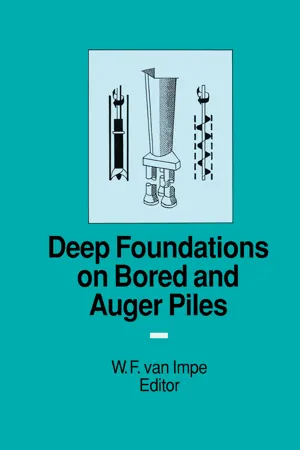
Deep Foundations on Bored and Auger Piles - BAP III
About this book
This text presents findings from the 3rd International Geotechnical Seminar, held in Ghent, Belgium. Topics include: American experiences with large diameter bored piles; case histories; static, dynamic and pile integrity testing; and installation parameters and capacity of screwed piles.
Information
Theme lecture 1
American experiences with large diameter bored piles
Applications of large-diameter bored piles in the United States
ABSTRACT: The current state of practice for large-diameter bored piles (LDBPs) in the United States is discussed, from the perspective of the writer, and several brief case studies are examined. The use of LDBPs is increasing in the United States primarily because of educational efforts and demands for foundations that are scour-resistant, adaptable to over-water construction and economically advantageous in restricted construction areas.
1 INTRODUCTION
Large-diameter bored piles (LDBPs) can be defined, for purposes of this paper, as cast-in-situ piles with diameters of at least 0.76 m. The use of LDBPs has increased dramatically in the United States in the past decade. ADSC, the international trade association for bored piles, reports that the value of bored pile construction in the U. S. increased from about $US 800,000,000 in 1992 to about $US 1,040,000,000 in 1997. The growth has been greatest in the transportation area, principally for bridges but also as soldiers and tangent piles for retaining structures. The use of LDBPs in bridge foundations has been stimulated by several factors, including the need to install foundations in rivers in which large volumes of soil can be scoured during extreme floods. Cylindrical LDBPs are viewed as more resistant to local scour than capped groups of smaller piles or noncylindrical piles, and they permit relatively easy penetration of hard, non-scourable geomaterial beneath the depth of maximum scour to provide for both lateral and axial stability after the scour event has occurred.
The ability of contractors to use casings as column forms in Overwater construction, even where large amounts of scour are not anticipated, eliminates the need for cofferdams. This attribute of LDBPs has given them a significant economic advantage that is just now being fully realized by the U. S. foundation engineering community. LDBPs are also being used increasingly as foundations for rehabilitated and expanded structures that must be installed in restricted spaces, such as freeway medians, that are not large enough to permit the economical marshaling of pre-fabricated, driven piles and construction equipment for groups of such piles, which are the main alternatives to LDBPs in the United States.
LDBPs have been found by designers to be particularly well-suited as foundations for structures that must resist extreme events that produce large lateral loads (e. g., seismic and vessel impact loading) because of the very large moments of inertia they provide. They have become widely used in seismic retrofit work for highway bridges in states such as California, where the seismic risk is high. For seismic retrofit and river crossing projects, it is not uncommon for LDBPs to have diameters as large as 2.44 m, even in soft to moderately hard rock. Even larger sizes are sometimes specified.
Although flexible mat (raft) foundations are relatively common for architectural structures in some areas of the United States, the use of LDBPs to reduce stresses and settlements in mats has not been implemented as it has in Europe and other parts of the world. The absence of this potentially important application of LDBPs appears to the writer to be associated with the fear of litigation on the part of designers, who work under contracts separate from the constructors, that is associated with their assuming the risk of designing a foundation system for which no local histories exist.
Simultaneously with the growing economic and technical pressures to use LDBPs, known in the United States as drilled shafts, their use has been significantly advanced by the technology transfer efforts of the Federal Highway Administration of the U. S. Department of Transportation, which has sponsored the development of a series of manuals of practice focusing on the design and construction of bored piles and which has introduced these manuals to practicing transportation engineers throughout the United States by means of formal training courses given at many locations. ADSC: The International Association for Foundation Drilling, has also been very active in educating practicing civil engineers from all sectors in the design and uses of bored piles through local seminars and publications.
The demand for LDBPs has fostered requirements for efficient and reliable designs, cost-effective and environmentally sensitive construction practices and dependable procedures to verify structural integrity (Baker et al., 1993).
Routine design of LDBPs in the United States follows the normal practice of characterizing the soil or rock (geomaterial) by sampling cohesive geomaterials and measuring their undrained shear strengths by means of unconfined, UU triaxial or CIU triaxial tests and by performing dynamic penetration tests (SPT, for example) in layers of cohesionless soils. Values of limiting side and base resistances are then established through correlations with these geomaterial properties. It is unusual for designs to be based on in-situ tests, such as the PMT, CPT or DMT tests, but on occasion designs are carried out in this way.
Full-scale or partial-scale load tests are relatively common means of developing job-specific correlations between geomaterial properties measured in the manner described above and unit side and base resistances in unusual soil or rock formations or in formations with which the designer lacks familiarity. The availability of the Osterberg Cell and the Statnamic loading device has greatly increased the frequency of load testing in recent years because of the reduced cost and increased loading capacity.
Allowable stress design (ASD) techniques, using nominal loads and resistances and global factors of safety (in the range of 2 to 3) are still prevalent. However, both the National Cooperative Highway Research Program (NCHRP) and the Electric Power Research Institute (EPRI) have sponsored important new research on reliability-based design of bored piles for highway and power transmission structures, respectively (Barker et al, 1991; Kulhawy, 1998). While ASD is still the norm in the United States, the results of research aimed at producing resistance factors derived systematically from reliability concepts, in some cases involving variances of geotechnical design parameters for construction sites, are beginning to find there way into design practice in the load and resistance factor (LRFD) format (e. g., AASHTO, 1994). This remains a controversial topic in the United States among geotechnical practitioners.
Policies and procedures for verification of the structural integrity of LDBPs varies considerably from agency to agency in the United States. Caltrans (the California Department of Transportation) is perhaps the most aggressive agency in the use of post-construction integrity testing, largely because of the importance of seismic loading in that state. All large-diameter bored piles constructed by direct displacement of either mineral or polymer drilling slurry by the fluid concrete are surveyed by Caltrans for defects by using gamma-gamma or cross-hole ultrasonic logging techniques within cast-in-pile tubes spaced evenly around the reinforcing cage at the rate of one per every 0.3 m of pile diameter. Other governmental agencies follow similar practice, perhaps casting access tubes in all piles but subjecting only those piles with suspicious construction histories to integrity tests.
2 EXAMPLES OF RECENT PROJECTS
The remainder of this paper will focus on a few specific examples of the use of large-diameter bored piles for projects in the U. S. on which the author has been a consultant. These include the
• St. Croix River Bridge, Oak Park Village, Minnesota (interpretation of half-scale load tests in soft, highly dilatant sandstone for use in design of production piles),
• GTE World Operations Headquarters, Dallas, Texas (simple measures for enhancing side resistance and decreasing settlement in clay-shale),
• Viaducts for Highway H-3, Halawa Valley, Hawaii (use of bored piles for seismic loading conditions in heterogeneous saprolite), and the
• Fred Hartmann Bridge, Baytown, Texas (use of bored piles at soft soil site to prevent environmental pollution of shallow ground water).
Common to all of these projects was the performance of full-scale load tests to verify the resistance and stiffness estimates at each unique construction site; however, the results of the load tests will not be discussed in all of the examples. The availability of expedient loading devices such as the Osterberg Load Cell and the Statnamic loading device has made it possible to conduct load tests much more frequently and to much higher loads than was feasible only a few years ago (O’Neill et al., 1997). In the United States, with its extremely variable subsurface conditions, routine design rules from CPT, PMT and other geotechnical tests, are not applied in any standardized manner. There is no doubt, therefore, that the capability to conduct significant numbers of site-specific load tests at relatively low cost has also encouraged the use of more LDBPs.
Emphasis for the first three projects will be on the methods that were used to compute the nominal ultimate resistance and stiffness of production piles fo...
Table of contents
- Cover
- Half Title
- Title Page
- Copyright Page
- Table of Contents
- Preface
- Theme lecture: 1 American experiences with large diameter bored piles
- Theme lecture: 2 Developments in horizontal capacity estimation of bored piles
- Theme lecture: 3 Case histories
- Theme lecture: 4 Static, dynamic and pile integrity testing
- Theme lecture: 5 Pile group and pile raft behaviour
- Theme lecture: 6 Installation parameters and capacity of screwed piles
- Discussion sessions 1 and 2 linked to Theme lectures 1 and 2
- Discussion session 3 linked to Theme lectures 4 and 5
- Discussion session 4: Standard and codes related to bored and auger piles
- Discussion session 5: Dynamic versus static pile testing for bored and auger piles
- Discussion session 6 linked to Theme lecture 6
- Discussion session 7: Pile group – Structure interaction
- Discussion session 8: Large diameter bored piles – Performance versus design
- Author index
Trusted by 375,005 students
Access to over 1.5 million titles for a fair monthly price.
Study more efficiently using our study tools.
Frequently asked questions
Yes, you can cancel anytime from the Subscription tab in your account settings on the Perlego website. Your subscription will stay active until the end of your current billing period. Learn how to cancel your subscription
No, books cannot be downloaded as external files, such as PDFs, for use outside of Perlego. However, you can download books within the Perlego app for offline reading on mobile or tablet. Learn how to download books offline
Perlego offers two plans: Essential and Complete
- Essential is ideal for learners and professionals who enjoy exploring a wide range of subjects. Access the Essential Library with 800,000+ trusted titles and best-sellers across business, personal growth, and the humanities. Includes unlimited reading time and Standard Read Aloud voice.
- Complete: Perfect for advanced learners and researchers needing full, unrestricted access. Unlock 1.5M+ books across hundreds of subjects, including academic and specialized titles. The Complete Plan also includes advanced features like Premium Read Aloud and Research Assistant.
We are an online textbook subscription service, where you can get access to an entire online library for less than the price of a single book per month. With over 1.5 million books across 990+ topics, we’ve got you covered! Learn about our mission
Look out for the read-aloud symbol on your next book to see if you can listen to it. The read-aloud tool reads text aloud for you, highlighting the text as it is being read. You can pause it, speed it up and slow it down. Learn more about Read Aloud
Yes! You can use the Perlego app on both iOS and Android devices to read anytime, anywhere — even offline. Perfect for commutes or when you’re on the go.
Please note we cannot support devices running on iOS 13 and Android 7 or earlier. Learn more about using the app
Please note we cannot support devices running on iOS 13 and Android 7 or earlier. Learn more about using the app
Yes, you can access Deep Foundations on Bored and Auger Piles - BAP III by W. Haegeman,W.F. van Impe in PDF and/or ePUB format, as well as other popular books in Technology & Engineering & Civil Engineering. We have over 1.5 million books available in our catalogue for you to explore.