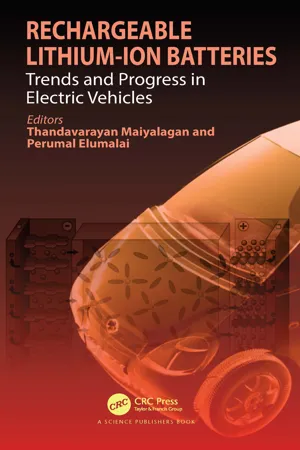
Lithium-ion batteries are the most promising among the secondary battery technologies, for providing high energy and high power required for hybrid electric vehicles (HEV) and electric vehicles (EV). Lithium-ion batteries consist of conventional graphite or lithium titanate as anode and lithium transition metal-oxides as cathode. A lithium salt dissolved in an aprotic solvent such as ethylene carbonate and diethylene carbonate is used as electrolyte. This rechargeable battery operates based on the principle of electrochemical lithium insertion/re-insertion or intercalation/de-intercalation during charging/discharging of the battery. It is essential that both electrodes have layered structure which should accept and release the lithium-ion. In advanced lithium-ion battery technologies, other than layered anodes are also considered. High cell voltage, high capacity as well as energy density, high Columbic efficiency, long cycle life, and convenient to fabricate any size or shape of the battery, are the vital features of this battery technology. Lithium-ion batteries are already being used widely in most of the consumer electronics such as mobile phones, laptops, PDAs etc. and are in early stages of application in HEV and EV, which will have far and wide implications and benefits to society. The book contains ten chapters, each focusing on a specific topic pertaining to the application of lithium-ion batteries in Electric Vehicles. Basic principles, electrode materials, electrolytes, high voltage cathodes, recycling spent Li-ion batteries and battery charge controller are addressed. This book is unique among the countable books focusing on the lithium-ion battery technologies for vehicular applications. It provides fundamentals and practical knowledge on the lithium-ion battery for vehicular application. Students, scholars, academicians, and battery and automobile industries will find this volume useful.
eBook - ePub
Rechargeable Lithium-Ion Batteries
Trends and Progress in Electric Vehicles
- 370 pages
- English
- ePUB (mobile friendly)
- Available on iOS & Android
eBook - ePub
Rechargeable Lithium-Ion Batteries
Trends and Progress in Electric Vehicles
About this book
Information
Table of contents
- Cover
- Title Page
- Copyright Page
- Preface
- Table of Contents
- About the Editors
- List of Corresponding Authors
- 1. Fundamental Principles of Lithium Ion Batteries
- 2. Issues and Challenges of Rechargeable Lithium Batteries
- 3. Advances in Rechargeable Lithium Ion Batteries and their Systems for Electric and Hybrid Electric Vehicles
- 4. Advanced Lithium Ion Batteries for Electric Vehicles: Promises and Challenges of Nanostructured Electrode Materials
- 5. Advanced High Voltage Cathode Materials for Rechargeable Lithium Ion Batteries
- 6. Nickel-based Cathode for Li-ion Batteries
- 7. Graphene-based Composites as Electrode Materials for Lithium Ion Batteries
- 8. Polymer Electrolytes for Lithium Ion Batteries
- 9. Processes and Technologies for the Recycling and Recovery of Spent Lithium Ion Batteries
- 10. Batteries Charge Controller and Its Technological Challenges for Plug-in Electric and Hybrid Electric Vehicles
- Index
Trusted by 375,005 students
Access to over 1.5 million titles for a fair monthly price.
Study more efficiently using our study tools.
Frequently asked questions
Yes, you can cancel anytime from the Subscription tab in your account settings on the Perlego website. Your subscription will stay active until the end of your current billing period. Learn how to cancel your subscription
No, books cannot be downloaded as external files, such as PDFs, for use outside of Perlego. However, you can download books within the Perlego app for offline reading on mobile or tablet. Learn how to download books offline
Perlego offers two plans: Essential and Complete
- Essential is ideal for learners and professionals who enjoy exploring a wide range of subjects. Access the Essential Library with 800,000+ trusted titles and best-sellers across business, personal growth, and the humanities. Includes unlimited reading time and Standard Read Aloud voice.
- Complete: Perfect for advanced learners and researchers needing full, unrestricted access. Unlock 1.5M+ books across hundreds of subjects, including academic and specialized titles. The Complete Plan also includes advanced features like Premium Read Aloud and Research Assistant.
We are an online textbook subscription service, where you can get access to an entire online library for less than the price of a single book per month. With over 1.5 million books across 990+ topics, we’ve got you covered! Learn about our mission
Look out for the read-aloud symbol on your next book to see if you can listen to it. The read-aloud tool reads text aloud for you, highlighting the text as it is being read. You can pause it, speed it up and slow it down. Learn more about Read Aloud
Yes! You can use the Perlego app on both iOS and Android devices to read anytime, anywhere — even offline. Perfect for commutes or when you’re on the go.
Please note we cannot support devices running on iOS 13 and Android 7 or earlier. Learn more about using the app
Please note we cannot support devices running on iOS 13 and Android 7 or earlier. Learn more about using the app
Yes, you can access Rechargeable Lithium-Ion Batteries by Thandavarayan Maiyalagan, Perumal Elumalai, Thandavarayan Maiyalagan,Perumal Elumalai in PDF and/or ePUB format, as well as other popular books in Technologie et ingénierie & Biologie. We have over 1.5 million books available in our catalogue for you to explore.