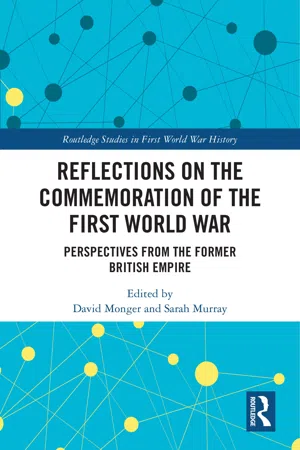
The First World War's centenary generated a mass of commemorative activity worldwide. Officially and unofficially; individually, collectively and commercially; locally, nationally and internationally, efforts were made to respond to the legacies of this vast conflict. This book explores some of these responses from areas previously tied to the British Empire, including Australia, Britain, Canada, India and New Zealand. Showcasing insights from historians of commemoration and heritage professionals it provides revealing insider and outsider perspectives of the centenary. How far did commemoration become celebration, and how merited were such responses? To what extent did the centenary serve wider social and political functions? Was it a time for new knowledge and understanding of the events of a century ago, for recovery of lost or marginalised voices, or for confirming existing clichés? And what can be learned from the experience of this centenary that might inform the approach to future commemorative activities? The contributors to this book grapple with these questions, coming to different answers and demonstrating the connections and disconnections between those involved in building public knowledge of the 'war to end all wars'.
eBook - ePub
Reflections on the Commemoration of the First World War
Perspectives from the Former British Empire
- 168 pages
- English
- ePUB (mobile friendly)
- Available on iOS & Android
eBook - ePub
Reflections on the Commemoration of the First World War
Perspectives from the Former British Empire
Part I
Commemoration and the centenary in perspective
1 Colonial commemoration in a time of multiculturalism
South Asia and the First World War1
Santanu Das
On Sunday 28 October 2018, two weeks before the centenary of the Armistice, Trafalgar Square in London erupted into festivity: it was Diwali, the Indian festival of lights. But, the year being 2018, the Diwali festivities turned into something different. There were men dressed up as First World War sepoys, young boys on parade, and khadi poppies on sale. Sadiq Khan, the first Muslim Mayor of London, spoke movingly about the South Asian contribution to the First World War: one and half million men from undivided India (comprising today’s Bangladesh, India, Pakistan and Myanmar, formerly Burma) were recruited, of whom over a million served abroad.2 Khan’s emphasis on the South Asian contribution was part of a two-fold shift that has been taking place over the last few years across Europe and particularly in Great Britain: a concerted effort to embed the memory of the First World War in a more multi-racial framework and employ it towards the vision of a more inclusive, multicultural society. What was new though in the aforementioned occasion was the khadi poppy which Sadiq Khan had donned. Khadi, the woven cotton fabric associated with anti-colonial nationalism in British India and particularly with Mahatma Gandhi, is here appropriated as a marker of military service under the Raj: war, empire, postcoloniality and multiculturalism are fused and confused as commemoration slips into celebration.
Sadiq Khan invoked the Mahatma but he was actually singing from the hymn-sheet of his fellow MP of South Asian origin and political opponent – the former Tory Minister Baroness Sayeeda Warsi. In 2013, in the lead-up to the centennial commemoration, Warsi had observed:
Our boys weren’t just Tommies; they were Tariqs and Tajinders too.A picture of a soldier in a turban is not what we immediately associate with the Great War. And yet so many men from so far away came to Europe to fight for the freedoms we enjoy today. Their legacy is our liberty, and every single one of us owes them a debt of gratitude.I will make it my mission to ensure that the centenary is a chance for everyone to learn about the contribution of the Commonwealth soldiers. After all, our shared future is based on our shared past.3
The previous year, in an article in The Sun, she had written:
There were also black British Soldiers, like the iconic footballer Walter Tull, who died in 1918 as he helped his men retreat in heavy gunfire.These are the people we must remember – people who everyone in today’s Britain can relate to.When I went head to head with BNP leader Nick Griffin on Question Time – the first time his party was given an airing on the Beeb – he was slapped down for stealing patriotism for his own racist ends.As the daughter of Pakistani immigrants, I proudly bang the drum for Britain’s heritage, because it’s mine too.After all, both my grandfathers fought with the Allies.I am also proud to serve in a government which respects our troops and resources them properly, honouring our Military Covenant.So two years from now, 100 years since the Great War began, let us all come together under one flag to remember what our heroes did for every single one of us.4
Warsi’s recommendation, in her capacity as the Faith and Communities minister at the time, set the agenda for the ‘Commonwealth’ war commemoration in Britain. Warsi is to be commended for her efforts to bring recognition to these colonial soldiers airbrushed out of Eurocentric narratives of the war. Four million non-white men were recruited into the armies of Europe and the United States during the war, including two million Africans and 1.5 million Indians. Warsi’s intervention was crucial at a time when, as she notes, the white supremacist British National Party (BNP) had been trying to hijack and whitewash First World War memory.5
The aforementioned speech, however, instrumentalises the past in complex ways. For the ethnic diasporic communities, the war contribution becomes a powerful way of seeking greater enfranchisement within and assimilation into British society. Imperial war service becomes a bulwark against racism and xenophobia as the status of the grandfather as a defender of Pax Britannia in its hour of need enables the ‘daughter of immigrants’ to ‘proudly bang’ the drum of her ‘British identity’. Within the South Asian context, Warsi’s reference to the Muslim ‘Tariq’ and the Sikh/Hindu ‘Tajinder’ is a shrewd and important recognition of the multi-religious, multi-ethnic and multi-lingual nature of the army of undivided India. And yet, if we press her rhetoric further, clear political agendas emerge. The emphasis is on ‘bravery’, the accent falls on ‘sacrifice’, the focus is on ‘shared past’ which, together with the term ‘Commonwealth soldiers’, erases the inequalities and asymmetries of empire. Indeed, ‘shared’ has become one of the most overused words in this centennial commemoration – ‘shared past’, ‘shared experience’, ‘shared memory’, to be put in the service of a ‘shared future’.6
In Britain, the First World War centennial commemoration has been invented as the grand-stage to play the theme of multiculturalism and tied to an agenda of social cohesion and community building. While it has resulted in a powerful expansion of war memory and an extraordinary outburst of energy, it has also resulted in the sanitisation of the violence of both war and empire. Such a process in turn prompts broader questions: how do we recover difficult, marginalised pasts and what is the relationship between historical amnesia, centennial commemoration and present-day concerns? Whose remembrance are we talking about and how can we decolonise war commemoration? This chapter engages with some of these questions through a focus on the Indian contribution to the First World War; starting with the Indian war experience itself and the post-war moment to understand the war’s contested legacies in the subcontinent.
Imperial war and post-war commemoration
Undivided India contributed the highest number of troops from any of the European colonies, dominions or protectorates. According to records of the time, the total number of Indian ranks recruited during the war, up to 31 December 1919, was 877,068 combatants and 563,369 non-combatants, making a total of 1,440,437; in addition, there were 122,000 men recruited in pre-war years. Between August 1914 and December 1919, India sent overseas for war purposes 622,224 soldiers and 474,789 non-combatants, to be pressed into one of the seven divisions that sailed to Europe, East Africa, Mesopotamia, the Sinai and Palestine, Suez, and Gallipoli.7 Why did these men enlist? Most came from poor, non-literate backgrounds for whom the military was an age-old profession; different impulses – social aspirations, family and community traditions and ideas of honour or izzat – were fused and confused with expectations of economic reward in the form of cash or, more commonly, land.
If the idea of the izzat-fuelled, loyalist sepoy has now been debunked as a colonial construction, the idea of these men as mere ‘mercenaries’ speaks, on the other hand, to a post-nationalist moment.8 As argued elsewhere, a more nuanced vocabulary is needed to understand the complex socio-psychological world of the sepoys in 1914 where financial incentive, ideas of izzat and varying degrees of ambivalence about their role in the colonial army were finely blended.9 While many censored sepoy letters speak eloquently about loyalty to the ‘Sarkar’, some hint at a deeply conflicted relationship to such duty. Consider the following letter written on 18 March 1915 by Amir Khan, shortly after the battle of Neuve Chapelle, to his brother in Punjab:
The enemy is weakening. In the fighting of the 10th March, up to the 12th, according to my estimate, 5,525 Germans were taken prisoners of war, and 25 guns and machine guns… Our new army is collected in great numbers. Wherever he shows strength, our guns at once knock him flat. Please God, I speak with certainty, our King – God bless him – is going to win and will win soon…[On a separate scrap of paper] God knows whether the land of France is stained with sin or whether the Day of Judgement has begun in France. For guns and of rifles, there is a deluge, bodies upon bodies, and blood flowing. God preserve us, what has come to pass! From dawn to dark and from dark to dawn it goes on like the hail that fell at Swarra [?] camp. But especially our guns have filled the German trenches with dead and made them brim with blood. God grant us grace, for grace is needed. Oh God, we repent! Oh God, we repent!10
Such ambivalence, already present in wartime testimonies, became endemic to the memory of the First World War in India during the post-war years amidst the rising tide of nationalism.
On 4 August 1914, India was dragged into the war as part of the British empire. However, the Indian nationalists supported the war effort enthusiastically: the road to India’s ‘Home Rule’, noted Mahatma Gandhi, lay in the fields of France and Flanders.11 Yet, after the war, contrary to widely held expectations, Woodrow Wilson’s doctri...
Table of contents
- Cover
- Half Title
- Series Page
- Title Page
- Copyright Page
- Table of Contents
- List of figures
- List of tables
- List of contributors
- Acknowledgements
- Introduction: assessing the centenary of the First World War
- Part I Commemoration and the centenary in perspective
- Part II The centenary in practice
- Index
Trusted by 375,005 students
Access to over 1.5 million titles for a fair monthly price.
Study more efficiently using our study tools.
Frequently asked questions
Yes, you can cancel anytime from the Subscription tab in your account settings on the Perlego website. Your subscription will stay active until the end of your current billing period. Learn how to cancel your subscription
No, books cannot be downloaded as external files, such as PDFs, for use outside of Perlego. However, you can download books within the Perlego app for offline reading on mobile or tablet. Learn how to download books offline
Perlego offers two plans: Essential and Complete
- Essential is ideal for learners and professionals who enjoy exploring a wide range of subjects. Access the Essential Library with 800,000+ trusted titles and best-sellers across business, personal growth, and the humanities. Includes unlimited reading time and Standard Read Aloud voice.
- Complete: Perfect for advanced learners and researchers needing full, unrestricted access. Unlock 1.5M+ books across hundreds of subjects, including academic and specialized titles. The Complete Plan also includes advanced features like Premium Read Aloud and Research Assistant.
We are an online textbook subscription service, where you can get access to an entire online library for less than the price of a single book per month. With over 1.5 million books across 990+ topics, we’ve got you covered! Learn about our mission
Look out for the read-aloud symbol on your next book to see if you can listen to it. The read-aloud tool reads text aloud for you, highlighting the text as it is being read. You can pause it, speed it up and slow it down. Learn more about Read Aloud
Yes! You can use the Perlego app on both iOS and Android devices to read anytime, anywhere — even offline. Perfect for commutes or when you’re on the go.
Please note we cannot support devices running on iOS 13 and Android 7 or earlier. Learn more about using the app
Please note we cannot support devices running on iOS 13 and Android 7 or earlier. Learn more about using the app
Yes, you can access Reflections on the Commemoration of the First World War by David Monger, Sarah Murray, David Monger,Sarah Murray in PDF and/or ePUB format, as well as other popular books in History & Australian & Oceanian History. We have over 1.5 million books available in our catalogue for you to explore.