eBook - PDF
Geographic Information Systems for Geoscientists
Modelling with GIS
- 417 pages
- English
- PDF
- Available on iOS & Android
eBook - PDF
About this book
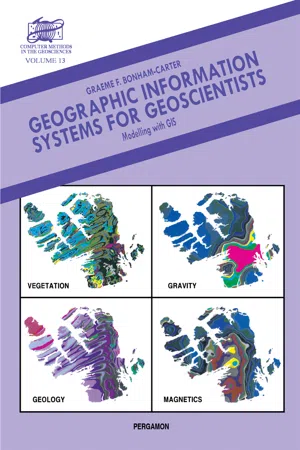
Geographic Information Systems for Geoscientists: Modelling with GIS provides an introduction to the ideas and practice of GIS to students and professionals from a variety of geoscience backgrounds. The emphasis in the book is to show how spatial data from various sources (principally paper maps, digital images and tabular data from point samples) can be captured in a GIS database, manipulated, and transformed to extract particular features in the data, and combined together to produce new derived maps, that are useful for decision-making and for understanding spatial interrelationship. The book begins by defining the meaning, purpose, and functions of GIS. It then illustrates a typical GIS application. Subsequent chapters discuss methods for organizing spatial data in a GIS; data input and data visualization; transformation of spatial data from one data structure to another; and the combination, analysis, and modeling of maps in both raster and vector formats. This book is intended as both a textbook for a course on GIS, and also for those professional geoscientists who wish to understand something about the subject. Readers with a mathematical bent will get more out of the later chapters, but relatively non-numerate individuals will understand the general purpose and approach, and will be able to apply methods of map modeling to clearly-defined problems.
Information
Topic
Personal DevelopmentSubtopic
TravelTable of contents
- Front Cover
- Geographic Information Systems for Geoscientists: Modelling with GIS
- Copyright Page
- Table of Contents
- Series Editor's Foreword
- Preface
- CHAPTER 1. Introduction to GIS
- CHAPTER 2. Spatial Data Models
- CHAPTER 3. Spatial Data Structures
- CHAPTER 4. Spatial Data Input
- Chapter 5. Visualization and Query of Spatial Data
- CHAPTER 6. Spatial Data Transformations
- CHAPTER 7. Tools for Map Analysis: Single Maps
- CHAPTER 8. Tools for Map Analysis: Map Pairs
- CHAPTER 9. Tools for Map Analysis: Multiple Maps
- APPENDIX I. Syntax for Modelling Pseudocode
- APPENDIX II. Fortran Program for Calculating Weights of Evidence
- APPENDIX III. Glossary of GIS Terms
- APPENDIX IV. GIS Acronyms
- Index
Trusted by 375,005 students
Access to over 1.5 million titles for a fair monthly price.
Study more efficiently using our study tools.
Frequently asked questions
Yes, you can cancel anytime from the Subscription tab in your account settings on the Perlego website. Your subscription will stay active until the end of your current billing period. Learn how to cancel your subscription
No, books cannot be downloaded as external files, such as PDFs, for use outside of Perlego. However, you can download books within the Perlego app for offline reading on mobile or tablet. Learn how to download books offline
Perlego offers two plans: Essential and Complete
- Essential is ideal for learners and professionals who enjoy exploring a wide range of subjects. Access the Essential Library with 800,000+ trusted titles and best-sellers across business, personal growth, and the humanities. Includes unlimited reading time and Standard Read Aloud voice.
- Complete: Perfect for advanced learners and researchers needing full, unrestricted access. Unlock 1.5M+ books across hundreds of subjects, including academic and specialized titles. The Complete Plan also includes advanced features like Premium Read Aloud and Research Assistant.
We are an online textbook subscription service, where you can get access to an entire online library for less than the price of a single book per month. With over 1.5 million books across 990+ topics, we’ve got you covered! Learn about our mission
Look out for the read-aloud symbol on your next book to see if you can listen to it. The read-aloud tool reads text aloud for you, highlighting the text as it is being read. You can pause it, speed it up and slow it down. Learn more about Read Aloud
Yes! You can use the Perlego app on both iOS and Android devices to read anytime, anywhere — even offline. Perfect for commutes or when you’re on the go.
Please note we cannot support devices running on iOS 13 and Android 7 or earlier. Learn more about using the app
Please note we cannot support devices running on iOS 13 and Android 7 or earlier. Learn more about using the app
Yes, you can access Geographic Information Systems for Geoscientists by Graeme F. Bonham-Carter in PDF and/or ePUB format, as well as other popular books in Personal Development & Travel. We have over 1.5 million books available in our catalogue for you to explore.