- 475 pages
- English
- PDF
- Available on iOS & Android
eBook - PDF
About this book
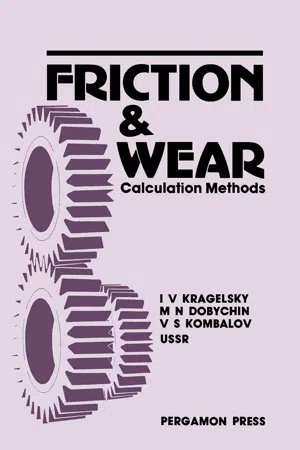
Friction and Wear: Calculation Methods provides an introduction to the main theories of a new branch of mechanics known as ""contact interaction of solids in relative motion."" This branch is closely bound up with other sciences, especially physics and chemistry. The book analyzes the nature of friction and wear, and some theoretical relationships that link the characteristics of the processes and the properties of the contacting bodies essential for practical application of the theories in calculating friction forces and wear values. The effect of the environment on friction and wear is also considered. Finally, the requirements, which must be fulfilled by the physicomechanical properties of the materials of which contacting bodies are made and which determine their behavior in moving contacts, are formulated. The book will be of interest to a wide circle of readers, e.g. engineers, designers, machine users, and research workers, working on the production of wear-resistant materials and working on the nature of friction and wear.
Information
Table of contents
- Front Cover
- Friction and Wear Calculation Methods
- Copyright Page
- Table of Contents
- Symbols
- Chapter 1. Interaction between, Changes in, and Damage to Solids in Sliding Contact
- Chapter 2. Contact Area
- Chapter 3. Critical Points Characterising the Conditions for the Transition fron One Type of Sliding Interaction to another
- Chapter 4. Preliminary Displacement and Static Friction
- Chapter 5. Dry and Boundary Friction
- Chapter 6. Fricticai on Impact
- Chapter 7. Rolling Friction
- Chapter 8. The Wear of Solids
- Chapter 9. Running-in and Equilibrium Roughness
- Chapter 10. Calculating the Wear of Machine Elements
- Chapter 11. Calculating the Wear of Machine Elenents in the Presence of an Abrasive
- Chapter 12. Methods of Evaluating the Frictional Properties of Materials
- Appendix
- References
- Subject Index
Trusted by 375,005 students
Access to over 1.5 million titles for a fair monthly price.
Study more efficiently using our study tools.
Frequently asked questions
Yes, you can cancel anytime from the Subscription tab in your account settings on the Perlego website. Your subscription will stay active until the end of your current billing period. Learn how to cancel your subscription
No, books cannot be downloaded as external files, such as PDFs, for use outside of Perlego. However, you can download books within the Perlego app for offline reading on mobile or tablet. Learn how to download books offline
Perlego offers two plans: Essential and Complete
- Essential is ideal for learners and professionals who enjoy exploring a wide range of subjects. Access the Essential Library with 800,000+ trusted titles and best-sellers across business, personal growth, and the humanities. Includes unlimited reading time and Standard Read Aloud voice.
- Complete: Perfect for advanced learners and researchers needing full, unrestricted access. Unlock 1.5M+ books across hundreds of subjects, including academic and specialized titles. The Complete Plan also includes advanced features like Premium Read Aloud and Research Assistant.
We are an online textbook subscription service, where you can get access to an entire online library for less than the price of a single book per month. With over 1.5 million books across 990+ topics, we’ve got you covered! Learn about our mission
Look out for the read-aloud symbol on your next book to see if you can listen to it. The read-aloud tool reads text aloud for you, highlighting the text as it is being read. You can pause it, speed it up and slow it down. Learn more about Read Aloud
Yes! You can use the Perlego app on both iOS and Android devices to read anytime, anywhere — even offline. Perfect for commutes or when you’re on the go.
Please note we cannot support devices running on iOS 13 and Android 7 or earlier. Learn more about using the app
Please note we cannot support devices running on iOS 13 and Android 7 or earlier. Learn more about using the app
Yes, you can access Friction and Wear by I V Kragelsky,M N Dobychin,V S Kombalov in PDF and/or ePUB format, as well as other popular books in Technology & Engineering & Engineering General. We have over 1.5 million books available in our catalogue for you to explore.