- 396 pages
- English
- ePUB (mobile friendly)
- Available on iOS & Android
eBook - ePub
About this book
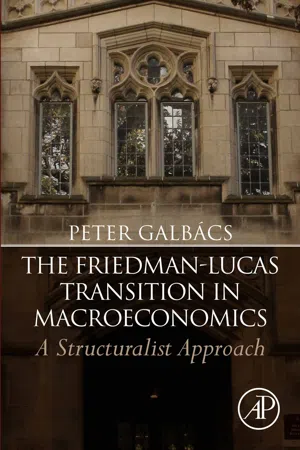
The Friedman-Lucas Transition in Macroeconomics: A Structuralist Approach considers how and to what extent monetarist and new classical theories of the business-cycle can be regarded as approximately true descriptions of a cycle's causal structure or whether they can be no more than useful predictive instruments. This book will be of interest to upper-division undergraduates, graduate students, researchers and professionals concerned with practical, theoretical and historical aspects of macroeconomics and business-cycle modeling.
- Offers a wide selection of Robert Lucas's unpublished works
- Discusses the history of business-cycle theories in the context of methodological advancements
- Suggests effective arguments for emphasizing the key role of representative agents and their assumed properties in macro-modeling
Information
Chapter 1
Methodology…?! Why?
Abstract
This chapter provides a brief review on some basic concepts and theories of economic methodology. All these theories come from the general philosophy of science to serve as the framework for the analysis of the methodological transition between Friedman and Lucas. After surveying the history and some major problems of modern economic methodology, two controversies of fundamental importance, the realism–anti-realism debate and the neoclassical-institutionalist dispute, get into the focus. In order to portray Lucas’s theoretical and methodological stance as a manifestation of realism, the first step to take is to suggest a definition of scientific realism that implies neither too high nor too low standards. Keeping away from an all-or-nothing case is the key to an interpretation of realism that by playing down the importance of formal supportive evidence places the emphasis upon the beliefs entertained in science. This account facilitates the close reading of Lucas’s texts carried out in the subsequent chapters.
Keywords
Realism; Anti-realism; Epistemology; Ontology; Methodology; Heterodoxy; Uskali Mäki; John Maynard Keynes; Milton Friedman; Robert E. Lucas
Some people laughed to see the alteration in
him, but he let them laugh, and little heeded them; for he was wise
enough to know that nothing ever happened on this globe, for good,
at which some people did not have their fill of laughter in the outset;
and knowing that such as these would be blind anyway, he thought it
quite as well that they should wrinkle up their eyes in grins, as have
the malady in less attractive forms
Charles Dickens: A Christmas carol
Our responsibility is to create new knowledge by pushing research into new, and hence necessarily controversial, territory. Consensus can be reached on specific issues, but consensus for a research area as a whole is equivalent to stagnation, irrelevance and death.
Robert E. Lucas
The purpose of this chapter is to introduce economic methodology as a general analytical framework. From a brief review on the evolution of modern methodology our road leads to some intriguing methodological problems of contemporary macroeconomics. Here it is argued that the evolution of our discipline raises a number of issues that can only be understood, analyzed, and solved in a methodological approach; these questions thus lie beyond the boundaries of our common theoretical debates. Of these issues the treatment of complexity, the use of economics in economic policy, and its relation to other social sciences are highlighted.
In this overview the realist turn initiated by Uskali Mäki emerges as one of the most important developments in economic methodology. This turn fundamentally changed the image our discipline draws of itself. Thanks to him, realism could effectively challenge the dominant anti-realist interpretations of economics. Scientific realism in the general philosophy of science is an optimistic epistemological attitude or belief according to which it is possible to make grounded claims regarding even the unobservable realm of reality. Whilst anti-realism denies this possibility, various albeit conflicting methodological strategies of gaining knowledge about socio-economic reality have emerged in the realist tradition. Tracing back the methodological disagreements to the underlying epistemological principles, it is argued that no analysis of economic theories can be complete without taking into account the epistemological, ontological, and methodological principles and strategies as well.
One of the most important accomplishments of the chapter is a simple definition of scientific realism easy to apply in the textual-based methodological analyses of the subsequent chapters. The absence of some incontrovertible evidences is perhaps the most cumbrous problem of scientific realism. Only such an evidence could by its undeniable verity convince sceptics to take a realist position. Accordingly, instead of making further troublesome attempts to by-pass or overcome the constraints that stem from the very nature of the connection between our senses and reality, the realist position is characterized below as a positive epistemological attitude or belief that is typical of theorists striving towards the causal understanding of reality. A crucial element of this attitude is the additional claim a realist attaches to her theories. Realists really believe that their theories are capable of unravelling the hidden levels of reality.
A case study on the neoclassical-institutionalist debate concludes the chapter to call attention to how and why methodological considerations ought to play a crucial role in theory assessment and interpretation.
1.1 Economic methodology as a juvenile subdiscipline suggesting some new aspects for theoretical analyses
1.1.1 Emergence and development
Economic methodology is one of the most novel subdisciplines of our science. In economics the term ‘methodology’ is applied in a twofold sense: there exist a ‘small-m’ and a ‘big-M’ methodology. Their approaches, scopes, and the researchers they involve are dissimilar. Small-m methodology is the playground of methodologically inclined economists, who seek answers to the practical questions of model building and forming assumptions. How to build ‘good’ economic models, what is meant by ‘goodness’ in this context, or how economists proceed in their research programmes, just to mention some of the typical questions. By contrast, big-M methodology is dominated by philosophers who as philosophers approach the questions raised by the ontological and cognitive status of economic models. These fields are of course overlapping to a certain extent. For the sake of a clear-cut distinction, Boland (2016) suggests the terms ‘methodology of economics’ (small-m methodology) and ‘philosophy of economics’ (big-M methodology). On the basis of the scientific background, quite a unanimous demarcation can be drawn in between as by profession economists are economists and philosophers are philosophers. Interestingly, Boland suggests that economists know more about philosophy (even if their knowledge does not stem from systematic studies) than philosophers know about economics. As a consequence, he argues, it would be unfortunate for economics if studies in its methodology were dominated by researchers alien to the field.
Methodological self-reflection became a constituent part of economic thinking relatively early as neoclassical founding fathers attached methodologies to their theories,1 which as a matter of fact were inseparable from the theories themselves. However, an independent economic methodology only emerged as late as in the 1980s. The early days of systematic methodological studies date back to the 1960s. From the preceding decades economists and economically interested philosophers of science bequeathed some sporadic methodological works only (Hands, 2015, pp. 61–62). In the 1960s, by contrast, the attention paid to economic methodology quickly intensified and one of the focus points of this newly emerged interest was Friedman’s (1953/2009) positivist methodology. Feelings evoked by the paper began to run so high that starting some systematic studies to clarify the methodological foundations of economics was no longer delayable.
The first occasion took place at the 1962 meeting of the American Economic Association, where apropos of Friedman’s positivist suggestions an intense debate flared up over the nature of a proper economic methodology (a recurrent topic of Chapter 4 below). After 1962, however, papers, book chapters, and books on economic methodology were still published only occasionally. It is also 1962 that Mark Blaug’s well-known textbook on the history of economics came out (Blaug, 1962). Blaug devoted its 17th chapter (A methodological postscript) to some methodological questions. Later Blaug developed this part into a complete volume (Blaug, 1980) the success and warm reception of which finally convinced the publishers to be open to methodology as an intriguing topic. This was thus the book that opened the avenue for the subsequent series of volumes in economic methodology (Boland, 2016, p. 20). From the period prior to the later breakthrough witnessed in the 1980s, Hands (2015) mentions only two books. One is a conference proceedings publication (Latsis, 1976). The 1974 conference was dedicated to the question what relevance Lakatos’s methodology of scientific research programmes has had in economics. The other is Wong’s tiny book on Samuelson’s revealed preference theory (Wong, 1978). Amongst the pathbreaking intellectual efforts Wong’s and Boland’s analyses on Friedman’s positivist methodology are also worth mentioning (Boland, 1979; Wong, 1973). As further positive examples, Rosenberg’s (1976) and Hausman’s (1981) studies are items to be labelled as philosophy of science with a specific interest in economics (Hausman, 2009, p. 36). After the mid-1970s the literature in economic methodology started an intense expansion.
Even though economic methodology showed up as a topic claiming wide attention, circumstances in the 1980s were still unfavourable. In those years the opinion leaders in both the neoclassical orthodoxy and the heterodox camp had passionate interest in methodology. In such a situation a branch of methodologists lying outside the cutting edge camp could seem to be a horde of kibitzers at best. First and foremost, it followed from the fact that methodology has sharply distinguished itself from purely descriptive history of science, so it could not avoid getting accused of normativity (Mäki, 2009a, p. 93). Economic methodologists seemed to know better how to do science than the theorists actively doing research. Blaug (1980) provides the best example of mixing some normative suggestions into the history of economic methodology, considerably weakening the scientific merit of his narrative.
The early development of economic methodology was fundamentally influenced by a debate taken place between economic historian E. Roy Weintraub and Uskali Mäki, who established economic methodology as we know it today. In this controversy Weintraub (1989) was particularly hostile against methodology and by calling its practical relevance into question he regarded even the idea of an outsider subdiscipline of economics as utterly harmful. Weintraub’s line of reasoning is problematic to say the least as the idea of a methodological subdiscipline torn apart from economics is difficult even to imagine. What is more, even practical economists engaging in methodological self-reflection cannot avoid taking such an outsider position, at least temporarily. Rather, methodology with its outsider point of view is likely to prove indispensable to rational self-control as disciplines cannot solve their methodological problems within their boundaries. In resolving our methodological debates, marginal utility theory is of no help.
Soon thereafter Mäki (1994a) responded to Weintraub’s suggestions and digging as down as to the level of the ultimate concepts and definitions refuted his concerns one by one. The significance of the debate is clearly indicated by the fact that a number of economic historians applying the widely neglected methodological aspect joined it later. For instance, Bruce Caldwell (1990) set the doubts over a possible normative role of methodology at rest. Quite ironically, many of the parties in the controversy later became colleagues at Duke University.
Economic methodology today covers an exceptionally wid...
Table of contents
- Cover image
- Title page
- Table of Contents
- Copyright
- Dedication
- Foreword
- Preface
- Acknowledgements
- Chapter 1: Methodology…?! Why?
- Chapter 2: Standing on the edge: Lucas in the Chicago tradition
- Chapter 3: Agents and structures
- Chapter 4: Realism and instrumentalism along the Friedman–Lucas transition
- Chapter 5: The end of economics?
- Index
Trusted by 375,005 students
Access to over 1.5 million titles for a fair monthly price.
Study more efficiently using our study tools.
Frequently asked questions
Yes, you can cancel anytime from the Subscription tab in your account settings on the Perlego website. Your subscription will stay active until the end of your current billing period. Learn how to cancel your subscription
No, books cannot be downloaded as external files, such as PDFs, for use outside of Perlego. However, you can download books within the Perlego app for offline reading on mobile or tablet. Learn how to download books offline
Perlego offers two plans: Essential and Complete
- Essential is ideal for learners and professionals who enjoy exploring a wide range of subjects. Access the Essential Library with 800,000+ trusted titles and best-sellers across business, personal growth, and the humanities. Includes unlimited reading time and Standard Read Aloud voice.
- Complete: Perfect for advanced learners and researchers needing full, unrestricted access. Unlock 1.5M+ books across hundreds of subjects, including academic and specialized titles. The Complete Plan also includes advanced features like Premium Read Aloud and Research Assistant.
We are an online textbook subscription service, where you can get access to an entire online library for less than the price of a single book per month. With over 1.5 million books across 990+ topics, we’ve got you covered! Learn about our mission
Look out for the read-aloud symbol on your next book to see if you can listen to it. The read-aloud tool reads text aloud for you, highlighting the text as it is being read. You can pause it, speed it up and slow it down. Learn more about Read Aloud
Yes! You can use the Perlego app on both iOS and Android devices to read anytime, anywhere — even offline. Perfect for commutes or when you’re on the go.
Please note we cannot support devices running on iOS 13 and Android 7 or earlier. Learn more about using the app
Please note we cannot support devices running on iOS 13 and Android 7 or earlier. Learn more about using the app
Yes, you can access The Friedman-Lucas Transition in Macroeconomics by Peter Galbács in PDF and/or ePUB format, as well as other popular books in Economics & Economic Theory. We have over 1.5 million books available in our catalogue for you to explore.