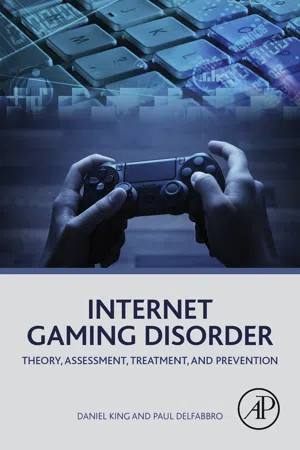
eBook - ePub
Internet Gaming Disorder
Theory, Assessment, Treatment, and Prevention
- 294 pages
- English
- ePUB (mobile friendly)
- Available on iOS & Android
eBook - ePub
Internet Gaming Disorder
Theory, Assessment, Treatment, and Prevention
About this book
Internet Gaming Disorder: Theory, Assessment, Treatment, and Prevention is an informative and practical introduction to the topics of Internet gaming disorder and problematic gaming. This book provides mental health clinicians with hands-on assessment, prevention, and treatment techniques for clients with problematic gaming behaviors and Internet gaming disorder. It provides an overview of the existing research on epidemiology, risk and protective factors, and discusses the distinct cognitive features that distinguish gaming from gambling and other related activities and disorders. Clinicians will find interest in discussion of the latest developments in cognitive-behavioral approaches to gaming disorder as well as the best structure for clinical interviews. Included in clinical sections are details of the key indicators of harm and impairment associated with problem gaming and how these might present in clinical cases. Internet Gaming Disorder is strongly evidence-based, draws extensively upon the latest international research literature, and provides insights into the likely future developments in this emerging field both in terms of technological development and new research approaches.
- Discusses the conceptual basis of Internet gaming disorder as a behavioral addiction
- Provides screening approaches for measuring excessive gaming
- Details a structured clinical interview approach for assessing gaming disorder
- Provides evidence-based clinical strategies for prevention and treatment
- Covers cognitive behavioral therapy and harm reduction strategies
Information
1
An introduction to gaming and IGD
Abstract
This chapter introduces the topic of video games as well as what has been termed Internet gaming disorder (IGD). Gaming is a rapidly growing and socially significant digital leisure activity, with many millions of regular players worldwide. This chapter will describe some of the important types and characteristics of video games, including discussion of recent innovations in gaming products and technologies that have transformed gaming into a time-consuming and potentially addictive activity. We will then highlight some of the research approaches to the study of IGD as well as current knowledge of the prevalence of gaming-related problems. This information provides a foundation for subsequent, more detailed discussions of IGD in relation to our current theoretical understanding of the phenomenon; how it is assessed; the most suitable service interventions; and examples of how clinical cases might present in practice contexts.
Keywords
Internet gaming disorder; Digital media; Gaming; Online; Technology; Prevalence; Monetization
Introduction and overview
Games can influence people’s lives. Throughout recorded history, the playing of games has been considered an essential and normal activity across the life-span. Through games, children learn to explore, to rehearse cognitive capacities, to release tension, and to bond with parents or affiliate with peers. Games can provide conditions that allow people to practice skills or act out roles of who they might want to be in real life. Moreover, the specific types of games that people choose to play can influence their personal development. For example, memory games can develop cognitive skills, social games can develop cooperation and communication skills, and adventure games can help people to confront their fears. People play what they like and get better at what they like by playing. Indeed, such is the psychological, social, and cultural importance of play that the lack of an ability to engage in play has often been seen as an early indicator of developmental disorders or delays or impairments later in life.
Although games in general are seen to be beneficial activities, the massive popularity of digital gaming over the last few decades, particularly online social games, has given rise to a new kind of concern: people who play too much. Researchers and clinicians are increasingly recognizing that some people play video games to such an extent that it interferes with their family life, work, education, sleep, hobbies, and social relationships. For these individuals, gaming is no longer a beneficial activity, but one that causes harm. Such players do not play freely or for enjoyment. They are unable to stop or control their gaming behavior.
Studies of problematic gaming behavior have led to our current understanding of some gaming-related problems as a new type of addiction—more specifically, a “behavioral addiction.” For some, an addiction to an activity rather than a type of substance may sound unconventional, if not questionable. However, as we will indicate in the chapters that follow, the available evidence shows that some vulnerable individuals are susceptible—due to factors including psychological predisposition, stress, risky environments, and the availability of gaming opportunities—to developing a habitual and self-destructive pattern of gaming. This behavior is characterized by many of the same features as disorders including gambling disorder and substance use disorder.
Individuals who engage in extremely problematic gaming behaviors, specifically those with an inability to self-regulate their gaming, are thought to have Internet gaming disorder (IGD). This classification is still new and not yet fully accepted in all nomenclatures. The Diagnostic and Statistical Manual of Mental Disorders, fifth edition (DSM-5), recognizes IGD as a disorder that may be included sometime in the future as a legitimate disorder, but one that for now still requires “further study.” As a related development, the upcoming International Classification of Diseases, 11th revision (ICD-11), is expected to include “Gaming Disorder”—this will mark the first time that gaming disorder is recognized as a diagnostic classification.
This chapter will begin with an introduction to video gaming products and technologies and will highlight the scope and global popularity of gaming. Recent innovations in gaming activities will then be discussed with reference to the potential implications for problem gaming and IGD. We will then highlight some of the common research approaches to the study of IGD and current understanding of the prevalence of gaming-related problems. This information is intended to “set the scene” for later chapters that will delve into the theoretical and practical issues associated with the empirical study and health response to IGD and related issues.
What are video games?
Many millions of people regularly play video games. For those unfamiliar with gaming, it may be helpful to know some of the basics about games, including the diversity of types and the types of experiences they can offer. Being acquainted with specific types of online games (e.g., massively multiplayer online [MMO] games) may be particularly useful for work with clients with IGD, because it may help, for example, in guiding screening questions and in making sense of client’s behaviors. However, one does not need to be a game “expert,” because it is the client’s understanding and experience that really matters in formulating relevant issues.
The term “video game” refers broadly to an interactive form of digital entertainment (Esposito, 2005). A game is designed by its developer to be played by a player. Typically, the player must use the game’s control scheme (e.g., keyboard, controller, or motion sensors) to manipulate images on a visual display (e.g., computer monitor, television, or smartphone) to reach an outcome usually defined as success or failure (Bartle, 2004; Salen & Zimmerman, 2004). Broadly, the player may win or advance, or lose.
This technical definition does not, however, really capture the psychological experience of gaming, particularly in the case of modern gaming. Many modern games offer unlimited experiences of winning and losing, as well as complex narratives and characters, large open worlds to explore, and opportunities to socialize with other players (King, Delfabbro, & Griffiths, 2010). Games enable players to alter their state of mind, experience different emotions, satisfy psychological needs, or simply pass time and escape reality (Ryan, Rigby, & Przybylski, 2006). Games may provide an alternative place to socialize outside of work and play (Steinkuehler & Williams, 2006) or offer some people an alternative existence to the real world (Castronova, 2008).
Games and gaming experiences are highly varied. They can differ according to genre (e.g., shooting, role-playing, and strategy), platforms (e.g., personal computer, smartphone), modes (e.g., single-player, competing against other players), online connectivity (i.e., playing online or offline), and objectives (e.g., defeating an opponent using violence, persuasion, or stealth tactics). Players will often develop a preference for certain types of experiences, just as gamblers have preferences for a specific gambling activity. The term “gamer” should, therefore, be considered only as a loose term to connote a person with a stable interest in gaming. Gamers are a large heterogeneous population, and therefore, problematic gamers vary greatly too.
Gaming may be considered a “leisure” activity. However, some games appear to share much in common with a job or may blur the boundaries between work and play. Individuals dedicated to a game may play on a daily “9 to 5” basis and refer to their gaming activities as a kind of tedious obligation (Yee, 2006a). They may say they are working on a game rather than playing. We have interviewed individuals who have referred to gaming as like a second job, albeit one without any financial return to the player (King & Delfabbro, 2009).
Another important dimension to gaming is the player’s attachment to virtual items, actions, and identities (King & Delfabbro, 2014). The virtual becomes “real enough.” Many people care about and remember what they did in games (Molesworth & Watkins, 2016). In this way, gaming is part of a broader societal trend toward valuing virtual goods and services. Just as people value “likes,” “clicks,” and “swipes” on social media, some gamers value and keep records of their progression and status in games. Gaming is not always simply disposable; it can matter greatly to some people as a supplementary record of their life.
The above characteristics of games form part of the explanation of why they can become problematic—even addictive—for some people. Their interactivity grants the user a sense of mastery and achievement. Their rewards provide a sense of excitement or emotional release. Their immersion helps the user to forget about problems and escape from distressing situations. Their endlessness enables any amount of time to be consumed by games. Their work-like structure gives the user a sens...
Table of contents
- Cover image
- Title page
- Table of Contents
- Copyright
- Preface
- Acknowledgments
- About the authors
- List of figures
- List of tables
- 1: An introduction to gaming and IGD
- 2: Theories and models of IGD
- 3: Risk and protective factors for IGD
- 4: Cognitive features of IGD
- 5: Screening and assessment of IGD
- 6: Case formulation for IGD
- 7: Treatment for IGD
- 8: Prevention and harm reduction for IGD
- 9: Future directions for IGD
- Index
Trusted by 375,005 students
Access to over 1.5 million titles for a fair monthly price.
Study more efficiently using our study tools.
Frequently asked questions
Yes, you can cancel anytime from the Subscription tab in your account settings on the Perlego website. Your subscription will stay active until the end of your current billing period. Learn how to cancel your subscription
No, books cannot be downloaded as external files, such as PDFs, for use outside of Perlego. However, you can download books within the Perlego app for offline reading on mobile or tablet. Learn how to download books offline
We are an online textbook subscription service, where you can get access to an entire online library for less than the price of a single book per month. With over 1.5 million books across 990+ topics, we’ve got you covered! Learn about our mission
Look out for the read-aloud symbol on your next book to see if you can listen to it. The read-aloud tool reads text aloud for you, highlighting the text as it is being read. You can pause it, speed it up and slow it down. Learn more about Read Aloud
Yes! You can use the Perlego app on both iOS and Android devices to read anytime, anywhere — even offline. Perfect for commutes or when you’re on the go.
Please note we cannot support devices running on iOS 13 and Android 7 or earlier. Learn more about using the app
Please note we cannot support devices running on iOS 13 and Android 7 or earlier. Learn more about using the app
Yes, you can access Internet Gaming Disorder by Daniel King,Paul Delfabbro,Torsten Liem,Tobias K. Dobler in PDF and/or ePUB format, as well as other popular books in Psychology & Addiction in Psychology. We have over 1.5 million books available in our catalogue for you to explore.