- 835 pages
- English
- PDF
- Available on iOS & Android
eBook - PDF
About this book
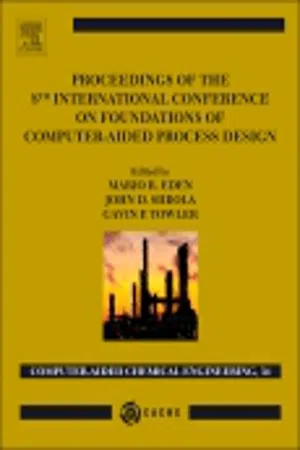
This volume collects together the presentations at the Eighth International Conference on Foundations of Computer-Aided Process Design, FOCAPD-2014, an event that brings together researchers, educators, and practitioners to identify new challenges and opportunities for process and product design.
The chemical industry is currently entering a new phase of rapid evolution. The availability of low-cost feedstocks from natural gas is causing renewed investment in basic chemicals in the OECD, while societal pressures for sustainability and energy security continue to be key drivers in technology development and product selection. This dynamic environment creates opportunities to launch new products and processes and to demonstrate new methodologies for innovation, synthesis and design. FOCAPD-2014 fosters constructive interaction among thought leaders from academia, industry, and government and provides a showcase for the latest research in product and process design.
- Focuses exclusively on the fundamentals and applications of computer-aided design for the process industries.
- Provides a fully archival and indexed record of the FOCAPD14 conference
- Aligns the FOCAPD series with the ESCAPE and PSE series
Information
Table of contents
- Front Cover
- Proceedings of the 8th International Conference on Foundations of Computer-Aided Process Design
- Copyright
- Contents
- Preface
- International Programming Committee
- Perspectives on Systems Engineering advances in Process and Product Design
- Challenges and Opportunities in the Design of New Energy Conversion Systems
- Multum in Parvo: A Process Intensification Retrospective and Outlook
- Challenges and opportunities in computer aided molecular design
- A perspective on process synthesis: Challenges and prospects
- Developing a Taxonomy for the Key Principles of Design and Education for Sustainability
- Molecules Matter: The Expanding Envelope of Process Design
- Design of Microbial Consortia for Industrial Biotechnology
- MPCCs and ROMS: New Paradigms for Multiscale Process Optimization
- The Future of Chemical Engineering Design:Impact of Faculty Makeup and Industrial Needs
- A Novel Framework for Carbon Capture, Utilization, and Sequestration, CCUS
- Product Design – From Molecules to Formulations to Devices
- Optimization Models for Optimal Investment, Drilling, and Water Management in Shale Gas Supply Chains
- Addressing a Design Defect: Process Targets and Flowsheets
- Challenges and Opportunities in Pharmaceutical Manufacturing Modeling and Optimization
- Viable Alternatives for Biofuels using Biochemical Pathways
- Perspectives on the Design and Planning of Oil Field Infrastructure
- Design of Integrated Biorefineries
- Transformation of Process Engineering – A Software Perspective
- On the development of strategies for water and energy management in the context of the waterenergy-food nexus
- Advanced Computational Tools for Optimizationand Uncertainty Quantification of Carbon Capture Processes
- Industrial Reflections on Modelling of Fine Chemicals and Seeds Process/Product Design
- A framework for the design, modeling and optimization of biomedical systems
- Spatially constrained interplant water network synthesis with water treatment options
- Revisiting the Simultaneous Process Optimization with Heat Integration Problem
- A Framework for the Modelling of Biphasic Reacting Systems
- Sustainable Process Synthesis-Intensification
- Towards Multi-period Planning of Direct Reuse Water Networks in Industrial Cities
- Superstructure Optimization: Reaction Yield Dependent CO2 Removal from OCM Product Gas
- Air Quality Considered Site Selection for New Chemical Plants
- Sustainability Assessment Methodology for Process and Product Design of Appropriate Technology for Developing Regions
- Characterization Based Reverse Design of Ionic Liquids
- Reactant Structure Generation by Signature Descriptors and Real Coded Genetic Algorithm
- Coupling Refrigeration System Synthesis and Heat Exchanger Network Design
- Techno-economic analysis of production and recovery of volatile fatty acids from brown algae using membrane distillation
- Application of the Generic Modelling Template Approach to Unsaturated Fatty Acid Oxidation and Crystallization Systems
- The Effect of Stage Recovery Uncertainties on the Selection of Process Structures
- Development of QSPR Model Relating Solvent Structure to Crystal Morphology
- Graph-Based Genetic Algorithm for De Novo Molecular Design
- Simulation of Spherical Particle Breakage
- Solution Strategies to Stochastic Design of Mineral Flotation Plants
- Bayesian Estimation, Uncertainty Propagation and Design of Experiments for CO2 Adsorption on Amine Sorbents
- Feasible Design of Multi-component Heterogeneous Reactive Distillation
- Computer-aided Molecular Design of ORC Working Fluids using PC-SAFT
- Static and dynamic simulation of NOx absorption tower based on a hybrid kinetic-equilibrium reac tion model
- New Perspective on Computer Aided Molecular Design: A Life Cycle Assessment Approach
- Uncertainty Quantification in Pharmaceutical Development
- Mathematical Programming Shortcut Screening Models for the Design of Integrated Waste Treatment Systems
- Robust chemical product design via fuzzy optimisation approach
- Optimal Design of Air Separation Plants with Variable Electricity Pricing
- Robust Autothermal Microchannel Reactors
- Effect of ship tilting on amine absorber with structured-packing for CO2 removal from natural gas
- A general methodology for energy efficiency of industrial chemical processes
- Systematic and Optimization-Based Design of Integrated Reaction-Separation Processes
- A Systematic Methodology Based on Residue Curve Maps for the Design of Batch Distillation Processes
- Considering parameter uncertainties in the design of safe processes
- Conceptual Design and Optimisation of Chemical Processes under Uncertainty by Two-Stage Programming
- Designing Optimum Protein-Excipient Interactions using Molecular Docking Simulations
- Process Modeling – Enabling Sustainable & Economically Attractive Innovation
- Process Synthesis, Design and Analysis using Process-Group Contribution Method
- Investigation of Process Efficiency of an Indirectly Heated Solar Reformer
- Attainable Regions in Crystallization Processes: Their Construction and the Influence of Parameter Uncertainty
- Systematic Chemical Reaction Pathway Synthesis for Sustainable Integrated Biorefineries
- Simultaneous Optimization and Heat Integration Based on Rigorous Process Simulations
- Nitrogen- and Climate Impact-based Metrics in Biomass Supply Chains
- Early Stage Design of a Biorefinery from Castor Oil
- Self-sufficient integrated algae based facility for diesel susbtitutes:FAEE and glycerol ethers
- Equation-Oriented Optimization of Cryogenic Systems for Coal Oxycombustion Power Plants
- Industrial-scale bioethanol production from brown algae and economic comparison of two pretreatment designs
- Multi-scale Material Screening and Process Optimization for Natural Gas Purification
- Optimal integration of compression heat with regenerative steam Rankine cycles
- Synergistic Biomass and Natural Gas Conversion to Liquid Fuel with Reduced CO2 Emissions
- MINLP model and algorithm for superstructure optimization of algae processing network
- Making transportation fuels and electricity from non-petroleum-based hybrid processes: process design and optimization
- Environmental Impact Assessment of Biorefinery Products Using Life Cycle Analysis
- A Mathematical Decomposition for the Synthesis and the Application of Total Site Analysis on Multi-product Biorefineries
- Application of Process Systems Engineering (PSE) Tools in Designing the Biorefinery
- Current Status of Optimal Design of Natural Gas Liquefaction Process
- Design and Optimisation of Power Plant Utility Systems
- Production of Liquid Transportation Fuels From Coal and Duckweed Biomass
- Multi-objective Design of Industrial Symbiosis in Palm Oil Industry
- Carbon Constrained Energy Planning (CCEP) with Carbon Capture and Storage Incorporating Carbon Credit Exchange
- Design Analysis of Integrated Microalgae Biorefineries
- A Methodology for the Optimization of Bioethanol Production via Biochemical Pathways
- Shale gas for the petrochemical industry: incorporation of novel technologies
- Designing a Waste to Energy Plant for Informal Settlements
- Synthesis of catalytic biomass-to-fuels strategies
- Screening and Assessing Product Portfolios in Biorefineries Combining Total Site Analysis and Process Synthesis
- A Novel Model for Evaluating the Viability of Strategies for Biorefining Processes from Various Stakeholder Perspectives: Case Study on Marginal Land Utilization
- Optimization and heat integration of hollow fiber based thermal swing adsorption process for CO2 capture from flue gas
- Modeling and Simulating Electrochemical Reduction of CO2 in a Microfluidic Cell
- Two Stage Bilevel Programming Approach for Representation of Biorefinery Investment Decision Making in a Pre-Established Timberlands Supply Chain
- Functional-unit-based life cycle optimization of sustainable biomass-to-electricity supply chain with economic and environmental tradeoffs
- Design of Combined Heat and Power Microgrids
- Forecastability as a Design Criterion in Wind Resource Assessment
- GLOBIE: An algorithm for the deterministic global optimization of box-constrained NLPs
- A Parallel Spectral-Projected-Gradient Method for Optimization in Process Engineering
- Rigorous Incorporation of Phase Equilibrium Calculations in Pressure Flow Networks for Plant Scale Dynamic Simulation
- Application of self-tuning High-fidelity Dynamic Simulation model for Soft-sensing
- MOSAIC: An Online Modeling Platform Supporting Automatic Discretization of Partial Differential Equation Systems
- Systematic Modeling for Optimization
- Parallel Solution of Nonlinear Contingency-constrained Network Problems
- Natural Language Modelling in Process Synthesis and Optimization
- Systematic Parameter Selection for Optimization under Uncertainty
- Indicators of Social Sustainability for Wastewater Treatment Processes
- Visual Modelling
- Data Clustering for Uncertainty Reduction – A Case Study of Solids Transport in Oil/Gas Pipelines
- Using GREENSCOPE for Sustainable Process Design: An Educational Opportunity
- Unified Interdisciplinary Methodology for Collaboration in Chemical Process Industry
- Effect of Backup Detection Levels in P-Median Formulations for Optimal Placement of Detectors in Mitigation Systems
- Resilience assessment of supply chains under different types of disruption
- A Framework for Design and Control Optimisation: Application on a CHP System
- An Integrated Approach to the Simultaneous Design and Operation of Industrial Facilities for Abnormal Situation Management
- Network-level Dynamics in Energy-integrated Batch Process Systems
- Novel Computer-Aided Approach for Biomass Operational Management
- Supply Chain Design towards sustainability: accounting for growth and jobs
- Design for Process Safety – A Perspective
- How to assess social aspects in supply chains?
- Comparison of different methods for predicting customized drug dosage in superovulation stage of in-vitro fertilization
- Author Index
Trusted by 375,005 students
Access to over 1.5 million titles for a fair monthly price.
Study more efficiently using our study tools.
Frequently asked questions
Yes, you can cancel anytime from the Subscription tab in your account settings on the Perlego website. Your subscription will stay active until the end of your current billing period. Learn how to cancel your subscription
No, books cannot be downloaded as external files, such as PDFs, for use outside of Perlego. However, you can download books within the Perlego app for offline reading on mobile or tablet. Learn how to download books offline
Perlego offers two plans: Essential and Complete
- Essential is ideal for learners and professionals who enjoy exploring a wide range of subjects. Access the Essential Library with 800,000+ trusted titles and best-sellers across business, personal growth, and the humanities. Includes unlimited reading time and Standard Read Aloud voice.
- Complete: Perfect for advanced learners and researchers needing full, unrestricted access. Unlock 1.5M+ books across hundreds of subjects, including academic and specialized titles. The Complete Plan also includes advanced features like Premium Read Aloud and Research Assistant.
We are an online textbook subscription service, where you can get access to an entire online library for less than the price of a single book per month. With over 1.5 million books across 990+ topics, we’ve got you covered! Learn about our mission
Look out for the read-aloud symbol on your next book to see if you can listen to it. The read-aloud tool reads text aloud for you, highlighting the text as it is being read. You can pause it, speed it up and slow it down. Learn more about Read Aloud
Yes! You can use the Perlego app on both iOS and Android devices to read anytime, anywhere — even offline. Perfect for commutes or when you’re on the go.
Please note we cannot support devices running on iOS 13 and Android 7 or earlier. Learn more about using the app
Please note we cannot support devices running on iOS 13 and Android 7 or earlier. Learn more about using the app
Yes, you can access Proceedings of the 8th International Conference on Foundations of Computer-Aided Process Design by in PDF and/or ePUB format, as well as other popular books in Technology & Engineering & Chemical & Biochemical Engineering. We have over 1.5 million books available in our catalogue for you to explore.