- 261 pages
- English
- PDF
- Available on iOS & Android
eBook - PDF
Digital Computer Structure and Design
About this book
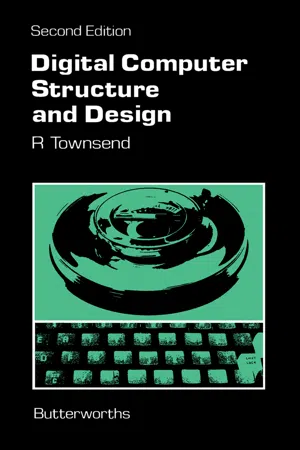
Digital Computer Structure and Design, Second Edition discusses switching theory, counters, sequential circuits, number representation, and arithmetic functions The book also describes computer memories, the processor, data flow system of the processor, the processor control system, and the input-output system. Switching theory, which is purely a mathematical concept, centers on the properties of interconnected networks of "gates." The theory deals with binary functions of 1 and 0 which can change instantaneously from one to the other without intermediate values. The binary number system is used in computer arithmetic and other operations due to its simplicity that can be easily adopted in device parameters. These operations involve only two levels: the "on" or "off" positions, which also offer maximum immunity to noise or circuit interference. The binary system is a very efficient way to represent numbers or to store data. When the computer uses this system, the clock cycle of the processor determines or divides the cycles for each sub-operation into steps. A master timing counter defines each of these steps, and synchronizes them avoid data loss or mix-ups. After the sub-operation has been completed, the monitor will display the result. Programmers, computer engineers, computer instructors, and students of computer science will find the book highly useful.
Information
Table of contents
- Front Cover
- Digital Computer Structure and Design
- Copyright Page
- Table of Contents
- Preface to Second Edition
- Chapter 1. Introduction
- Chapter 2. Switching Theory
- Chapter 3. Counters and Sequential Circuits
- Chapter 4. Number Representation in Computers
- Chapter 5. Addition and Subtraction
- Chapter 6. Multiplication and Division
- Chapter 7. Computer Memories
- Chapter 8. Functional Description of a Small Processor
- Chapter 9. The Data Flow System of the Processor
- Chapter 10. The Processor Control System
- Chapter 11. The Input-Output System
- Appendix: Graphic Symbols for Logic Diagrams
- Index
Trusted by 375,005 students
Access to over 1.5 million titles for a fair monthly price.
Study more efficiently using our study tools.
Frequently asked questions
Yes, you can cancel anytime from the Subscription tab in your account settings on the Perlego website. Your subscription will stay active until the end of your current billing period. Learn how to cancel your subscription
No, books cannot be downloaded as external files, such as PDFs, for use outside of Perlego. However, you can download books within the Perlego app for offline reading on mobile or tablet. Learn how to download books offline
Perlego offers two plans: Essential and Complete
- Essential is ideal for learners and professionals who enjoy exploring a wide range of subjects. Access the Essential Library with 800,000+ trusted titles and best-sellers across business, personal growth, and the humanities. Includes unlimited reading time and Standard Read Aloud voice.
- Complete: Perfect for advanced learners and researchers needing full, unrestricted access. Unlock 1.5M+ books across hundreds of subjects, including academic and specialized titles. The Complete Plan also includes advanced features like Premium Read Aloud and Research Assistant.
We are an online textbook subscription service, where you can get access to an entire online library for less than the price of a single book per month. With over 1.5 million books across 990+ topics, we’ve got you covered! Learn about our mission
Look out for the read-aloud symbol on your next book to see if you can listen to it. The read-aloud tool reads text aloud for you, highlighting the text as it is being read. You can pause it, speed it up and slow it down. Learn more about Read Aloud
Yes! You can use the Perlego app on both iOS and Android devices to read anytime, anywhere — even offline. Perfect for commutes or when you’re on the go.
Please note we cannot support devices running on iOS 13 and Android 7 or earlier. Learn more about using the app
Please note we cannot support devices running on iOS 13 and Android 7 or earlier. Learn more about using the app
Yes, you can access Digital Computer Structure and Design by R. Townsend in PDF and/or ePUB format, as well as other popular books in Technology & Engineering & Applied Mathematics. We have over 1.5 million books available in our catalogue for you to explore.