- 188 pages
- English
- PDF
- Available on iOS & Android
eBook - PDF
About this book
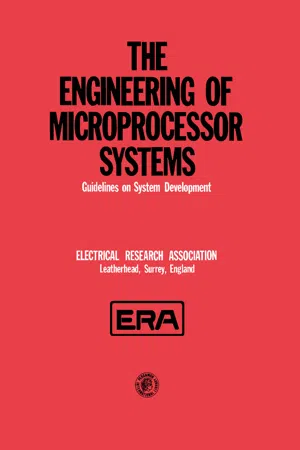
The Engineering of Microprocessor Systems: Guidelines on System Development provides economical and technical guidance for use when incorporating microprocessors in products or production processes and assesses the alternatives that are available. This volume is part of Project 0251 undertaken by The Electrical Research Association, which aims to give managers and development engineers advice and comment on the development process and the hardware and software needed to support the engineering of microprocessor systems. The results of Phase 1 of the five-phase project are contained in this first volume. It presents an overview of the technology of microprocessors themselves, of the development process, and of the range of development aids which will be covered in greater depth in later volumes. Also included are specific recommendations, facts, or guidelines on the choices to be made or procedures to be adopted. This volume is aimed primarily at the manager or other users responsible for microprocessor system developments, but who may lack direct experience in this field. It is intended to provide a decision framework and background material for management considering such developments for the first time, so that the special problems and key aspects of a microprocessor based development can be identified from the start.
Trusted by 375,005 students
Access to over 1 million titles for a fair monthly price.
Study more efficiently using our study tools.
Information
Table of contents
- Front Cover
- The Engineering of Microprocessor Systems: Guidelines on System Development
- Copyright Page
- Table of Contents
- INTRODUCTION
- PROJECT 0251 - SUMMARY INDEX
- VOLUME 1 GUIDELINES ON SYSTEM DEVELOPMENT
- PREFACE
- SECTION 1: A GUIDE TO THE JARGON
- SECTION 2: THE SIGNIFICANCE OF MICROPROCESSORS FOR INDUSTRY
- SECTION 3: CHOOSING THE RIGHT TECHNOLOGY
- SECTION 4: SELECTING THE MICROPROCESSOR
- SECTION 5: THE DEVELOPMENT PROCESS
- SECTION 6: SETTING UP THE DEVELOPMENT LABORATORY
- APPENDIX: GLOSSARY OF MICROELECTRONICSAND COMPUTER TERMS
Frequently asked questions
Yes, you can cancel anytime from the Subscription tab in your account settings on the Perlego website. Your subscription will stay active until the end of your current billing period. Learn how to cancel your subscription
No, books cannot be downloaded as external files, such as PDFs, for use outside of Perlego. However, you can download books within the Perlego app for offline reading on mobile or tablet. Learn how to download books offline
Perlego offers two plans: Essential and Complete
- Essential is ideal for learners and professionals who enjoy exploring a wide range of subjects. Access the Essential Library with 800,000+ trusted titles and best-sellers across business, personal growth, and the humanities. Includes unlimited reading time and Standard Read Aloud voice.
- Complete: Perfect for advanced learners and researchers needing full, unrestricted access. Unlock 1.4M+ books across hundreds of subjects, including academic and specialized titles. The Complete Plan also includes advanced features like Premium Read Aloud and Research Assistant.
We are an online textbook subscription service, where you can get access to an entire online library for less than the price of a single book per month. With over 1 million books across 990+ topics, we’ve got you covered! Learn about our mission
Look out for the read-aloud symbol on your next book to see if you can listen to it. The read-aloud tool reads text aloud for you, highlighting the text as it is being read. You can pause it, speed it up and slow it down. Learn more about Read Aloud
Yes! You can use the Perlego app on both iOS and Android devices to read anytime, anywhere — even offline. Perfect for commutes or when you’re on the go.
Please note we cannot support devices running on iOS 13 and Android 7 or earlier. Learn more about using the app
Please note we cannot support devices running on iOS 13 and Android 7 or earlier. Learn more about using the app
Yes, you can access The Engineering of Microprocessor Systems by Sam Stuart in PDF and/or ePUB format, as well as other popular books in Technology & Engineering & Engineering General. We have over one million books available in our catalogue for you to explore.