eBook - ePub
German Campaign in Russia: Planning and Operations (1940-1942)
Barbarossa to Stalingrad: Eastern Front strategy and command decisions, 1941-1942
- 316 pages
- English
- ePUB (mobile friendly)
- Available on iOS & Android
eBook - ePub
German Campaign in Russia: Planning and Operations (1940-1942)
Barbarossa to Stalingrad: Eastern Front strategy and command decisions, 1941-1942
About this book
The aim of this edition is to present in a comprehensive way the strategy and military operations of the German army in the attack on Russia in World War 2. The narrative starts with Hitler's initial plans for an invasion of Russia and ends at the time of Germany's maximum territorial gains during the battle for Stalingrad.
Contents:
Strategic Planning
Operational Planning
The Initial Operations (22 June-31 July 1941)
Planning for Future Operations
The Diversion and Reassembly
The German Attack on Moscow
The Russian Counteroffensive (December 1941-February 1942)
Preliminary Planning for a German Offensive in the Caucasus, 1942
Preparations for the German Summer Offensive
Initial Operations and New Plans (July 1942)
The Period of Stagnation (August-October 1942)
Critical Analysis of the German Summer Offensive in 1942
List of German Military Leaders (July 1940-November 1942)
Chronology of the Events
Information
Topic
StoriaSubtopic
Storia russaGerman Campaign in Russia: Planning and Operations (1940-1942)
WW2: Strategic & Operational Planning: Directive Barbarossa, The Initial Operations, German Attack on Moscow, German Offensive in the Caucasus
Madison & Adams Press, 2018. No claim to original U.S. Government Works
Contact [email protected]
Contact [email protected]
ISBN 978-80-268-8267-1
This is a publication of Madison & Adams Press. Our production consists of thoroughly prepared educational & informative editions: Advice & How-To Books, Encyclopedias, Law Anthologies, Declassified Documents, Legal & Criminal Files, Historical Books, Scientific & Medical Publications, Technical Handbooks and Manuals. All our publications are meticulously edited and formatted to the highest digital standard. The main goal of Madison & Adams Press is to make all informative books and records accessible to everyone in a high quality digital and print form.
Table of Contents
FOREWORD
PART ONE PLANNING
Chapter 1 Strategic Planning
Initial Discussions (July 1940)
The Marcks Plan (5 August 1940)
Staff Work (August-September 1940)
Admiral Raeder's Suggestions (26 September 1940)
Strategic Survey (October 1940)
The Preliminary Plan (November-5 December 1940)
General Staff and Command Post Exercises (November-December 1940)
Economic Survey
Directive BARBAROSSA (18 December 1940)
Chapter 2 Operational Planning
The Army's Operation Order (3 February 1941)
Initiation of Subordinate Staffs (February-March 1941)
Changes in Plans (March-April 1941)
Army Group South
Far North
Delay in the Start
The Draft of Directive No. 32 (11 June 1947)
Strategic Concentration (21 June 1941)
Air Support
Other Factors
Estimate of Soviet Strength (June 1941)
Sources of Information
Estimate of Red Army Dispositions
Estimate of Soviet Air Force Strength
PART TWO OPERATIONS IN 1941
Chapter 3 The Initial Operations (22 June-31 July 1941)
D Day
The Situation on 30 June 1941
Developments in Early July 1941
The Mid-July Estimate
Directive No. 33 (19 July 1941)
The Army's Letter to the Armed Forces High Command
The Situation Toward the End of July 1947
Chapter 4 Planning for Future Operations
The Army's Order of 28 July 1941
Directive No. 34 (30 July 1941)
Hitler's Vacillation Over Strategy
The Supplement to Directive No. 34 (12 August 1941)
Developments to Mid-August 1941
The Army Memorandum of 18 August 1941
Hitler's Decision (20 August 1941)
Chapter 5 The Diversion and Reassembly
The Personnel Situation (End of August 1941)
Increasing Logistical Difficulties (Early September 1941)
POL
Track-Laying and Wheeled Vehicles
Developments to Mid-September 1947
Directive No. 35 (6 September 1941)
The Situation at the End of September 1941
Military-Economic Survey (2 October 1941)
The Muddy Period and Its Effect on Operations (October 1941)
Hitler's Plan for the Seizure of Moscow (12 October 1941)
Chapter 6 The German Attack on Moscow
Strategic Factors
Last-Minute Planning and Operations to 13 November 1941
The Course of the Offensive (14 November-5 December 1941)
The Personnel Situation (End of November 1941)
Critique
PART THREE 1942 — THE YEAR OF INDECISION
Chapter 7 The Russian Counteroffensive (December 1941 - February 1942)
The First German Reverses
Hitler's Directive No. 39 (8 December 1941)
The Army High Command Order of 8 December 1941
Intelligence Estimate
Plans
The Mission of the Army Groups
Conduct of Operations
Organization
The Red Army Seizes the Initiative
Developments to 25 December 1941
The German Crisis in Mid-January 1942
The Crisis Reaches Its Climax (Beginning of February 1942)
The Russian Offensive Is Halted (20 February 1942)
Critique
Chapter 8 Preliminary Planning for a German Offensive in the Caucasus, 1942
Exploratory Steps (July 1940-September 1941)
The First Plan for a Caucasus Operation (October 1941)
Caucasus Planning in November 1941
Effects of the Moscow Setback (January 1942)
The First Preparatory Orders (February 1942)
The Navy's Role (February 1942)
Intelligence Estimate (20 February 1942)
Hitler's Preoccupations in Early March 1942
The Situation at the End of March 1942
Chapter 9 Preparations for the German Summer Offensive
Directive No. 41 (5 April 1942)
Estimates, Delays, and Disappointments in April 1942
Intelligence Estimate
Delay in the Preliminary Operations
The Situation at Army Group Center
Chain of Command
Transportation
Turkey Remains Neutral
Logistical Preparations
Timing
Chain of Command
Supplies
Motor Vehicles
Rail Transportation
Summary
Organizational Problems
Rehabilitation of Units
Shortage of Technicians
Construction of Fortifications
Oil Brigade Caucasus
Casualties and Replacements
The Participation of Germany's Allies
Rear Area Security
Army Group South's Defense Line
The Role of Army Group A
Feint and Counerfeint
Warning Notes (May 1942)
The Armed Forces Potential in the Spring of 1942
The Preliminary Operations (May-June 1942)
Last-Minute Incidents and Impressions (June 1942)
Chapter 10 Initial Operations and New Plans (July 1942)
The First Phase (28 June-6 July 1942)
The Second Phase (30 June -7 July 1942)
Changes in the German Order of Battle (July 1942)
The Army Group A Offensive
The Operation Plan
The Army Group A Attack
German and Russian Weaknesses
Directive No. 43
The Continuation of Operations
The Situation of the Other Army Groups by 20 July 1942
Directive No. 44 (21 July 1942)
Directive No. 45 (23 July 1942)
German Shortages
Tanks
Gasoline
Stalingrad Takes Priority Over the Caucasus (End of July 1942)
Chapter 11 The Period of Stagnation (August-October 1942)
Developments to Mid-August 1942
Personnel and Other Problems (16-18 August 1942)
The Situation in the Caucasus (Second Half of August 1942)
The Opening of the Battle for Stalingrad (End of August 1942)
The German Leadership Crisis (September 1942)
Faulty Intelligence and its Interpretation
The German Offensive Grinds to a Halt (26 September 1942)
German Estimates in October and Early November 1942
Army Group A
Army Group B
The Estimate of 6 November
The Oil of the Caucasus
German Efforts at Production
Russian Supplies
Local Engagements (October-Mid-November 1942)
Chapter 12 Critical Analysis of the German Summer Offensive in 1942
Different Concepts of Strategy
Differences over the Choice of Objective
Mistakes in the Execution of the German Offensive
Appendixes
Appendix A List of German Military Leaders July 1940 - November 1942)
Appendix B Chronology of Events
FOREWORD
Table of Contents
Clausewitz observed of Russia that "it was a country which could be subdued only by its own weakness and by the effects of internal dissension. In order to strike these vulnerable spots of its body politic, Russia would have to be agitated at the very center." In reading this study, the military student will realize how dearly the Germans had to pay for ignoring Clausewitz's advice.
The purpose of this study is to describe German planning and operations in the first part of the campaign against Russia. The narrative starts with Hitler's initial plans for an invasion of Russia and ends at the time of Germany's maximum territorial gains during the battle for Stalingrad. A subsequent volume will depict the course of events from the Russian counteroffensive in November 1942 to the capture of Berlin in April 1945.
The material for this study was obtained from German military records now in the custody of The Adjutant General, Department of the Army. Monographs by former German general officers who had an active part in the planning and operations provided additional information. The authors of these monographs, prepared for the Historical Division, United States Army, Europe, include Generaloberst (Gen.) Franz Halder, Chief of Staff of the German Army from 1938-42; Generaloberst Gotthard Heinrici, a former corps, army, and army group commander on the Russian front: and several others.
The study was written by Mr. George E. Blau of the Special Studies Division, Office of the Chief of Military History. In his presentation, the author made every effort to give an objective account of Germany's initial efforts to conquer Soviet Russia in World War II.
PART ONE
PLANNING
Table of Contents
Chapter 1
Strategic Planning
Table of Contents
Initial Discussions
(July 1940)
Table of Contents
After the conclusion of the French campaign in June 1940 Hitler devoted his attention to initiating plans for the seaborne invasion of England-Operation SEELOEWE. On 16 July he issued the directive for the operation. Three days later, in a speech before the Reichstag, Hitler made peace overtures to Great Britain. When they did not produce the expected reaction in Britain, he could only conclude that his last remaining enemy was continuing the war hoping for a change in the U.S. attitude and for future assistance from the Soviet Union.
On 21 July, after discussing the invasion of England with his military advisers, Hitler asked Field Marshal Walter von Brauchitsch, the Commander in Chief of the Army, to study the Russian problem and submit plans for a campaign against the Soviet Union. In regard to the latter the following was mentioned:
1. The concentration of attack forces would take 4 to 6 weeks.
2. The military objective would be to defeat the Russian Army or at least to seize so much Russian territory that the armaments plants in eastern Germany, particularly those in Berlin and Upper Silesia, and the Romanian oil fields would be beyond the range of Russian air attacks. At the same time the German ground forces would have to advance far enough to bring important production centers of European Russia within striking distance of the Luftwaffe.
3. The political aims would include the creation of an independent Ukraine and a confederation of Baltic States under German domination.
4. The Army would need approximately 80-100 combat divisions; the Soviet Union had some 50-75 good Russian divisions in Europe. If the campaign against Russia was launched that autumn, some of the German air power committed against Britain would have to be transferred to the East.
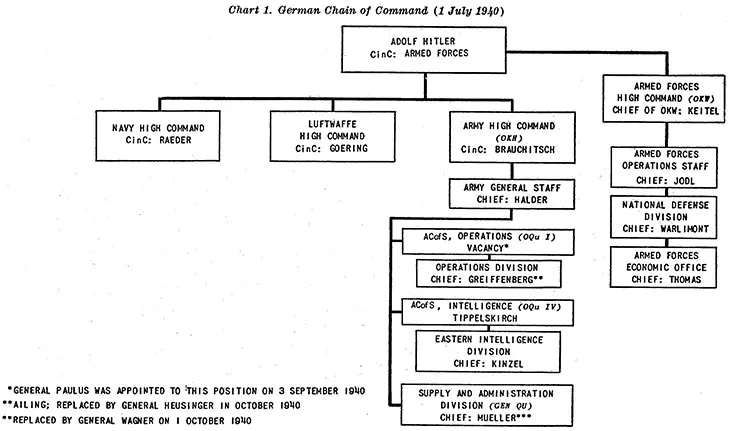
The following day, Brauchitsch informed Generaloberst (Gen.) Franz Halder, Chief, Army General Staff, of the discussions that had taken place at the previous day's conference and asked him to study the various problems involved in an operation against Russia. Halder thereupon requested Lt. Col. Eberhardt Kinzel, Chief, Eastern Intelligence Division, to brief him on Russian troop dispositions and asked Col. Hans von Greiffenberg, Chief, Operations Division, to assign a special assistant to the preparation of a tentative plan for a campaign against the Soviet Union. [See chart 1.]
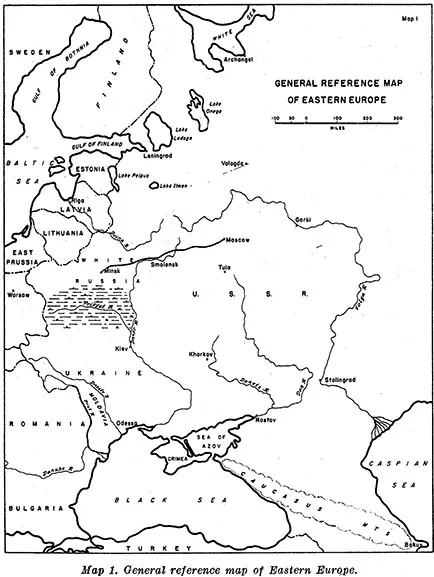
On the basis of data provided by Kinzel on 26 July, Halder concluded that an attack launched from assembly areas in East Prussia and northern Poland toward Moscow would offer the best chances for success. After the seizure of Moscow the Russian forces defending the Ukraine and the Black Sea coast would be compelled to fight a series of battles with reversed front. [See map 1.]
The first draft of the Operations Division plan placed the main effort south of the Pripyat Marshes. The plan also called for 100 divisions. Halder, however, preferred to place the main effort north of the Pripyat.
Two days later, 29 July, Generalmajor (Brig. Gen.) Erich Marcks was temporarily assigned to Army High Command headquarters to draw up a campaign plan against the Soviet Union. General Marcks was chief of staff of the Eighteenth Army, which had recently been assigned to the Russian border and was preparing plans for defense against a possible Russian attack.
The same day General der Artillerie (Lt. Gen.) Alfred Jodl, Chief, Armed Forces Operations Staff, informed Col. Walter Warlimont, Chief, National Defense Division, and a group of officers working on his staff that Hitler had made up his mind to start a preventive war against Russia. The Army and Luftwaffe were to employ all available forces to eliminate forever the Bolshevist danger in the East. Since an eventual conflict between the National Socialist and Communist ideologies was inevitable, the Fuehrer preferred to extend the war into eastern Europe right then to being forced to resume hostilities after a few years of intermittent peace. Originally, Hitler had intended to invade Russia in the autumn of 1940, but Field Marshal Wilhelm Keitel had pointed out the difficulties of a winter campaign in Russia and had presented convincing evidence that the existing road and rail net in the newly acquired...
Table of contents
- German Campaign in Russia: Planning and Operations (1940-1942)
Trusted by 375,005 students
Access to over 1.5 million titles for a fair monthly price.
Study more efficiently using our study tools.
Frequently asked questions
Yes, you can cancel anytime from the Subscription tab in your account settings on the Perlego website. Your subscription will stay active until the end of your current billing period. Learn how to cancel your subscription
No, books cannot be downloaded as external files, such as PDFs, for use outside of Perlego. However, you can download books within the Perlego app for offline reading on mobile or tablet. Learn how to download books offline
Perlego offers two plans: Essential and Complete
- Essential is ideal for learners and professionals who enjoy exploring a wide range of subjects. Access the Essential Library with 800,000+ trusted titles and best-sellers across business, personal growth, and the humanities. Includes unlimited reading time and Standard Read Aloud voice.
- Complete: Perfect for advanced learners and researchers needing full, unrestricted access. Unlock 1.5M+ books across hundreds of subjects, including academic and specialized titles. The Complete Plan also includes advanced features like Premium Read Aloud and Research Assistant.
We are an online textbook subscription service, where you can get access to an entire online library for less than the price of a single book per month. With over 1.5 million books across 990+ topics, we’ve got you covered! Learn about our mission
Look out for the read-aloud symbol on your next book to see if you can listen to it. The read-aloud tool reads text aloud for you, highlighting the text as it is being read. You can pause it, speed it up and slow it down. Learn more about Read Aloud
Yes! You can use the Perlego app on both iOS and Android devices to read anytime, anywhere — even offline. Perfect for commutes or when you’re on the go.
Please note we cannot support devices running on iOS 13 and Android 7 or earlier. Learn more about using the app
Please note we cannot support devices running on iOS 13 and Android 7 or earlier. Learn more about using the app
Yes, you can access German Campaign in Russia: Planning and Operations (1940-1942) by U.S. Department of Defense in PDF and/or ePUB format, as well as other popular books in Storia & Storia russa. We have over 1.5 million books available in our catalogue for you to explore.