eBook - ePub
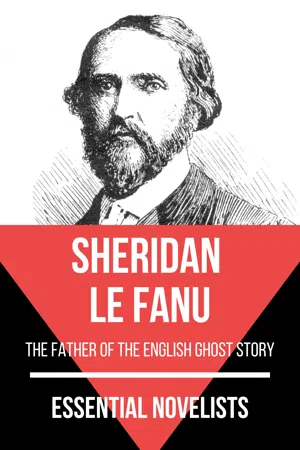
Essential Novelists - Sheridan Le Fanu
the father of the English ghost story
- 401 pages
- English
- ePUB (mobile friendly)
- Available on iOS & Android
eBook - ePub
Essential Novelists - Sheridan Le Fanu
the father of the English ghost story
About this book
Welcome to the Essential Novelists book series, were we present to you the best works of remarkable authors.
For this book, the literary critic August Nemo has chosen the two most important and meaningful novels of Sheridan Le Fanu which are Carmilla and Uncle Silas.
Joseph Thomas Sheridan Le Fanu was a leading ghost story writer of the nineteenth century and was central to the development of the genre in the Victorian era. M. R. James described Le Fanu as "absolutely in the first rank as a writer of ghost stories".
Novels selected for this book:
- Carmilla
- Uncle Silas
This is one of many books in the series Essential Novelists. If you liked this book, look for the other titles in the series, we are sure you will like some of the authors.
Information
Publisher
Tacet BookseBook ISBN
9783968582122
Year
2020


Uncle Silas

Volume I

I
AUSTIN RUTHYN, OF KNOWL, and His Daughter
IT WAS WINTER —THAT is, about the second week in November —and great gusts were rattling at the windows, and wailing and thundering among our tall trees and ivied chimneys —a very dark night, and a very cheerful fire blazing, a pleasant mixture of good round coal and spluttering dry wood, in a genuine old fireplace, in a sombre old room. Black wainscoting glimmered up to the ceiling, in small ebony panels; a cheerful clump of wax candles on the tea-table; many old portraits, some grim and pale, others pretty, and some very graceful and charming, hanging from the walls. Few pictures, except portraits long and short, were there. On the whole, I think you would have taken the room for our parlour. It was not like our modern notion of a drawing-room. It was a long room too, and every way capacious, but irregularly shaped.
A girl, of a little more than seventeen, looking, I believe, younger still; slight and rather tall, with a great deal of golden hair, dark grey-eyed, and with a countenance rather sensitive and melancholy, was sitting at the tea-table, in a reverie. I was that girl.
The only other person in the room —the only person in the house related to me —was my father. He was Mr. Ruthyn, of Knowl, so called in his county, but he had many other places, was of a very ancient lineage, who had refused a baronetage often, and it was said even a viscounty, being of a proud and defiant spirit, and thinking themselves higher in station and purer of blood than two-thirds of the nobility into whose ranks, it was said, they had been invited to enter. Of all this family lore I knew but little and vaguely; only what is to be gathered from the fireside talk of old retainers in the nursery.
I am sure my father loved me, and I know I loved him. With the sure instinct of childhood I apprehended his tenderness, although it was never expressed in common ways. But my father was an oddity. He had been early disappointed in Parliament, where it was his ambition to succeed. Though a clever man, he failed there, where very inferior men did extremely well. Then he went abroad, and became a connoisseur and a collector; took a part, on his return, in literary and scientific institutions, and also in the foundation and direction of some charities. But he tired of this mimic government, and gave himself up to a country life, not that of a sportsman, but rather of a student, staying sometimes at one of his places and sometimes at another, and living a secluded life.
Rather late in life he married, and his beautiful young wife died, leaving me, their only child, to his care. This bereavement, I have been told, changed him —made him more odd and taciturn than ever, and his temper also, except to me, more severe. There was also some disgrace about his younger brother —my uncle Silas —which he felt bitterly.
He was now walking up and down this spacious old room, which, extending round an angle at the far end, was very dark in that quarter. It was his wont to walk up and down, thus, without speaking —an exercise which used to remind me of Chateaubriand’s father in the great chamber of the Château de Combourg. At the far end he nearly disappeared in the gloom, and then returning emerged for a few minutes, like a portrait with a background of shadow, and then again in silence faded nearly out of view.
This monotony and silence would have been terrifying to a person less accustomed to it than I. As it was, it had its effect. I have known my father a whole day without once speaking to me. Though I loved him very much, I was also much in awe of him.
While my father paced the floor, my thoughts were employed about the events of a month before. So few things happened at Knowl out of the accustomed routine, that a very trifling occurrence was enough to set people wondering and conjecturing in that serene household. My father lived in remarkable seclusion; except for a ride, he hardly ever left the grounds of Knowl; and I don’t think it happened twice in the year that a visitor sojourned among us.
There was not even that mild religious bustle which sometimes besets the wealthy and moral recluse. My father had left the Church of England for some odd sect, I forget its name, and ultimately became, I was told, a Swedenborgian. But he did not care to trouble me upon the subject. So the old carriage brought my governess, when I had one, the old housekeeper, Mrs. Rusk, and myself to the parish church every Sunday. And my father, in the view of the honest Rector who shook his head over him —“a cloud without water, carried about of winds, and a wandering star to whom is reserved the blackness of darkness” —corresponded with the “minister” of his church, and was provokingly contented with his own fertility and illumination; and Mrs. Rusk, who was a sound and bitter churchwoman, said he fancied he saw visions and talked with angels like the rest of that “rubbitch.”
I don’t know that she had any better foundation than analogy and conjecture for charging my father with supernatural pretensions; and in all points when her orthodoxy was not concerned, she loved her master and was a loyal housekeeper.
I found her one morning superintending preparations for the reception of a visitor, in the hunting-room it was called, from the pieces of tapestry that covered its walls, representing scenes, à la Wouvermans, of falconry, and the chase, dogs, hawks, ladies, gallants, and pages. In the midst of whom Mrs. Rusk, in black silk, was rummaging drawers, counting linen, and issuing orders.
“Who is coming, Mrs. Rusk?”
Well, she only knew his name. It was a Mr. Bryerly. My papa expected him to dinner, and to stay for some days.
“I guess he’s one of those creatures, dear, for I mentioned his name just to Dr. Clay (the Rector), and he says there is a Doctor Bryerly, a great conjurer among the Swedenborg sect —and that’s him, I do suppose.”
In my hazy notions of these sectaries there was mingled a suspicion of necromancy, and a weird freemasonry, that inspired something of awe and antipathy.
Mr. Bryerly arrived time enough to dress at his leisure, before dinner. He entered the drawing-room —a tall, lean man, all in ungainly black, with a white choker, with either a black wig, or black hair dressed in imitation of one, a pair of spectacles, and a dark, sharp, short visage, rubbing his large hands together, and with a short brisk nod to me, whom he plainly regarded merely as a child, he sat down before the fire, crossed his legs, and took up a magazine.
This treatment was mortifying, and I remember very well the resentment of which he was quite unconscious.
His stay was not very long; not one of us divined the object of his visit, and he did not prepossess us favourably. He seemed restless, as men of busy habits do in country houses, and took walks, and a drive, and read in the library, and wrote half a dozen letters.
His bedroom and dressing-room were at the side of the gallery, directly opposite to my father’s, which had a sort of anteroom en suite, in which were some of his theological books.
The day after Mr. Bryerly’s arrival, I was about to see whether my father’s water caraffe and glass had been duly laid on the table in this anteroom, and in doubt whether he was there, I knocked at the door.
I suppose they were too intent on other matters to hear, but receiving no answer, I entered the room. My father was sitting in his chair, with his coat and waistcoat off, Mr. Bryerly kneeling on a stool beside him, rather facing him, his black scratch wig leaning close to my father’s grizzled hair. There was a large tome of their divinity lore, I suppose, open on the table close by. The lank black figure of Mr. Bryerly stood up, and he concealed something quickly in the breast of his coat.
My father stood up also, looking paler, I think, than I ever saw him till then, and he pointed grimly to the door, and said, “Go.”
Mr. Bryerly pushed me gently back with his hands to my shoulders, and smiled down from his dark features with an expression quite unintelligible to me.
I had recovered myself in a second, and withdrew without a word. The last thing I saw at the door was the tall, slim figure in black, and the dark, significant smile following me: and then the door was shut and locked, and the two Swedenborgians were left to their mysteries.
I remember so well the kind of shock and disgust I felt in the certainty that I had surprised them at some, perhaps, debasing incantation —a suspicion of this Mr. Bryerly, of the ill-fitting black coat, and white choker —and a sort of fear came upon me, and I fancied he was asserting some kind of mastery over my father, which very much alarmed me.
I fancied all sorts of dangers in the enigmatical smile of the lank high-priest. The image of my father, as I had seen him, it might be, confessing to this man in black, who was I knew not what, haunted me with the disagreeable uncertainties of a mind very uninstructed as to the limits of the marvellous.
I mentioned it to no one. But I was immensely relieved when the sinister visitor took his departure the morning after, and it was upon this occurrence that my mind was now employed.
Someone said that Dr. Johnson resembled a ghost, who must be spoken to before it will speak. But my father, in whatever else he may have resembled a ghost, did not in that particular; for no one but I in his household —and I very seldom —dared to address him until first addressed by him. I had no notion how singular this was until I began to go out a little among friends and relations, and found no such rule in force anywhere else.
As I leaned back in my chair thinking, this phantasm of my father came, and turned, and vanished with a solemn regularity. It was a peculiar figure, strongly made, thickset, with a face large, and very stern; he wore a loose, black velvet coat and waistcoat. It was, however, the figure of an elderly rather than an old man —though he was then past seventy —but firm, and with no sign of feebleness.
I remember the start with which, not suspecting that he was close by me, I lifted my eyes, and saw that large, rugged countenance looking fixedly on me, from less than a yard away.
After I saw him, he continued to regard me for a second or two; and then, taking one of the heavy candlesticks in his gnarled hand, he beckoned me to follow him; which, in silence and wondering, I accordingly did.
He led me across the hall, where there were lights burning, and into a lobby by the foot of the back stairs, and so into his library.
It is a long, narrow room, with two tall, slim windows at the far end, now draped in dark curtains. Dusky it was with but one candle; and he paused near the door, at the left-hand side of which stood, in those days, an old-fashioned press or cabinet of carved oak. In front of this he stopped.
He had odd, absent ways, and talked more to himself, I believe, than to all the rest of the world put together.
“She won’t understand,” he whispered, looking at me enquiringly. “No, she won’t. Will she?”
Then there was a pause, during which he brought forth from his breast pocket a small bunch of some half-dozen keys, on one of which he looked frowningly, every now and then balancing it a little before his eyes, between his finger and thumb, as he deliberated.
I knew him too well, of course, to interpose a word.
“They are easily frightened —ay, they are. I’d better do it another way.”
And pausing, he looked in my face as he might upon a picture.
“They are —yes —I had better do it another way —another way; yes —and she’ll not suspect —she’ll not suppose.”
Then he looked steadfastly upon the key, and from it to me, suddenly lifting it up, and said abruptly, “See, child,” and, after a second or two, “Remember this key.”
It was oddly shaped, and unlike others.
“Yes, sir.” I always called him “sir.”
“It opens that,” and he tapped it sharply on the door of the cabinet. “In the daytime it is always here,” at which word he dropped it into his pocket again. “You see? —and at night under my pillow —you hear me?”
“Yes, sir.”
“You won’t forget this cabinet —oak —next the door —on your left —you won’t forget?”
“No, sir.”
“Pity she’s a girl, and so young —ay, a girl, and so young —no sense —giddy. You say, you’ll remember?”
“Yes, sir.”
“It behoves you.”
He turned round and looked full upon me, like a man who has taken a sudden resolution; and I think for a moment he had made up his mind to tell me a great deal more. But if so, he changed it again; and after another pause, he said slowly and sternly —“You will tell nobody what I have said, under pain of my displeasure.”
“Oh! no, sir!”
“Good child!”
“Except,” he resumed, “under one contingency; that is, in case I should be absent, and Dr. Bryerly —you recollect the thin gentleman, in spectacles and a black wig, who spent three days here last month —should come and enquire for the key, you understand, in my absence.”
“Yes, sir.”
So he kissed me on the forehead, and said —
“Let us return.”
Which, accordingly, we did, in silence; the storm outside, like a dirge on a great org...
Table of contents
- Table of Contents
- Author
- Carmilla
- Uncle Silas
- About the Publisher
- Colophon
Trusted by 375,005 students
Access to over 1.5 million titles for a fair monthly price.
Study more efficiently using our study tools.