- 275 pages
- English
- ePUB (mobile friendly)
- Available on iOS & Android
eBook - ePub
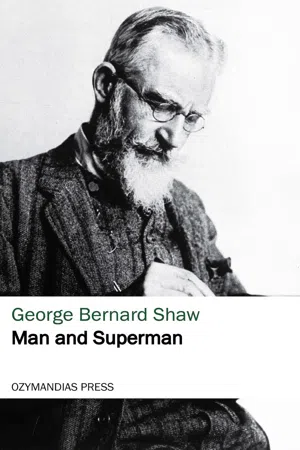
Man and Superman
About this book
Mr. Whitefield has recently died, and his will indicates that his daughter Ann should be left in the care of two men, Roebuck Ramsden and Jack Tanner. Ramsden, a venerable old man, distrusts John Tanner, an eloquent youth with revolutionary ideas, saying "He is prodigiously fluent of speech, restless, excitable (mark the snorting nostril and the restless blue eye, just the thirty-secondth of an inch too wide open), possibly a little mad". In spite of what Ramsden says, Ann accepts Tanner as her guardian, though Tanner doesn't want the position at all. She also challenges Tanner's revolutionary beliefs with her own ideas. Despite Tanner's professed dedication to anarchy, he is unable to disarm Ann's charm, and she ultimately persuades him to marry her, choosing him over her more persistent suitor, a young man named Octavius Robinson.
Information
Topic
LetteraturaSubtopic
ClassiciACT III
~
EVENING IN THE SIERRA NEVADA. Rolling slopes of brown, with olive trees instead of apple trees in the cultivated patches, and occasional prickly pears instead of gorse and bracken in the wilds. Higher up, tall stone peaks and precipices, all handsome and distinguished. No wild nature here: rather a most aristocratic mountain landscape made by a fastidious artist-creator. No vulgar profusion of vegetation: even a touch of aridity in the frequent patches of stones: Spanish magnificence and Spanish economy everywhere.
Not very far north of a spot at which the high road over one of the passes crosses a tunnel on the railway from Malaga to Granada, is one of the mountain amphitheatres of the Sierra. Looking at it from the wide end of the horse-shoe, one sees, a little to the right, in the face of the cliff, a romantic cave which is really an abandoned quarry, and towards the left a little hill, commanding a view of the road, which skirts the amphitheatre on the left, maintaining its higher level on embankments and on an occasional stone arch. On the hill, watching the road, is a man who is either a Spaniard or a Scotchman. Probably a Spaniard, since he wears the dress of a Spanish goatherd and seems at home in the Sierra Nevada, but very like a Scotchman for all that. In the hollow, on the slope leading to the quarry-cave, are about a dozen men who, as they recline at their cave round a heap of smouldering white ashes of dead leaf and brushwood, have an air of being conscious of themselves as picturesque scoundrels honoring the Sierra by using it as an effective pictorial background. As a matter of artistic fact they are not picturesque; and the mountains tolerate them as lions tolerate lice. An English policeman or Poor Law Guardian would recognize them as a selected band of tramps and ablebodied paupers.
This description of them is not wholly contemptuous. Whoever has intelligently observed the tramp, or visited the ablebodied ward of a workhouse, will admit that our social failures are not all drunkards and weaklings. Some of them are men who do not fit the class they were born into. Precisely the same qualities that make the educated gentleman an artist may make an uneducated manual laborer an ablebodied pauper. There are men who fall helplessly into the workhouse because they are good for nothing; but there are also men who are there because they are strongminded enough to disregard the social convention (obviously not a disinterested one on the part of the ratepayer) which bids a man live by heavy and badly paid drudgery when he has the alternative of walking into the workhouse, announcing himself as a destitute person, and legally compelling the Guardians to feed, clothe and house him better than he could feed, clothe and house himself without great exertion. When a man who is born a poet refuses a stool in a stockbroker’s office, and starves in a garret, spunging on a poor landlady or on his friends and relatives rather than work against his grain; or when a lady, because she is a lady, will face any extremity of parasitic dependence rather than take a situation as cook or parlormaid, we make large allowances for them. To such allowances the ablebodied pauper and his nomadic variant the tramp are equally entitled.
Further, the imaginative man, if his life is to be tolerable to him, must have leisure to tell himself stories, and a position which lends itself to imaginative decoration. The ranks of unskilled labor offer no such positions. We misuse our laborers horribly; and when a man refuses to be misused, we have no right to say that he is refusing honest work. Let us be frank in this matter before we go on with our play; so that we may enjoy it without hypocrisy. If we were reasoning, farsighted people, four fifths of us would go straight to the Guardians for relief, and knock the whole social system to pieces with most beneficial reconstructive results. The reason we do got do this is because we work like bees or ants, by instinct or habit, not reasoning about the matter at all. Therefore when a man comes along who can and does reason, and who, applying the Kantian test to his conduct, can truly say to us, If everybody did as I do, the world would be compelled to reform itself industrially, and abolish slavery and squalor, which exist only because everybody does as you do, let us honor that man and seriously consider the advisability of following his example. Such a man is the able-bodied, able-minded pauper. Were he a gentleman doing his best to get a pension or a sinecure instead of sweeping a crossing, nobody would blame him; for deciding that so long as the alternative lies between living mainly at the expense of the community and allowing the community to live mainly at his, it would be folly to accept what is to him personally the greater of the two evils.
We may therefore contemplate the tramps of the Sierra without prejudice, admitting cheerfully that our objects—briefly, to be gentlemen of fortune—are much the same as theirs, and the difference in our position and methods merely accidental. One or two of them, perhaps, it would be wiser to kill without malice in a friendly and frank manner; for there are bipeds, just as there are quadrupeds, who are too dangerous to be left unchained and unmuzzled; and these cannot fairly expect to have other men’s lives wasted in the work of watching them. But as society has not the courage to kill them, and, when it catches them, simply wreaks on them some superstitious expiatory rites of torture and degradation, and than lets them loose with heightened qualifications for mischief, it is just as well that they are at large in the Sierra, and in the hands of a chief who looks as if he might possibly, on provocation, order them to be shot.
This chief, seated in the centre of the group on a squared block of stone from the quarry, is a tall strong man, with a striking cockatoo nose, glossy black hair, pointed beard, upturned moustache, and a Mephistophelean affectation which is fairly imposing, perhaps because the scenery admits of a larger swagger than Piccadilly, perhaps because of a certain sentimentality in the man which gives him that touch of grace which alone can excuse deliberate picturesqueness. His eyes and mouth are by no means rascally; he has a fine voice and a ready wit; and whether he is really the strongest man in the party, or not, he looks it. He is certainly, the best fed, the best dressed, and the best trained. The fact that he speaks English is not unexpected in spite of the Spanish landscape; for with the exception of one man who might be guessed as a bullfighter ruined by drink and one unmistakable Frenchman, they are all cockney or American; therefore, in a land of cloaks and sombreros, they mostly wear seedy overcoats, woollen mufflers, hard hemispherical hats, and dirty brown gloves. Only a very few dress after their leader, whose broad sombrero with a cock’s feather in the band, and voluminous cloak descending to his high boots, are as un-English as possible. None of them are armed; and the ungloved ones keep their hands in their pockets because it is their national belief that it must be dangerously cold in the open air with the night coming on. (It is as warm an evening as any reasonable man could desire).
Except the bullfighting inebriate there is only one person in the company who looks more than, say, thirty-three. He is a small man with reddish whiskers, weak eyes, and the anxious look of a small tradesman in difficulties. He wears the only tall hat visible: it shines in the sunset with the sticky glow of some sixpenny patent hat reviver, often applied and constantly tending to produce a worse state of the original surface than the ruin it was applied to remedy. He has a collar and cuff of celluloid; and his brown Chesterfield overcoat, with velvet collar, is still presentable. He is pre-eminently the respectable man of the party, and is certainly over forty, possibly over fifty. He is the corner man on the leader’s right, opposite three men in scarlet ties on his left. One of these three is the Frenchman. Of the remaining two, who are both English, one is argumentative, solemn, and obstinate; the other rowdy and mischievous.
The chief, with a magnificent fling of the end of his cloak across his left shoulder, rises to address them. The applause which greets him shows that he is a favorite orator.
THE CHIEF. Friends and fellow brigands. I have a proposal to make to this meeting. We have now spent three evenings in discussing the question Have Anarchists or Social-Democrats the most personal courage? We have gone into the principles of Anarchism and Social-Democracy at great length. The cause of Anarchy has been ably represented by our one Anarchist, who doesn’t know what Anarchism means [laughter]—
THE ANARCHIST. [rising] A point of order, Mendoza—
MENDOZA. [forcibly] No, by thunder: your last point of order took half an hour. Besides, Anarchists don’t believe in order.
THE ANARCHIST. [mild, polite but persistent: he is, in fact, the respectable looking elderly man in the celluloid collar and cuffs] That is a vulgar error. I can prove—
MENDOZA. Order, order.
THE OTHERS [shouting] Order, order. Sit down. Chair! Shut up.
The Anarchist is suppressed.
MENDOZA. On the other hand we have three Social-Democrats among us. They are not on speaking terms; and they have put before us three distinct and incompatible views of Social-Democracy.
THE MAJORITY. [shouting assent] Hear, hear! So we are. Right.
THE ROWDY SOCIAL-DEMOCRAT. [smarting under oppression] You ain’t no Christian. You’re a Sheeny, you are.
MENDOZA. [with crushing magnanimity] My friend; I am an exception to all rules. It is true that I have the honor to be a Jew; and, when the Zionists need a leader to reassemble our race on its historic soil of Palestine, Mendoza will not be the last to volunteer [sympathetic applause—hear, hear, etc.]. But I am not a slave to any superstition. I have swallowed all the formulas, even that of Socialism; though, in a sense, once a Socialist, always a Socialist.
THE SOCIAL-DEMOCRATS. Hear, hear!
MENDOZA. But I am well aware that the ordinary man—even the ordinary brigand, who can scarcely be called an ordinary man [Hear, hear!]—is not a philosopher. Common sense is good enough for him; and in our business affairs common sense is good enough for me. Well, what is our business here in the Sierra Nevada, chosen by the Moors as the fairest spot in Spain? Is it to discuss abstruse questions of political economy? No: it is to hold up motor cars and secure a more equitable distribution of wealth.
THE SULKY SOCIAL-DEMOCRAT. All made by labor, mind you.
MENDOZA. [urbanely] Undoubtedly. All made by labor, and on its way to be squandered by wealthy vagabonds in the dens of vice that disfigure the sunny shores of the Mediterranean. We intercept that wealth. We restore it to circulation among the class that produced it and that chiefly needs it—the working class. We do this at the risk of our lives and liberties, by the exercise of the virtues of courage, endurance, foresight, and abstinence—especially abstinence. I myself have eaten nothing but prickly pears and broiled rabbit for three days.
THE SULKY SOCIAL-DEMOCRAT. [Stubbornly] No more ain’t we.
MENDOZA. [indignantly] Have I taken more than my share?
THE SULKY SOCIAL-DEMOCRAT. [unmoved] Why should you?
THE ANARCHIST. Why should he not? To each according to his needs: from each according to his means.
THE FRENCHMAN. [shaking his fist at the anarchist] Fumiste!
MENDOZA. [diplomatically] I agree with both of you.
THE GENUINELY ENGLISH BRIGANDS. Hear, hear! Bravo, Mendoza!
MENDOZA. What I say is, let us treat one another as gentlemen, and strive to excel in personal courage only when we take the field.
THE ROWDY SOCIAL-DEMOCRAT. [derisively] Shikespear.
A whistle comes from the goatherd on the hill. He springs up and points excitedly forward along the road to the north.
THE GOATHERD. Automobile! Automobile! [He rushes down the hill and joins the rest, who all scramble to their fe...
Table of contents
- EPISTLE DEDICATORY TO ARTHUR BINGHAM WALKLEY
- ACT I
- ACT II
- ACT III
- ACT IV
Trusted by 375,005 students
Access to over 1.5 million titles for a fair monthly price.
Study more efficiently using our study tools.
Frequently asked questions
Yes, you can cancel anytime from the Subscription tab in your account settings on the Perlego website. Your subscription will stay active until the end of your current billing period. Learn how to cancel your subscription
No, books cannot be downloaded as external files, such as PDFs, for use outside of Perlego. However, you can download books within the Perlego app for offline reading on mobile or tablet. Learn how to download books offline
Perlego offers two plans: Essential and Complete
- Essential is ideal for learners and professionals who enjoy exploring a wide range of subjects. Access the Essential Library with 800,000+ trusted titles and best-sellers across business, personal growth, and the humanities. Includes unlimited reading time and Standard Read Aloud voice.
- Complete: Perfect for advanced learners and researchers needing full, unrestricted access. Unlock 1.5M+ books across hundreds of subjects, including academic and specialized titles. The Complete Plan also includes advanced features like Premium Read Aloud and Research Assistant.
We are an online textbook subscription service, where you can get access to an entire online library for less than the price of a single book per month. With over 1.5 million books across 990+ topics, we’ve got you covered! Learn about our mission
Look out for the read-aloud symbol on your next book to see if you can listen to it. The read-aloud tool reads text aloud for you, highlighting the text as it is being read. You can pause it, speed it up and slow it down. Learn more about Read Aloud
Yes! You can use the Perlego app on both iOS and Android devices to read anytime, anywhere — even offline. Perfect for commutes or when you’re on the go.
Please note we cannot support devices running on iOS 13 and Android 7 or earlier. Learn more about using the app
Please note we cannot support devices running on iOS 13 and Android 7 or earlier. Learn more about using the app
Yes, you can access Man and Superman by George Bernard Shaw in PDF and/or ePUB format, as well as other popular books in Letteratura & Classici. We have over 1.5 million books available in our catalogue for you to explore.