eBook - ePub
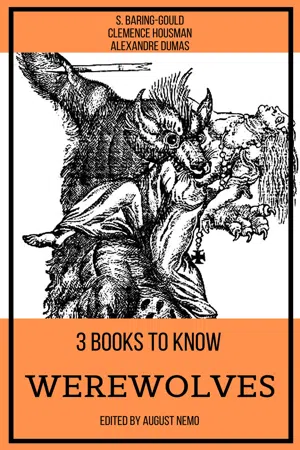
3 books to know Werewolves
- 303 pages
- English
- ePUB (mobile friendly)
- Available on iOS & Android
eBook - ePub
3 books to know Werewolves
About this book
Welcome to the3 Books To Knowseries, our idea is to help readers learn about fascinating topics through three essential and relevant books.
These carefully selected works can be fiction, non-fiction, historical documents or even biographies.
We will always select for you three great works to instigate your mind, this time the topic is:Werewolves.
In folklore, a werewolf is a human with the ability to shapeshift into a wolf-like creature, after a curse. Belief in werewolves developed in parallel to the belief in witches, in the course of the Late Middle Ages and the Early Modern period.
The Book of Were-Wolves reports of actual cases of alleged lycanthropy. Rev. Sabine Baring-Gould does a investigative work and bringing us real incident tied to the werewolf myth.
Clemence Housman innovates in the book The Were-Wolf by bringing a woman protagonist and a sensual werewolf. About it, H. P. Lovecraft said: "attains a high degree of gruesome tension and achieves some extent the atmosphere of authentic folklore"
French writer Alexandre Dumas wrote The Wolf-Leader based on the legends he heard as a child. Dumas tells the story of a man who makes a pact with the devil and is cursed with lycanthropy.
Cursed, monstrous, or sensual, or one of the authors brings us his vision of this ancient myth. A book to read in a full moon night (if you dare).
This is one of many books in the series 3 Books To Know. If you liked this book, look for the other titles in the series, we are sure you will like some of the topics.
Information
Publisher
Tacet BookseBook ISBN
9783968581064
Year
2020


The Wolf-Leader

BY ALEXANDRE DUMAS

Introduction: Who Mocquet was, and how this Tale Became Known to the Narrator
WHY, I ASK MYSELF, during those first twenty years of my literary life, from 1827 to 1847, did I so rarely turn my eyes and thoughts towards the little town where I was born, towards the woods amid which it lies embowered, and the villages that cluster round it? How was it that during all that time the world of my youth seemed to me to have disappeared, as if hidden behind a cloud, whilst the future which lay before me shone clear and resplendent, like those magic islands which Columbus and his companions mistook for baskets of flowers floating on the sea?
Alas! simply because during the first twenty years of our life, we have Hope for our guide, and during the last twenty, Reality.
From the hour when, weary with our journey, we ungird ourselves, and dropping the traveller’s staff, sit down by the way-side, we begin to look back over the road that we have traversed; for it is the way ahead that now is dark and misty, and so we turn and gaze into the depths of the past.
Then with the wide desert awaiting us in front, we are astonished, as we look along the path which we have left behind, to catch sight of first one and then another of those delicious oases of verdure and shade, beside which we never thought of lingering for a moment, and which, indeed we had passed by almost without notice.
But, then, how quickly our feet carried us along in those days! we were in such a hurry to reach that goal of happiness, to which no road has ever yet brought any one of us.
It is at this point that we begin to see how blind and ungrateful we have been; it is now that we say to ourselves, if we could but once more come across such a green and wooded resting-place, we would stay there for the rest of our lives, would pitch our tent there, and there end our days.
But the body cannot go back and renew its existence, and so memory has to make its pious pilgrimage alone; back to the early days and fresh beginnings of life it travels, like those light vessels that are borne upward by their white sails against the current of a river. Then the body once more pursues its journey; but the body without memory is as the night without stars, as the lamp without its flame.... And so body and memory go their several ways.
The body, with chance for its guide, moves towards the unknown.
Memory, that bright will-o’-the-wisp, hovers over the land-marks that are left behind; and memory, we may be sure, will not lose her way. Every oasis is revisited, every association recalled, and then with a rapid flight she returns to the body that grows ever more and more weary, and like the humming of a bee, like the song of a bird, like the murmur of a stream, tells the tale of all that she has seen.
And as the tired traveller listens, his eyes grow bright again, his mouth smiles, and a light steals over his face. For Providence in kindness, seeing that he cannot return to youth, allows youth to return to him. And ever after he loves to repeat aloud what memory tells, him in her soft, low voice.
And is our life, then, bounded by a circle like the earth? Do we, unconsciously, continue to walk towards the spot from which we started? And as we travel nearer and nearer to the grave, do we again draw closer, ever closer, to the cradle?
II
I CANNOT SAY. BUT WHAT happened to myself, that much at any rate I know. At my first halt along the road of life, my first glance backwards, I began by relating the tale of Bernard and his uncle Berthelin, then the story of Ange Pitou, his fair fiancée, and of Aunt Angélique; after that I told of Conscience and Mariette; and lastly of Catherine Blum and Father Vatrin.
I am now going to tell you the story of Thibault and his wolves, and of the Lord of Vez. And how, you will ask, did I become acquainted with the events which I am now about to bring before you? I will tell you.
Have you read my Mémoires, and do you remember one, by name Mocquet, who was a friend of my father’s?
If you have read them, you will have some vague recollection of this personage. If you have not read them, you will not remember anything about him at all.
In either case, then, it is of the first importance that I should bring Mocquet clearly before your mind’s eye.
As far back as I can remember, that is when I was about three years of age, we lived, my father and mother and I, in a little Château called Les Fossés, situated on the boundary that separates the departments of Aisne and Oise, between Haramont and Longpré. The little house in question had doubtless been named Les Fossés on account of the deep and broad moat, filled with water, with which it was surrounded.
I do not mention my sister, for she was at school in Paris, and we only saw her once a year, when she was home for a month’s holiday.
The household, apart from my father, mother and myself, consisted—firstly: of a large black dog, called Truffe, who was a privileged animal and made welcome wherever he appeared, more especially as I regularly went about on his back; secondly: of a gardener, named Pierre, who kept me amply provided with frogs and snakes, two species of living creatures in which I was particularly interested; thirdly: of a negro, a valet of my father’s, named Hippolyte, a sort of black merry-andrew, whom my father, I believe, only kept that he might be well primed with anecdotes wherewith to gain the advantage in his encounters with Brunel and beat his wonderful stories; fourthly: of a keeper named Mocquet, for whom I had a great admiration, seeing that he had magnificent stories to tell of ghosts and were-wolves, to which I listened every evening, and which were abruptly broken off the instant the General—as my father was usually called—appeared on the scene; fifthly: of a cook, who answered to the name of Marie, but this figure I can no longer recall, it is lost to me in the misty twilight of life; I remember only the name, as given to someone of whom but a shadowy outline remains in my memory, and about whom, as far as I recollect, there was nothing of a very poetic character.
Mocquet, however, is the only person that need occupy our attention for the present. Let me try to make him known to you, both as regards his personal appearance and his character.
III
MOCQUET WAS A MAN OF about forty years of age, short, thick-set, broad of shoulder, and sturdy of leg. His skin was burnt brown by the sun, his eyes were small and piercing, his hair grizzled, and his black whiskers met under his chin in a half circle.
As I look back, his figure rises before me, wearing a three-cornered hat, and clad in a green waistcoat with silver buttons, velveteen cord breeches, and high leathern gaiters, with a game-bag over his shoulder, his gun in his hand, and a cutty-pipe in his mouth.
Let us pause for a moment to consider this pipe, for this pipe grew to be, not merely an accessory, but an integral part of Mocquet. Nobody could remember ever having seen Mocquet without it. If by any chance Mocquet did not happen to have it in his mouth, he had it in his hand.
This pipe, having to accompany Mocquet into the heart of the thickest coverts, it was necessary that it should be of such a kind as to offer the least possible opportunity to any other solid body of bringing about its destruction; for the destruction of his old, well-coloured cutty would have been to Mocquet a loss that years alone could have repaired. Therefore the stem of Mocquet’s pipe was not more than half-an-inch long; moreover you might always wager that half that half inch at least was supplied by the quill of a feather.
This habit of never being without his pipe, which, by causing the almost entire disappearance of both canines, had hollowed out a sort of vice for itself on the left side of his mouth, between the fourth incisor and the first molar, had given rise to another of Mocquet’s habits; this was to speak with his teeth clenched, whereby a certain impression of obstinacy was conveyed by all he said.—This became even more marked if Mocquet chanced at any moment to take his pipe out of his mouth, for there was nothing then to prevent the jaws closing and the teeth coming together in a way which prevented the words passing through them at all except in a sort of whistle, which was hardly intelligible.
Such was Mocquet with respect to outward appearance. In the following pages I will endeavour to give some idea of his intellectual capacity and moral qualities.
IV
EARLY ONE MORNING, before my father had risen, Mocquet walked into his room, and planted himself at the foot of the bed, stiff and upright as a sign-post.
“Well, Mocquet,” said my father, “what’s the matter now? what gives me the pleasure of seeing you here at this early hour?”
“The matter is, General,” replied Mocquet with the utmost gravity, “the matter is that I am nightmared.”
Mocquet had, quite unawares to himself, enriched the language with a double verb, both active and passive.
“You are nightmared?” responded my father, raising himself on his elbow. “Dear, dear, that’s a serious matter, my poor Mocquet.”
“You are right there, General.”
And Mocquet took his pipe out of his mouth, a thing he did rarely, and only on the most important occasions.
“And how long have you been nightmared?” continued my father compassionately.
“For a whole week, General.”
“And who by, Mocquet?”
“Ah! I know very well who by,” answered Mocquet, through his teeth, which were so much the more tightly closed that his pipe was in his hand, and his hand behind his back.
“And may I also know by whom?”
“By Mother Durand, of Haramont, who, as you will have heard, is an old witch.”
“No, indeed, I assure you I had no idea of such a thing.”
“Ah! but I know it well enough; I’ve seen her riding past on her broomstick to her Witches’ Sabbath.”
“You have seen her go by on her broomstick?”
“As plainly as I see you, General; and more than that, she has an old black billy-goat at home that she worships.”
“And why should she come and nightmare you?”
“To revenge herself on me, because I came upon her once at midnight on the heath of Gondreville, when she was dancing round and round in her devil’s circle.”
“This is a most serious accusation which you bring against her, my friend; and before repeating to anyone what you have been telling me in private, I think it would be as well if you tried to collect some more proofs.”
“Proofs! What more proofs do I want! Does not every soul in the village know that in her youth she was the Mistress of Thibault, the wolf-leader?”
“Indeed! I must look carefully into this matter, Mocquet.”
“I am looking very carefully into it myself, and she shall pay for it, the old mole!”
Old mole was an expression that Mocquet had borrowed from his friend Pierre, the gardener, who, as he had no worse enemies to deal with than moles, gave the name of mole to everything and everybody that he particularly detested.
V
“I MUST LOOK CAREFULLY into this matter”—these words were not said by my father by reason of any belief he had in the truth of Mocquet’s tale about his nightmare; and even the fact of the nightmare being admitted by him, he gave no credence to the idea that it was Mother Durand who had nightmared the keeper. Far from it; but my father was not ignorant of the superstitions of the people, and he knew that belief in spells was still wide-spread among the peasantry in the country districts. He had heard of terrible acts of revenge carried out by the victims on some man or woman who they thought had bewitched them, in the belief that the charm would thus be broken; and Mocquet, while he stood denouncing Mother Durand to my father, had had such an accent of menace in his voice, and had given such a grip to his gun, that my father thought it wise to appear to agree with everything he said, in order to gain his confidence and so prevent him doing anything without first consulting him.
So, thinking that he had so far gained an influence over Mocquet, my father ventured to say:
“But before you make her pay for it, my good Mocquet, you ought to be quite sure that no one can cure you of your nightmare.”
“No one can cure me, General,” replied Mocquet in a tone of conviction.
“How! No one able to cure you?”
“No one; I have tried the impossible.”
“And how did you try?”
“First of all, I drank a large bowl of hot wine before going to bed.”
“And who recommended that remedy? was it Monsieur Lécosse?” Monsieur Lécosse was the doctor in repute at Villers-Cotterets.
“Monsieur Lécosse?” exclaimed Mocquet. “No, indeed! What should he know about spells! By my faith, no! it was not Monsieur Lécosse.”
“Who was it, then?”
“It was the shepherd of Longpré.”
“But a bowl of wine, you dunderhead! Why, you must have been dead drunk.”
“The shepherd drank half of it.”
“I see; now I understand why he prescribed it. And did the bowl of wine have any effect?”
“Not any, General; she came trampling over my chest that night, just as if I had taken nothing.”
“And what did you do next? You were not obliged, I suppose, to limit your efforts to your bowl of hot wine?”
“I did what I do when I want to catch a wily beast.”
Mocquet made use of a phraseology which was all his own; no one had ever succeeded in inducing him to say a wild beast; every time my father said wild beast, Mocquet would answer, “Yes, General, I know, a wily beast.”
“You still stick to your wily beast, then?” my father said to him on one occasion.
“Yes, General, but not out of obstinacy.”
“And why then, may I ask?”
“Because, General, with all due respect to you, you are mistaken about it.”
“Mistaken? I? How?”
“Because you ought not to say a wild beast, but a wily beast.”
“And what is a wily beast, Mocquet?”
“It is an animal that only goes about at night; that is, an animal that creeps into the pigeon-houses and kills the pigeons, like the pole-cat, or into the chicken-houses, to kill the chickens, like the fox; or into the folds, to kill the sheep, like the wolf; it means an animal which is cunning and deceitful, in short, a wily beast.”
It was impossible to find anything to say after such a logical definition as this.—My father, therefore, remained silent, and Mocquet, feeling that he had gained a victory, continued to call wild beasts, wily beasts, utterly unable to understand my father’s obstinacy in continuing to call wily beasts, wild beasts.
So now you understand why, when my father asked him what else he had done, Mocquet answered, “I did what I do when I want to catch a wily beast.”
We have interrupted the conversation to give this explanation; but as there was no need of explanation between my father and Mocquet, they had gone on talking, you must understand, without any such break.
VI
“AND WHAT IS IT YOU do, Mocquet, when you want to catch this animal of yours?” asked my father.
“I set a trarp, General.” Mocquet always called a trap a trarp.
“Do you mean to tell me you have set a trap to catch Mother Durand?”
My fathe...
Table of contents
- Table of Contents
- Introduction
- Authors
- The Book of Were-Wolves
- The Were-Wolf
- The Wolf-Leader
- About the Publisher
- Colophon
Trusted by 375,005 students
Access to over 1.5 million titles for a fair monthly price.
Study more efficiently using our study tools.