eBook - ePub
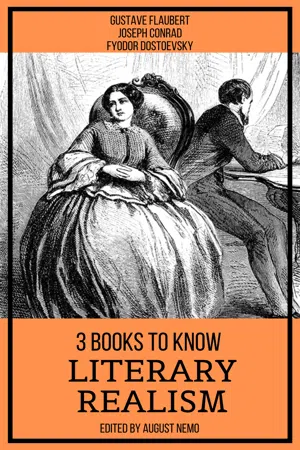
3 books to know Literary Realism
- 731 pages
- English
- ePUB (mobile friendly)
- Available on iOS & Android
eBook - ePub
3 books to know Literary Realism
About this book
Welcome to the3 Books To Knowseries, our idea is to help readers learn about fascinating topics through three essential and relevant books.
These carefully selected works can be fiction, non-fiction, historical documents or even biographies.
We will always select for you three great works to instigate your mind, this time the topic is:Literary Realism:
- Madame Bovary, by Gustave Flaubert
- Heart of Darkness, by Joseph Conrad
- The idiot, by Fyodor DostoyevskyLong established as one of the greatest novels, Madame Bovary has been described as a "perfect" work of fiction. Henry James wrote: "Madame Bovary has a perfection that not only stamps it, but that makes it stand almost alone: it holds itself with such a supreme unapproachable assurance as both excites and defies judgment." The realist movement was, in part, a reaction against romanticism. Emma may be said to be the embodiment of a romantic: in her mental and emotional process, she has no relation to the realities of her world.
Heart of Darkness is a novel by Polish-British novelist Joseph Conrad about a narrated voyage up the Congo River into the Congo Free State in the so-called heart of Africa. Central to Conrad's work is the idea that there is little difference between so-called civilised people and those described as savages; Heart of Darkness raises questions about imperialism and racism.
The title of The Idiot is an ironic reference to the central character of the novel, Prince Lev Nikolayevich Myshkin, a young man whose goodness, open-hearted simplicity and guilelessness lead many of the more worldly characters he encounters to mistakenly assume that he lacks intelligence and insight. In the character of Prince Myshkin, Dostoevsky set himself the task of depicting "the positively good and beautiful man." The novel examines the consequences of placing such a unique individual at the centre of the conflicts, desires, passions and egoism of worldly society, both for the man himself and for those with whom he becomes involved.
This is one of many books in the series 3 Books To Know. If you liked this book, look for the other titles in the series, we are sure you will like some of the topics.
Information
Publisher
Tacet BookseBook ISBN
9783968587523
Year
2020


The Idiot

BY FYODOR DOSTOYEVSKY
PART I
I.

TOWARDS THE END OF November, during a thaw, at nine o’clock one morning, a train on the Warsaw and Petersburg railway was approaching the latter city at full speed. The morning was so damp and misty that it was only with great difficulty that the day succeeded in breaking; and it was impossible to distinguish anything more than a few yards away from the carriage windows.
Some of the passengers by this particular train were returning from abroad; but the third-class carriages were the best filled, chiefly with insignificant persons of various occupations and degrees, picked up at the different stations nearer town. All of them seemed weary, and most of them had sleepy eyes and a shivering expression, while their complexions generally appeared to have taken on the colour of the fog outside.
When day dawned, two passengers in one of the third-class carriages found themselves opposite each other. Both were young fellows, both were rather poorly dressed, both had remarkable faces, and both were evidently anxious to start a conversation. If they had but known why, at this particular moment, they were both remarkable persons, they would undoubtedly have wondered at the strange chance which had set them down opposite to one another in a third-class carriage of the Warsaw Railway Company.
One of them was a young fellow of about twenty-seven, not tall, with black curling hair, and small, grey, fiery eyes. His nose was broad and flat, and he had high cheek bones; his thin lips were constantly compressed into an impudent, ironical—it might almost be called a malicious—smile; but his forehead was high and well formed, and atoned for a good deal of the ugliness of the lower part of his face. A special feature of this physiognomy was its death-like pallor, which gave to the whole man an indescribably emaciated appearance in spite of his hard look, and at the same time a sort of passionate and suffering expression which did not harmonize with his impudent, sarcastic smile and keen, self-satisfied bearing. He wore a large fur—or rather astrachan—overcoat, which had kept him warm all night, while his neighbour had been obliged to bear the full severity of a Russian November night entirely unprepared. His wide sleeveless mantle with a large cape to it—the sort of cloak one sees upon travellers during the winter months in Switzerland or North Italy—was by no means adapted to the long cold journey through Russia, from Eydkuhnen to St. Petersburg.
The wearer of this cloak was a young fellow, also of about twenty-six or twenty-seven years of age, slightly above the middle height, very fair, with a thin, pointed and very light coloured beard; his eyes were large and blue, and had an intent look about them, yet that heavy expression which some people affirm to be a peculiarity as well as evidence, of an epileptic subject. His face was decidedly a pleasant one for all that; refined, but quite colourless, except for the circumstance that at this moment it was blue with cold. He held a bundle made up of an old faded silk handkerchief that apparently contained all his travelling wardrobe, and wore thick shoes and gaiters, his whole appearance being very un-Russian.
His black-haired neighbour inspected these peculiarities, having nothing better to do, and at length remarked, with that rude enjoyment of the discomforts of others which the common classes so often show:
“Cold?”
“Very,” said his neighbour, readily, “and this is a thaw, too. Fancy if it had been a hard frost! I never thought it would be so cold in the old country. I’ve grown quite out of the way of it.”
“What, been abroad, I suppose?”
“Yes, straight from Switzerland.”
“Wheugh! my goodness!” The black-haired young fellow whistled, and then laughed.
The conversation proceeded. The readiness of the fair-haired young man in the cloak to answer all his opposite neighbour’s questions was surprising. He seemed to have no suspicion of any impertinence or inappropriateness in the fact of such questions being put to him. Replying to them, he made known to the inquirer that he certainly had been long absent from Russia, more than four years; that he had been sent abroad for his health; that he had suffered from some strange nervous malady—a kind of epilepsy, with convulsive spasms. His interlocutor burst out laughing several times at his answers; and more than ever, when to the question, “whether he had been cured?” the patient replied:
“No, they did not cure me.”
“Hey! that’s it! You stumped up your money for nothing, and we believe in those fellows, here!” remarked the black-haired individual, sarcastically.
“Gospel truth, sir, Gospel truth!” exclaimed another passenger, a shabbily dressed man of about forty, who looked like a clerk, and possessed a red nose and a very blotchy face. “Gospel truth! All they do is to get hold of our good Russian money free, gratis, and for nothing.”
“Oh, but you’re quite wrong in my particular instance,” said the Swiss patient, quietly. “Of course I can’t argue the matter, because I know only my own case; but my doctor gave me money—and he had very little—to pay my journey back, besides having kept me at his own expense, while there, for nearly two years.”
“Why? Was there no one else to pay for you?” asked the black-haired one.
“No—Mr. Pavlicheff, who had been supporting me there, died a couple of years ago. I wrote to Mrs. General Epanchin at the time (she is a distant relative of mine), but she did not answer my letter. And so eventually I came back.”
“And where have you come to?”
“That is—where am I going to stay? I—I really don’t quite know yet, I—”
Both the listeners laughed again.
“I suppose your whole set-up is in that bundle, then?” asked the first.
“I bet anything it is!” exclaimed the red-nosed passenger, with extreme satisfaction, “and that he has precious little in the luggage van!—though of course poverty is no crime—we must remember that!”
It appeared that it was indeed as they had surmised. The young fellow hastened to admit the fact with wonderful readiness.
“Your bundle has some importance, however,” continued the clerk, when they had laughed their fill (it was observable that the subject of their mirth joined in the laughter when he saw them laughing); “for though I dare say it is not stuffed full of friedrichs d’or and louis d’or—judge from your costume and gaiters—still—if you can add to your possessions such a valuable property as a relation like Mrs. General Epanchin, then your bundle becomes a significant object at once. That is, of course, if you really are a relative of Mrs. Epanchin’s, and have not made a little error through—well, absence of mind, which is very common to human beings; or, say—through a too luxuriant fancy?”
“Oh, you are right again,” said the fair-haired traveller, “for I really am almost wrong when I say she and I are related. She is hardly a relation at all; so little, in fact, that I was not in the least surprised to have no answer to my letter. I expected as much.”
“H’m! you spent your postage for nothing, then. H’m! you are candid, however—and that is commendable. H’m! Mrs. Epanchin—oh yes! a most eminent person. I know her. As for Mr. Pavlicheff, who supported you in Switzerland, I know him too—at least, if it was Nicolai Andreevitch of that name? A fine fellow he was—and had a property of four thousand souls in his day.”
“Yes, Nicolai Andreevitch—that was his name,” and the young fellow looked earnestly and with curiosity at the all-knowing gentleman with the red nose.
This sort of character is met with pretty frequently in a certain class. They are people who know everyone—that is, they know where a man is employed, what his salary is, whom he knows, whom he married, what money his wife had, who are his cousins, and second cousins, etc., etc. These men generally have about a hundred pounds a year to live on, and they spend their whole time and talents in the amassing of this style of knowledge, which they reduce—or raise—to the standard of a science.
During the latter part of the conversation the black-haired young man had become very impatient. He stared out of the window, and fidgeted, and evidently longed for the end of the journey. He was very absent; he would appear to listen—and heard nothing; and he would laugh of a sudden, evidently with no idea of what he was laughing about.
“Excuse me,” said the red-nosed man to the young fellow with the bundle, rather suddenly; “whom have I the honour to be talking to?”
“Prince Lef Nicolaievitch Muishkin,” replied the latter, with perfect readiness.
“Prince Muishkin? Lef Nicolaievitch? H’m! I don’t know, I’m sure! I may say I have never heard of such a person,” said the clerk, thoughtfully. “At least, the name, I admit, is historical. Karamsin must mention the family name, of course, in his history—but as an individual—one never hears of any Prince Muishkin nowadays.”
“Of course not,” replied the prince; “there are none, except myself. I believe I am the last and only one. As to my forefathers, they have always been a poor lot; my own father was a sublieutenant in the army. I don’t know how Mrs. Epanchin comes into the Muishkin family, but she is descended from the Princess Muishkin, and she, too, is the last of her line.”
“And did you learn science and all that, with your professor over there?” asked the black-haired passenger.
“Oh yes—I did learn a little, but—”
“I’ve never learned anything whatever,” said the other.
“Oh, but I learned very little, you know!” added the prince, as though excusing himself. “They could not teach me very much on account of my illness.”
“Do you know the Rogojins?” asked his questioner, abruptly.
“No, I don’t—not at all! I hardly know anyone in Russia. Why, is that your name?”
“Yes, I am Rogojin, Parfen Rogojin.”
“Parfen Rogojin? dear me—then don’t you belong to those very Rogojins, perhaps—” began the clerk, with a very perceptible increase of civility in his tone.
“Yes—those very ones,” interrupted Rogojin, impatiently, and with scant courtesy. I may remark that he had not once taken any notice of the blotchy-faced passenger, and had hitherto addressed all his remarks direct to the prince.
“Dear me—is it possible?” observed the clerk, while his face assumed an expression of great deference and servility—if not of absolute alarm: “what, a son of that very Semen Rogojin—hereditary honourable citizen—who died a month or so ago and left two million and a half of roubles?”
“And how do you know that he left two million and a half of roubles?” asked Rogojin, disdainfully, and not deigning so much as to look at the other. “However, it’s true enough that my father died a month ago, and that here am I returning from Pskoff, a month after, with hardly a boot to my foot. They’ve treated me like a dog! I’ve been ill of fever at Pskoff the whole time, and not a line, nor farthing of money, have I received from my mother or my confounded brother!”
“And now you’ll have a million roubles, at least—goodness gracious me!” exclaimed the clerk, rubbing his hands.
“Five weeks since, I was just like yourself,” continued Rogojin, addressing the prince, “with nothing but a bundle and the clothes I wore. I ran away from my father and came to Pskoff to my aunt’s house, where I caved in at once with fever, and he went and died while I was away. All honour to my respected father’s memory—but he uncommonly nearly killed me, all the same. Give you my word, prince, if I hadn’t cut and run then, when I did, he’d have murdered me like a dog.”
“I suppose you angered him somehow?” asked the prince, looking at the millionaire with considerable curiosity. But though there may have been something remarkable in the fact that this man was heir to millions of roubles there was something about him which surprised and interested the prince more than that. Rogojin, too, seemed to have taken up the conversation with unusual alacrity it appeared that he was still in a considerable state of excitement, if not absolutely feverish, and was in real need of someone to talk to for the mere sake of talking, as safety-valve to his agitation.
As for his red-nosed neighbour, the latter—since the information as to the identity of Rogojin—hung over him, seemed to be living on the honey of his words and in the breath of his nostrils, catching at every syllable as though it were a pearl of great price.
“Oh, yes; I angered him—I certainly did anger him,” replied Rogojin. “But what puts me out so is my brother. Of course my mother couldn’t do anything—she’s too old—and whatever brother Senka says is law for her! But why couldn’t he let me know? He sent a telegram, they say. What’s the good of a telegram? It frightened my aunt so that she sent it back to the office unopened, and there it’s been ever since! It’s only thanks to Konief that I heard at all; he wrote me all about it. He says my brother cut off the gold tassels from my father’s coffin, at night ‘because they’re worth a lot of money!’ says he. Why, I can get him sent off to Siberia for that alone, if I like; it’s sacrilege. Here, you—scarecrow!” he added, addressing the clerk at his side, “is it sacrilege or not, by law?”
“Sacrilege, certainly—certainly sacrilege,” said the latter.
“And it’s Siberia for sacrilege, isn’t it?”
“Undoubtedly so; Siberia, of course!”
“They will think that I’m still ill,” continued Rogojin to the prince, “but I sloped off quietly, seedy as I was, took the train and came away. Aha, brother Senka, yo...
Table of contents
- Table of Contents
- Introduction
- Authors
- Madame Bovary
- Heart of Darkness
- The Idiot
- About the Publisher
- Colophon
Trusted by 375,005 students
Access to over 1.5 million titles for a fair monthly price.
Study more efficiently using our study tools.