The thesis will try to summarise the major power system problems and the important role of the FACTS devices to enhance the power system quality. Then, it will give a brief description for various FACTS and Active Filters controllers as mentioned on the existing publications. Most of the control schemes introduced in the existing papers were designed either for eliminating current harmonics or eliminating voltage flickers or for load flow control. So, this work is devoted to find a proper optimal control schemes for a system with series or shunt or series and shunt converters that can provide all functions together.Various optimal control schemes will be designed for systems with series, shunt and series-shunt converters with the objective to control the load flow through a lines and to eliminate current harmonics and voltage flickers with different strategies for tracking. Chapter 1: Gives a general description of most power system problems and the basic techniques used to improve the power system quality. It also gives idea about basic objectives from the FACTS devices.Chapter 2: Offers detailed description for the basic types of FACTS devices and active filters existing in power industry.Chapter 3: Describes various shunt controllers for control of the Static Compensator (STATCOM) and various series controllers for the control of the Static Synchronous Series Compensator (SSSC) and various Unified Power Flow Controllers (UPFC) as covered in most existing papers.Chapter 4: Describes the major control schemes for the shunt active filter as covered by most existing papers.Chapter 5: Describes the major control schemes for the other types of active filters as covered by most existing papers.Chapter 6: Gives description for optimal control design.Chapter 7: Case studies to design different optimal control schemes for system with UPFC unit to control the power flow, eliminate voltage flicker and eliminate current harmonics. The case studies were repeated for system with only series or shunt converters.
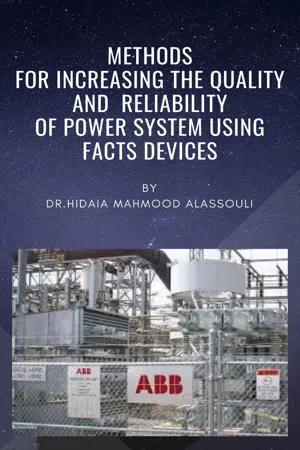
eBook - ePub
Methods for Increasing the Quality and Reliability of Power System Using FACTS Devices
- 216 pages
- English
- ePUB (mobile friendly)
- Available on iOS & Android
eBook - ePub
Methods for Increasing the Quality and Reliability of Power System Using FACTS Devices
About this book
Information
Chapter 1: Basic Power System Quality Problems
The information given in this chapter are based on Ref. [1], Ref. [2] and Ref. [3].
1 Basic Power System Problems
1.1 Transient
An undesirable event that is undesirable and momentary in mature.
1.1.1 Impulsive Transient
Sudden non power frequency change in steady state conditions of voltage or current (i.e. lightening is impulsive transient).
1.1.2 Oscillatory Transient
Consists of voltage and currents whose instantaneous value changes polarity rapidly. It is defined by its spectral content, duration and magnitude. The spectral contents subclasses are high, medium and low frequency. The oscillatory transients with frequency greater than 500 kHz and duration measured in microseconds are high frequency oscillatory transients. The oscillatory transient with frequency 5-500 kHz and duration 10 microseconds are medium frequency oscillatory transients. Back to back eneregization of capacitor results in oscillatory transient currents in 10 kHz. Transient with frequency components less than 5 kHz and (0.3 to 0.5 ms) is low frequency transient. Oscillatory transients with principal frequencies less than 300 Hz can also be found in distribution system. These are generally associated with ferroresonance and transformer energization.
1.1.3 Principe of Overvoltage Protection
The main sources of the transient over voltage protection are capacitor switching, magnification of capacitor switching transients and lightening.
The fundamental principles of overvoltage protection of load equipment are:
- Limit the voltage across sensitive insulation.
- Divert the surge current a way from the load.
- Block the surge current from entering the load.
- Bond ground references together at the equipment.
- Reduce or prevent surge current from flowing between grounds.
- Create a low pass filter using blocking or limiting principles.
The surge arresters and transient voltage surge supressors are widely used. Their main function is to limit the voltage that can appear between two points in the circuit.
1.2 Long Duration Voltage Variation
1.2.1 Overvoltages
Increase in rms. ac voltage greater than 110% at the power frequency for longer than 1 min. It results from load switching (e.g. switching off large load or energising large capacitor). It results because the system is too week for voltage regulation or voltage control is inadequate.
1.2.2 Undervoltages
Decrease in voltage less than 90% at the power frequency for duration longer than 1 min. A load switching on or a capacitor bank switching off can cause an undervoltage until the voltage equipment on system can bring voltage back to within tolerances.
1.2.3 Sustained Interruption
When supply voltage has been zero for longer time than 1 min, the long duration voltage variation is considered as sustained interruption.
1.2.4 Protection against Long Duration Voltage Variations
The root cause of most voltage regulation problems is that there is too much impedance in the power system to properly supply the load. Therefore, the voltage drops too low under heavy load. Conversely, when the source voltage is boosted to overcome the impedance, there can be an overvoltage condition when the load drops too low. The corrective measures usually involve either compensation for the impedance or compensation for the voltage drops caused by the impedance.
The options for improving the voltage regulation are
- Add voltage regulators, which boosts the apparent .
- Add shunt capacitors to reduce the current and shift it to be more in phase with the voltage.
- Add series capacitors to cancel the inductive impedance drop ()
- Reconducor lines to change to a larger size to reduce the impedance .
- Change the service transformer to larger size to reduce the impedance .
- Add static var. compensators, which serve the same purpose as capacitors for rapidly changing loads.
There are a variety of voltage regulation devices in use on utility and industrial power systems. We divide them into three major classes:
- Tap changing transformers.
- Isolation devices with separate voltage regulators.
- Impedance compensation devices, such as capacitors.
Isolation devices include UPS systems, ferroresonant transformers, M-G sets, and the like. These are devices that isolate the load from power source by performing some sort of energy conversion. Therefore, the load side of the device can be separately regulated and can maintain constant voltage regardless of what is occurring at the power supply. The downside of using such devices is that they introduce more losses and may also cause harmonics problems on the power supply system.
Shunt capacitors help maintain the voltage by reducing the current in the lines. To maintain a more constant voltage, the capacitors can be switched in conjunction with the load, usually in small incremental steps to follow the load more closely.
Series capacitors are rare because of the extra care in engineering required for the series capacitor installation. The series capacitors compensate for most of the inductance in the system up to the load. If the system is highly inductive, this represents a significant reduction in impedance.
Another approach to flicker-causing loads is to apply static var. compensators. These can react within few cycles to maintain a fairly constant voltage by controlling the reactive power production. Such devices are commonly used on arc furnaces and other randomly varying loads where the system is weak and the resulting flicker is affecting nearby customers.
1.3 Short Duration Voltage Variation
1.3.1 Interruption
Occurs when supply voltage or load currents decrease to less than 0.1 pu for period of time not greater than 1 min. It results of the power system faults and equipment failure.
1.3.2 Sags
A decrease to between 0.1 to 0.9 in rms. voltage or current for duration from 0.5 cycle to 1 min. They are caused by energization of heavy load or starting of large motors i.e. typical voltage sag can be associated with SLG fault on another feeder or substation.
1.3.3 Swell
Increase between 1.1 and 1.8 p.u. in rms. voltage or current of power frequency for duration from 0.5 cycles to 1 min. It is associated with system faults. One way when the voltage sag can occur for temporary voltage rise on unfaulted phase during SLG and also can be caused by switching off large load or energising large capacitor.
1.3.4 Protection against Voltage Sags and Interruption
As we entertain solutions at higher levels, solution is more costly. The solution close to the load is cheaper. The least cost solution is often for the end user to specify to the supplier that the machine is able to ride through sags of ...
Table of contents
- Methods for Increasing the Quality and Reliability of Power System Using FACTS Devices
- Author Biography
- Acknowledgments
- Table of Contents
- Preface
- Thesis Objective
- Chapter 1: Basic Power System Quality Problems
- Chapter 2: FACTS Devices and Active Filters
- Chapter 3: Control Strategies for Load Flow FACTS Devices
- Chapter 4: Three Phase Shunt Active Power Filter Control Algorithms
- Chapter 5: Other Three Phase Active Power Filter Topologies Control Algorithms
- Chapter 6: Optimal Control with Tracking
- Chapter 7: Optimal Control of UPFC for Load Flow Control and Voltage Flicker and Current Harmonics Elimination
- Chapter 8: Summery
- References
Trusted by 375,005 students
Access to over 1.5 million titles for a fair monthly price.
Study more efficiently using our study tools.
Frequently asked questions
Yes, you can cancel anytime from the Subscription tab in your account settings on the Perlego website. Your subscription will stay active until the end of your current billing period. Learn how to cancel your subscription
No, books cannot be downloaded as external files, such as PDFs, for use outside of Perlego. However, you can download books within the Perlego app for offline reading on mobile or tablet. Learn how to download books offline
Perlego offers two plans: Essential and Complete
- Essential is ideal for learners and professionals who enjoy exploring a wide range of subjects. Access the Essential Library with 800,000+ trusted titles and best-sellers across business, personal growth, and the humanities. Includes unlimited reading time and Standard Read Aloud voice.
- Complete: Perfect for advanced learners and researchers needing full, unrestricted access. Unlock 1.5M+ books across hundreds of subjects, including academic and specialized titles. The Complete Plan also includes advanced features like Premium Read Aloud and Research Assistant.
We are an online textbook subscription service, where you can get access to an entire online library for less than the price of a single book per month. With over 1.5 million books across 990+ topics, we’ve got you covered! Learn about our mission
Look out for the read-aloud symbol on your next book to see if you can listen to it. The read-aloud tool reads text aloud for you, highlighting the text as it is being read. You can pause it, speed it up and slow it down. Learn more about Read Aloud
Yes! You can use the Perlego app on both iOS and Android devices to read anytime, anywhere — even offline. Perfect for commutes or when you’re on the go.
Please note we cannot support devices running on iOS 13 and Android 7 or earlier. Learn more about using the app
Please note we cannot support devices running on iOS 13 and Android 7 or earlier. Learn more about using the app
Yes, you can access Methods for Increasing the Quality and Reliability of Power System Using FACTS Devices by Dr. Hidaia Mahmood Alassouli in PDF and/or ePUB format, as well as other popular books in Technology & Engineering & Electrical Engineering & Telecommunications. We have over 1.5 million books available in our catalogue for you to explore.