eBook - ePub
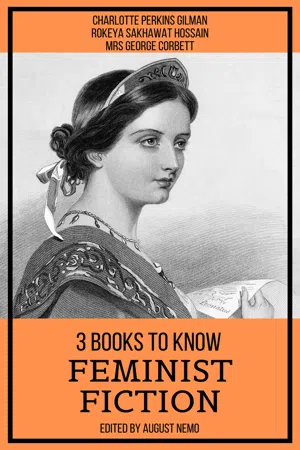
3 books to know Feminist Fiction
- 200 pages
- English
- ePUB (mobile friendly)
- Available on iOS & Android
eBook - ePub
3 books to know Feminist Fiction
About this book
Welcome to the3 Books To Knowseries, our idea is to help readers learn about fascinating topics through three essential and relevant books.
These carefully selected works can be fiction, non-fiction, historical documents or even biographies.
We will always select for you three great works to instigate your mind, this time the topic is:Feminist Fiction.
- Herland by Charlotte Perkins Gilman
- Sultana's Dream by Rokeya Sakhawat Hossain
- New Amazonia: A Foretaste of the Future by Mrs. George CorbettHerland is a utopian novel from 1915, written by feminist Charlotte Perkins Gilman. The book describes an isolated society composed entirely of women, who reproduce via parthenogenesis (asexual reproduction). The result is an ideal social order: free of war, conflict, and domination. It was first published in monthly installments as a serial in 1915 in The Forerunner, a magazine edited and written by Gilman between 1909 and 1916. The story is told from the perspective of Vandyck "Van" Jennings, a sociology student who, along with two friends, Terry O. Nicholson and Jeff Margrave, forms an expedition party to explore an area of uncharted land rumored to be home to a society consisting entirely of women. The three friends do not entirely believe the rumors because they are unable to think of a way how human reproduction could occur without males.
Sultana's Dream is a 1905 feminist utopian story written by Rokeya Sakhawat Hossain, a Muslim feminist, writer and social reformer from Bengal. It depicts a feminist utopia (called Ladyland) in which women run everything and men are secluded, in a mirror-image of the traditional practice of purdah. The women are aided by science fiction-esque "electrical" technology which enables laborless farming and flying cars; the women scientists have discovered how to trap solar power and control the weather. This results in "a sort of gender-based Planet of the Apes where the roles are reversed and the men are locked away in a technologically advanced future."
New Amazonia: A Foretaste of the Future is a feminist utopian novel, written by Elizabeth Burgoyne Corbett and first published in 1889. It was one element in the wave of utopian and dystopian literature that marked the later nineteenth and early twentieth centuries. In her novel, Corbett envisions a successful suffragette movement eventually giving rise to a breed of highly evolved "Amazonians" who turn Ireland into a utopian society. The book's female narrator wakes up in the year 2472, much like Julian West awakens in the year 2000 in Edward Bellamy's Looking Backward (1888). Corbett's heroine, however, is accompanied by a man of her own time, who has similarly awakened from a hashish dream to find himself in New Amazonia.
This is one of many books in the series 3 Books To Know. If you liked this book, look for the other titles in the series, we are sure you will like some of the topics
Information
Index
Literature


Herland

BY CHARLOTTE PERKINS Gilman

Chapter 1
A Not Unnatural Enterprise
THIS IS WRITTEN FROM memory, unfortunately. If I could have brought with me the material I so carefully prepared, this would be a very different story. Whole books full of notes, carefully copied records, firsthand descriptions, and the pictures—that’s the worst loss. We had some bird’s-eyes of the cities and parks; a lot of lovely views of streets, of buildings, outside and in, and some of those gorgeous gardens, and, most important of all, of the women themselves.
Nobody will ever believe how they looked. Descriptions aren’t any good when it comes to women, and I never was good at descriptions anyhow. But it’s got to be done somehow; the rest of the world needs to know about that country.
I haven’t said where it was for fear some self-appointed missionaries, or traders, or land-greedy expansionists, will take it upon themselves to push in. They will not be wanted, I can tell them that, and will fare worse than we did if they do find it.
It began this way. There were three of us, classmates and friends—Terry O. Nicholson (we used to call him the Old Nick, with good reason), Jeff Margrave, and I, Vandyck Jennings.
We had known each other years and years, and in spite of our differences we had a good deal in common. All of us were interested in science.
Terry was rich enough to do as he pleased. His great aim was exploration. He used to make all kinds of a row because there was nothing left to explore now, only patchwork and filling in, he said. He filled in well enough—he had a lot of talents—great on mechanics and electricity. Had all kinds of boats and motorcars, and was one of the best of our airmen.
We never could have done the thing at all without Terry.
Jeff Margrave was born to be a poet, a botanist—or both—but his folks persuaded him to be a doctor instead. He was a good one, for his age, but his real interest was in what he loved to call “the wonders of science.”
As for me, sociology’s my major. You have to back that up with a lot of other sciences, of course. I’m interested in them all.
Terry was strong on facts—geography and meteorology and those; Jeff could beat him any time on biology, and I didn’t care what it was they talked about, so long as it connected with human life, somehow. There are few things that don’t.
We three had a chance to join a big scientific expedition. They needed a doctor, and that gave Jeff an excuse for dropping his just opening practice; they needed Terry’s experience, his machine, and his money; and as for me, I got in through Terry’s influence.
The expedition was up among the thousand tributaries and enormous hinterland of a great river, up where the maps had to be made, savage dialects studied, and all manner of strange flora and fauna expected.
But this story is not about that expedition. That was only the merest starter for ours.
My interest was first roused by talk among our guides. I’m quick at languages, know a good many, and pick them up readily. What with that and a really good interpreter we took with us, I made out quite a few legends and folk myths of these scattered tribes.
And as we got farther and farther upstream, in a dark tangle of rivers, lakes, morasses, and dense forests, with here and there an unexpected long spur running out from the big mountains beyond, I noticed that more and more of these savages had a story about a strange and terrible Woman Land in the high distance.
“Up yonder,” “Over there,” “Way up”—was all the direction they could offer, but their legends all agreed on the main point—that there was this strange country where no men lived—only women and girl children.
None of them had ever seen it. It was dangerous, deadly, they said, for any man to go there. But there were tales of long ago, when some brave investigator had seen it—a Big Country, Big Houses, Plenty People—All Women.
Had no one else gone? Yes—a good many—but they never came back. It was no place for men—of that they seemed sure.
I told the boys about these stories, and they laughed at them. Naturally I did myself. I knew the stuff that savage dreams are made of.
But when we had reached our farthest point, just the day before we all had to turn around and start for home again, as the best of expeditions must in time, we three made a discovery.
The main encampment was on a spit of land running out into the main stream, or what we thought was the main stream. It had the same muddy color we had been seeing for weeks past, the same taste.
I happened to speak of that river to our last guide, a rather superior fellow with quick, bright eyes.
He told me that there was another river—“over there, short river, sweet water, red and blue.”
I was interested in this and anxious to see if I had understood, so I showed him a red and blue pencil I carried, and asked again.
Yes, he pointed to the river, and then to the southwestward. “River—good water—red and blue.”
Terry was close by and interested in the fellow’s pointing.
“What does he say, Van?”
I told him.
Terry blazed up at once.
“Ask him how far it is.”
The man indicated a short journey; I judged about two hours, maybe three.
“Let’s go,” urged Terry. “Just us three. Maybe we can really find something. May be cinnabar in it.”
“May be indigo,” Jeff suggested, with his lazy smile.
It was early yet; we had just breakfasted; and leaving word that we’d be back before night, we got away quietly, not wishing to be thought too gullible if we failed, and secretly hoping to have some nice little discovery all to ourselves.
It was a long two hours, nearer three. I fancy the savage could have done it alone much quicker. There was a desperate tangle of wood and water and a swampy patch we never should have found our way across alone. But there was one, and I could see Terry, with compass and notebook, marking directions and trying to place landmarks.
We came after a while to a sort of marshy lake, very big, so that the circling forest looked quite low and dim across it. Our guide told us that boats could go from there to our camp—but “long way—all day.”
This water was somewhat clearer than that we had left, but we could not judge well from the margin. We skirted it for another half hour or so, the ground growing firmer as we advanced, and presently we turned the corner of a wooded promontory and saw a quite different country—a sudden view of mountains, steep and bare.
“One of those long easterly spurs,” Terry said appraisingly. “May be hundreds of miles from the range. They crop out like that.”
Suddenly we left the lake and struck directly toward the cliffs. We heard running water before we reached it, and the guide pointed proudly to his river.
It was short. We could see where it poured down a narrow vertical cataract from an opening in the face of the cliff. It was sweet water. The guide drank eagerly and so did we.
“That’s snow water,” Terry announced. “Must come from way back in the hills.”
But as to being red and blue—it was greenish in tint. The guide seemed not at all surprised. He hunted about a little and showed us a quiet marginal pool where there were smears of red along the border; yes, and of blue.
Terry got out his magnifying glass and squatted down to investigate.
“Chemicals of some sort—I can’t tell on the spot. Look to me like dyestuffs. Let’s get nearer,” he urged, “up there by the fall.”
We scrambled along the steep banks and got close to the pool that foamed and boiled beneath the falling water. Here we searched the border and found traces of color beyond dispute. More—Jeff suddenly held up an unlooked-for trophy.
It was only a rag, a long, raveled fragment of cloth. But it was a well-woven fabric, with a pattern, and of a clear scarlet that the water had not faded. No savage tribe that we had heard of made such fabrics.
The guide stood serenely on the bank, well pleased with our excitement.
“One day blue—one day red—one day green,” he told us, and pulled from his pouch another strip of bright-hued cloth.
“Come down,” he said, pointing to the cataract. “Woman Country—up there.”
Then we were interested. We had our rest and lunch right there and pumped the man for further information. He could tell us only what the others had—a land of women—no men—babies, but all girls. No place for men—dangerous. Some had gone to see—none had come back.
I could see Terry’s jaw set at that. No place for men? Dangerous? He looked as if he might shin up the waterfall on the spot. But the guide would not hear of going up, even if there had been any possible method of scaling that sheer cliff, and we had to get back to our party before night.
“They might stay if we told them,” I suggested.
But Terry stopped in his tracks. “Look here, fellows,” he said. “This is our find. Let’s not tell those cocky old professors. Let’s go on home with ‘em, and then come back—just us—have a little expedition of our own.”
We looked at him, much impressed. There was something attractive to a bunch of unattached young men in finding an undiscovered country of a strictly Amazonian nature.
Of course we didn’t believe the story—but yet!
“There is no such cloth made by any of these local tribes,” I announced, examining those rags with great care. “Somewhere up yonder they spin and weave and dye—as well as we do.”
“That would mean a considerable civilization, Van. There couldn’t be such a place—and not known about.”
“Oh, well, I don’t know. What’s that old republic up in the Pyrenees somewhere—Andorra? Precious few people know anything about that, and it’s been minding its own business for a thousand years. Then there’s Montenegro—splendid little state—you could lose a dozen Montenegroes up and down these great ranges.”
We discussed it hotly all the way back to camp. We discussed it with care and privacy on the voyage home. We discussed it after that, still only among ourselves, while Terry was making his arrangements.
He was hot about it. Lucky he had so much money—we might have had to beg and advertise for years to start the thing, and then it would have been a matter of public amusement—just sport for the papers.
But T. O. Nicholson could fix up his big steam yacht, load his specially-made big motorboat aboard, and tuck in a “dissembled” biplane without any more notice than a snip in the society column.
We had provisions and preventives and all manner of supplies. His previous experience stood him in good stead there. It was a very complete little outfit.
We were to leave the yacht at the nearest safe port and go up that endless river in our motorboat, just the three of us and a pilot; then drop the pilot when we got to that last stopping place of the previous party, and hunt up that clear water stream ourselves.
The motorboat we were going to leave at anchor in that wide shallow lake. It had a special covering of fitted armor, thin but strong, shut up like a clamshell.
“Those natives can’t get into it, or hurt it, or move it,” Terry explained proudly. “We’ll start our flier from the lake and leave the boat as a base to come back to.”
“If we come back,” I suggested cheerfully.
“‘Fraid the ladies will eat you?” he scoffed.
“We’re not so sure about those ladies, you know,” drawled Jeff. “There may be a contingent of gentlemen with poisoned arrows or something.”
“You don’t need to go if you don’t want to,” Terry remarked drily.
“Go? You’ll have to get an injunction to stop me!” Both Jeff and I were sure about that.
But we did have differences of opinion, all the long way.
An ocean voyage is an excellent time for discussion. Now we had no eavesdroppers, we could loll and loaf in our deck chairs and talk and talk—there was nothing else to do. Our absolute lack of facts only made the field of discussion wider.
“We’ll leave papers with our consul where the yacht stays,” Terry planned. “If we don’t come back in—say a month—they can send a relief party after us.”
“A punitive expedition,” I urged. “If the ladies do eat us we must make reprisals.”
“They can locate that last stopping place easy enough, and I’ve made a sort of chart of that lake and cliff and waterfall.”
“Yes, but how will they get up?” asked Jeff.
“Same way we do, of course. If three valuable American citizens are lost up there, they will follow somehow—to say nothing of the glittering attractions of that fair land—let’s call it ‘Feminisia,’” he broke off.
“You’re right, Terry. Once the story gets out, the river will crawl with expeditions and the airships rise like a swarm of mosquitoes.” I laughed as I thought of it. “We’ve made a great mistake not to let Mr. Yellow Press in on this. Save us! What headlines!”
“Not much!” said Terry grimly. “This is our party. We’re going to find that place alone.”
“What are you going to do with it when you do find it—if you do?” Jeff asked mildly.
Jeff was a tender soul. I think he thought that country—if there was one—was just blossoming with roses and babies and canaries and tidies, and all that sort of thing.
And Terry, in his secret heart, had visions of a sort of sublimated summer resort—just Girls and Girls and Girls—and that he was going to be—well, Terry was popular among women even when there were other men around, and it’s not to be wondered at that he had pleasant dreams of what might happen. I could see it in his eyes as he lay there, looking at the long blue rollers slipping by, and fingering that impressive mustache of his.
But I thought—then—that I could form a far clearer idea of what was before us than either of them.
“You’re all off, boys,” I insisted. “If there is such a place—and there does seem some foundation for believing it—you’ll find it’s built on a sort of matriarchal principle, that’s all. The men have a separate cult of their own, less socially developed than the women, and make them an annual visit—a sort of wedding call. This is a condition known to have existed—here’s just a survival. They’ve got some peculiarly isolated valley or tableland up there, and their primeval customs have survived. That’s all there is to it.”
“How about the boys?” Jeff asked.
“Oh, the men take them away as soon as they are five or six, you see.”
“And how about this danger theory all our guides were so sure of?”
“Danger enough, Terry, and we’ll have to be mighty careful. Women of that stage of culture are quite able to defend themselves and hav...
Table of contents
- Table of Contents
- Introduction
- Authors
- Herland
- Sultana's Dream
- New Amazonia: A Foretaste of the Future
- About the Publisher
- Colophon
Trusted by 375,005 students
Access to over 1.5 million titles for a fair monthly price.
Study more efficiently using our study tools.
Frequently asked questions
Yes, you can cancel anytime from the Subscription tab in your account settings on the Perlego website. Your subscription will stay active until the end of your current billing period. Learn how to cancel your subscription
No, books cannot be downloaded as external files, such as PDFs, for use outside of Perlego. However, you can download books within the Perlego app for offline reading on mobile or tablet. Learn how to download books offline
Perlego offers two plans: Essential and Complete
- Essential is ideal for learners and professionals who enjoy exploring a wide range of subjects. Access the Essential Library with 800,000+ trusted titles and best-sellers across business, personal growth, and the humanities. Includes unlimited reading time and Standard Read Aloud voice.
- Complete: Perfect for advanced learners and researchers needing full, unrestricted access. Unlock 1.5M+ books across hundreds of subjects, including academic and specialized titles. The Complete Plan also includes advanced features like Premium Read Aloud and Research Assistant.
We are an online textbook subscription service, where you can get access to an entire online library for less than the price of a single book per month. With over 1.5 million books across 990+ topics, we’ve got you covered! Learn about our mission
Look out for the read-aloud symbol on your next book to see if you can listen to it. The read-aloud tool reads text aloud for you, highlighting the text as it is being read. You can pause it, speed it up and slow it down. Learn more about Read Aloud
Yes! You can use the Perlego app on both iOS and Android devices to read anytime, anywhere — even offline. Perfect for commutes or when you’re on the go.
Please note we cannot support devices running on iOS 13 and Android 7 or earlier. Learn more about using the app
Please note we cannot support devices running on iOS 13 and Android 7 or earlier. Learn more about using the app
Yes, you can access 3 books to know Feminist Fiction by Charlotte Perkins Gilman,Rokeya Sakhawat Hossain,Mrs George Corbett,August Nemo in PDF and/or ePUB format, as well as other popular books in Literature & Women Authors Literary Collections. We have over 1.5 million books available in our catalogue for you to explore.