- 611 pages
- English
- ePUB (mobile friendly)
- Available on iOS & Android
eBook - ePub
The American Revolution & The French Revolution
About this book
The Age of Revolution is the period from approximately 1774 to 1849 in which a number of significant revolutionary movements occurred in many parts of Europe and the Americas. The period is noted for the change in government from absolutist monarchies to constitutionalist states and republics. Two most significant events of the period were the American Revolution and the French Revolution. This edition will give you the complete insight into these events, explaining the causes, connections and consequences of these two major revolutions that changed the entire course of human history.
Information
Subtopic
Early American HistoryIndex
HistoryAmerican Revolution
Table of Contents
The Beginnings
Table of Contents
During the seventy years which elapsed between the overthrow of the Stuart dynasty and the victory of Wolfe on the Heights of Abraham, the relations between the American colonies and the British government were, on the whole, peaceful; and the history of the colonies, except for the great and romantic struggle with New France, would have been almost destitute of striking incidents. In view of the perpetual menace from France, it was clearly unwise for the British government to irritate the colonies, or do anything to weaken their loyalty; and they were accordingly left very much to themselves. Still, they were not likely to be treated with any great liberality,—for such was not then, as it is hardly even yet, the way of governments,—and if their attachment to England still continued strong, it was in spite of the general demeanour of the mother-country.
The Lords of Trade
Since 1675 the general supervision of the colonies had been in the hands of a standing committee of the Privy Council, styled the “Lords of the Committee of Trade and Plantations,” and familiarly known as the “Lords of Trade.” To this board the governors sent frequent and full reports of the proceedings in the colonial legislatures, of the state of agriculture and trade, of the revenues of the colonies, and of the way in which the public money was spent. In private letters, too, the governors poured forth their complaints into the ears of the Lords of Trade, and these complaints were many and loud. Except in Pennsylvania and Maryland, which were like hereditary monarchies, and in Connecticut and Rhode Island, where the governors were elected by the people, the colonial governors were now invariably appointed by the Crown. In most cases they were inclined to take high views regarding the royal prerogative, and in nearly all cases they were unable to understand the political attitude of the colonists, who on the one hand gloried in their connection with England, and on the other hand, precisely because they were Englishmen, were unwilling to yield on any occasion whatsoever one jot or tittle of their ancient liberties. Moreover, through the ubiquity of the popular assemblies and the directness of their control over the administration of public affairs, the political life of America was both really and ostensibly freer than that of England was at that time; and the ancient liberties of Englishmen, if not better preserved, were at least more conspicuously asserted. As a natural consequence, the royal governors were continually trying to do things which the people would not let them do, they were in a chronic state of angry warfare with their assemblies, and they were incessant in their complaints to the Lords of Trade. They represented the Americans as a factious and turbulent people, with their heads turned by queer political crotchets, unwilling to obey the laws and eager to break off their connection with the British Empire. In this way they did much to arouse an unfriendly feeling toward the colonies, although eminent Englishmen were not wanting who understood American affairs too well to let their opinions be thus lightly influenced. Upon the Lords of Trade these misrepresentations wrought with so much effect that now and then they would send out instructions to suspend the writ of habeas corpus, or to abridge the freedom of the press. Sometimes their acts were absurdly arbitrary. In New Hampshire, the people maintained that as free-born Englishmen they had the right to choose their representatives; but the governor held, on the contrary, that this was no right, but only a privilege, which the Crown might withhold, or grant, or revoke, all at its own good pleasure. To uphold the royal prerogative, the governor was instructed to issue writs for elections to some of the towns, while withholding them from others; but the resistance of the people to this piece of tyranny was so determined that the Lords of Trade thought it best to yield.
The governor’s salary
In Massachusetts, for more than thirty years, there went on an unceasing controversy between the General Court and the successive royal governors, Shute, Burnet, and Belcher, with reference to the governor’s salary. The Lords of Trade insisted that the governor should be paid a fixed salary; but lest this should make the governor too independent, the General Court obstinately refused to establish a salary, but made grants to the governor from year to year, in imitation of the time-honoured usage of Parliament. This method was, no doubt, inconvenient for the governors; but the colonists rightly valued it as one of the safeguards of popular liberty, and to their persistent refusal the Crown was obliged to give way. Similar controversies, in New York and South Carolina, were attended with similar results; while in Virginia the assembly more than once refused to vote supplies, on the ground that the liberties of the colony were in danger.
Such grievances as these, reported year by year to the Lords of Trade, and losing nothing in the manner in which they were told, went far to create in England an opinion that America was a lawless country, and sorely in need of a strong government. From time to time various schemes were proposed for limiting the powers of the colonial assemblies, for increasing the power of the governors, for introducing a titled nobility, for taxing the colonists by act of Parliament, or for weakening the feeling of local independence by uniting several colonies into one. Until after the French troubles had been disposed of, little came of any of these schemes.
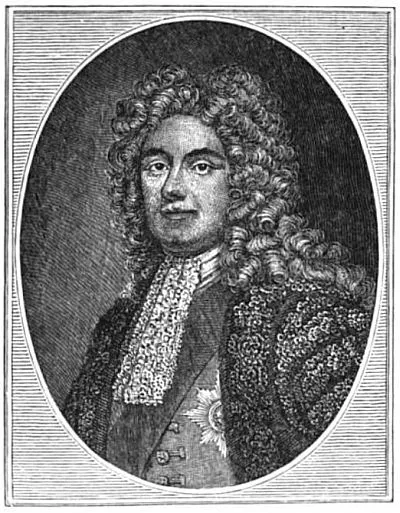
SIR ROBERT WALPOLE
Sir Robert Walpole
A plan for taxing the colonies was once proposed to Sir Robert Walpole, but the sagacious old statesman dismissed it with a laugh. “What!” said he. “I have half of Old England set against me already, and do you think I will have all New England likewise?” From time to time the liberal charters of Rhode Island and Connecticut were threatened, but nothing came of this. But in one direction the Lords of Trade were more active. One of their most cherished plans was to bring about a union of all the colonies under a single head; but this was not to be a union of the kind which the Americans, with consummate statesmanship, afterward wrought out for themselves. It was not to be a union based upon the idea of the sacredness of local self-government, but it was a union to be achieved, as far as possible, at the expense of local self-government. To bring all the colonies together under a single viceroy would, it was thought, diminish seriously the power of each local assembly, while at the same time such a union would no doubt make the military strength of the colonies much more available in case of war.
In 1764, Francis Bernard, Governor of Massachusetts, wrote that “to settle the American governments to the greatest possible advantage, it will be necessary to reduce the number of them; in some places to unite and consolidate; in others to separate and transfer; and in general to divide by natural boundaries instead of imaginary lines. If there should be but one form of government established for the North American provinces, it would greatly facilitate the reformation of them.” As long ago as 1701, Robert Livingston of New York had made similar suggestions; and in 1752, Dinwiddie of Virginia recommended that the Northern and Southern colonies be united respectively into two great confederacies.
The desirableness of bringing about a union of the colonies was also recognized by all the most liberal-minded American statesmen, though from a very different point of view. They agreed with the royal governors and with the Lords of Trade as to the urgent need for concentrating the military strength of the colonies, and they thought that this end could best be subserved by some kind of federal union. But at the same time they held that the integrity of the local self-government of each colony was of the first importance, and that no system of federation would be practicable which should in any degree essentially impair that integrity. To bring about a federal union on such terms was no easy matter; it was a task fitted to tax the greatest of statesmen at any time. At that time it was undoubtedly a hopeless task. The need for union was not generally felt by the people.
Weakness of the sentiment of union
The sympathies between the different colonies were weak and liable to be overborne by prejudices arising from rivalry or from differences in social structure. To the merchant of Boston, the Virginian planter was still almost a foreigner, though both the one and the other were pure-blooded Englishmen. Commercial jealousies were very keen. Disputes about boundaries were not uncommon. In 1756, Georgia and South Carolina actually came to blows over the navigation of the Savannah river. Jeremiah Dummer, in his famous “Defence of the New England Charters,” said that it was impossible that the colonies should ever be brought to unite; and Burnaby thought that if the hand of Great Britain were once taken off, there would be chronic civil war all the way from Maine to Georgia.
The Albany Congress
In 1754, the prospect of immediate war with the French led several of the royal governors to call for a congress of all the colonies, to be held at Albany. The primary purpose of the meeting was to make sure of the friendship of the Six Nations, and to organize a general scheme of operations against the French. The secondary purpose was to prepare some plan of confederation which all the colonies might be persuaded to adopt. New Hampshire, Massachusetts, Rhode Island, Connecticut, New York, Pennsylvania, and Maryland—only seven colonies of the thirteen—sent commissioners to this congress. The people showed little interest in the movement. It does not appear that any public meetings were held in favour of it. Among the newspapers, the only one which warmly approved of it seems to have been the “Pennsylvania Gazette,” edited by Benjamin Franklin, which appeared with a union device and the motto “Unite or Die!”
The circumstances of Franklin’s life, no less than the wide sweep of his intelligence, had fitted him for sounder views of the political needs of the time than were taken by most of his contemporaries. As a native of Massachusetts who dwelt in Pennsylvania, he may be said to have belonged to two very different colonies; and he had spent time enough in London to become well acquainted with British ideas.
Franklin’s plan of union, 1754
During the session of the Albany Congress, a first attempt was made to establish a permanent union of the thirteen colonies. It was to Franklin that the plan was chiefly due. The legislative assembly of each colony was to choose, once in three years, representatives to attend a federal Grand Council; which was to meet every year at Philadelphia, a town which could be reached by a twenty days’ journey either from South Carolina or from New Hampshire. This Grand Council was to choose its own speaker, and could neither be dissolved nor prorogued, nor kept sitting longer than six weeks at any one time, except by its own consent or by especial order of the Crown. The Grand Council was to make treaties with the Indians and to regulate the Indian trade; and it was to have sole power of legislation on all matters concerning the colonies as a whole. To these ends, it could levy taxes, enlist soldiers, build forts, and nominate all civil officers. Its laws were to be submitted to the king for approval, and the royal veto, in order to be of effect, must be exercised within three years.
To this Grand Council each colony was to send a number of representatives, proportioned to its contributions to the continental military service; yet no colony was to send less than two or more than seven representatives. With the exception of such matters of general concern as were to be managed by the Grand Council, each colony was to retain its powers of legislation intact. On an emergency, any colony might singly defend itself against foreign attack, and the federal government was prohibited from impressing soldiers or seamen without the consent of the local legislature.
The supreme executive power was to be vested in a president or governor-general, appointed and paid by the Crown. He was to nominate all military officers, subject to the approval of the Grand Council, and was to have a veto on all the acts of the Grand Council. No money could be issued save by joint order of the governor-general and the council.
This plan, said Franklin, “is not altogether to my mind, but it is as I could get it.” It should be observed, to the credit of its author, that this scheme, long afterward known as the “Albany Plan,” contemplated the formation of a self-sustaining federal government, and not of a mere league. As Frothingham well says, “It designed to confer on the representatives of the people the power of making laws acting directly on individuals, and appointing officers to execute them, and yet not to interfere with the execution of the laws operating on the same individuals by the local officers.” It would have erected “a public authority as obligatory in its sphere as the local governments were in their spheres.” In this respect it was much more complete than the scheme of confederation agreed on in Congress in 1777, and it afforded a valuable precedent for the more elaborate and perfect Federal Constitution of 1787. It was in its main features a noble scheme, and the great statesman who devised it was already looking forward to the immense growth of the American Union, though he had not yet foreseen the separation of the colonies from the mother-country. In less than a century, he said, the great country behind the Alleghanies must become “a populous and powerful dominion;” and he recommended that two new colonies should at once be founded in the West,—the one on Lake Erie, the other in the valley of the Ohio,—with free chartered governments like those of Rhode Island and Connecticut.
But public opinion was not yet ripe for the adoption of Franklin’s bold and comprehensive ideas. Of the royal governors who were anxious to see the colonies united on any terms, none opposed the plan except Delancey of New York, who wished to reserve to the governors a veto upon all elections of representatives to the Grand Cou...
Table of contents
- The American Revolution & The French Revolution
- Table of Contents
- American Revolution
- French Revolution
Trusted by 375,005 students
Access to over 1.5 million titles for a fair monthly price.
Study more efficiently using our study tools.
Frequently asked questions
Yes, you can cancel anytime from the Subscription tab in your account settings on the Perlego website. Your subscription will stay active until the end of your current billing period. Learn how to cancel your subscription
No, books cannot be downloaded as external files, such as PDFs, for use outside of Perlego. However, you can download books within the Perlego app for offline reading on mobile or tablet. Learn how to download books offline
Perlego offers two plans: Essential and Complete
- Essential is ideal for learners and professionals who enjoy exploring a wide range of subjects. Access the Essential Library with 800,000+ trusted titles and best-sellers across business, personal growth, and the humanities. Includes unlimited reading time and Standard Read Aloud voice.
- Complete: Perfect for advanced learners and researchers needing full, unrestricted access. Unlock 1.5M+ books across hundreds of subjects, including academic and specialized titles. The Complete Plan also includes advanced features like Premium Read Aloud and Research Assistant.
We are an online textbook subscription service, where you can get access to an entire online library for less than the price of a single book per month. With over 1.5 million books across 990+ topics, we’ve got you covered! Learn about our mission
Look out for the read-aloud symbol on your next book to see if you can listen to it. The read-aloud tool reads text aloud for you, highlighting the text as it is being read. You can pause it, speed it up and slow it down. Learn more about Read Aloud
Yes! You can use the Perlego app on both iOS and Android devices to read anytime, anywhere — even offline. Perfect for commutes or when you’re on the go.
Please note we cannot support devices running on iOS 13 and Android 7 or earlier. Learn more about using the app
Please note we cannot support devices running on iOS 13 and Android 7 or earlier. Learn more about using the app
Yes, you can access The American Revolution & The French Revolution by Charles Downer Hazen,John Fiske in PDF and/or ePUB format, as well as other popular books in History & Early American History. We have over 1.5 million books available in our catalogue for you to explore.