
eBook - ePub
A Thousand-Mile Walk to the Gulf (Illustrated Edition)
- 113 pages
- English
- ePUB (mobile friendly)
- Available on iOS & Android
eBook - ePub
A Thousand-Mile Walk to the Gulf (Illustrated Edition)
About this book
"JOHN MUIR, Earth-planet, Universe."—These words are written on the inside cover of the notebook from which the contents of this volume have been taken. They reflect the mood in which the late author and explorer undertook his thousand-mile walk to the Gulf of Mexico. No less does this refreshingly cosmopolitan address, which might have startled any finder of the book, reveal the temper and the comprehensiveness of Mr. Muir's mind. He never was and never could be a parochial student of nature.
In September 1867, Muir undertook a walk of about 1,000 miles (1,600 km) from Kentucky to Florida, which he recounted in his book A Thousand-Mile Walk to the Gulf. He had no specific route chosen, except to go by the "wildest, leafiest, and least trodden way I could find."
Information
CHAPTER I
KENTUCKY FORESTS AND CAVES
Table of Contents
I HAD long been looking from the wild woods and gardens of the Northern States to those of the warm South, and at last, all drawbacks overcome, I set forth [from Indianapolis] on the first day of September, 1867, joyful and free, on a thousand-mile walk to the Gulf of Mexico. [The trip to Jeffersonville, on the banks of the Ohio, was made by rail.] Crossing the Ohio at Louisville [September 2], I steered through the big city by compass without speaking a word to any one. Beyond the city I found a road running southward, and after passing a scatterment of suburban cabins and cottages I reached the green woods and spread out my pocket map to rough-hew a plan for my journey.
My plan was simply to push on in a general southward direction by the wildest, leafiest, and least trodden way I could find, promising the greatest extent of virgin forest. Folding my map, I shouldered my little bag and plant press and strode away among the old Kentucky oaks, rejoicing in splendid visions of pines and palms and tropic flowers in glorious array, not, however, without a few cold shadows of loneliness, although the great oaks seemed to spread their arms in welcome.
I have seen oaks of many species in many kinds of exposure and soil, but those of Kentucky excel in grandeur all I had ever before beheld. They are broad and dense and bright green. In the leafy bowers and caves of their long branches dwell magnificent avenues of shade, and every tree seems to be blessed with a double portion of strong exulting life. Walked twenty miles, mostly on river bottom, and found shelter in a rickety tavern.
September 3. Escaped from the dust and squalor of my garret bedroom to the glorious forest. All the streams that I tasted hereabouts are salty and so are the wells. Salt River was nearly dry. Much of my way this forenoon was over naked limestone. After passing the level ground that extended twenty-five or thirty miles from the river I came to a region of rolling hills called Kentucky Knobs—hills of denudation, covered with trees to the top. Some of them have a few pines. For a few hours I followed the farmers’ paths, but soon wandered away from roads and encountered many a tribe of twisted vines difficult to pass.
Emerging about noon from a grove of giant sunflowers, I found myself on the brink of a tumbling rocky stream [Rolling Fork]. I did not expect to find bridges on my wild ways, and at once started to ford, when a negro woman on the opposite bank earnestly called on me to wait until she could tell the “men folks” to bring me a horse—that the river was too deep and rapid to wade and that I would “sartain be drowned” if I attempted to cross. I replied that my bag and plants would ballast me; that the water did not appear to be deep, and that if I were carried away, I was a good swimmer and would soon dry in the sun shine. But the cautious old soul replied that no one ever waded that river and set off for a horse, saying that it was no trouble at all.
In a few minutes the ferry horse came gingerly down the bank through vines and weeds. His long stilt legs proved him a natural wader. He was white and the little sable negro boy that rode him looked like a bug on his back. After many a tottering halt the outward voyage was safely made, and I mounted behind little Nig. He was a queer specimen, puffy and jet as an India rubber doll and his hair was matted in sections like the wool of a merino sheep. The old horse, overladen with his black and white burden, rocked and stumbled on his stilt legs with fair promises of a fall. But all ducking signs failed and we arrived in safety among the weeds and vines of the rugged bank. A salt bath would have done us no harm. I could swim and little Afric looked as if he might float like a bladder.
I called at the homestead where my ferryman informed me I would find “tollable” water. But, like all the water of this section that I have tasted, it was intolerable with salt. Every thing about this old Kentucky home bespoke plenty, unpolished and unmeasured. The house was built in true Southern style, airy, large, and with a transverse central hall that looks like a railway tunnel, and heavy rough outside chimneys. The negro quarters and other buildings are enough in number for a village, altogether an interesting representative of a genuine old Kentucky home, embosomed in orchards, corn fields and green wooded hills.
Passed gangs of woodmen engaged in felling and hewing the grand oaks for market. Fruit very abundant. Magnificent flowing hill scenery all afternoon. Walked southeast from Elizabethtown till wearied and lay down in the bushes by guess.
September 4. The sun was gilding the hilltops when I was awakened by the alarm notes of birds whose dwelling in a hazel thicket I had disturbed. They flitted excitedly close to my head, as if scolding or asking angry questions, while several beautiful plants, strangers to me, were looking me full in the face. The first botanical discovery in bed! This was one of the most delightful camp grounds, though groped for in the dark, and I lingered about it enjoying its trees and soft lights and music.
Walked ten miles of forest. Met a strange oak with willow-looking leaves. Entered a sandy stretch of black oak called “Barrens,” many of which were sixty or seventy feet in height, and are said to have grown since the fires were kept off, forty years ago. The farmers hereabouts are tall, stout, happy fellows, fond of guns and horses. Enjoyed friendly chats with them. Arrived at dark in a village that seemed to be drawing its last breath. Was guided to the “tavern” by a negro who was extremely accommodating. “No trouble at all,” he said.
September 5. No bird or flower or friendly tree above me this morning; only squalid garret rubbish and dust. Escaped to the woods. Came to the region of caves. At the mouth of the first I discovered, I was surprised to find ferns which belonged to the coolest nooks of Wisconsin and northward, but soon observed that each cave rim has a zone of climate peculiar to itself, and it is always cool. This cave had an opening about ten feet in diameter, and twenty-five feet perpendicular depth. A strong cold wind issued from it and I could hear the sounds of running water. A long pole was set against its walls as if intended for a ladder, but in some places it was slippery and smooth as a mast and would test the climbing powers of a monkey. The walls and rim of this natural reservoir were finely carved and flowered. Bushes leaned over it with shading leaves, and beautiful ferns and mosses were in rows and sheets on its slopes and shelves. Lingered here a long happy while, pressing specimens and printing this beauty into memory.
Arrived about noon at Munfordville; was soon discovered and examined by Mr. Munford himself, a pioneer and father of the village. He is a surveyor—has held all country offices, and every seeker of roads and lands applies to him for information. He regards all the villagers as his children, and all strangers who enter Munfordville as his own visitors. Of course he inquired my business, destination, et cetera, and invited me to his house.
After refreshing me with “parrs” he complacently covered the table with bits of rocks, plants, et cetera, things new and old which he had gathered in his surveying walks and supposed to be full of scientific interest. He informed me that all scientific men applied to him for information, and as I was a botanist, he either possessed, or ought to possess, the knowledge I was seeking, and so I received long lessons concerning roots and herbs for every mortal ill. Thanking my benefactor for his kindness, I escaped to the fields and followed a railroad along the base of a grand hill ridge. As evening came on all the dwellings I found seemed to repel me, and I could not muster courage enough to ask entertainment at any of them. Took refuge in a log schoolhouse that stood on a hillside beneath stately oaks and slept on the softest looking of the benches.
September 6. Started at the earliest bird song in hopes of seeing the great Mammoth Cave before evening. Overtook an old negro driving an ox team. Rode with him a few miles and had some interesting chat concerning war, wild fruits of the woods, et cetera. “Right heah,” said he, “is where the Rebs was a-tearin’ up the track, and they all a sudden thought they seed the Yankees a-comin’, obah dem big hills dar, and Lo’d, how dey run.” I asked him if he would like a renewal of these sad war times, when his flexible face suddenly calmed, and he said with intense earnestness, “Oh, Lo’d, want no mo wa, Lo’d no.” Many of these Kentucky negroes are shrewd and intelligent, and when warmed upon a subject that interests them, are eloquent in no mean degree.
Arrived at Horse Cave, about ten miles from the great cave. The entrance is by a long easy slope of several hundred yards. It seems like a noble gateway to the birthplace of springs and fountains and the dark treasuries of the mineral kingdom. This cave is in a village [of the same name] which it supplies with an abundance of cold water, and cold air that issues from its fern-clad lips. In hot weather crowds of people sit about it in the shade of the trees that guard it. This magnificent fan is capable of cooling everybody in the town at once.
Those who live near lofty mountains may climb to cool weather in a day or two, but the overheated Kentuckians can find a patch of cool climate in almost every glen in the State. The villager who accompanied me said that Horse Cave had never been fully explored, but that it was several miles in length at least. He told me that he had never been at Mammoth Cave—that it was not worth going ten miles to see, as it was nothing but a hole in the ground, and I found that his was no rare case. He was one of the useful, practical men—too wise to waste precious time with weeds, caves, fossils, or any thing else that he could not eat.
Arrived at the great Mammoth Cave. I was surprised to find it in so complete naturalness. A large hotel with fine walks and gardens is near it. But fortunately the cave has been unimproved, and were it not for the narrow trail that leads down the glen to its door, one would not know that it had been visited. There are house-rooms and halls whose entrances give but slight hint of their grandeur. And so also this magnificent hall in the mineral kingdom of Kentucky has a door comparatively small and unpromising. One might pass within a few yards of it without noticing it. A strong cool breeze issues constantly from it, creating a northern climate for the ferns that adorn its rocky front.
I never before saw Nature’s grandeur in so abrupt contrast with paltry artificial gardens. The fashionable hotel grounds are in exact parlor taste, with many a beautiful plant cultivated to deformity, and arranged in strict geometrical beds, the whole pretty affair a laborious failure side by side with Divine beauty. The trees around the mouth of the cave are smooth and tall and bent forward at the bottom, then straight upwards. Only a butternut seems, by its angular knotty branches, to sympathize with and belong to the cave, with a fine growth of Cystopteris and Hypnum.
Started for Glasgow Junction. Got belated in the hill woods. Inquired my way at a farm house and was invited to stay overnight in a rare, hearty, hospitable manner. Engaged in familiar running talk on politics, war times, and theology. The old Kentuckian seemed to take a liking to me and advised me to stay in these hills until next spring, assuring me that I would find much to interest me in and about the Great Cave; also, that he was one of the school officials and was sure that I could obtain their school for the winter term. I sincerely thanked him for his kind plans, but pursued my own.
September 7. Left the hospitable Kentuckians with their sincere good wishes and bore away southward again through the deep green woods. In noble forests all day. Saw mistletoe for the first time. Part of the day I traveled with a Kentuckian from near Burkesville. He spoke to all the negroes he met with familiar kindly greetings, addressing them always as "Uncles" and "Aunts." All travelers one meets on these roads, white and black, male and female, travel on horseback. Glasgow is one of the few Southern towns that shows ordinary American life. At night with a well-to-do farmer.
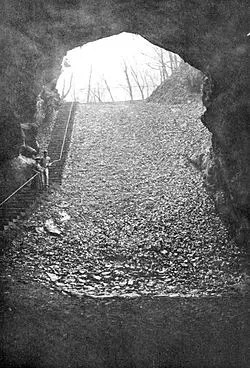
ENTRANCE TO MAMMOTH CAVE
September 8. Deep, green, bossy sea of waving, flowing hilltops. Corn and cotton and tobacco fields scattered here and there. I had imagined that a cotton field in flower was something magnificent. But cotton is a coarse, rough, straggling, unhappy looking plant, not half as good-looking as a field of Irish potatoes.
Met a great many negroes going to meeting, dressed in their Sunday best. Fat, happy looking, and contented. The scenery on approaching the Cumberland River becomes still grander. Burkesville, in beautiful location, is embosomed in a glorious array of verdant flowing hills. The Cumberland must be a happy stream. I think I could enjoy traveling with it in the midst of such beauty all my life. This evening I could find none willing to take me in, and so lay down on a hillside and fell asleep muttering praises to the happy abounding beauty of Kentucky.
September 9. Another day in the most favored province of bird and flower. Many rapid streams, flowing in beautiful flower-bordered cañons embosomed in dense woods. Am seated on a grand hill-slope that leans back against the sky like a picture. Amid the wide waves of green wood there are spots of autumnal yellow and the atmosphere, too, has the dawnings of autumn in colors and sounds. The soft light of morning falls upon ripening forests of oak and elm, walnut and hickory, and all Nature is thoughtful and calm. Kentucky is the greenest, leafiest State I have yet seen. The sea of soft temperate plant-green is deepest here.
Comparing volumes of vegetable verdure in different countries to a wedge, the thick end would be in the forests of Kentucky, the other in the lichens and mosses of the North. This verdure wedge would not be perfect in its lines. From Kentucky it would maintain its thickness long and well in passing the level forests of Indiana and Canada. From the maples and pines of Canada it would slope rapidly to the bleak Arctic hills with dwarf birches and alders; thence it would thin out in a long edge among hardy lichens and liverworts and mosses to the dwelling-places of everlasting frost. Far the grandest of all Kentucky plants are her noble oaks. They are the master existences of her exuberant forests. Here is the Eden, the paradise of oaks. Passed the Kentucky line towards evening and obtained food and shelter from a thrifty Tennessee farmer, after he had made use of all the ordinary anti-hospitable arguments of cautious comfortable families.
September 10. Escaped from a heap of uncordial kindness to the generous bosom of the woods. After a few miles of level ground in luxuriant tangles of brooding vines, I began the ascent of the Cumberland Mountains, the first real mountains that my foot ever touched or eyes beheld. The ascent was by a nearly regular zigzag slope, mostly covered up like a tunnel by overarching oaks. But there were a few openings where the glorious forest road of Kentucky was grandly seen, stretching over hill and valley, adjusted to every slope and curve by the hands of Nature—the most sublime and comprehensive picture that ever entered my eyes. Reached the summit in six or seven hours—a strangely long period of up-grade work to one accustomed only to the hillocky levels of Wisconsin and adjacent States.
CHAPTER II
Crossing the Cumberland Mountains
Table of Contents
I HAD climbed but a short distance when I was overtaken by a young man on horseback, who soon showed that he intended to rob me if he should find the job worth while. After he had inquired where I came from, and where I was going, he offered to carry my bag. I told him that it was so light that I did not feel it at all a burden; but he insisted and coaxed until I allowed him to carry it. As soon as he had gained possession I noticed that he gradually increased his speed, evidently trying to get far enough ahead of me to examine the contents without being observed. But I was too good a walker and runner for him to get far. At a turn of the road, after trotting his horse for about half an hour, and when he thought he was out of sight, I caught him rummaging my poor bag. Finding there only a comb, brush, towel, soap, a change of underclothing, a copy of Burns’s poems, Milton’s Paradise Lost, and a small New Testament, he waited for me, handed back my bag, and returned down the hill, saying that he had forgotten something.
I found splendid growths of shining-leaved Ericaceæ [heathworts] for which the Alleghany Mountains are noted. Also ferns of which Osmunda cinnamomea [Cinnamon Fern] is the largest and perhaps the most abundant. Osmunda regalis [Flowering Fern] is also common here, but not large. In Wood’s[1] and Gray’s Botany Osmunda cinnamomea is said to be a much larger fern than Osmunda Claytoniana, This I found to be true in Tennessee and southward, but in Indiana, part of Illinois, and Wisconsin the opposite is true. Found here the beautiful, sensitive Sckrankia, or sensitive brier. It is a long, prickly, leguminous vine, with dense heads of small, yellow fragrant flowers.
Vines growing on roadsides receive many a tormenting blow, simply because they give evidence of feeling. Sensitive people are served in the same way. But the roadside vine soon becomes less sensitive, like people getting used to teasing—Nature, in this instance, making for the comfort of flower creatures the same benevolent arrangement as for man. Thus I found that the Schrankia vines growing along foot paths leading to a backwoods schoolhouse were much less sensitive than those in the adjacent unfrequented woods, having learned to pay but slight attention to the tingling strokes they get from teasing scholars.
It is startling to see the pairs of pinnate leaves rising quickly out of the grass and folding themselves close in regular succession from the root to the end of the prostrate stems, ten to twenty feet in length. How little we know as yet of the life of plants—their hopes and fears, pains and enjoyments!
Traveled a few miles with an old Tennessee farmer who was much excited on account o...
Table of contents
- A Thousand-Mile Walk to the Gulf (Illustrated Edition)
- Table of Contents
- INTRODUCTION
- CHAPTER I. KENTUCKY FORESTS AND CAVES
- CHAPTER II. Crossing the Cumberland Mountains
- CHAPTER III. THROUGH THE RIVER COUNTRY OF GEORGIA
- CHAPTER IV. CAMPING AMONG THE TOMBS
- CHAPTER V. THROUGH FLORIDA SWAMPS AND FORESTS
- CHAPTER VI. CEDAR KEYS
- CHAPTER VII. A SOJOURN IN CUBA
- CHAPTER VIII. BY A CROOKED ROUTE TO CALIFORNIA
- CHAPTER IX. TWENTY HILL HOLLOW[1]
Trusted by 375,005 students
Access to over 1.5 million titles for a fair monthly price.
Study more efficiently using our study tools.
Frequently asked questions
Yes, you can cancel anytime from the Subscription tab in your account settings on the Perlego website. Your subscription will stay active until the end of your current billing period. Learn how to cancel your subscription
No, books cannot be downloaded as external files, such as PDFs, for use outside of Perlego. However, you can download books within the Perlego app for offline reading on mobile or tablet. Learn how to download books offline
Perlego offers two plans: Essential and Complete
- Essential is ideal for learners and professionals who enjoy exploring a wide range of subjects. Access the Essential Library with 800,000+ trusted titles and best-sellers across business, personal growth, and the humanities. Includes unlimited reading time and Standard Read Aloud voice.
- Complete: Perfect for advanced learners and researchers needing full, unrestricted access. Unlock 1.5M+ books across hundreds of subjects, including academic and specialized titles. The Complete Plan also includes advanced features like Premium Read Aloud and Research Assistant.
We are an online textbook subscription service, where you can get access to an entire online library for less than the price of a single book per month. With over 1.5 million books across 990+ topics, we’ve got you covered! Learn about our mission
Look out for the read-aloud symbol on your next book to see if you can listen to it. The read-aloud tool reads text aloud for you, highlighting the text as it is being read. You can pause it, speed it up and slow it down. Learn more about Read Aloud
Yes! You can use the Perlego app on both iOS and Android devices to read anytime, anywhere — even offline. Perfect for commutes or when you’re on the go.
Please note we cannot support devices running on iOS 13 and Android 7 or earlier. Learn more about using the app
Please note we cannot support devices running on iOS 13 and Android 7 or earlier. Learn more about using the app
Yes, you can access A Thousand-Mile Walk to the Gulf (Illustrated Edition) by John Muir,Herbert K. Job,Herbert W. Gleason in PDF and/or ePUB format, as well as other popular books in Tecnología e ingeniería & Biografías de ciencia y tecnología. We have over 1.5 million books available in our catalogue for you to explore.