eBook - ePub
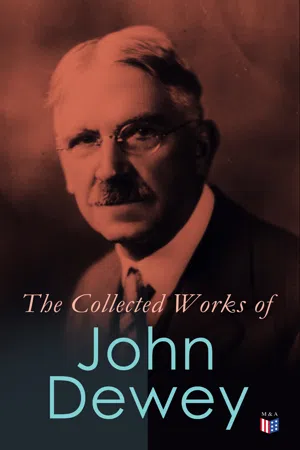
The Collected Works of John Dewey
American School System, Theory of Educational, Philosophy, Psychological Works, Political Writings: 40 Titles in One Volume
- 3,637 pages
- English
- ePUB (mobile friendly)
- Available on iOS & Android
eBook - ePub
The Collected Works of John Dewey
American School System, Theory of Educational, Philosophy, Psychological Works, Political Writings: 40 Titles in One Volume
About this book
Madison & Adams Press presents to you this meticulously edited John Dewey collection, formatted to the highest digital standards and adjusted for readability on all devices.
Contents:
Books on Education
Democracy and Education
Child and the Curriculum
School and Society
Schools Of To-morrow
The Schools of Utopia
Moral Principles in Education
Interest and Effort in Education
Health and Sex in Higher Education
My Pedagogic Creed
Books on Philosophy
German Philosophy and Politics
Leibniz's New Essays Concerning the Human Understanding
Studies in Logical Theory
Interpretation of Savage Mind
Ethics
The Problem of Values
Soul and Body
Logical Conditions of a Scientific Treatment of Morality
Evolutionary Method As Applied To Morality
Influence of Darwin on Philosophy
Nature and Its Good: A conversation
Intelligence and Morals
Experimental Theory of Knowledge
Intellectualist Criterion for Truth
A Short Catechism Concerning Truth
Beliefs and Existences
Experience and Objective Idealism
The Postulate of Immediate Empiricism
"Consciousness" and Experience
Significance of the Problem of Knowledge
Essays in Experimental Logic
Reconstruction in Philosophy
Does Reality Possess Practical Character?
Books on Psychology
Psychology and Social Practice
Psychological Doctrine and Philosophical Teaching
Psychology as Philosophic Method
New Psychology
How We Think
Reflex Arc Concept in Psychology
Psychology of Effort
Creative Intelligence
Ego as Cause
Terms 'Conscious' and 'Consciousness'
On Some Current Conceptions of the term 'Self'
Psychological Standpoint
Theory of Emotion
Psychology of Infant Language
Knowledge and Speech Reaction
Human Nature and Conduct
Books on Politics
China, Japan and the U.S.A
Letters
Criticisms
The Chicago School by William James
John Dewey's Logical Theory
The Pragmatic Theory of Truth
Information
Topic
EducationSubtopic
Education Theory & PracticeEthics (with James Hayden Tufts)
Table of Contents
Preface
Table of Contents
The significance of this text in Ethics lies in its effort to awaken a vital conviction of the genuine reality of moral problems and the value of reflective thought in dealing with them. To this purpose are subordinated the presentation in Part I. of historic material; the discussion in Part II. of the different types of theoretical interpretation, and the consideration, in Part III., of some typical social and economic problems which characterize the present.
Experience shows that the student of morals has difficulty in getting the field objectively and definitely before him so that its problems strike him as real problems. Conduct is so intimate that it is not easy to analyze. It is so important that to a large extent the perspective for regarding it has been unconsciously fixed by early training. The historical method of approach has proved in the classroom experience of the authors an effective method of meeting these difficulties. To follow the moral life through typical epochs of its development enables students to realize what is involved in their own habitual standpoints; it also presents a concrete body of subject-matter which serves as material of analysis and discussion.
The classic conceptions of moral theory are of remarkable importance in illuminating the obscure places of the moral life and in giving the student clues which will enable him to explore it for himself. But there is always danger of either dogmatism or a sense of unreality when students are introduced abruptly to the theoretical ideas. Instead of serving as tools for understanding the moral facts, the ideas are likely to become substitutes for the facts. When they are proffered ready-made, their theoretical acuteness and cleverness may be admired, but their practical soundness and applicability are suspected. The historical introduction permits the student to be present, as it were, at the social situations in which the intellectual instruments were forged. He appreciates their relevancy to the conditions which provoked them, and he is encouraged to try them on simple problems before attempting the complex problems of the present. By assisting in their gradual development he gains confidence in the ideas and in his power to use them.
In the second part, devoted more specifically to the analysis and criticism of the leading conceptions of moral theory, the aim accordingly has not been to instill the notions of a school nor to inculcate a ready-made system, but to show the development of theories out of the problems and experience of every-day conduct, and to suggest how these theories may be fruitfully applied in practical exigencies. Aspects of the moral life have been so thoroughly examined that it is possible to present certain principles in the confidence that they will meet general acceptance. Rationalism and hedonism, for example, have contributed toward a scientific statement of the elements of conduct, even though they have failed as self-inclosed and final systems. After the discussions of Kant and Mill, Sidgwick and Green, Martineau and Spencer, it is possible to affirm that there is a place in the moral life for reason and a place for happiness,—a place for duty and a place for valuation. Theories are treated not as incompatible rival systems which must be accepted or rejected en bloc, but as more or less adequate methods of surveying the problems of conduct. This mode of approach facilitates the scientific estimation and determination of the part played by various factors in the complexity of moral life. The student is put in a position to judge the problems of conduct for himself. This emancipation and enlightenment of individual judgment is the chief aim of the theoretical portion.
In a considerable part of the field, particularly in the political and economic portions of Part III., no definitive treatment is as yet possible. Nevertheless, it is highly desirable to introduce the student to the examination of these unsettled questions. When the whole civilized world is giving its energies to the meaning and value of justice and democracy, it is intolerably academic that those interested in ethics should have to be content with conceptions already worked out, which therefore relate to what is least doubtful in conduct rather than to questions now urgent. Moreover, the advantages of considering theory and practice in direct relation to each other are mutual. On the one hand, as against the a priori claims of both individualism and socialism, the need of the hour seems to us to be the application of methods of more deliberate analysis and experiment. The extreme conservative may deprecate any scrutiny of the present order; the ardent radical may be impatient of the critical and seemingly tardy processes of the investigator; but those who have considered well the conquest which man is making of the world of nature cannot forbear the conviction that the cruder method of trial and error and the time-honored method of prejudice and partisan controversy need not longer completely dominate the regulation of the life of society. They hope for a larger application of the scientific method to the problems of human welfare and progress. Conversely, a science which takes part in the actual work of promoting moral order and moral progress must receive a valuable reflex influence of stimulus and of test. To consider morality in the making as well as to dwell upon values already established should make the science more vital. And whatever the effect upon the subject-matter, the student can hardly appreciate the full force of his materials and methods as long as they are kept aloof from the questions which are occupying the minds of his contemporaries.
Teachers who are limited in time will doubtless prefer to make their own selections of material, but the following suggestions present one possible line of choice. In Part I., of the three chapters dealing with the Hebrew, Greek, and modern developments, any one may be taken as furnishing an illustration of the method; and certain portions of Chapter IX. may be found more detailed in analysis than is necessary for the beginner. In Part II., Chapters XI.-XII. may be omitted without losing the thread of the argument. In Part III., any one of the specific topics—viz., the political state, the economic order, the family—may be considered apart from the others. Some teachers may prefer to take Parts in their entirety. In this case, any two may be chosen.
As to the respective shares of the work for which the authors are severally responsible, while each has contributed suggestions and criticisms to the work of the other in sufficient degree to make the book throughout a joint work, Part I. has been written by Mr. Tufts, Part II. by Mr. Dewey, and in Part III., Chapters XX. and XXI. are by Mr. Dewey, Chapters XXII.-XXVI. by Mr. Tufts.
It need scarcely be said that no attempt has been made in the bibliographies to be exhaustive. When the dates of publication of the work cited are given, the plan has been in general to give, in the case of current literature, the date of the latest edition, and in the case of some classical treatises the date of original publication.
In conclusion, the authors desire to express their indebtedness to their colleagues and friends Dr. Wright, Mr. Talbert, and Mr. Eastman, who have aided in the reading of the proof and with other suggestions.
Chapter I
Introduction
Table of Contents
§ 1. DEFINITION AND METHOD
Provisional Definition.—The place for an accurate definition of a subject is at the end of an inquiry rather than at the beginning, but a brief definition will serve to mark out the field. Ethics is the science that deals with conduct, in so far as this is considered as right or wrong, good or bad. A single term for conduct so considered is "moral conduct," or the "moral life." Another way of stating the same thing is to say that Ethics aims to give a systematic account of our judgments about conduct, in so far as these estimate it from the standpoint of right or wrong, good or bad.
Ethical and Moral.—The terms "ethics" and "ethical" are derived from a Greek word ethos which originally meant customs, usages, especially those belonging to some group as distinguished from another, and later came to mean disposition, character. They are thus like the Latin word "moral," from mores, or the German sittlich, from Sitten. As we shall see, it was in customs, "ethos," "mores," that the moral or ethical began to appear. For customs were not merely habitual ways of acting; they were ways approved by the group or society. To act contrary to the customs of the group brought severe disapproval. This might not be formulated in precisely our terms—right and wrong, good and bad,—but the attitude was the same in essence. The terms ethical and moral as applied to the conduct of to-day imply of course a far more complex and advanced type of life than the old words "ethos" and "mores," just as economics deals with a more complex problem than "the management of a household," but the terms have a distinct value if they suggest the way in which the moral life had its beginning.
Two Aspects of Conduct.—To give a scientific account of judgments about conduct, means to find the principles which are the basis of these judgments. Conduct or the moral life has two obvious aspects. On the one hand it is a life of purpose. It implies thought and feeling, ideals and motives, valuation and choice. These are processes to be studied by psychological methods. On the other hand, conduct has its outward side. It has relations to nature, and especially to human society. Moral life is called out or stimulated by certain necessities of individual and social existence. As Protagoras put it, in mythical form, the gods gave men a sense of justice and of reverence, in order to enable them to unite for mutual preservation.1 And in turn the moral life aims to modify or transform both natural and social environments, to build a "kingdom of man" which shall be also an ideal social order—a "kingdom of God." These relations to nature and society are studied by the biological and social sciences. Sociology, economics, politics, law, and jurisprudence deal particularly with this aspect of conduct. Ethics must employ their methods and results for this aspect of its problem, as it employs psychology for the examination of conduct on its inner side.
The Specific Problem of Ethics.—But ethics is not merely the sum of these various sciences. It has a problem of its own which is created by just this twofold aspect of life and conduct. It has to relate these two sides. It has to study the inner process as determined by the outer conditions or as changing these outer conditions, and the outward behavior or institution as determined by the inner purpose, or as affecting the inner life. To study choice and purpose is psychology; to study choice as affected by the rights of others and to judge it as right or wrong by this standard is ethics. Or again, to study a corporation may be economics, or sociology, or law; to study its activities as resulting from the purposes of persons or as affecting the welfare of persons, and to judge its acts as good or bad from such a point of view, is ethics.
Genetic Study.—When we deal with any process of life it is found to be a great aid for understanding the present conditions if we trace the history of the process and see how present conditions have come about. And in the case of morality there are four reasons in particular for examining earlier stages. The first is that we may begin our study with a simpler material. Moral life at present is extremely complex. Professional, civic, domestic, philanthropic, ecclesiastical, and social obligations claim adjustment. Interests in wealth, in knowledge, in power, in friendship, in social welfare, make demand for recognition in fixing upon what is good. It is desirable to consider first a simpler problem. In the second place, this complex moral life is like the human body in that it contains "rudiments" and "survivals." Some of our present standards and ideals were formed at one period in the past, and some at another. Some of these apply to present conditions and some do not. Some are at variance with others. Many apparent conflicts in moral judgments are explained when we discover how the judgments came to be formed in the first instance. We cannot easily understand the moral life of to-day except in the light of earlier morality. The third reason is that we may get a more objective material for study. Our moral life is so intimate a part of ourselves that it is hard to observe impartially. Its characteristics escape notice because they are so familiar. When we travel we find the customs, laws, and moral standards of other peoples standing out as "peculiar." Until we have been led by some such means to compare our own conduct with that of others it probably does not occur to us that our own standards are also peculiar, and hence in need of explanation. It is as difficult scientifically as it is personally "to see ourselves as others see us." It is doubtless true that to see ourselves merely as others see us would not be enough. Complete moral analysis requires us to take into our reckoning motives and purposes which may perhaps be undiscoverable by the "others." But it is a great aid to this completer analysis if we can sharpen our vision and awaken our attention by a comparative study. A fourth reason for a genetic study is that it emphasizes the dynamic, progressive character of morality. Merely to examine the present may easily give the impression that the moral life is not a life, a moving process, something still in the making—but a changeless structure. There is moral progress as well as a moral order. This may be discovered by an analysis of the very nature of moral conduct, but it stands out more clearly and impressively if we trace the actual development in history. Before attempting our analysis of the present moral consciousness and its judgments, we shall therefore give an outline of the earlier stages and simpler phases.
Theory and Practice.—Finally, if we can discover ethical principles these ought to give some guidance for the unsolved problems of life which continually present themselves for decision. Whatever may be true for other sciences it would seem that ethics at least ought to have some practical value. "In this theater of man's life it is reserved for God and the angels to be lookers on." Man must act; and he must act well or ill, rightly or wrongly. If he has reflected, has considered his conduct in the light of the general principles of human order and progress, he ought to be able to act more intelligently and freely, to achieve the satisfaction that always attends on scientific as compared with uncritical or rule-of-thumb practice. Socrates gave the classic statement for the study of conduct when he said, "A life unexamined, uncriticized, is not worthy of man."
§ 2. CRITERION OF THE MORAL
It is not proposed to attempt at this point an accurate or minute statement of what is implied in moral conduct, as this is the task of Part II. But for the purposes of tracing in Part I. the beginnings of morality, it is desirable to have a sort of rough chart to indicate to the student what to look for in the earlier stages of his exploration, and to enable him to keep his bearings on the way.
Certain of the characteristics of the moral may be seen in a cross-section, a statement of the elements in moral conduct at a given time. Other characteristics come out more clearly by comparing later with earlier stages. We give first a cross-section.
1. Characteristics of the Moral Life in Cross-section.—In this cross-section the first main division is suggested by the fact that we sometimes give our attention to what is done or intended, and sometimes to how or why the act is done. These divisions may turn out to be less absolute than they seem, but common life uses them and moral theories have often selected the one or the other as the important aspect. When we are told to seek peace, tell the truth, or aim at the greatest happiness of the greatest number, we are charged to do or intend some definite act. When we are urged to be conscientious or pure in heart the emphasis is on a kind of attitude that might go with a variety of acts. A newspaper advocates a good measure. So far, so good. But people may ask, what is the motive in this? and if this is believed to be merely selfish, they do not credit the newspaper with having genuine interest in reform. On the other hand, sincerity alone is not enough. If a man advocates frankly and sincerely a scheme for enriching himself at the public expense we condemn him. We say his very frankness shows his utter disregard for others. One of the great moral philosophers has indeed said that to act rationally is all that is necessary, but he at once goes on to claim that this implies treating every man as an end and not merely a means, and this calls for a particular kind of action. Hence we may assume for the present purpose a general agreement that our moral judgments take into account both what is done or intended, and how or why the act is done. These two aspects are sometimes called the "matter" and the "form," or the "content" and the attitude. We shall use the simpler terms, the What and the How.
The "What" as a Criterion.—If we neglect for the moment the How and think of the What, we find two main standpoints employed i...
Table of contents
- The Collected Works of John Dewey
- Table of Contents
- On Education
- Democracy and Education: An Introduction to the Philosophy of Education
- The Child and the Curriculum
- The School and Society
- Schools Of To-morrow
- The Schools of Utopia
- Moral Principles in Education
- Interest and Effort in Education
- Health and Sex in Higher Education
- My Pedagogic Creed
- On Philosophy
- German Philosophy and Politics
- Leibniz's New Essays Concerning the Human Understanding: A Critical Exposition
- Studies in Logical Theory
- Interpretation of Savage Mind
- Ethics (with James Hayden Tufts)
- The Problem of Values
- Soul and Body
- Logical Conditions of a Scientific Treatment of Morality
- The Evolutionary Method As Applied To Morality: Its Scientific Necessity & Its Significance for Conduct
- The Influence of Darwin on Philosophy1
- Nature and Its Good: A conversation1
- Intelligence and Morals1
- The Experimental Theory of Knowledge1
- The Intellectualist Criterion for Truth1
- A Short Catechism Concerning Truth1
- Beliefs and Existences1
- Experience and Objective Idealism1
- The Postulate of Immediate Empiricism1
- "Consciousness" and Experience1
- The Significance of the Problem of Knowledge1
- Essays in Experimental Logic
- Reconstruction in Philosophy
- Does Reality Possess Practical Character?
- On Psychology
- Psychology and Social Practice1
- Psychological Doctrine and Philosophical Teaching
- Psychology as Philosophic Method
- The New Psychology
- How We Think
- The Reflex Arc Concept in Psychology
- The Psychology of Effort
- Creative Intelligence: Essays in the Pragmatic Attitude et al.
- The Ego as Cause
- The Terms 'Conscious' and 'Consciousness'
- On Some Current Conceptions of the term 'Self'
- The Psychological Standpoint
- The Theory of Emotion: Emotional Attitudes & the Significance of Emotions
- The Psychology of Infant Language
- Knowledge and Speech Reaction
- Human Nature and Conduct: An Introduction to Social Psychology
- On Politics
- China, Japan and the U.S.A: Present-day Conditions in the Far East and Their Bearing on the Washington Conference
- Letters from China and Japan
- Criticisms of John Dewey
- The Chicago School1 by William James
- John Dewey's Logical Theory by Delton Thomas Howard
- The Pragmatic Theory of Truth as Developed by Peirce, James, and Dewey by Denton Loring Geyer
Trusted by 375,005 students
Access to over 1.5 million titles for a fair monthly price.
Study more efficiently using our study tools.
Frequently asked questions
Yes, you can cancel anytime from the Subscription tab in your account settings on the Perlego website. Your subscription will stay active until the end of your current billing period. Learn how to cancel your subscription
No, books cannot be downloaded as external files, such as PDFs, for use outside of Perlego. However, you can download books within the Perlego app for offline reading on mobile or tablet. Learn how to download books offline
Perlego offers two plans: Essential and Complete
- Essential is ideal for learners and professionals who enjoy exploring a wide range of subjects. Access the Essential Library with 800,000+ trusted titles and best-sellers across business, personal growth, and the humanities. Includes unlimited reading time and Standard Read Aloud voice.
- Complete: Perfect for advanced learners and researchers needing full, unrestricted access. Unlock 1.5M+ books across hundreds of subjects, including academic and specialized titles. The Complete Plan also includes advanced features like Premium Read Aloud and Research Assistant.
We are an online textbook subscription service, where you can get access to an entire online library for less than the price of a single book per month. With over 1.5 million books across 990+ topics, we’ve got you covered! Learn about our mission
Look out for the read-aloud symbol on your next book to see if you can listen to it. The read-aloud tool reads text aloud for you, highlighting the text as it is being read. You can pause it, speed it up and slow it down. Learn more about Read Aloud
Yes! You can use the Perlego app on both iOS and Android devices to read anytime, anywhere — even offline. Perfect for commutes or when you’re on the go.
Please note we cannot support devices running on iOS 13 and Android 7 or earlier. Learn more about using the app
Please note we cannot support devices running on iOS 13 and Android 7 or earlier. Learn more about using the app
Yes, you can access The Collected Works of John Dewey by John Dewey in PDF and/or ePUB format, as well as other popular books in Education & Education Theory & Practice. We have over 1.5 million books available in our catalogue for you to explore.