eBook - ePub
Available until 23 Dec |Learn more
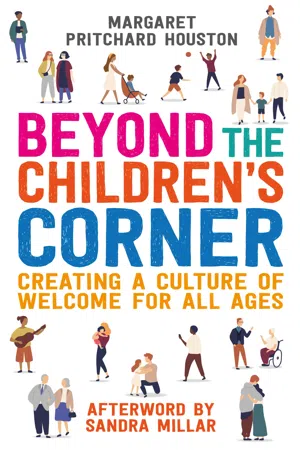
Beyond the Children's Corner
Creating a culture of welcome for all ages
This book is available to read until 23rd December, 2025
- 160 pages
- English
- ePUB (mobile friendly)
- Available on iOS & Android
eBook - ePub
Available until 23 Dec |Learn more
About this book
This is a practical handbook for churches on how to become more welcoming to children and families in worship. It is designed to encourage PCCs and ministry teams to reflect on the spiritual needs of children, the pastoral needs of families, and how to remove barriers and manage change effectively.
Frequently asked questions
Yes, you can cancel anytime from the Subscription tab in your account settings on the Perlego website. Your subscription will stay active until the end of your current billing period. Learn how to cancel your subscription.
No, books cannot be downloaded as external files, such as PDFs, for use outside of Perlego. However, you can download books within the Perlego app for offline reading on mobile or tablet. Learn more here.
Perlego offers two plans: Essential and Complete
- Essential is ideal for learners and professionals who enjoy exploring a wide range of subjects. Access the Essential Library with 800,000+ trusted titles and best-sellers across business, personal growth, and the humanities. Includes unlimited reading time and Standard Read Aloud voice.
- Complete: Perfect for advanced learners and researchers needing full, unrestricted access. Unlock 1.4M+ books across hundreds of subjects, including academic and specialized titles. The Complete Plan also includes advanced features like Premium Read Aloud and Research Assistant.
We are an online textbook subscription service, where you can get access to an entire online library for less than the price of a single book per month. With over 1 million books across 1000+ topics, we’ve got you covered! Learn more here.
Look out for the read-aloud symbol on your next book to see if you can listen to it. The read-aloud tool reads text aloud for you, highlighting the text as it is being read. You can pause it, speed it up and slow it down. Learn more here.
Yes! You can use the Perlego app on both iOS or Android devices to read anytime, anywhere — even offline. Perfect for commutes or when you’re on the go.
Please note we cannot support devices running on iOS 13 and Android 7 or earlier. Learn more about using the app.
Please note we cannot support devices running on iOS 13 and Android 7 or earlier. Learn more about using the app.
Yes, you can access Beyond the Children's Corner by Margaret Pritchard Houston in PDF and/or ePUB format, as well as other popular books in Theology & Religion & Christian Rituals & Practice. We have over one million books available in our catalogue for you to explore.
Information
1. We Are Family
When you hear the word ‘family’, what image springs immediately to mind?
Despite the fact that most of us know better, the image that probably came to you was of a heterosexual couple in their twenties or thirties, with a few young children. They may be well dressed and smiling. They might have a dog.
This might bear no relation to your family now, or the family you grew up in, yet it’s still the prevailing archetype of family. But more and more, modern families reflect a broader and more diverse vision of family. While that may make us nervous, actually a diversity of family styles – and families who struggle and have problems and can’t always stay together – is very biblical. For better or worse, family has never been simple and straightforward. And God’s welcome to families, the families God chooses to work with and make holy, is broader than just the nuclear family. And more complicated.
The families in the Bible include polygamy, the use of a woman’s servant as a surrogate for pregnancy without the servant’s consent, the ostracism of women with infertility, the command for a rape victim to marry their abuser, and more.
And there are stories that are universal in how they show the painful and broken sides of family life – one of the first family stories of the Bible, that of Cain and Abel, is one of murderous sibling rivalry and jealousy.
Isaac blatantly favours one son over another, and this sin has long-term consequences – estrangement, exile, loss. Only when the brothers can begin to trust each other, to stop fighting over scraps of their father’s love, can reconciliation occur.
Rachel and Leah are bought and sold as property by their cousin, and their relationship is one of bitterness and envy, vying for position. Absalom rises in armed rebellion against his father, and their feud brings a whole country into bloodshed.
Yet these flawed men and women, who hurt each other and break relationships, are people of God. Any theology of family must reckon with this, must have a place for those whose family relationships aren’t picture-perfect. But it must do this without excusing damage and abuse or demanding immediate forgiveness without justice and atonement for the real hurt caused.
On the other side of this coin, however, there are places in the Bible where God urges his people to understand that family is more than blood, and that the love of family is broader than the stereotypical nuclear family with 2.4 kids and a pet.
Ruth, an outsider and immigrant, is brought into the family of God through her care for her late husband’s mother, and becomes an ancestor of King David and Jesus. Samuel is given by his mother to the Temple, and raised (fostered?) by Eli, whose relationship with his own sons is troubled, at best.
Jesus is raised by his biological mother and a stepfather, and later says that anyone who follows him is his sibling, regardless of whether they are his blood relatives. On the cross, he gives Mary and the Beloved Disciple to each other, as mother and son.
And the early Church was suspicious of marriage and parenting, encouraging Christians instead to prepare themselves for the coming of the Kingdom.
Any understanding our churches have of family must therefore also be broader than blood relations, and account for different kinds of relationships and structures of family – as well as for those who choose, or by circumstance are made, to live without a family.
This is because ultimately, in baptism, we are called to a non-hierarchical family, ‘children of the same heavenly Father’, all one generation apart from God himself. We are all family because we are children of God.
Reflection
Take a few minutes to write down all the different household configurations, of two or more people, that you might encounter in your parish.
Which of these have grown significantly in the last 50 years?
What makes a family?
Why did God make families?
What is different about family life now from 50 years ago?
Now take a look at your list of different household configurations above, and compare it to the list below.
Who Are Family?
The We Are Family research conducted by the Methodist Church found that church workers reported coming into contact with many different kinds of families, including:
- Two-parent heterosexual families;
- Single-parent families;
- Couples without children;
- Same-sex couples with children;
- Families from a range of ethnic groups;
- Fostering and adoptive families;
- Blended families, with step-parents and step-children;
- Families with additional-needs children;
- Extended families, involving different generations;
- Couples whose children have left home;
- Families with a carer.1
Are there any on your list that are missing from the one above?
Even within these groups, there is variation. A foster family may be fostering children biologically related to one or more of the parents, or not. A single parent family may be a woman who had fertility treatment on her own, a widow or widower raising their children, or a parent who has divorced. A two-parent family may be legally married or cohabiting. Same-sex couples may be raising children from previous heterosexual relationships, so they may also be a blended family, or they may be raising children conceived together through fertility treatment or adopted children.
Couples without children may be waiting until the time is right, or they may have chosen not to have children. They may be undergoing fertility treatment and longing for a child. They may be bereaved parents, their status as parents visible only to themselves and those who know of their loss.
But while there is a great deal of variation in types and structures of family, the Office for National Statistics found in 2016 that married or civil-partnered families are still the most common type, though cohabiting unmarried couples are the fastest growing.2 The majority of children still grow up in households with two parents – though of course some of these may be blended families, or have children with additional needs, or otherwise fit one of the other categories listed above.
What services are there for families in your area? What types of families do they serve? What fostering and adoption services are nearby? Are there children’s centres? Mental health services? A children’s hospital? A fertility clinic? A foodbank? What different configurations of families are living in your area and what are their needs?
Because despite a strong cultural narrative of modern life being more isolated than ever before, the idea that ‘it takes a village to raise a child’ still resonates with parents, and the church is part of that village. The research into baptisms conducted by the Church of England’s Life Events team found that the biggest reason for parents wanting their children to be baptized was so that they would have godparents.3
‘A christening gives parents the opportunity to formally involve other significant adults in their child’s upbringing, for advice, protection, support and encouragement, and they will give a lot of thought to choosing good people’, the research says. It found that ‘The choice of godparents often honours long friendships, and in choosing them, parents are envisaging a relationship that will last at least 20 years, probably a lifetime.’
One parent I spoke with told me, ‘Both times I’ve found myself looking down at a positive pregnancy test, my first thought was, “Oh God, who’s going to help me do this?” Of course I’m lucky in that I have my partner, but in that moment when the reality is beginning to dawn on you, you know you’re going to need more than that. It’s like that quote from About a Boy – two isn’t enough. You need backup.’
This desire – for a community of loving adults – has clear implications for mission and ministry, and for what the church can offer to provide what parents want for their children. And it also suggests we would be remiss to overlook the importance of recognizing the godparent/godchild relationship when families come to us for baptisms.
What else do parents value, when it comes to spirituality? The majority of parents with very young children will be under 40. This is relevant, because recent polling for YouGov shows that for the first time, in the last few years, the number of people under 40 identifying themselves as ‘nones’ – that is, of no religion – passed 50%.
While this may seem like bad news at first glance, this group is not as straightforward as they seem. Linda Woodhead, the author of the research, writes, ‘Only a minority of nones … are convinced atheists … the largest bloc is made up of maybes, doubters, and don’t knows, plus 5.5% who definitely believe in God. As to what kind of God they believe in, less than a quarter of the nones who think there is a God adhere to the traditional idea of a personal “God”, with the rest believing in a spirit, life-force, energy, or simply “something there”. So the nones are not [a] phalanx of doughty secularists … but they are certainly more sceptical about the existence of God than those who identify as religious.’
But Woodhead’s idea of religion doesn’t end with identification – she then goes on to look at practice, where again she finds that ‘the picture is not straightforwardly secular … A quarter [of nones] report taking part in some kind of personal religious or spiritual practice in the course of a month, such as praying. What they absolutely do not do is take part in communal religious practices … On the whole they do not much care for religious leaders, institutions and authorities, but they tolerate them … The only...
Table of contents
- Copyright information
- Contents
- Introduction
- 1. We Are Family
- 2. First Steps and Solid Foundations
- 3. The Building, or Who Fits in the Boat?
- 4. The Dreaded ‘Shhhhhh’ and Other Cultural Barriers to Welcome
- 5. Boiling Frogs, and Shock and Awe
- 6. Do Not Hinder Them
- Afterword: From Stranger to Friend
- Appendix 1: ‘Home Sweet Home’
- Appendix 2: Resource List
- Appendix 3: Contents of Themed Story Bags/Baskets for Imaginative Spiritual Play