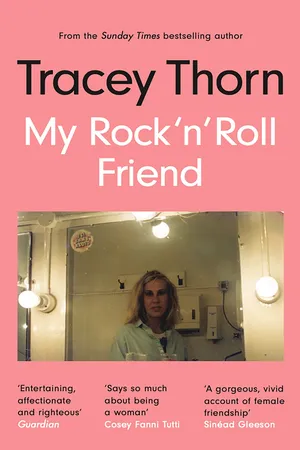
'Entertaining, affectionate and righteous' Guardian
'Says so much about being a woman' Cosey Fanni Tutti
In 1983, backstage at the Lyceum in London, Tracey Thorn and Lindy Morrison first met. Tracey's music career was just beginning, while Lindy, drummer for The Go-Betweens, was ten years her senior. They became confidantes, comrades and best friends, a relationship cemented by gossip and feminism, books and gigs and rock 'n' roll love affairs.
Thorn takes stock of thirty-seven years of friendship, teasing out the details of connection and affection between two women who seem to be either complete opposites or mirror images of each other. She asks what people see, who does the looking, and ultimately who writes women out of – and back into – history.
- 224 pages
- English
- ePUB (mobile friendly)
- Available on iOS & Android
eBook - ePub
My Rock 'n' Roll Friend
About this book
Information
BOYS’ GAMES
Sydney, 1988
A woman is in a TV studio, being interviewed.
She’s being interviewed because she’s the drummer in a rock ’n’ roll band.
Beside her sits one of the band’s songwriters, who used to be her boyfriend. He’s wearing a necklace and lipstick. The interviewer is a geeky-looking guy in glasses, with tinted hair.
The woman is a blonde in a T-shirt, sitting with her legs apart, a short skirt pulled up between her thighs.
The interviewer wants to talk about sexism. And so most of the questions are to the woman. Because sexism is a problem for women to explain, and define, and answer for. We know this.
‘Now, Lindy, is there any difference do you think between men and women’s ability to express emotion?’
She starts to answer – her face is serious, polite – then she smiles.
‘Yes, there’s an enormous difference. I think that women can express emotion by being hysterical, and, and, the thing that’s said to me most often within the band’ – she looks up, thinking hard, leg jiggling slightly, then looks to the songwriter – ‘is to stop being emotional, stop being angry, stop expressing it. Because I think we’re encouraged as youngsters to cry, and I don’t think boys are allowed to, and I think there’s a secret language men have which is why you’re all so MUCH in power.’
She pulls back, takes hold of her hair and scrapes it into a ponytail, looking down and grinning widely. She seems placatory, but then suddenly her tone changes, becoming faintly angry. Turning again to the songwriter, she says to him in a louder, harsher voice, ‘Robbie, are you gonna let me talk, or are you gonna play this game with him?’
The camera pulls back so now the songwriter is in shot too, and she is gesturing between him and the interviewer.
‘Are you gonna play this boys’ game?’
She slaps her legs.
‘OK, let’s NOT be serious, let’s play boys’ games.’
‘Now, no, no—’ the interviewer interjects.
But it’s too late; she’s reaching beneath her chair for something and she pulls out a water pistol, and her voice is rising now.
‘My God, I’m BRILLIANT at boys’ games’ – she squirts the interviewer who has a hand up to protect himself and turns – ‘absolutely BRILLIANT’ – and squirts the song-writer, who also has a hand up. All three of them are smiling, but something has been unleashed, very, very quickly. The atmosphere is electric and alert, all eyes on the woman and what she might do next. The audience applauds.
CUT.
Lindy Morrison was thirty-seven years old at this point. Not young by rock ’n’ roll standards. It was near the end of her time in The Go-Betweens. The band would break up soon, having been together for almost a decade. She and the songwriter, Robert, who was thirty-one, had already parted company after several years together, although many people never even knew they’d been a couple. Journalists were embarrassed when they found out. How could they not have noticed? All those song lyrics, for one thing. All those songs about her, about them. It seemed it was all spelled out there on the records, but who ever knows? Maybe it had been a mistake to have ended up in a band together, but it had just happened that way without any planning, and so now here they were, still connected, still individuals. Part of a group, utterly separate.
Along with a bunch of other ex-pat Australians, The Go-Betweens had lived in London for a few years during the mid-’80s, and Lindy had become my best friend. We had talked and talked, seen ourselves in each other, looked for and found a resonance, a comforting sense of home.
But now the band were back in Australia, and they were trying, still trying, always trying, to make it in the music business. Ambition and enthusiasm had set the motor running, but it had been a longer and harder slog than any of them had imagined. They’d come close a couple of times, but things hadn’t panned out, and success had proved elusive, while critical acclaim came easily. For Lindy, who’d had a life before the band and was now consumed by her dreams of a life to come – a life she’d have to create, probably by herself – the engine was running on empty. She must have been so past all this, so weary. So very, very tired of all these boys, all these games.
CUT.
Back in the interview, the woman has a beer beside her now and is smoking a cigarette.
‘Now, Lindy, have you turned out, do you think, as your parents would have liked? The drummer in a rock ’n’ roll band?’
She blows smoke out, forcefully, looks down, pulls a face, then smiles, wide, eye-crinkling, and laughs. ‘No, I don’t think so. But then I don’t think parents, if they have girls, want them to turn out to be plumbers or train drivers either, else there’d probably be a few more of them around as well. I think they would have preferred me to get married and have children. There’s a pretty big tradition of women doing that.’
She grins hugely.
‘And, uh, why didn’t you?’
‘I never wanted to get married, cos I always felt it was a bit of ownership. You know, somebody owns you.’
This is said in a tone of sadness. Or maybe that’s wrong, maybe that’s projection. It could just as easily be tiredness, or even just sheer boredom at finding herself still saying this, still having this conversation.
The interviewer continues. ‘Rock ’n’ roll’s a pretty macho world, generally. Do you have to put up with a lot of sleaziness or condescending attitudes from men in the industry?’
Without missing a beat she answers, ‘I’ve got pretty good at being sleazy and condescending myself.’ She is staring him out, and the mood has once again become confrontational. But who started it? And how long ago?
The interviewer adopts a jokey, sleazy voice and, smiling greasily, he leans forwards, and OH MY GOD, he appears, though it’s out of shot, to touch her leg.
‘Don’t you DARE stroke my leg,’ she says with a big laugh, but she means it.
‘She’s much taller than I am,’ he says pathetically.
‘Am I? I didn’t think I was that tall.’
The mood changes again, in an instant. She picks up her beer with both hands, as though trying to appear smaller and weaker. Maybe this has been a pattern, taking men on, then backing down, taking them on again. The shot pulls back so we can see that the songwriter, the ex-boyfriend, is looking away, disengaged from this whole conversation. He is smiling slightly, at someone we can’t see, someone off set. He’s elsewhere.
‘But do you cop much of that “Oh, she’s a woman drummer, she’s not the real thing”?’
‘Pretty constantly. Now that I’m older it’s not as bad, but when I was younger, nearly every single day.’
‘How d’you deal with it?’
‘I developed a very aggressive way of dealing. I just turned into what I’ve been commonly called – a bully.’
‘Well, for example, imagine I’m saying, “She’s no good, she’s just a woman”.’
‘And I’m five years younger? I would have thrown my glass of beer at you.’
She goes to say something else, but the interviewer addresses a question to the songwriter, and realising she has interrupted, she apologises quickly.
‘Robert, do you find yourself consciously, or subconsciously, treating Lindy or Amanda a bit differently? Are you more gentle with them than you might be with a guy?’
‘Um, no, not really. I think, when we started the band, always . . . I knew it was going to be a band of both sexes.’
‘So, it’s no issue with you, really?’
A brisk shake of the head. It’s clear the interviewer will get nothing out of him on this topic. There’s a digression while the interviewer teases him about sometimes wearing a dress. The songwriter objects – ‘I only did it two times’ – and in the background she challenges him – ‘Robert, that’s not true. You used to walk around the bedroom all the time in a nightgown.’
She looks at him affectionately, in a way you could easily mistake for love. Or the ghost of love.
CUT.
When I first met them they were crazy about each other. Or seemed to be. They were allies – another couple in a band, trying to make it work, proving it could work. But maybe it couldn’t. It didn’t for them.
And this TV interview makes you wonder how far they were allies to each other. She’s on her own, fighting this battle alone once again. He’s wearing his lipstick and his necklace, but he’s the songwriter in the band, so he’s not having to defend his corner. Lindy is the one who has to justify herself, account for herself, explain once again what on earth it is she thinks she’s doing here.
The conversation is about sexism, and the man is wearing lipstick, but she’s the one doing all the work.
CUT.
Now a biker has joined them, and he’s been seated next to the woman. He’s not a member of the band, or their road crew, or anyone they know. He is there simply to add a spark of controversy – to provoke her and to start an argument. He’s her adversary and things are about to get gladiatorial.
The biker is wearing denim jeans, a black Harley Davidson T-shirt and a leather waistcoat. He has sunglasses on his head, a mullet and a huge moustache. He is textbook biker. Cartoon biker.
‘Raymond,’ says the interviewer, ‘what do you think of feminism?’
Good question, yes. We all want to know what Raymond the biker thinks of feminism.
‘I’m not really sure what it means. I mean, to me a feminist is . . . it conjures up images of short hair, overalls . . . they don’t shave—’
‘Wow, come on. I’m a feminist. Look, I shave’ – she lifts a bare leg up to him – ‘D’you wanna look at my armpits?’ – raises an arm to him.
‘Are you a feminist?’ says the biker. And he leers at her, in a predatory manner.
‘Yeah, course I’m a feminist.’
‘What does it mean?’ he says, in a challenging tone. He’s squaring up to her now, looking like he wants a row. Or maybe sex. There’s definitely something in the air.
‘It means’ – she breathes a deep heavy sigh – ‘it means that I want to feel totally free as a woman. And not feel in any way oppressed by old attitudes that men have forced upon us.’
Her tone is serious: not angry, not playful, just explanatory. It’s courteous of her to pay him the compliment of implying this conversation is worth having. Maybe she’s not kidding herself that she’ll convert him, but she’s aware that this is a TV show, and a wider audience is watching with interest. Maybe it’s worth trying to explain to them. Or maybe she just has to speak up on behalf of her sisters. She’s been handed the banner, now she’s got to lead the bloody march.
The biker interrupts her, ignoring her sincerity. This is a game, and he wants to score points, to win. ‘You wanna get on top?’
She looks down. Jesus, we’ve ended up here again. Nothing I’ve said has made any difference.
‘No, no,’ she says, and just for a moment she sounds beaten, ready to quit right here.
But it’s not over. She pushes back her hair. She sits up straight. No. Fuck ’em. Damned if I’m gonna let him have the last word.
‘Well, if I wanted to be flippant, yes, I’d say I wanna be on top. Sitting down at some bar I’m gonna say, “Yes, I wanna be on top.”’ She folds her arms. ‘But I’m not sitting at a bar, I’m trying to have a serious conversation.
‘So, NO, I don’t just wanna be on top, Ray-MOND.’
CUT.
When she gets home from the TV station, Lindy writes me a letter and posts it from an address in Darling Point, Sydney. ‘I miss you so much,’ she writes, ‘you wouldn’t believe it, Tracey Thorne.’ Spelling my name wrong as usual. It’s wrong on the envelope too.
The Go-Betweens are about to start recording a new album – 16 Lovers Lane – which will be their last. ‘Over here, we start rehearsing tomorrow,’ she writes. ‘Thank god, I’ve been out of control really.’ Everything is becoming complicated for them: relationships are breaking, allegiances forming and dissolving. The letter talks about the ‘newfound chumminess’ between the band’s two song-writers, Robert and Grant, which is causing friction. They’d announced that the two of them were going to produce the new album themselves, asserting control and ownership, which riled the other members of the band. ‘Amanda and I actually kicked each other under the table . . . After some argument they proffered that the credit would be The Go-Betweens but they had all the executive decision making. “Oh,” we said, because we were both feeling a little awestruck by this no-nonsense mate-ship approach.’
Somewhat bitterly, she refers to the two boys as ‘Hamlet and Horatio’, although admits they have written some good new songs. ‘All love songs except for one of Rob’s titled “Clouds”, about clouds, I think, but then I’m so literal.’
The letter complains that her sex life has been atrocious; there’s been no action at all for months, apart from her bringing home a man called WOLF, who had tattoos and long hair but was doing so much speed he couldn’t get it up.
He did play with me. But now when I see him he runs away and hides. I chased him mercilessly, only because I felt like dinner hadn’t finished. Anyway I picked up the marching orders which is a good thing as I could never take him home to Mum’s, and spending all night in a bar waiting for him was damaging my health. I’m a fool.
The songwriter ex-boyfriend, Robert, is meanwhile having an affair with a woman who is engaged to someone else. Lindy had screamed at him that he was being a pig and he had screamed back, ‘You never let me finish a sentence for the whole seven years and at least she listens.’
‘SHIT!’ writes Lindy.
She is feeling lost back in Australia, having trouble adapting. ‘Biting my nails, silly, non-concentrated. I’m glad we’re starting work tomorrow, perhaps that will give me something to hold on to.’
And then she tells me what had happened at the TV show.
We did six songs and then an interview over one and a half hours – just Rob and I. The topic – sex roles. They brought in a biker – I mean a really killer biker who said things to me like ‘You just want to be on top’ and ‘You couldn’t take me on your back’. It was hilarious. Actually we did very well. I was very languid on camera sitting with my legs apart and my skirt falling between my legs. Flirting with the biker who between takes asked if I would like to spend the night with him after the show, said I would have the time of my life, he could make love all night.
She ends, possibly imagining my shocked disbelieving face – a face I wear much of the time when she is talking to me – with the simple words: ‘This is TRUE.’
CUT.
Here are the things I hadn’t known when we first met, in London, in 1983: she was thirty-one years old to my twenty, and already on the third act of her adult life. Five years earlier, she’d been living in Brisbane, in a shared house with a bohemian collection of visual artists and musicians, and was the drummer with an uncompromising feminist punk band. Queensland, of which Brisbane is the capital city, chafed under the rule of a quasi-fascist premier, Joh Bjelke-Petersen, and operated more or less as a police state. Political protest was quashed, corruption was rife, law and order out of control. Her band were chased by cops every time they went to a gig, or played one. For young people, Indigenous people, anyone who stood out or who was at all unconventional, harassment and arrests were common. Lindy was caught in the middle of all this and dreaming of escape.
Five years before that, in 1972, when I was ten years old and still at primary school, she had been living in a different shared house, with a bunch of actors, all of them politically engaged, progressive and radical. A newly graduated social worker, she was the only white woman employed by the Aboriginal and Torres Strait Islander Legal Service (ATSILS) in Spring Hill, Brisbane. She was out of her comfort zone and out of her depth, but nonetheless committed to the idealistic task of improving life wherever possible for Brisbane’s oppressed and mistreated Indigenous population. She shared duties with the activist Denis Walker, who was know...
Table of contents
- Introduction
- PART ONE
- PART TWO
- PART THREE
- PART FOUR
- PART FIVE
- Postscript
- Bibliography
- Acknowledgements
- Permission Credits
Trusted by 375,005 students
Access to over 1.5 million titles for a fair monthly price.
Study more efficiently using our study tools.
Frequently asked questions
Yes, you can cancel anytime from the Subscription tab in your account settings on the Perlego website. Your subscription will stay active until the end of your current billing period. Learn how to cancel your subscription
No, books cannot be downloaded as external files, such as PDFs, for use outside of Perlego. However, you can download books within the Perlego app for offline reading on mobile or tablet. Learn how to download books offline
Perlego offers two plans: Essential and Complete
- Essential is ideal for learners and professionals who enjoy exploring a wide range of subjects. Access the Essential Library with 800,000+ trusted titles and best-sellers across business, personal growth, and the humanities. Includes unlimited reading time and Standard Read Aloud voice.
- Complete: Perfect for advanced learners and researchers needing full, unrestricted access. Unlock 1.5M+ books across hundreds of subjects, including academic and specialized titles. The Complete Plan also includes advanced features like Premium Read Aloud and Research Assistant.
We are an online textbook subscription service, where you can get access to an entire online library for less than the price of a single book per month. With over 1.5 million books across 990+ topics, we’ve got you covered! Learn about our mission
Look out for the read-aloud symbol on your next book to see if you can listen to it. The read-aloud tool reads text aloud for you, highlighting the text as it is being read. You can pause it, speed it up and slow it down. Learn more about Read Aloud
Yes! You can use the Perlego app on both iOS and Android devices to read anytime, anywhere — even offline. Perfect for commutes or when you’re on the go.
Please note we cannot support devices running on iOS 13 and Android 7 or earlier. Learn more about using the app
Please note we cannot support devices running on iOS 13 and Android 7 or earlier. Learn more about using the app
Yes, you can access My Rock 'n' Roll Friend by Tracey Thorn in PDF and/or ePUB format, as well as other popular books in Mezzi di comunicazione e arti performative & Biografie in ambito musicale. We have over 1.5 million books available in our catalogue for you to explore.