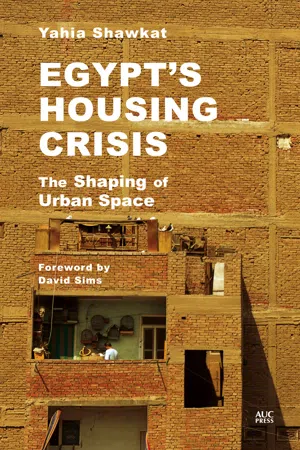
A provocative analysis of the roots of Egypt's housing crisis and the ways in which it can be tackled
Along with football and religion, housing is a fundamental cornerstone of Egyptian life: it can make or break marriage proposals, invigorate or slow down the economy, and popularize or embarrass a ruler. Housing is political. Almost every Egyptian ruler over the last eighty years has directly associated himself with at least one large-scale housing project. It is also big business, with Egypt currently the world leader in per capita housing production, building at almost double China's rate, and creating a housing surplus that counts in the millions of units.
Despite this, Egypt has been in the grip of a housing crisis for almost eight decades. From the 1940s onward, officials deployed a number of policies to create adequate housing for the country's growing population. By the 1970s, housing production had outstripped population growth, but today half of Egypt's one hundred million people cannot afford a decent home.
Egypt's Housing Crisis takes presidential speeches, parliamentary reports, legislation, and official statistics as the basis with which to investigate the tools that officials have used to 'solve' the housing crisis—rent control, social housing, and amnesties for informal self-building—as well as the inescapable reality of these policies' outcomes. Yahia Shawkat argues that wars, mass displacement, and rural–urban migration played a part in creating the problem early on, but that neoliberal deregulation, crony capitalism and corruption, and neglectful planning have made things steadily worse ever since. In the final analysis he asks, is affordable housing for all really that hard to achieve?
- English
- ePUB (mobile friendly)
- Available on iOS & Android
eBook - ePub
About this book
Information
Table of contents
- Cover Page
- Title Page
- Copyright Page
- Contents
- List of Figures
- List of Tables
- Foreword David Sims
- Acknowledgments
- Abbreviations and Acronyms
- Timeline
- Introduction: The Politics of Shelter in Egypt
- 1. Etymology of a Crisis
- 2. Self-builders
- 3. Old to New Rent
- 4. ‘Model’ Villages for ‘Model’ Citizens
- 5. Government Housing, a Brief History
- 6. Government Housing Today
- 7. Housing Unravels
- Epilogue: Back to Homes
- Notes
- Bibliography
Trusted by 375,005 students
Access to over 1.5 million titles for a fair monthly price.
Study more efficiently using our study tools.
Frequently asked questions
Yes, you can cancel anytime from the Subscription tab in your account settings on the Perlego website. Your subscription will stay active until the end of your current billing period. Learn how to cancel your subscription
No, books cannot be downloaded as external files, such as PDFs, for use outside of Perlego. However, you can download books within the Perlego app for offline reading on mobile or tablet. Learn how to download books offline
Perlego offers two plans: Essential and Complete
- Essential is ideal for learners and professionals who enjoy exploring a wide range of subjects. Access the Essential Library with 800,000+ trusted titles and best-sellers across business, personal growth, and the humanities. Includes unlimited reading time and Standard Read Aloud voice.
- Complete: Perfect for advanced learners and researchers needing full, unrestricted access. Unlock 1.5M+ books across hundreds of subjects, including academic and specialized titles. The Complete Plan also includes advanced features like Premium Read Aloud and Research Assistant.
We are an online textbook subscription service, where you can get access to an entire online library for less than the price of a single book per month. With over 1.5 million books across 990+ topics, we’ve got you covered! Learn about our mission
Look out for the read-aloud symbol on your next book to see if you can listen to it. The read-aloud tool reads text aloud for you, highlighting the text as it is being read. You can pause it, speed it up and slow it down. Learn more about Read Aloud
Yes! You can use the Perlego app on both iOS and Android devices to read anytime, anywhere — even offline. Perfect for commutes or when you’re on the go.
Please note we cannot support devices running on iOS 13 and Android 7 or earlier. Learn more about using the app
Please note we cannot support devices running on iOS 13 and Android 7 or earlier. Learn more about using the app
Yes, you can access Egypt's Housing Crisis by Yahia Shawkat in PDF and/or ePUB format, as well as other popular books in Social Sciences & 21st Century History. We have over 1.5 million books available in our catalogue for you to explore.