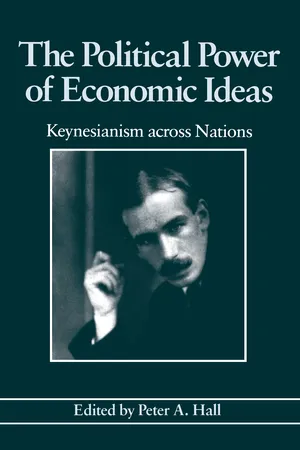
John Maynard Keynes once observed that the "ideas of economists and political philosophers, both when they are right and when they are wrong, are more powerful than is commonly understood." The contributors to this volume take that assertion seriously. In a full-scale study of the impact of Keynesian doctrines across nations, their essays trace the reception accorded Keynesian ideas, initially during the 1930s and then in the years after World War II, in a wide range of nations, including Britain, the United States, France, Germany, Italy, Japan, and Scandinavia. The contributors review the latest historical evidence to explain why some nations embraced Keynesian policies while others did not. At a time of growing interest in comparative public policy-making, they examine the central issue of how and why particular ideas acquire influence over policy and politics.
Based on three years of collaborative research for the Social Science Research Council, the volume takes up central themes in contemporary economics, political science, and history. The contributors are Christopher S. Allen, Marcello de Cecco, Peter Alexis Gourevitch, Eleanor M. Hadley, Peter A. Hall, Albert O. Hirschman, Harold James, Bradford A. Lee, Jukka Pekkarinen, Pierre Rosanvallon, Walter S. Salant, Margaret Weir, and Donald Winch.
eBook - ePub
The Political Power of Economic Ideas
Keynesianism across Nations
- English
- ePUB (mobile friendly)
- Available on iOS & Android
eBook - ePub
About this book
Information
Publisher
Princeton University PressYear
2020Print ISBN
9780691023021
9780691077994
eBook ISBN
9780691221380
1
INTRODUCTION
IN A MEMORABLE phrase, John Maynard Keynes once observed that “the ideas of economists and political philosophers, both when they are right and when they are wrong, are more powerful than is commonly understood.”1 This book takes that assertion seriously: its object is to trace the impact of Keynesian ideas across nations in order to understand why an economic theory influences policy in some places and periods, yet not in others. We begin by considering the response to the economic depression of the 1930s, which inspired many of Keynes’ own theories, and then turn to the reception given Keynesian ideas in the three decades after World War II when many nations erected the systems of macroeconomic management they still largely use today.
The focus of this volume is explicitly comparative.2 Several of the chapters consider more than one country, and all have benefited from a number of comparative discussions. Together, they provide a detailed account of the reception given Keynes’ ideas by the major industrial nations of the world and they review the processes whereby those ideas became an important component of policy. That is the first purpose of this volume. Limitations of space prevent us from considering the transition from Keynesian ideas that took place in the 1970s as the unexpected coincidence of inflation and unemployment led to a search for new economic strategies; but our findings about the rise of Keynesian policies could well inform another study focused on their attenuation.
The second purpose of this book is to identify factors that might explain why some nations embraced Keynesian ideas, while others did not. Few subjects are more important or more intractable. Ideas are generally acknowledged to have an influence over policy making. Even those who seek to expose the bare conflicts of interest hidden behind political rhetoric or historical nostalgia admit that ideas play an important role in affairs of state. But that role is not easily described. Any attempt to specify the conditions under which ideas acquire political influence inevitably teeters on the brink of reductionism, while the failure to make such an attempt leaves a large lacuna at the center of our understanding of public policy. The contributors to this volume cut into a particularly difficult theoretical problem.
Why should we take the ideas of John Maynard Keyes as the case to be studied? Although currently out of fashion, Keynes was the most influential economist of his generation; his work left an indelible mark on modern economic theory. As A. C. Pigou, hardly Keynes’ greatest admirer, puts it: “Those of us who disagree in part with his analysis have, nevertheless, undoubtedly been affected by it in our own thinking; and it is very hard to know exactly where we stood before. Not a little of what we now believe ourselves to have known all along, it may well be we owe to him.”3 For most of this century, Keynesian ideas have been central to the major debates about economic policy; and since his works were read and discussed around the world, they are particularly suitable for cross-national study.
Even more important is the larger political role played by Keynesian ideas. Like the concepts of Karl Marx, who died in the year that Keynes was born, the ideas of John Maynard Keynes seem quintessential to a historical era. They are closely associated with a major transformation in the economic role of the state that is one of the hallmarks of this century. Although Keynes was by no means responsible for the expansion of the welfare state that is sometimes linked to his name, his theories placed increasing responsibility for economic performance on the government’s shoulders, and his attacks on the priority which classical economics attached to a balanced budget helped to loosen a fiscal constraint that stood in the way of more generous social programs.4 In these respects, to study the emerging influence of Keynesian ideas is to consider many of the factors that lie behind the development of the modern state since the 1920s.
Partly for this reason, of course, Keynesianism has acquired a rather broad set of connotations in the contemporary field. On the one hand, the literature is full of debates among fundamentalist Keynesians, neoclassical Keynesians, neo-Keynesians, and post-Keynesians, which cannot be unraveled fully here. On the other hand, the notion of a “Keynesian state” or of a “Keynesian era” is often used more generally to refer to the social and economic practices associated with the management of a capitalist economy in the postwar period. As they trace the growing influence of Keynesian ideas, many of the essays that follow implicitly describe the process whereby a particular economic theory acquired multiple meanings in the political and economic arenas of different nations. Indeed, the very ambiguity of Keynesian ideas was one source of their influence. They became a cloak with which to cover or dress up a wide variety of economic practices.
Nevertheless, all of the chapters in this volume take as their point of departure a set of doctrines closely associated with Keynes’ own writings. Some go into detail on this point, and since there are many excellent accounts of Keynes’ economic theories, it is not our intention to provide another one.5 However, it might be useful to identify those aspects of Keynes’ thought on which the book as a whole concentrates.
We are primarily concerned with two implications for policy that are foreshadowed in some of Keynes’ earlier work but derive most directly from the theoretical analysis of The General Theory of Employment, Interest and Money published in 1936. The first follows from Keynes’ rejection of Say’s Law (that aggregate supply creates its own demand) and the corresponding tenet of marginalist analysis that, left to their own devices, markets will clear, initially through the adjustment of prices rather than quantities. The implication of this classical view is that markets are fundamentally stable and will tend to move the economy toward equilibrium at the highest practicable rate of employment. While leaving open the possibility that this might be true in the long run, Keynes argued that rigidities introduced into markets by producer organizations, the variability of business confidence, and a variety of other common phenomena render the private economy fundamentally unstable and liable to prolonged stagnation at unnecessarily low levels of employment. The conclusion which Keynes drew from this analysis is that some form of government action may be necessary to moderate the fluctuations of the private economy and restore it to full employment. Here Keynes broke with the doctrine of laissez-faire to argue that the state has a responsibility to intervene regularly in the operation of the economy.
A second aspect of the same analysis specifies what kind of policies are likely to be most useful for managing economic fluctuations. In The General Theory, Keynes rejected conventional views of the relationship between savings and investment, which held that the best way to increase investment was to lower interest rates (or the price of capital) and to increase its supply by limiting the amount absorbed by the public debt. Instead, he argued that investment responds to many factors and governments might best deal with economic depression by raising the level of aggregate demand for goods. He went on to argue that the government could itself exercise some control over this by increasing its own expenditures (or lowering taxes) because these injections of funds would increase the aggregate purchasing power of consumers by a multiple of the original amount, as the funds were passed from person to person through successive transactions, leaking away only gradually into savings, taxes, and imports. This is the famous “multiplier” analysis adapted from work by Richard Kahn.
The analysis contained three important, and relatively novel, prescriptions. First, it suggested that the government could influence overall levels of growth and employment in the economy by means of a strategy based on the management of aggregate demand. To the existing alternatives of laissez-faire or direct industrial intervention that policy makers seemed to face, Keynes added a third option based on demand management. Second, while Keynes did not discount the usefulness of monetary policy altogether, his analysis put a new emphasis on the role of fiscal policy. Third, Keynesian theory rejected the principle that the government budget should generally be balanced in favor of an approach that justified deficit spending financed by public borrowings in times of economic recession, and budgetary surpluses to counter inflationary pressure when aggregate demand was likely to exceed supply. Together, these are the basic principles behind countercyclical demand management.
At the risk of neglecting Keynes’ many other contributions to economic theory, we are primarily concerned with the readiness of governments to intervene in the economy in line with the principles of countercyclical demand management. This is the policy outcome we want to explain. In the postwar period, it refers to the systematic use of fiscal and monetary policy to moderate fluctuations in the economy. In the 1930s, the relevant outcome was more generally a willingness to accept rising public sector deficits in order to finance public works or other spending programs designed to lower unemployment. The reflationary programs of the interwar period often owed little to Keynes’ own ideas but could be described in more general terms as Keynesian.6
If the adoption of Keynesian policies is one of the firmest measures of the influence of Keynesian ideas and the principal focus of this volume, we will find, however, that those ideas acquired influence in other ways as well. In some cases, they transformed the intellectual environment of economics, and, in others, they altered the terms of political discourse in such a way as to legitimate a variety of policies and make new combinations of political forces possible.
Hence, the essays in this volume tackle three tasks. First, they seek to explain the relative willingness of governments to engage in deficit spending during the 1930s or countercyclical demand management during the postwar period. Second, they attempt to trace and account for the relative influence of Keynesian ideas themselves on the policies of each nation. And, third, they explore the way in which Keynesianism, as a more general set of symbolic ideas, became a component of the class coalitions and political compromises that structured the political economy of the postwar world.
This sort of enterprise involves the development of an appropriate theoretical framework. The theoretical issues surrounding explanations for the relative acceptance of Keynesian ideas and policies across nations have not yet been the subject of extensive inquiry or debate. Very little systematic work has been done in this area. Nevertheless, a review of the literature suggests that we might distinguish between three broad approaches to this kind of problem. These might be termed economist-centered, state-centered, and coalition-centered perspectives, respectively. The recent literature contains important examples of these approaches and, in nuanced form, each is represented in the essays that follow. Some authors stress one or another as their case seems to dictate; others incorporate elements of each into their account. For analytic clarity, however, it would be useful to begin by examining these approaches in ideal-typical form.
AN ECONOMIST-CENTERED APPROACH
We can begin with the economist-centered approach adopted by a majority of the monographs devoted to the diffusion of Keynesian ideas.7 It treats the problem of explaining the acceptance of Keynesian policies primarily as a problem of explaining the influence that Keynesian ideas achieved among members of the economics profession. This approach contains an implicit model of the policymaking process that privileges the role of professional economists and stresses the impact of expert advice on policy.8 Economists are gradually won over to Keynesian modes of analysis and then press their conclusions on politicians. This is a “trickle up” model for the diffusion of Keynesian ideas.
If this approach is taken, the relative influence of Keynesian ideas turns on two sorts of factors. Most important are the theoretical characteristics of the ideas themselves, that is to say, those aspects of the ideas that render them more or less persuasive to other experts. To assess Keynes’ ideas in these terms, of course, we need an overarching model of the characteristics that tend to render new ideas economically persuasive.
In his essay for this volume, Walter Salant suggests that Thomas Kuhn’s account of how scientific paradigms succeed one another might provide an appropriate model for the progress of economic knowledge as well. A Kuhnian account sees economic theorizing as puzzle-solving, and it implies that one theory succeeds another primarily because it defines and solves puzzles in a more satisfying way. In particular, one theory would supersede another because it proved better at explaining the empirical observations that remained anomalous in terms of the earlier theory. The prolonged unemployment of the interwar period could be seen as one such anomaly.
Harry Johnson has taken this approach one step further to argue that the triumph of the Keynesian paradigm over its predecessor also depended on a set of factors specific to the conditions under which economic knowledge is produced. In particular, he ascribes the growing popularity of Keynesian ideas to the clever way in which Keynes opened up new questions susceptible to the kind of quantitative investigations that would constitute a research program for young scholars, reformulated old concepts into new ones, such as the theory of liquidity preference, so as to force those who wanted to use his ideas to speak in a new language, and deliberately posed his propositions in counterintuitive terms in order to mount the kind of challenge to prevailing orthodoxy that would appeal to a new generation of economists.9
The second set of factors that becomes especially significant if one adopts this approach are the institutional parameters that structure communication within the economics profession and between economists and policy makers. In any nation, these might include: the degree to which there existed a large and sophisticated body of academic economists; the influence allowed younger economists in the profession (because, as Keynes himself predicted, his ideas appealed particularly to the young); the openness of the public authorities to advice and personnel from centers of academic economics; and the relative influence of professional economists, as opposed to financial administrators, inside the policy-making arms of the government.
Considered as a whole, the economist-centered approach to the impact of Keynesian ideas has one great virtue and one weakness. Its virtue is to draw our attention to the qualities of Keynesian ideas themselves. It suggests that ideas may have a persuasiveness, and hence a political dynamism, of their own; and it forces us to ask which ideational qualities make for persuasiveness and which detract from it. It must be added, however, that the persuasiveness of a new set of economic ideas is always relational, that is to say, it depends not simply on the ideas themselves but on the way in which they fit with other existing ideas, including the pertinent array of existing economic theories, recognized puzzles, and observations of the contemporary economic world.
The approach is problematic, however, in that it may attribute too much influence over policy to the economics profession. Notwithstanding Keynes’ famous dictum that practical men are often the slaves of some defunct economist, the essays in this volume show that the degree of influence economists were able to exert over policy varied widely over time and across nations. Even where economists were heavily involved in the policy process, economic theories were often only one of many considerations that went into the ultimate determination of policy.10 Once again, however, there are pertinent differences between the short and long terms—of the sort Keynes liked to contemplate. As the interwar years gave way to the postwar period, economists gained a more important role in the policy process of almost all the nations studied here. The importance of economic theory to policy may thereby have grown. Similarly, as Keynesian ideas became part of a neoclassical synthesis widely shared among economists across the world, many of those ideas acquired a kind of background significance even where countercyclical demand management was not the reigning policy doctrine. Nevertheless, in most national settings, a full account of the process whereby Keynesian ideas acquired influence must move beyond this economist-centered approach to incorporate a more complete model of the policy-making process as a whole.
A STATE-CENTERED APPROACH
The state-centered approach, to which we now turn, takes a step in this direction. It is elaborated in an influential article by Margaret Weir and Theda Skocpol comparing responses to the 1930s Depression in Sweden, Britain, and the United States.11 They suggest that the reception accorded new economic ideas will be influenced by the institutional configuration of the state and its prior experience with related policies. In the sphere of policy formulation, the relative openness of policy-making institutions to advice from outside economists is said to affect the speed with which developments in economic theory can be incorporated into policy, and the administrative biases implicit in the instit...
Table of contents
- Cover Page
- Title Page
- Copyright Page
- Contents
- List of Contributors
- Preface
- 1. Introduction
- 2. The Spread of Keynesian Doctrines and Practices in the United States
- 3. Ideas and Politics: The Acceptance of Keynesianism in Britain and the United States
- 4. Keynesian Politics: The Political Sources of Economic Policy Choices
- 5. Keynes, Keynesianism, and State Intervention
- 6. The Miscarriage of Necessity and Invention: Proto-Keynesianism and Democratic States in the 1930s
- 7. The Development of Keynesianism in France
- 8. Keynes and Italian Economics
- 9. What Is Keynesian About Deficit Financing? The Case of Interwar Germany
- 10. The Underdevelopment of Keynesianism in the Federal Republic of Germany
- 11. The Diffusion of Keynesian Ideas in Japan
- 12. Keynesianism and the Scandinavian Models of Economic Policy
- 13. How the Keynesian Revolution Was Exported from the United States, and Other Comments
- 14. Conclusion: The Politics of Keynesian Ideas
- Index
Trusted by 375,005 students
Access to over 1.5 million titles for a fair monthly price.
Study more efficiently using our study tools.
Frequently asked questions
Yes, you can cancel anytime from the Subscription tab in your account settings on the Perlego website. Your subscription will stay active until the end of your current billing period. Learn how to cancel your subscription
No, books cannot be downloaded as external files, such as PDFs, for use outside of Perlego. However, you can download books within the Perlego app for offline reading on mobile or tablet. Learn how to download books offline
Perlego offers two plans: Essential and Complete
- Essential is ideal for learners and professionals who enjoy exploring a wide range of subjects. Access the Essential Library with 800,000+ trusted titles and best-sellers across business, personal growth, and the humanities. Includes unlimited reading time and Standard Read Aloud voice.
- Complete: Perfect for advanced learners and researchers needing full, unrestricted access. Unlock 1.5M+ books across hundreds of subjects, including academic and specialized titles. The Complete Plan also includes advanced features like Premium Read Aloud and Research Assistant.
We are an online textbook subscription service, where you can get access to an entire online library for less than the price of a single book per month. With over 1.5 million books across 990+ topics, we’ve got you covered! Learn about our mission
Look out for the read-aloud symbol on your next book to see if you can listen to it. The read-aloud tool reads text aloud for you, highlighting the text as it is being read. You can pause it, speed it up and slow it down. Learn more about Read Aloud
Yes! You can use the Perlego app on both iOS and Android devices to read anytime, anywhere — even offline. Perfect for commutes or when you’re on the go.
Please note we cannot support devices running on iOS 13 and Android 7 or earlier. Learn more about using the app
Please note we cannot support devices running on iOS 13 and Android 7 or earlier. Learn more about using the app
Yes, you can access The Political Power of Economic Ideas by Peter A. Hall,Noam Lupu in PDF and/or ePUB format, as well as other popular books in Economics & Economic History. We have over 1.5 million books available in our catalogue for you to explore.